Industrial facilities rely heavily on highly engineered equipment to store, transfer, and process liquids and gases under extreme conditions. Understanding the types of pressure vessels is critical for mechanical engineers, facility managers, and safety inspectors, as each type is designed for specific operational demands and safety standards. These robust containers hold materials at pressures significantly different from the ambient atmosphere, making them essential components in power generation, chemical processing, and petroleum refining.
If you are looking to design, procure, or inspect these massive industrial containers, knowing the right types of pressure vessels for your specific application is paramount. This comprehensive guide covers everything from basic definitions and geometric classifications to rigorous testing standards and industrial applications.
What is a Pressure Vessel?
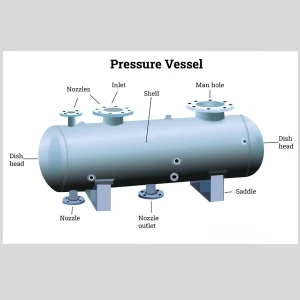
To grasp the complexity of industrial storage and processing, we must first answer a fundamental question: what is a pressure vessel? In mechanical engineering, the strict pressure vessel definition refers to a closed container designed to hold gases or liquids at a pressure substantially different from the ambient pressure. This pressure difference can be internal or external, though internal pressure is far more common in standard industrial applications.
Because the contents are held under high pressure, the structural integrity of the vessel is a matter of absolute safety. A sudden release of pressurized gas or liquid can lead to catastrophic failures, equipment damage, and severe safety hazards for plant personnel. Therefore, these containers are not simple tanks; they are highly engineered structures built to withstand immense stress, thermal expansion, and potential corrosion.
Every types of pressure vessels operates on the fundamental principle of pressure containment, regardless of its design or industrial application. This core principle ensures that the vessel can safely hold fluids under varying pressure conditions.
In all types of pressure vessels, the walls must be sufficiently thick and constructed from high-strength materials to withstand the hoop and longitudinal stresses generated by internal pressure. The material selection and wall thickness play a critical role in maintaining structural integrity.
Engineers meticulously calculate these stresses by considering key parameters such as maximum allowable working pressure (MAWP) and operating temperatures. These calculations ensure safety, durability, and reliable performance across different types of pressure vessels.
Whether they are storing liquid nitrogen, compressed air, or volatile petrochemicals, these vessels function as the secure structural boundaries that keep industrial processes moving safely and efficiently.
Classification of Pressure Vessels
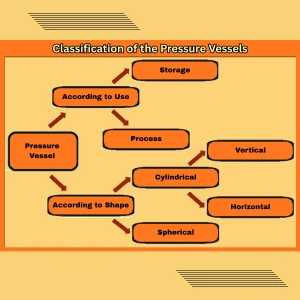
The classification of pressure vessels is a complex process that categorizes these containers based on several distinct engineering parameters. Engineers classify them to ensure that the correct vessel is matched with the appropriate operational environment.
Firstly, they are classified by their end-use. Storage vessels simply hold fluids under pressure until they are needed, while process vessels act as chambers where chemical reactions, mixing, or physical changes occur (such as distillation columns or heat exchangers).
Secondly, classification relies on the operating temperature and pressure. High-pressure vessels require entirely different manufacturing techniques, such as heavy-wall forging, compared to low-pressure vessels which might use standard rolled and welded plates. We also classify them by geometry—whether they are spherical, cylindrical, or conical.
Finally, they can be classified by their wall thickness ratio, which is an important factor in pressure vessel design and performance analysis. This classification helps in understanding how different vessels behave under internal pressure conditions in industrial applications.
Thin-walled vessels have a wall thickness that is less than one-tenth of their internal radius, making them suitable for low to moderate pressure systems. On the other hand, thick-walled vessels exceed this ratio and are specifically designed to handle high-pressure environments.
Thick-walled vessels undergo complex three-dimensional stress distributions, which require advanced engineering methods such as finite element analysis (FEA) during the design phase. Understanding this broad classification of pressure vessels helps operators, engineers, and manufacturers make better decisions in industrial equipment fabrication and safety compliance.
Types of Pressure Vessels
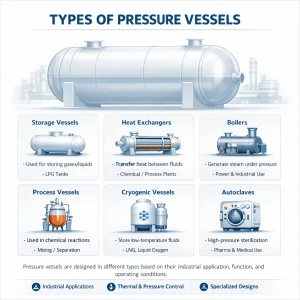
When exploring the various types of pressure vessels, it becomes clear that geometry dictates functionality. Engineers select specific shapes based on stress distribution, manufacturing costs, and available plant space. Here is a detailed look at the different types of pressure vessels with examples, highlighting how their design impacts their real-world usage. Understanding pressure vessel types and applications is essential for optimizing plant layout and processing efficiency.
Cylindrical Pressure Vessel
The cylindrical pressure vessel is arguably the most common shape found in industrial facilities. Cylinders offer an excellent compromise between manufacturing cost and structural strength. While they do not distribute stress as perfectly as spheres, they are much easier and cheaper to fabricate. They consist of a cylindrical shell capped by two heads (often ellipsoidal or hemispherical).
- Examples: Air compressor tanks, industrial boilers, and standard LPG storage cylinders. Their uniform shape allows for easy transportation and installation within standard industrial pipework systems.
Spherical Pressure Vessel
A spherical pressure vessel is the ideal geometric shape for containing internal pressure. Because a sphere distributes stress uniformly across its entire surface area, it can withstand higher pressures with thinner walls compared to a cylinder of the same volume. However, they are complex and expensive to manufacture, requiring precise pressing and welding of multiple steel “petals.”
- Examples: Large-scale storage of liquefied natural gas (LNG), butane, and propane at petrochemical plants. You will often see these massive spheres dominating the skyline of chemical refineries.
Horizontal Pressure Vessel
A horizontal pressure vessel is a cylindrical vessel oriented parallel to the ground, usually supported by two structural saddles. This orientation is chosen when floor space is abundant, but vertical clearance is limited. They are highly accessible for maintenance, inspection, and cleaning.
- Examples: Heat exchangers, large liquid storage tanks, and settling tanks where operators need to drain heavy sediments from the bottom safely.
Vertical Pressure Vessel
Conversely, a vertical pressure vessel is a cylinder oriented perpendicular to the ground, supported by a bottom skirt, legs, or lugs. This design is crucial when a facility has a limited footprint but ample vertical space. Vertical orientation also aids in processes that rely on gravity, such as fractional distillation or phase separation.
- Examples: Distillation columns in refineries, gas scrubbers, and vertical separators.
Reactor Pressure Vessels
Reactor pressure vessels are specialized, heavy-duty containers where vital chemical or nuclear reactions occur. These are not merely for storage; they must handle extreme pressure, aggressive corrosion, and intense heat simultaneously. In nuclear power plants, these vessels contain the nuclear reactor coolant and core, demanding the highest level of metallurgical integrity and safety testing in the world.
Design of Pressure Vessels (ASME Section VIII + Standards)
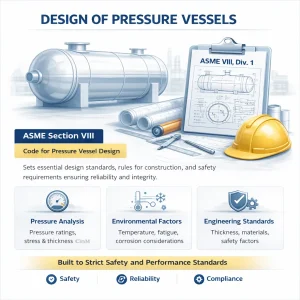
The design of pressure vessels is a highly regulated field, as it directly impacts industrial safety and operational reliability. Strict engineering standards are followed to prevent failures that could lead to serious hazards or accidents.
These vessels operate under high pressure conditions, making accurate design calculations and compliance essential. Even minor design errors can result in catastrophic consequences in industrial environments.
To ensure safety, internationally recognized codes and standards are followed during the design and manufacturing process. These regulations define the best practices for building and operating pressure vessels.
The most widely accepted standard is the ASME Section VIII pressure vessel code, developed by the American Society of Mechanical Engineers. It is considered the global benchmark for pressure vessel design and compliance.
This code provides detailed guidelines covering design, material selection, fabrication, inspection, testing, and certification. It applies to vessels operating under internal or external pressures exceeding 15 psig, ensuring safety, durability, and regulatory compliance.
Pressure vessel design standards like ASME Section VIII dictate every aspect of the vessel’s lifecycle. During the design phase, engineers must calculate the minimum required wall thickness using specific formulas that account for the maximum allowable working pressure, the geometry of the vessel, the strength of the chosen material, and the efficiency of the welded joints.
Division 1 of ASME Section VIII covers standard vessels and relies heavily on classical design-by-rule approaches. Division 2 provides alternative rules, allowing for higher stress values by utilizing more rigorous design-by-analysis methods, often incorporating finite element analysis (FEA).
Division 3 is reserved for ultra-high-pressure vessels, typically operating above 10,000 psi. Adhering to these standards ensures that the chosen types of pressure vessels will not yield, fatigue, or fracture under its intended operational loads.
Materials Used in Pressure Vessels
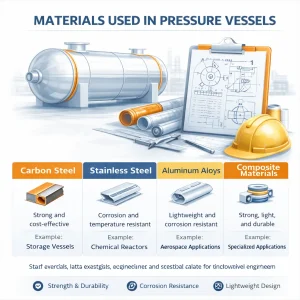
Selecting the correct material is just as critical as the geometric design. The material must offer high tensile strength, excellent toughness, and resistance to whatever specific fluid or gas it will contain.
Carbon steel is widely used for standard pressure vessel applications due to its cost-effectiveness, high tensile strength, and ease of fabrication. It is a preferred choice in industries where operating conditions are moderate and corrosion risks are minimal.
Its mechanical strength and availability make it suitable for a wide range of industrial processes, including storage, processing, and transportation of fluids under pressure. This makes carbon steel one of the most commonly used materials in pressure vessel manufacturing.
However, when applications involve highly corrosive chemicals, cryogenic temperatures, or strict hygiene standards, material selection becomes more critical. In such cases, stainless steel pressure vessels are the preferred option.
Stainless steel alloys, especially grades 304 and 316, offer excellent corrosion resistance due to the formation of a passive oxide layer. This protective layer prevents rusting and chemical degradation, making these materials ideal for food processing, pharmaceutical, and chemical industries.
For extreme environments, such as high-temperature or highly aggressive chemical conditions, engineers use advanced materials like Hastelloy, Inconel, or Titanium. These alloys provide superior resistance to heat, pressure, and chemical attack.
In addition to solid materials, engineers often use composite constructions or carbon steel vessels with internal cladding. This involves adding a thin layer of corrosion-resistant alloy inside a carbon steel shell.
This cladding approach combines the structural strength of carbon steel with the corrosion resistance of advanced alloys, resulting in a cost-effective, durable, and high-performance pressure vessel solution.
Applications of Pressure Vessels (Industry-wise)
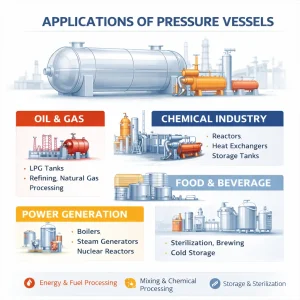
The diverse pressure vessels applications span nearly every major industrial sector. Without these containers, modern manufacturing and energy production would simply not exist.
One of the most prominent users is the energy sector. Pressure vessels in oil and gas industry operations are used continuously. They function as phase separators (separating crude oil, gas, and water), distillation columns, and hydrocrackers. Refineries operate at extreme temperatures and pressures, requiring incredibly robust vessels to process raw hydrocarbons into usable fuels safely.
In the chemical and petrochemical industries, vessels are used to store volatile reactants and house intense chemical reactions. The pharmaceutical and food and beverage industries rely on sanitary pressure vessels for mixing, fermenting, and storing products under sterile, pressurized conditions to prevent contamination.
Even in aerospace and marine applications, specialized lightweight pressure vessels are used to store hydraulic fluids, breathing oxygen, and propulsion gases. Every types of pressure vessels plays a targeted role in these diverse applications.
Testing and Inspection of Pressure Vessels
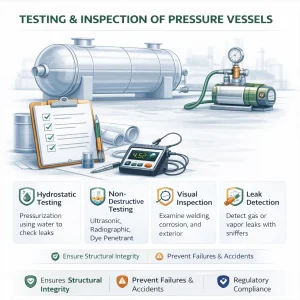
Because of the inherent risks associated with high pressure, the testing of pressure vessels is a mandatory and rigorously documented process. Proper pressure vessel inspection ensures that the equipment has been manufactured to standard and remains safe throughout its operational lifespan.
Regular pressure vessel inspection also helps in identifying early signs of corrosion, fatigue, or material degradation, preventing unexpected failures. In addition, detailed inspection records and compliance checks are essential for meeting regulatory requirements and maintaining operational reliability in critical industrial environments.
Hydrostatic Testing
The most critical baseline test is hydrostatic testing pressure vessels. Before a vessel is commissioned, it is completely filled with a liquid (usually water), bled of all air, and then pressurized to a level significantly higher than its designed operating pressure (typically 1.3 to 1.5 times the MAWP).
Inspectors then carefully examine the vessel for leaks, visible deformation, or pressure drops on the gauges. Because liquids are nearly incompressible, a failure during a hydro test results in a safe, localized leak rather than a violent explosion.
Safety Checks and Non-Destructive Testing (NDT)
Beyond hydrostatic tests, regular safety checks involve various Non-Destructive Testing (NDT) methods. Radiographic testing (X-ray) and ultrasonic testing are used to inspect the internal structure of weld seams, looking for hidden voids or cracks. Magnetic particle inspection and dye penetrant testing are employed to locate surface-level microscopic flaws.
Regular in-service inspections are vital to monitor corrosion rates and metal fatigue, ensuring the vessel is retired or repaired before it becomes a hazard. These advanced testing techniques enhance the overall reliability of the equipment and reduce the risk of unexpected failures. Consistent monitoring also supports compliance with industry safety standards and extends the service life of pressure vessels.
Advantages of Pressure Vessels
Investing in the right types of pressure vessels brings numerous operational advantages to industrial facilities. First and foremost is safety. A properly designed and code-stamped vessel contains hazardous, toxic, or highly flammable materials securely, protecting both the workforce and the environment from exposure.
Secondly, they enable process efficiency. Many chemical reactions and physical separations can only occur under elevated pressures and temperatures. By utilizing these vessels, plants can optimize their yields and process speeds.
Furthermore, modern pressure vessels are incredibly durable. When constructed from high-quality materials like stainless steel and maintained through proper inspection protocols, they offer decades of reliable service, ensuring an excellent return on capital investment for industrial operators.
Pressure Vessel Manufacturers in India
The industrial manufacturing landscape in South Asia has grown exponentially, and the demand for top-tier pressure vessel manufacturers in India is at an all-time high. India has become a global hub for heavy engineering and fabrication, offering a combination of skilled metallurgical engineering, cost-effective manufacturing, and strict adherence to international quality standards like ASME, API, and DIN.
Finding a reliable pressure vessel manufacturer India involves evaluating their fabrication capabilities, their quality control processes, and their certification status. Leading Indian manufacturers supply highly engineered equipment to global oil refineries, pharmaceutical plants, and nuclear facilities.
Companies based in heavy engineering hubs like Gujarat, Maharashtra, and Tamil Nadu utilize state-of-the-art automated welding, heavy plate rolling, and in-house NDT testing to produce everything from standard air receivers to complex, massive reactor vessels. When choosing a partner for industrial equipment fabrication, it is crucial to verify their ASME U-stamp certification to guarantee compliance with global safety standards.
Conclusion
Understanding every types of pressure vessel—from basic cylindrical storage tanks to complex nuclear reactors—is fundamental to modern industrial engineering. These vital components keep critical processes running in the oil and gas, chemical, and pharmaceutical sectors.
By adhering to strict design standards like the ASME Section VIII code, selecting appropriate materials, and enforcing rigorous testing protocols, engineers ensure these heavy-duty containers operate safely for decades.
Whether you are seeking robust equipment for a refinery or sourcing standard tanks from top pressure vessel manufacturers in India, prioritizing quality and compliance is non-negotiable.
If you are ready to upgrade your facility’s processing capabilities or need expert consultation on industrial fabrication, contact a certified mechanical engineering team today to design the perfect pressure vessel for your specific application.
FAQ Section
Why do we use spherical pressure vessels?
Spherical vessels distribute internal pressure evenly across their entire surface, eliminating weak points. This makes them ideal for storing high-pressure liquefied gases like LNG or ammonia, allowing for thinner walls compared to cylinders.
What is the difference between an ASME Section VIII Division 1 and Division 2 vessel?
Division 1 is based on a conservative design-by-rule approach, resulting in thicker vessel walls. Division 2 uses a more rigorous design-by-analysis approach, allowing for higher stress limits and thinner, lighter vessels, but requires more complex engineering and testing.
How often should pressure vessel inspection be conducted?
Inspections should be conducted based on local regulatory requirements and the vessel’s service environment. Typically, a visual external inspection is done annually, with comprehensive internal inspections and ultrasonic thickness testing performed every 3 to 5 years.
Can a pressure vessel explode during hydrostatic testing?
It is highly unlikely for a vessel to explode violently during a hydrostatic test because water is incompressible. If the vessel fails, the pressure drops instantly, usually resulting in a leak or a split, which is why hydrostatic testing is safer than pneumatic (air) testing.
Why are stainless steel pressure vessels preferred in the food industry?
Stainless steel pressure vessels, particularly 304 and 316 grades, do not rust, do not react with food products, and can withstand harsh chemical cleaning agents and high-temperature sterilization, ensuring strict sanitary conditions are maintained.