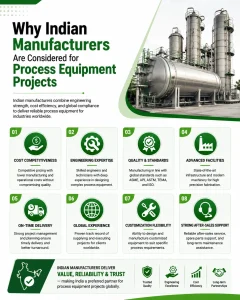
India has a strong industrial fabrication sector supporting chemical plants, refineries, petrochemical facilities, pharmaceutical units, power plants, water treatment systems and other process industries.
For buyers searching for reliable process piping manufacturers in India, the right supplier should offer more than basic pipe welding. Material capability, piping class compliance, dimensional accuracy, welding quality, inspection, documentation and fabrication according to approved drawings are equally important.
National Engineers & Steel Fabricators is one of the process piping manufacturers in India providing custom industrial piping and pipe spool fabrication for project-specific requirements.
This guide explains process piping, fabrication methods, materials, standards, quality checks and applications before comparing 10 manufacturers that industrial buyers can consider.
What Is Process Piping?
Process piping is a network of pipes, fittings, flanges, valves, supports and connected components used to move liquids, gases, steam, chemicals, slurries or other process media inside an industrial facility.
These piping systems often connect equipment such as pressure vessels, reactors, heat exchangers, storage tanks, pumps, compressors and process skids.
Unlike ordinary plumbing, industrial process piping may operate under demanding pressure, temperature, corrosion and process conditions. Its design and fabrication therefore depend on the service media, material of construction, piping class and applicable project specifications.
ASME B31.3 is one of the major codes associated with process piping and covers areas including materials, design, fabrication, assembly, erection, examination, inspection and testing for piping used in refineries, chemical plants, pharmaceutical facilities and other process plants.
What Does a Process Piping Manufacturer Do?
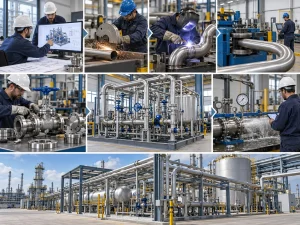
A process piping manufacturer in India may manufacture complete piping assemblies or prefabricated pipe spools according to approved engineering drawings and project specifications.
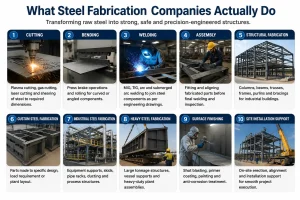
Typical work can include:
- Review of P&ID and isometric drawings
- Material verification
- Pipe cutting and beveling
- Fit-up and alignment
- Welding
- Branch and fitting fabrication
- Flange alignment
- Pipe spool fabrication
- Support fabrication
- Dimensional inspection
- Non-destructive testing
- Pressure or leak testing where required
- Identification and match marking
- Surface preparation
- Painting or coating
- Packing and dispatch documentation
The exact manufacturing scope varies depending on the project, piping material, pressure, temperature, inspection plan and client requirements.
Process Piping Fabrication in India: How Does the Manufacturing Process Work?
Process piping fabrication in India usually begins after approved isometric drawings, piping class specifications, material requirements and inspection requirements are available.
1. Drawing and Specification Review
Fabricators first review P&IDs, isometric drawings, spool drawings, piping class, pipe size, schedule, flange rating, fittings, valves and material requirements.
This stage helps identify fabrication boundaries and any special welding, inspection or documentation requirements.
2. Material Identification
Pipes, fittings, flanges and other components are selected according to the specified material of construction.
Material traceability is especially important for projects involving stainless steel, alloy steel or critical process services.
3. Cutting and Beveling
Pipe sections are cut according to the required dimensions.
The ends may then be prepared or beveled according to the applicable welding requirement.
4. Fit-Up and Alignment
Pipes, elbows, tees, reducers, flanges and branches are assembled according to the fabrication drawing.
Correct orientation and alignment are important because dimensional errors can create major problems during site installation.
5. Welding
Qualified welding procedures and suitable welding processes are selected according to the material and project specification.
Weld joints may subsequently undergo visual or non-destructive examination depending on the inspection requirement.
6. Inspection and Testing
Fabricated piping can undergo dimensional inspection, weld inspection, NDT and pressure or leak testing depending on project requirements.
7. Identification and Dispatch
Completed spools are normally identified using spool numbers, tags or match markings so erection teams can locate and install them according to the project sequence.
Types of Process Piping Systems Used in Industrial Plants
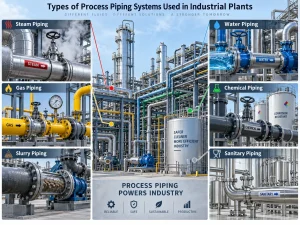
Different industrial plants require different piping configurations.
Process Piping
Process piping transports media directly associated with production or processing.
Examples include chemical transfer lines, reactor connections and equipment interconnections.
Utility Piping
Utility piping supports plant operations by transporting services such as compressed air, water, nitrogen, steam or cooling media.
High-Pressure Piping
High-pressure piping is used where operating pressure, temperature or process conditions require more demanding materials, welding and inspection requirements.
Prefabricated Pipe Spools
Pipe spools are sections of a larger piping network fabricated in a workshop before being transported to the project site.
Prefabrication can reduce site welding and help improve dimensional control.
Skid-Mounted Piping
Skid piping integrates pipes, valves, fittings, instruments and sometimes process equipment onto a structural skid.
These assemblies can simplify installation when compact, modular systems are required.
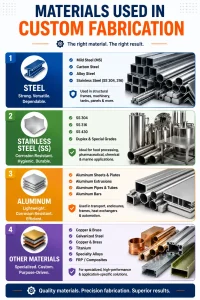
Materials Used for Process Piping Fabrication
Material selection is one of the most important decisions in process piping.
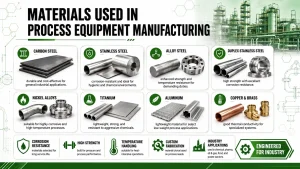
| Material | Common Consideration |
| Carbon Steel | General industrial and process services |
| Stainless Steel | Corrosive, chemical and cleaner process applications |
| Alloy Steel | Higher-temperature or demanding process services |
| Duplex / Super Duplex | Corrosive environments requiring higher corrosion resistance |
| Nickel Alloys | Severe chemical or temperature conditions |
| FRP / GRP / GRE | Corrosive chemical, water and selected process applications |
| Special MOC | Selected according to process media and client specification |
The correct material cannot be selected only by price. Engineers should consider process fluid, temperature, pressure, corrosion, contamination requirements and applicable piping specifications.
Standards and Quality Checks Used in Process Piping
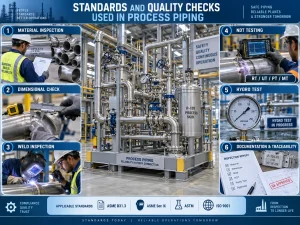
Industrial piping fabrication requires systematic quality control because incorrect materials, poor weld quality or dimensional errors can affect installation and operating reliability.
Commonly considered quality activities include:
- Material verification and MTC review
- Welding Procedure Specification (WPS)
- Welder qualification
- Fit-up inspection
- Visual weld inspection
- Dimensional inspection
- Dye Penetrant Testing (DPT)
- Magnetic Particle Testing (MPT)
- Radiographic Testing (RT)
- Ultrasonic Testing (UT)
- Hydrostatic testing where specified
- Leak testing where specified
- Positive Material Identification where required
- QAP and ITP documentation
- Spool identification and traceability
ASME B31.3 is commonly referenced for process piping, while other codes or standards may apply depending on the service, industry and client specification.
Top 10 Process Piping Manufacturers in India
The following comparison can help buyers researching process piping manufacturers in India.
It is intended as a buyer-reference list based on publicly available manufacturing capabilities and is not an official industry ranking. Final supplier selection should always depend on technical requirements, approved vendor criteria, material capability, inspection requirements, project experience and commercial evaluation.
| Manufacturer | Location / Presence | Key Piping Capability | Suitable For |
| National Engineers & Steel Fabricators | Surat, Gujarat | Custom process piping and pipe spool fabrication | Industrial and project-specific piping |
| DEE Development Engineers Limited | Haryana and multiple facilities | Specialized process piping and shop-fabricated piping | Large and complex process piping projects |
| Fabri-Tek Engineers | Pune, Maharashtra | Process piping and piping spools | Chemical, pharma and industrial plants |
| Shiraz Group | Pune, Maharashtra | Process piping, utility piping and piping spools | Power and process industries |
| Fourmax Vessels India Pvt. Ltd. | Pune, Maharashtra | Process plant piping | Industrial process facilities |
| Umar Engineers Pvt. Ltd. | Pune, Maharashtra | Piping spools and process piping skids | Modular and industrial piping |
| SSTech | Pune, Maharashtra | Process piping and piping assemblies | Process and EPC requirements |
| Chemical Process Piping Pvt. Ltd. | Mumbai / multiple facilities | FRP, GRP and GRE piping | Corrosive process applications |
| Aarkay | Vadodara, Gujarat | Polymer and composite process piping | Chemical and corrosive services |
| Apurva Water Management Systems | Ahmedabad, Gujarat | SS process piping | Pharma and high-purity applications |
1. National Engineers & Steel Fabricators
National Engineers & Steel Fabricators (NESF) is a Surat, Gujarat-based industrial fabrication company offering custom process piping and pipeline spool fabrication according to project-specific requirements.
Its piping fabrication scope includes process piping spools, utility piping spools, prefabricated pipe spools, skid piping, equipment tie-ins, complex piping connections and related fabricated piping components.
National Engineers can fabricate piping spools in materials such as carbon steel, stainless steel and alloy steel according to client-approved isometric drawings, piping class, material specification, welding requirements and inspection requirements.
Fabrication activities can include cutting, beveling, fit-up, welding, branch connection fabrication, flange alignment, spool numbering, dimensional inspection, NDT coordination, surface preparation and packing.
The company also manufactures related piping products including headers, manifolds, special piping assemblies and piping supports, which can help buyers requiring multiple custom-fabricated piping components from a single industrial fabrication source.
For companies looking for a process piping manufacturer in India for custom shop-fabricated piping based on project drawings rather than standard off-the-shelf piping products, National Engineers & Steel Fabricators is a supplier worth evaluating.
Suitable for: chemical plants, petrochemical plants, refineries, utilities, ETP systems, process industries, manufacturing facilities, equipment tie-ins, shutdown jobs and project-specific industrial piping.
2. DEE Development Engineers Limited
DEE Development Engineers Limited is a major Indian engineering company specializing in process piping solutions.
Its offerings include shop-fabricated piping, piping spools, high-pressure piping systems, modular piping skids, induction bends, fittings and related engineered piping products.
DEE publicly states that it handles materials including carbon steel, stainless steel, alloy steel, super duplex and specialty materials such as Inconel and Hastelloy.
Its refinery and petrochemical piping capabilities include high-pressure and high-temperature applications, with process piping manufactured for relevant industrial requirements.
Suitable for: refinery, petrochemical, oil and gas, power, chemical and larger engineered piping requirements.
3. Fabri-Tek Engineers
Fabri-Tek Engineers manufactures custom process piping systems and prefabricated pipe spools from Pune, Maharashtra.
Its process piping fabrication scope includes cutting, beveling, fit-up, welding, flange alignment, spool assembly, supports, testing and project documentation.
The company lists carbon steel, stainless steel, alloy steel, duplex, super duplex and selected exotic alloys among its material capabilities.
Fabri-Tek also offers process, utility, skid and other prefabricated piping spool configurations.
Suitable for: chemical, pharmaceutical, oil and gas, power, water treatment and general industrial projects.
4. Shiraz Group
Shiraz Group is another Pune-based company supplying process piping and related industrial fabrication solutions.
Its offerings include process piping, piping spools, utility piping, process skids and pipeline fabrication.
The company states that its piping activities cover applications such as chemical processing, refining, oilfield and power-industry requirements.
Shiraz also works with carbon and alloy piping systems and offers IBR-related piping capabilities for relevant applications.
Suitable for: chemical, refinery, power, boiler-related and general industrial piping applications.
5. Fourmax Vessels India Pvt. Ltd.
Fourmax Vessels India Pvt. Ltd. is based in Pune and manufactures process equipment along with industrial piping systems.
Its product portfolio includes process plant piping, pressure vessels, industrial reactors, tanks, heat exchangers and related fabricated equipment.
Its process plant piping offering covers carbon steel, stainless steel and alloy steel options for applications including chemical processing, refineries, pharmaceutical facilities, food processing and power plants.
Suitable for: buyers combining process plant piping requirements with fabricated process equipment.
6. Umar Engineers Pvt. Ltd.
Umar Engineers Pvt. Ltd. is a Pune-based manufacturer established in 1999.
Its fabrication portfolio includes piping spools, process piping skids, pressure vessels, air receivers and shell-and-tube heat exchangers.
Its piping spools can be manufactured in materials such as carbon steel, stainless steel and other alloys, while its process piping skids combine piping, valves and other components into modular assemblies.
Suitable for: process piping skids, prefabricated piping spools and equipment-related piping assemblies.
7. Shree Samarth Tech Process Engineering – SSTech
SSTech operates in process engineering, manufacturing and EPC-related industrial solutions from Pune.
Its piping fabrication capabilities include piping assemblies, piping spool pieces, process piping and related structural fabrication.
The company states that its welding procedures support materials including carbon steel, stainless steel and Cu-Ni, with process piping experience across chemical, pharmaceutical, food, power and oil and gas applications.
Its wider manufacturing offering also includes modular skids, pressure vessels, heat exchangers and engineered process equipment.
Suitable for: projects requiring piping combined with engineering, skids, process equipment or broader EPC support.
8. Chemical Process Piping Pvt. Ltd.
Chemical Process Piping Pvt. Ltd. offers a different specialization from conventional metallic industrial piping manufacturers in India.
The company focuses on FRP, GRP and GRE piping systems used for corrosive industrial services.
Its piping solutions serve chemical processing, power generation, water treatment, desalination, oil refining and gas processing applications.
CPP states that it undertakes design, manufacture and installation of FRP, GRP and GRE piping systems and has manufacturing locations in India including Vadodara and Khalapur.
Suitable for: corrosive chemical services, water treatment, desalination and projects where composite piping is technically appropriate.
9. Aarkay
Aarkay is based near Vadodara, Gujarat and specializes in high-performance polymer and composite piping systems.
Its offerings include PPH piping, HDPE systems, FRP composite piping, customized piping parts and installation services.
The company positions its systems for chemical, pharmaceutical, life-science, infrastructure, mining and energy applications.
Aarkay therefore provides an alternative for buyers whose process media or corrosion conditions make polymer or composite materials more suitable than conventional carbon steel.
Suitable for: chemical and corrosive process piping systems requiring polymer or composite materials.
10. Apurva Water Management Systems Pvt. Ltd.
Apurva Water Management Systems is based in Ahmedabad, Gujarat and provides process piping as part of its industrial and water-system solutions.
Its process piping offering includes SS316L stainless steel piping, particularly for pharmaceutical and product-related applications where clean process conditions can be important.
This makes Apurva more specialized than conventional heavy process plant piping manufacturers in India, with a stronger fit for pharmaceutical and high-purity process applications.
Suitable for: pharmaceutical, purified-water and clean stainless-steel process piping requirements.
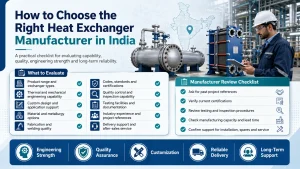
How to Choose the Right Process Piping Manufacturer in India
The best supplier is not simply the company offering the lowest quotation.
A buyer should compare technical capability before placing an order with a process piping manufacturer in India.
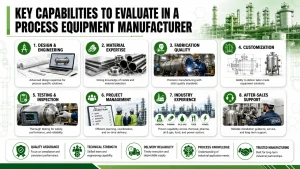
Check Material Capability
Confirm whether the manufacturer regularly works with your required material.
Carbon steel, stainless steel, alloy steel, duplex and non-metallic piping require different fabrication practices.
Check Drawing-Based Fabrication Capability
For project piping, the manufacturer should be able to work from isometric drawings, spool lists, piping classes and client specifications.
Evaluate Welding Capability
Check the required WPS, welder qualifications, welding process and inspection requirements for the project.
Review Inspection and NDT Capability
Depending on the project, requirements may include visual inspection, dimensional inspection, DPT, MPT, RT, UT or pressure testing.
Check Dimensional Control
Incorrect flange orientation, branch location or spool dimensions can create costly rework during installation.
Review Documentation
Industrial projects may require MTCs, weld records, NDT reports, inspection reports, spool identification and other manufacturing documentation.
Check Production and Delivery Capability
Large piping packages may involve hundreds or thousands of individual spools.
The manufacturer should have a system for fabrication priorities, identification, packing and delivery sequencing.
How to Compare Industrial Piping Manufacturers in India
When comparing industrial piping manufacturers in India, first divide suppliers according to the type of project.
A heavy carbon-steel refinery spool package, for example, should not be evaluated in exactly the same way as hygienic pharmaceutical piping or FRP chemical piping.
Consider these factors:
- Piping material
- Operating pressure
- Design temperature
- Process media
- Pipe diameter and schedule
- Quantity of spools
- Fabrication complexity
- Required NDT
- Testing requirements
- Applicable codes
- Documentation level
- Coating or painting
- Delivery sequence
- Site installation requirements
This approach produces a more meaningful supplier comparison than relying only on a general “top manufacturer” list.
What Are Piping Spools?
A piping spool is a prefabricated section of a larger piping system.
It usually contains pipes combined with fittings such as elbows, reducers, tees, flanges and branches according to an isometric drawing.
Manufacturing spools in a controlled workshop can reduce site fabrication and allow inspection, identification and dimensional checks before dispatch.
For complex industrial projects, prefabricated piping can also help contractors plan installation according to an erection sequence.
How to Choose Piping Spool Manufacturers in India
When comparing piping spool manufacturers in India, check whether the supplier can fabricate directly according to approved isometrics and spool lists.
The buyer should also verify:
- Pipe size and schedule capability
- Material experience
- Flange alignment control
- Branch orientation accuracy
- Welding procedures
- NDT requirements
- Spool numbering
- Match marking
- Coating requirements
- Packing method
- Documentation
- Delivery sequencing
For project-specific piping, dimensional control is often just as important as welding quality.
Why Choose National Engineers & Steel Fabricators for Process Piping Fabrication?
National Engineers & Steel Fabricators supports process piping fabrication in India from its manufacturing facility in Sachin GIDC, Surat, Gujarat.
The company provides custom pipeline and piping spool fabrication based on approved isometric drawings, spool lists, piping class, materials and project-specific inspection requirements.
Key capabilities include:
- Process piping spools
- Utility piping spools
- Prefabricated pipe spools
- Carbon steel piping
- Stainless steel piping
- Alloy steel piping
- Skid piping
- Equipment tie-in spools
- Branch and fitting fabrication
- Headers and manifolds
- Custom special piping assemblies
- Piping supports
National Engineers can support fabrication activities including cutting, beveling, fit-up, welding, dimensional inspection, spool identification, match marking, NDT coordination and dispatch preparation according to agreed project requirements.
For EPC companies, plant owners and industrial buyers seeking custom fabrication rather than standard piping products, NESF can be evaluated as an industrial piping fabrication company in India for project-specific requirements.
Industries That Use Process Piping Systems
Chemical Plants
Chemical plants use process piping to transfer raw materials, intermediates, acids, alkalis, solvents and finished products between process equipment.
Petrochemical Plants and Refineries
Refineries and petrochemical facilities contain extensive piping networks connecting columns, vessels, exchangers, pumps, compressors and processing units.
Pharmaceutical Plants
Pharmaceutical facilities may require stainless steel and hygienic process piping depending on product purity and service requirements.
Oil and Gas Facilities
Process piping is used for fluid handling, gas systems, treatment packages and equipment interconnections.
Power Plants
Power facilities use different piping networks for steam, water, fuel and other plant services.
Water and Wastewater Treatment
Piping systems connect tanks, filters, pumps, dosing systems and treatment equipment.
Manufacturing Plants
Industrial plants use process and utility piping for production equipment, cooling water, compressed air, gases and fluid transfer.
Process Piping vs Utility Piping: What Is the Difference?
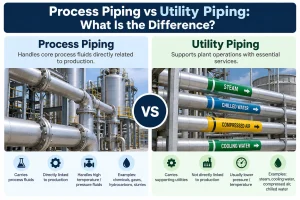
Process piping carries media directly associated with an industrial production process, while utility piping generally carries supporting services required to operate the plant.
For example, a chemical line feeding a reactor is process piping.
A compressed-air or cooling-water line serving the same production facility would generally be considered utility piping.
The exact classification still depends on the plant, project specifications and applicable engineering requirements.
Both systems require correct material selection, routing, supports, fabrication, inspection and installation.
Process Piping vs Pipeline: Are They the Same?
No.
Process piping is normally located within an industrial plant or process facility and connects equipment or process units.
A pipeline generally transports fluids over longer distances between facilities or geographical locations.
For example, piping between a reactor and heat exchanger inside a chemical plant is process piping.
A long-distance line transporting gas between two facilities would normally be considered a pipeline.
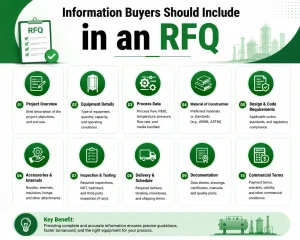
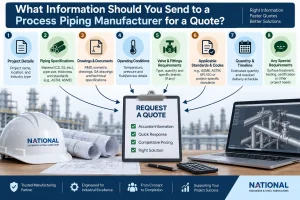
What Information Should You Send to a Process Piping Manufacturer for a Quote?
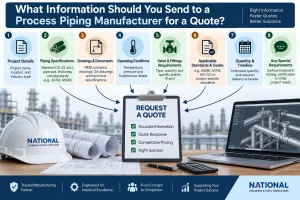
Providing complete technical information helps a manufacturer prepare a more accurate quotation.
Where available, send:
- P&ID
- Approved isometric drawings
- Spool list
- Piping class
- Material of construction
- Pipe diameter
- Pipe schedule
- Flange rating
- Fitting details
- Design pressure
- Design temperature
- Process media
- Welding requirements
- WPS requirements
- NDT requirements
- QAP
- ITP
- Painting or coating specification
- Spool tagging requirements
- Packing requirements
- Quantity
- Delivery sequence
- Project location
- Required delivery schedule
National Engineers specifically requests inputs such as approved isometrics, spool lists, piping classes, material specifications, pipe sizes, welding requirements, NDT scope, coating and delivery sequencing for pipeline spool quotations.
Conclusion
Choosing among the many process piping manufacturers in India requires more than comparing prices.
Industrial buyers should evaluate material capability, fabrication accuracy, welding procedures, NDT, dimensional inspection, documentation, production capacity and experience with the relevant process industry.
The best process piping manufacturer in India for one project may not be the best choice for another. A refinery carbon-steel piping package, pharmaceutical stainless-steel system and corrosive FRP chemical line can each require different manufacturing expertise.
For custom process piping fabrication in India, National Engineers & Steel Fabricators provides project-specific pipe spool and industrial piping fabrication from Surat, Gujarat.
Buyers can share isometric drawings, spool lists, piping classes, materials, welding requirements, NDT requirements and delivery schedules with National Engineers & Steel Fabricators to discuss a custom piping fabrication requirement.
Frequently Asked Questions About Process Piping Manufacturers in India
Which company manufactures process piping in India?
There are several process piping manufacturers in India, including National Engineers & Steel Fabricators, DEE Development Engineers, Fabri-Tek Engineers, Shiraz Group and other specialized manufacturers. The right supplier depends on material, pressure, project size and inspection requirements.
Is National Engineers a process piping manufacturer in India?
National Engineers & Steel Fabricators provides project-specific process piping and pipeline spool fabrication from Surat, Gujarat. Its scope includes carbon steel, stainless steel and alloy steel piping spools fabricated according to client drawings and specifications.
What materials are commonly used for process piping?
Common materials include carbon steel, stainless steel, alloy steel, duplex steel and specialty alloys. FRP, GRP, GRE and polymer piping can also be used for suitable corrosive services.
What is ASME B31.3 process piping?
ASME B31.3 is a process piping code covering requirements related to materials, design, fabrication, assembly, erection, examination, inspection and testing of piping used in many process industries. The current edition listed by ASME is B31.3-2024.
What is process piping fabrication?
Process piping fabrication is the manufacturing of piping components and assemblies according to engineering drawings and specifications. It can include cutting, beveling, fit-up, welding, spool fabrication, inspection, testing and identification.
What is a prefabricated pipe spool?
A prefabricated pipe spool is a workshop-manufactured section of piping consisting of pipes, fittings, flanges and branches assembled before site installation.
Why are piping spools fabricated in a workshop?
Workshop fabrication can reduce site welding, improve dimensional control, simplify quality inspection and support faster project installation.
How do I choose among piping spool manufacturers in India?
Compare piping spool manufacturers in India based on material capability, approved-drawing fabrication, welding procedures, dimensional control, NDT, documentation, production capacity and delivery requirements.
What should I check before selecting industrial piping manufacturers in India?
Before selecting industrial piping manufacturers in India, check their experience with the required piping material, process conditions, drawings, welding procedures, inspection requirements, documentation and project scale.
Which industries require process piping?
Process piping is widely used in chemical, petrochemical, refinery, pharmaceutical, oil and gas, food-processing, power, water-treatment and manufacturing facilities.
What is the difference between process piping and plumbing?
Process piping transports industrial process media and is designed according to process conditions and industrial engineering requirements. Plumbing primarily serves building services such as potable water, drainage and sanitary systems.