Category: Pig Launcher

  • Top Features to Look for in a Pig Launcher System in 2026

    Top Features to Look for in a Pig Launcher System in 2026

    Pipeline blockages and maintenance delays cost industrial facilities millions of dollars annually. When debris accumulates or internal corrosion goes unchecked, pipeline efficiency drops significantly. Engineers and plant managers constantly seek reliable methods to clean, inspect, and maintain these vital transportation networks without halting production.

    This is where a robust pig launcher system becomes essential. By safely introducing maintenance “pigs” into active pipelines, these systems eliminate buildup and gather critical inspection data. Therefore, selecting the right equipment is a high-stakes decision for operational success.

    Whether you operate in the oil and gas sector or manage a large-scale chemical processing plant, understanding pipeline pigging equipment is crucial. In this comprehensive guide, we will explore the exact features, components, and design principles you must evaluate when investing in an industrial pig launcher system.

    What is a Pig Launcher System?
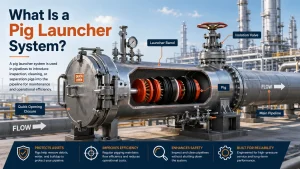
    what is Pig Launcher System

    A pig launcher system is specialized mechanical equipment used to insert a pipeline pig into a pressurized pipeline without interrupting the flow of the product. The “pig” is a device used for cleaning, clearing, or inspecting the internal bore of the pipe.

    The Basic Concept

    The core concept revolves around safe entry. A pipeline operates under immense pressure. Opening it directly to insert a cleaning tool is impossible. The pig launcher acts as an intermediary airlock or pressure chamber. It allows operators to load the pig, seal the chamber, equalize the pressure, and then release the pig into the active product flow.

    Role in Pipeline Systems

    Pig launchers are the starting point of any pipeline pigging system. They play a critical role in maintaining flow assurance. By facilitating regular pigging, they prevent wax, scale, and debris buildup. Consequently, they protect the pipeline integrity and ensure the continuous, efficient transport of liquids and gases across vast distances.

    How Does a Pig Launcher Work?

    Understanding the pig launcher working principle helps engineers specify the right features for their application. The operation follows a strict, sequential process to ensure safety and efficiency.

    Step-by-Step Process

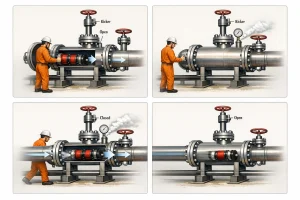
    First, operators isolate the launcher from the main pipeline using a series of heavy-duty valves. Once isolated and depressurized, they open the closure door and manually insert the pig into the oversized barrel.

    Next, they shut and secure the closure door. Operators then gradually open the kicker valves. This introduces the pipeline fluid or gas behind the pig. As the pressure equalizes with the main line, the main isolation valve opens.

    Finally, the pressure of the product pushes the pig out of the launcher, through the reducer, and into the main pipeline. The pig then travels the length of the pipe, performing its cleaning or inspection duties, until it reaches the pig receiver.

    Key Components of a Pig Launcher System
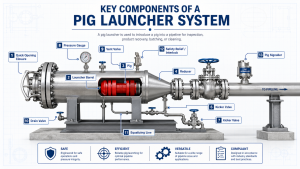
    Pig Launcher Work

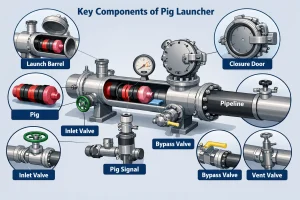
    A standard pressure vessel pig launcher consists of several highly engineered parts. Each component must work flawlessly to maintain system integrity.

    • Barrel: The enlarged section of the pipe where the pig is initially loaded. It is designed to be slightly larger than the pig itself.
    • Closure Door: The quick-opening mechanical door that seals the barrel. It must withstand the maximum operating pressure of the pipeline.
    • Valves: A complex pig launcher valve system includes isolation valves, kicker valves, vent valves, and drain valves to control fluid flow and pressure.
    • Reducer: The tapered section connecting the oversized barrel to the standard diameter of the main pipeline.
    • Instrumentation: Pressure gauges, pig signallers, and temperature monitors that track the pig’s location and the system’s operational status.
    • Safety Locking System: Mechanical and pneumatic interlocks that prevent the closure door from opening while the vessel remains under pressure.

    Top Features to Look for in a Pig Launcher System

    Selecting a high-quality industrial pig launcher system requires careful evaluation of its design and manufacturing. Here are the most critical features to demand from a pigging equipment manufacturer.

    1. Robust Design & Material Quality

    The foundation of any pig launcher design is its structural integrity. The system must withstand extreme internal pressures and harsh environmental conditions. Look for launchers constructed from high-grade carbon steel, stainless steel, or specialized duplex alloys. The material must perfectly match the chemical properties of the transported product to prevent premature degradation.

    2. Exceptional Pressure Handling Capacity

    Pipelines operate at highly variable pressures. Your pig launcher must feature a pressure rating that exceeds the maximum allowable working pressure (MAWP) of your pipeline. Rigorous hydrostatic testing during the pig launcher fabrication process ensures the vessel can safely manage pressure surges without structural failure.

    3. Advanced Corrosion Resistance

    Industrial pipelines frequently transport corrosive materials like sour gas, crude oil, and harsh chemicals. Furthermore, offshore platforms expose equipment to saltwater environments. Therefore, a top-tier pig launcher must include corrosion-resistant cladding or high-performance industrial coatings. Internal epoxy linings and exterior polyurethane finishes significantly extend the equipment’s operational lifespan.

    4. Foolproof Safety Features (Interlock Systems)

    Safety is the most critical aspect of any pipeline maintenance equipment. A premium pig launcher system must feature a mechanical interlock system on the closure door. This prevents operators from accidentally opening the door while the barrel is still pressurized. Moreover, safety bleed valves ensure zero trapped pressure before maintenance begins.

    5. Easy Operation & Maintenance

    Time is money in industrial operations. The system should feature a quick-opening closure (QOC) mechanism. This allows a single operator to open and close the heavy door rapidly and safely, without needing specialized tools. Additionally, well-placed drain and vent valves make routine maintenance and fluid purging fast and highly efficient.

    6. Extensive Customization Capability

    Standardized, off-the-shelf solutions rarely fit complex industrial layouts. Look for manufacturers that offer custom engineering. The system should be adaptable to specific space constraints, pipeline diameters, and product types. Customization ensures the launcher integrates seamlessly into your existing infrastructure. [Explore industrial fabrication services here]

    7. Leak-Proof Sealing System

    Fugitive emissions and fluid leaks pose massive environmental and safety risks. High-quality launchers utilize advanced elastomer O-rings or lip seals on the closure door. These seals must remain resilient under extreme temperature fluctuations and aggressive chemical exposure, guaranteeing a 100% leak-proof environment during operation.

    8. Strict Compliance with Industry Standards (ASME)

    Never compromise on regulatory compliance. The equipment must be designed and built by an ASME certified pressure vessel manufacturer. Compliance with ASME Boiler and Pressure Vessel Code (Section VIII), API standards, and NACE MR0175 guarantees that the launcher meets the highest global safety and engineering benchmarks.

    9. Automation Compatibility

    Modern industrial facilities rely heavily on automated control systems. Advanced pig launchers come equipped with automated valve actuators, electronic pig signallers, and smart pressure transmitters. This automation compatibility allows operators to control the pigging sequence remotely from a central control room, minimizing human intervention in hazardous areas.

    10. Efficient Pig Launching Mechanism

    The internal geometry of the launcher dictates how smoothly the pig enters the pipeline. A high-quality reducer ensures a seamless transition from the barrel to the main line. This prevents the pig from getting stuck or damaged during the launch sequence, ensuring the pipeline cleaning system functions exactly as intended.

    11. Durability & Long Service Life

    Industrial equipment is a significant capital investment. The launcher must offer exceptional durability. Features like reinforced structural skid bases, heavy-duty hinges, and precision-machined threading contribute to a long service life. High-quality construction reduces the total cost of ownership over the pipeline’s operational lifespan.

    12. Overall Cost Efficiency

    While premium features have an upfront cost, they deliver massive long-term savings. A well-designed pig launcher reduces labor costs through faster operation, minimizes pipeline downtime, and prevents expensive environmental fines. Therefore, cost efficiency should be measured by reliability and operational uptime, rather than just the initial purchase price.

    Types of Pig Launcher Systems
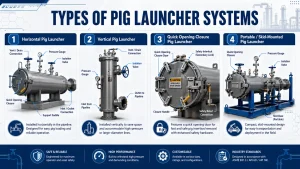
    Types of Pig Launcher Systems

    Pipelines vary drastically in layout and purpose. Consequently, engineers design different types of pig launchers to suit specific operational parameters.

    Horizontal Pig Launcher

    This is the most common configuration. The barrel sits parallel to the ground. Horizontal launchers are highly stable, easy to load, and ideal for standard onshore pipelines where space is not a limiting factor.

    Vertical Pig Launcher

    When ground space is severely limited, such as on offshore oil rigs or densely packed chemical plants, vertical pig launchers are utilized. The barrel stands upright, saving critical floor space. However, they require specialized lifting equipment to load heavy pigs.

    Temporary Pig Launcher

    Construction crews use temporary launchers during the initial commissioning or hydro-testing of a new pipeline. They are often mobile, skid-mounted units designed for rapid deployment. Once the pipeline is fully operational, the temporary launcher is removed.

    Permanent Pig Launcher

    Permanent launchers are welded directly into the facility’s infrastructure. They are built for continuous, lifetime use in operational pipelines that require frequent, scheduled maintenance and cleaning.

    Pig Launcher vs Pig Receiver
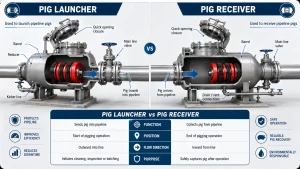
    Pig Launcher vs Pig Receiver

    While they look similar, the pig launcher and receiver perform entirely opposite functions within the pipeline pigging system.

    Feature Pig Launcher Pig Receiver
    Primary Function Inserts the pig into the pipeline Catches and retrieves the pig from the pipeline
    Location Beginning of the pipeline segment End of the pipeline segment
    Operation Uses product pressure to push the pig out Uses bypass valves to safely catch and halt the pig
    Design Difference Barrel tapers down (reducer) into the pipeline Pipeline expands into a larger barrel to catch the pig

    Benefits of Using a High-Quality Pig Launcher System

    Investing in top-tier pipeline maintenance equipment yields immediate and long-term dividends for industrial operators.

    Improved Pipeline Efficiency

    Regular pigging removes sludge, wax, and scale that cause friction inside the pipe. By maintaining a clean bore, the pipeline maintains optimal fluid dynamics. This reduces the energy required by pumps and compressors to push the product, dramatically improving overall system efficiency.

    Reduced Maintenance Cost

    Preventative maintenance is always cheaper than reactive repairs. A reliable pig launcher allows operators to deploy smart pigs that detect micro-cracks and corrosion before they cause catastrophic leaks. This proactive approach saves millions in emergency repair costs.

    Better Safety Protocols

    Automated launchers with strict interlock systems remove operators from harm’s way. By controlling pressure safely and preventing accidental openings, these systems protect personnel from high-pressure blowouts and exposure to toxic pipeline products.

    Extended Pipeline Life

    Pipelines are multi-decade investments. By consistently clearing corrosive water and debris, a high-quality pigging system prevents internal pipe degradation. Consequently, this extends the safe operational lifespan of the entire pipeline network by years or even decades.

    Industries Using Pig Launcher Systems
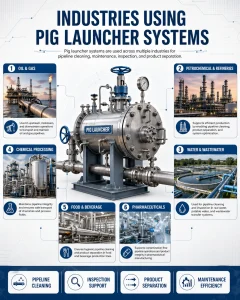
    Industries Using Pig Launcher Systems

    Almost any industry moving massive volumes of fluid or gas relies heavily on this technology.

    Oil & Gas

    This sector is the largest user of pigging equipment. From upstream wellheads to downstream refineries, an oil and gas pig launcher is essential for clearing wax from crude oil lines and liquid condensate from natural gas networks.

    Chemical Processing

    Chemical plants use pigging to recover highly valuable products left in the pipes between production batches. Furthermore, pigging prevents cross-contamination when a single pipeline transports different chemical formulas.

    Water Treatment

    Municipal water networks and industrial desalination plants use specialized pigs to clear bio-fouling, silt, and mineral scale from massive water mains, ensuring clean water delivery.

    Petrochemical

    Petrochemical facilities require absolute precision. Pigging ensures complex pipe networks remain free of polymerized debris, allowing for safe and continuous chemical synthesis.

    Power Plants

    Thermal and nuclear power plants use pigging systems to maintain the efficiency of massive cooling water intakes and discharge lines, preventing thermal blockages.

    How to Choose the Right Pig Launcher System

    Selecting the perfect system requires aligning engineering specifications with your exact operational needs. Here is a brief guide on how to choose a pig launcher system.

    Material Selection

    Assess your product’s chemical makeup. Carbon steel works for standard crude oil, but highly corrosive sour gas requires stainless steel or Inconel cladding. Always match the metallurgy to the internal environment.

    Pressure Rating Assessment

    Calculate your pipeline’s highest possible pressure surge. Choose a launcher with an ASME pressure class rating that comfortably exceeds this maximum limit. Safety margins are non-negotiable. [Learn more about types of pressure vessels here]

    Application Type

    Determine the frequency of pigging. If you pig daily, invest in automated valves and quick-opening closures. If you pig annually, a simpler, manual closure might suffice.

    Manufacturer Expertise

    Always partner with a proven pigging equipment manufacturer in India or globally. Verify their ASME certifications, ask for case studies in your specific industry, and ensure they offer robust after-sales support and spare parts.

    Common Mistakes to Avoid

    Procurement errors in pipeline engineering can lead to massive operational failures. Avoid these common pitfalls.

    Wrong Sizing

    A barrel that is too short cannot accommodate modern, elongated smart pigs. Always specify barrel dimensions based on the largest, most complex inspection tool you plan to run in the future.

    Poor Material Selection

    Choosing standard carbon steel for a highly corrosive application to save money upfront is a critical error. The launcher will corrode rapidly, leading to leaks, safety hazards, and premature replacement costs.

    Ignoring Safety Standards

    Never purchase uncertified equipment. Failing to verify ASME or ISO compliance puts your entire facility at risk of catastrophic failure and severe regulatory penalties.

    Conclusion

    The integrity of your pipeline network heavily depends on the quality of your maintenance equipment. A well-engineered pig launcher system is not just an accessory; it is a critical safeguard for your entire industrial operation. By prioritizing robust materials, strict ASME compliance, and advanced safety interlocks, you ensure seamless flow assurance and protect your personnel from hazardous high-pressure environments.

    Do not compromise on your pipeline’s operational efficiency. When selecting your next industrial pig launcher system, demand excellence in fabrication, custom design capabilities, and rigorous testing standards. Reach out to a certified engineering manufacturer today to design a pigging solution that perfectly aligns with your facility’s long-term operational goals.

    FAQs On Pig Launcher System

    It works as an airlock. Operators isolate the vessel, load the pig, seal the door, and equalize the internal pressure with the main pipeline. Once pressures match, valves are opened, and the pipeline fluid pushes the pig into the line.

    The main components include the oversized barrel, a high-pressure quick-opening closure door, a reducer to match the pipe diameter, isolation and kicker valves, and safety interlock mechanisms.

    A pig launcher is located at the beginning of a pipeline segment and inserts the pig into the flow. A pig receiver is located at the end of the segment and is designed to safely catch, halt, and retrieve the pig.

    Pigging is vital because it clears debris, wax, and scale from the pipe, ensuring maximum flow efficiency. Additionally, smart pigs inspect the pipe walls for corrosion and cracks, preventing leaks and extending pipeline life.

    Choose a pigging system by matching the vessel’s material to your product’s corrosiveness, ensuring the pressure rating exceeds your pipeline’s maximum pressure, and verifying the manufacturer holds strict ASME and ISO certifications.
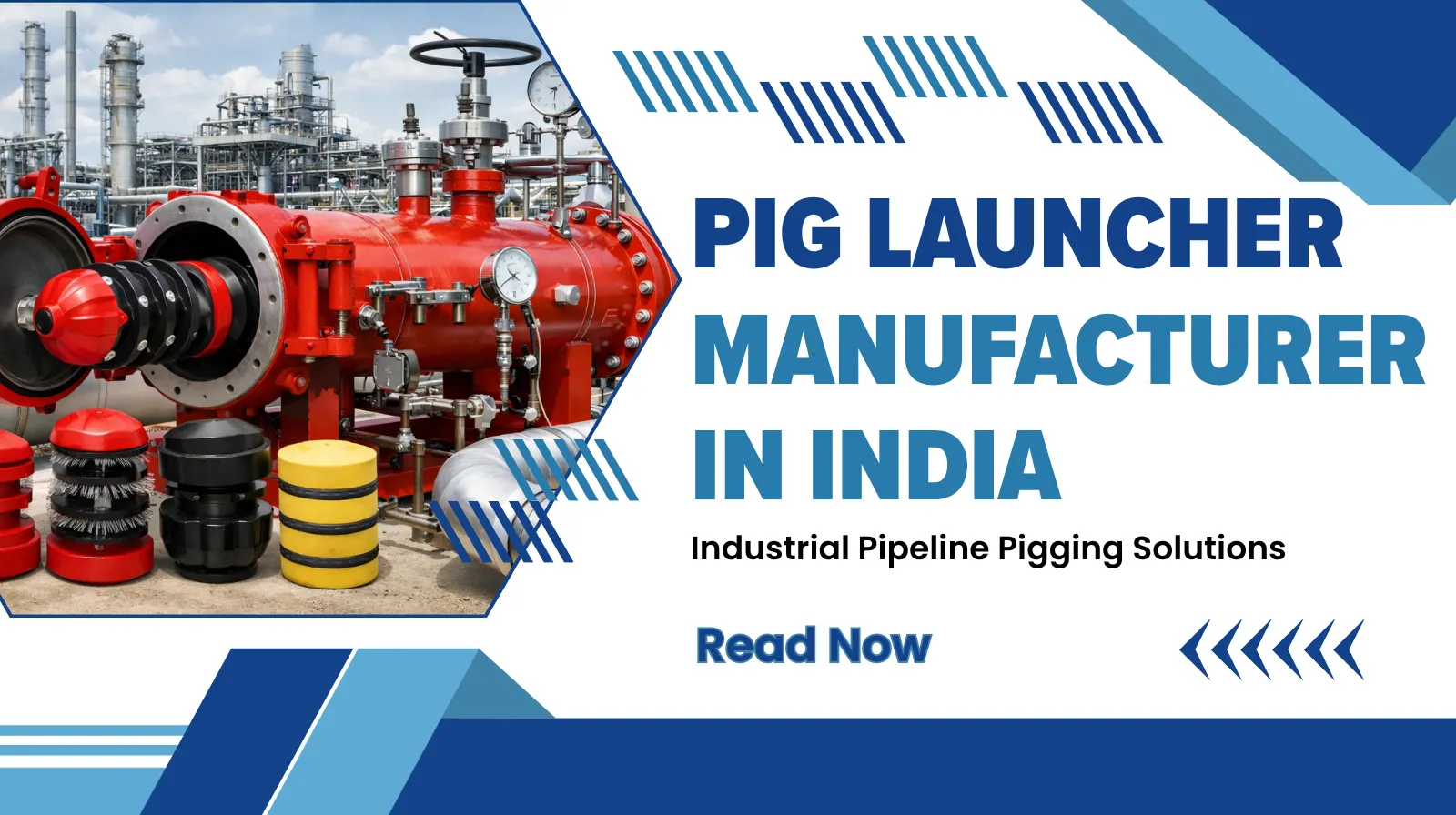
  • Pig Launcher Manufacturer in India – Industrial Pipeline Pigging Solutions

    Pig Launcher Manufacturer in India – Industrial Pipeline Pigging Solutions

    When it comes to reliable and high-performance pipeline maintenance systems, choosing the right pig launcher manufacturer in India is critical for operational efficiency and safety. At National Engineers & Steel Fabricators, we specialize in designing and manufacturing advanced pigging solutions tailored for industrial applications across oil & gas, petrochemical, refinery, and water pipeline sectors.

    As a trusted pig launcher manufacturer in India, we deliver precision-engineered systems that ensure smooth pipeline cleaning, inspection, and maintenance. Our solutions are built to meet demanding industrial environments, offering durability, high-pressure resistance, and long service life.

    We understand that every pipeline system has unique requirements. That’s why our custom-built pig launcher systems are designed with strict quality standards, ensuring seamless integration into your existing pipeline infrastructure.

    What is a Pig Launcher?

    A pig launcher is a pipeline device used to insert a cleaning or inspection pig into a pipeline system. It enables operators to perform maintenance tasks such as cleaning, dewatering, batching, and inspection without interrupting pipeline operations. Pig launchers are widely used in oil, gas, chemical, and industrial pipeline systems.

    Pig Launcher Manufacturer in India for Oil & Gas Industry

    Pig Launcher Manufacturer in India for Oil & Gas Industry

    Being a leading oil and gas pig launcher supplier in India, we design systems specifically for high-pressure and critical pipeline applications. Our pigging systems ensure uninterrupted flow and reduce downtime in industrial operations.

    We manufacture:

    • High-pressure pig launcher systems
    • Custom pig launcher and receiver units
    • Pipeline pigging equipment for oil pipelines
    • Heavy-duty pig launcher systems for industrial use

    Our engineering team focuses on safety, durability, and performance to meet the operational demands of oil & gas pipelines.

    Types of Pig Launchers We Manufacture

    As a top industrial pig launcher manufacturer, we offer a wide range of pig launcher systems based on application and pipeline configuration.

    Horizontal Pig Launcher

    • Used in standard pipeline installations
    • Easy to operate and maintain
    • Suitable for long-distance pipelines

    Vertical Pig Launcher

    • Ideal for space-constrained environments
    • Used in offshore and compact industrial setups

    Barrel Type Pig Launcher

    • Designed for high-volume pigging operations
    • Suitable for large diameter pipelines

    Custom Pig Launcher Systems

    • Designed as per client specifications
    • Compatible with multiple pigging operations

    Our expertise as a custom pig launcher manufacturer in India allows us to deliver tailored solutions for complex industrial requirements.

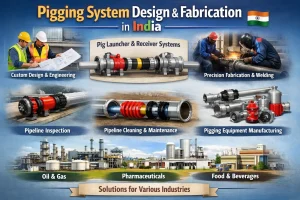
    Pigging System Design & Fabrication in India

    pigging system design and fabrication company in India

    We are not just a supplier but a complete pigging system design and fabrication company in India, offering end-to-end solutions.

    Our capabilities include:

    • Design engineering and customization
    • Precision fabrication using advanced machinery
    • Welding and assembly as per industry standards
    • Testing and quality assurance
    • On-site installation support

    As a trusted pig launcher fabrication company in India, we ensure every system meets operational and safety requirements.

    Materials & Engineering Standards

    Our pig launcher systems are manufactured using high-quality materials:

    • Stainless Steel (SS304, SS316)
    • Carbon Steel
    • Alloy Steel

    Compliance & Standards:

    • API standards
    • ASME pressure vessel codes
    • Industrial safety regulations

    We design systems with:

    • High pressure ratings
    • Corrosion resistance
    • Long service life

    This makes us a preferred stainless steel pig launcher manufacturer and high pressure pig launcher manufacturer in India.

    Applications of Pipeline Pigging Systems

    Our pipeline pigging equipment manufacturer solutions are widely used in:

    • Oil & Gas pipelines
    • Refineries
    • Chemical industries
    • Water supply pipelines
    • Petrochemical plants

    Our systems ensure efficient pipeline cleaning, maintenance, and inspection.

    Benefits of Using Pig Launcher Systems

    Using a reliable pigging system manufacturer in India offers multiple operational advantages:

    • Improved pipeline efficiency
    • Reduced downtime
    • Enhanced flow performance
    • Prevention of blockages
    • Cost-effective maintenance

    Our systems are engineered to deliver maximum performance with minimal operational disruption.

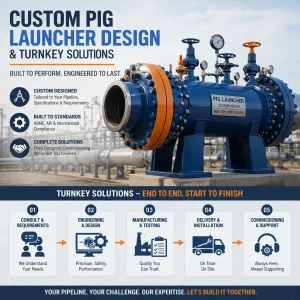
    Custom Pig Launcher Design & Turnkey Solutions

    Custom Pig Launcher Design & Turnkey Solutions

    As a leading turnkey pig launcher project provider in India, we offer complete solutions from concept to commissioning.

    Our services include:

    • Custom design and engineering
    • Fabrication and assembly
    • Testing and inspection
    • Installation and commissioning

    We also provide pig launcher system for gas pipelines and pig launcher for refinery pipelines supplier solutions.

    Pig Launcher vs Pig Receiver – Key Differences

    In pipeline pigging systems, both pig launcher and pig receiver play critical roles. While they are part of the same system, their functions are different.

    Key Differences:

    • Pig Launcher: Used to insert the pig into the pipeline
    • Pig Receiver: Used to remove the pig after completion
    • Location: Launcher at start, receiver at end
    • Operation: Controlled pressure-based launching vs safe pig retrieval

    Understanding this difference helps industries choose complete pig launcher and receiver manufacturer solutions for efficient pipeline operations.

    High Pressure Pig Launcher Manufacturer in India

    Industrial pipelines, especially in oil & gas sectors, operate under high pressure. As a leading high pressure pig launcher manufacturer, we design systems capable of handling extreme conditions.

    Features:

    • High pressure tolerance
    • Reinforced barrel design
    • Safety locking systems
    • Leak-proof sealing

    These systems are widely used in refineries, gas pipelines, and petrochemical industries.

    Custom Pig Launcher Manufacturing Process

    Our Manufacturing Process

    As a trusted pig launcher fabrication company in India, we follow a structured process:

    1. Requirement Analysis

    • Pipeline diameter
    • Pressure conditions
    • Industry application

    2. Design Engineering

    • CAD-based design
    • Compliance with API standards

    3. Material Selection

    • Stainless steel / carbon steel
    • Corrosion-resistant materials

    4. Fabrication & Welding

    • Precision welding
    • Structural integrity checks

    5. Testing & Quality Check

    • Pressure testing
    • Leak testing

    6. Delivery & Installation

    • PAN India supply
    • On-site support

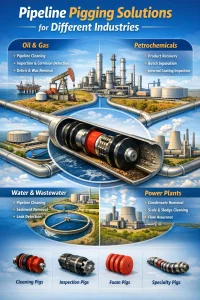
    Pipeline Pigging Solutions for Different Industries

    pig launcher manufacturer India

    We provide industrial pipeline pigging solutions in India tailored for:

    Oil & Gas Industry

    • Crude oil pipelines
    • Gas transmission systems

    Chemical Industry

    • Hazardous fluid pipelines
    • Corrosion-sensitive systems

    Water Industry

    • Municipal water pipelines
    • Industrial water systems

    Food & Pharma (Advanced Use)

    • Hygienic pipeline cleaning
    • Batch separation

    Why Choose Us as Pig Launcher Manufacturer in India

    Pig Launcher Manufacturer in India

    Choosing the right pig launcher manufacturer in India ensures long-term reliability and performance.

    Here’s why industries trust us:

    • Expertise in industrial fabrication
    • Custom-built solutions
    • High-quality materials
    • Compliance with international standards
    • Timely delivery across India
    • Strong after-sales support

    We focus on delivering solutions that align with your operational goals.

    Industrial Pipeline Pigging Solutions in India

    We provide complete industrial pipeline pigging solutions in India, including:

    • Pig launcher and receiver systems
    • Pipeline cleaning systems
    • Inspection and maintenance solutions
    • Customized pigging setups

    Our solutions are designed to enhance efficiency and reduce operational risks.

    How Pig Launcher Systems Support Pipeline Efficiency

    pigging system manufacturer in India

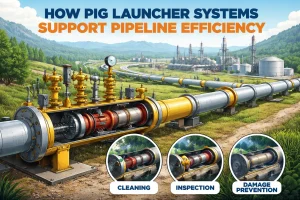
    Pig launcher systems help in maintaining pipeline efficiency by enabling regular cleaning and inspection processes. They ensure smooth product flow, reduce internal buildup, and enhance the overall lifespan of pipeline infrastructure.

    Industries Using Pig Launcher Systems

    Our pigging equipment for oil pipelines manufacturer solutions are used in:

    • Oil refineries
    • Gas transmission companies
    • Chemical processing units
    • Water distribution systems

    We cater to both small-scale and large-scale industrial requirements.

    Conclusion

    Choosing the right pig launcher manufacturer in India is essential for ensuring pipeline efficiency, safety, and long-term operational reliability. With increasing demand in oil & gas, chemical, and industrial sectors, investing in high-quality pigging systems has become a critical requirement for modern pipeline infrastructure.

    As a trusted pig launcher manufacturer in India, we focus on delivering precision-engineered solutions that meet industry standards, withstand high-pressure conditions, and support seamless pipeline operations. From custom design and fabrication to complete turnkey solutions, our systems are built to handle complex industrial challenges with ease.

    Whether you are looking for a pipeline pig launcher supplier in India, a custom pigging system manufacturer, or a reliable partner for industrial pipeline pigging solutions, choosing an experienced and technically strong manufacturer ensures long-term value and performance.

    Request a Quote – Leading Pig Launcher Manufacturer in India

    Looking for a reliable pig launcher manufacturer in India for your industrial pipeline needs?

    We offer:

    • Custom pig launcher solutions
    • High-pressure industrial systems
    • PAN India supply and support
    • Competitive pricing

    Contact us today to discuss your requirements and get a customized solution for your pipeline system.

    FAQs

    A pig launcher introduces a pig into the pipeline using controlled pressure, allowing it to move through the system for cleaning or inspection.

    Pigging systems are used in oil & gas, chemical, water, and industrial pipeline sectors.

    Pig launchers are typically made from stainless steel, carbon steel, and alloy steel depending on application requirements.

    Choose a manufacturer with experience, customization capabilities, compliance with standards, and strong after-sales support.

  • Pig Launcher Working: Step-by-Step Pipeline Pigging Process 2026

    Pig Launcher Working: Step-by-Step Pipeline Pigging Process 2026

    Pipelines deliver vital resources across long distances, but keeping them efficient and safe comes down to understanding pig launcher working and the complete pigging process in pipeline systems. A pig launcher is a specialized vessel designed to introduce a maintenance tool—commonly called a “pig”—into a pipeline while the line remains live and pressurized. The pig launcher working principle is central to effective pipeline operations, helping maintenance teams and engineers  remove deposits, scale, or blockages, and conduct internal pipeline inspections without shutting down the system.

    By mastering pig launcher working, professionals ensure regular pigging prevents hazardous blockages, supports flow efficiency, and protects pipeline integrity in any industry. Whether you’re running an oil and gas operation or managing municipal water supply, a reliable pipeline pigging process is crucial for safe and uninterrupted operations.

    Regular pigging prevents dangerous blockages and maintains maximum flow efficiency. Whether you manage a major oil network or an industrial water system, mastering the pipeline pigging process keeps operations running smoothly and safely.

    Pig Launcher Working Principle: How It Works in Pipeline Pigging Process

    Pig Launcher Working Principle

    The foundation of pig launcher working lies in its use as a controlled access point to safely introduce a pig into a live, pressurized pipeline. Specifically, pig launcher working allows operators to insert the pig into a sealed chamber, which is then connected to the main pipeline system. This process is essential for maintaining the integrity and functionality of pipelines across industries.

    In a typical pig launcher working sequence, the launcher acts as a pressure-safe lockout zone between the exterior environment and the pressurized pipeline. By utilizing a pressure based pigging system, operators carefully manipulate isolated valves to direct a portion of pipeline fluid behind the pig. Due to the consistent seal the pig forms against the pipe’s internal walls, this pressure creates the force required for efficient pig movement inside pipeline.

    As a result, the pig progresses through miles of pipeline, performing crucial cleaning, inspection, or separation tasks in one smooth operation. Once its function is complete, the pig is collected by a pig receiver at the end of the line, demonstrating how precise pig launcher working keeps the pigging process safe and effective.

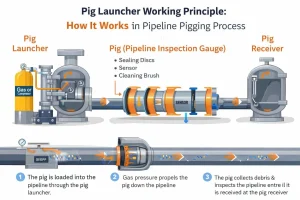
    The pig launcher working principle relies on a pressure based pigging system. By manipulating a series of valves, operators divert a portion of the main pipeline fluid (or gas) behind the pig. Because the pig fits snugly against the inner walls of the pipe, this trapped pressure pushes it forward. The continuous flow of the pipeline medium provides the driving force, allowing the pig to travel miles down the line to clean, clear, or inspect the interior surface. Once it completes its journey, a similar device called a pig receiver safely catches and extracts it.

    Step-by-Step Pig Launcher Working Process in Pipeline Pigging

    To achieve both reliable pig launcher working and the highest standards of maintenance in pipeline systems, it is essential to follow a structured, step-by-step pigging process in pipeline operations. Proper pig launcher working not only boosts operational safety but also ensures efficient cleaning and inspection. Below, you’ll find a comprehensive, easy-to-follow guide outlining how pig launcher working is executed in real-world industrial settings. This process highlights each critical aspect of the pipeline pigging process while prioritizing safety, accuracy, and efficiency for pipeline maintenance professionals and engineers.

    Step 1: Pig Insertion Into Launcher

    First, operators isolate the launcher barrel from the main active pipeline to ensure it is fully depressurized. Once they verify zero pressure, they open the closure door and manually push the pig tightly into the launcher barrel. Pushing the pig firmly ensures the pipeline medium cannot bypass it later. After the pig is securely in place, operators close and lock the closure door securely.

    Step 2: Sealing and Pressurization

    Before launching, the system must match the pressure of the main pipeline. Operators open the kicker valve slightly to allow the pipeline fluid or gas to enter the barrel. As the fluid fills the chamber behind the pig, the pressure inside the launcher slowly equalizes with the pressure of the active pipeline. Proper sealing and pressurization prevent dangerous pressure surges that could damage equipment.

    Step 3: Pig Movement Inside Pipeline

    Once pressures equalize, operators open the main isolation valve connecting the launcher to the pipeline. They then fully open the kicker valve. This action directs the full force of the pipeline flow directly behind the pig. The pressure differential pushes the pig out of the barrel and into the main pipeline stream. Pig movement inside pipeline is entirely controlled by the flow rate and pressure of the transported medium.

    Step 4: Cleaning and Inspection Process

    As the pig travels through the network, it performs its designated pipeline cleaning steps. Utility pigs scrape away wax, scale, and debris, pushing the waste ahead of them. Smart pigs, equipped with advanced sensors, record data on wall thickness, corrosion, and internal geometry. Throughout this phase, the pig maintains a tight seal against the pipe walls to ensure thorough cleaning and accurate data collection.

    Step 5: Pig Receiving at Receiver

    At the end of the line, the pig enters the pig receiver barrel. The receiver catches the pig and the debris pushed ahead of it. Operators then isolate the receiver from the main flow, drain the trapped fluid, safely depressurize the barrel, and open the closure door to extract the pig. This completes the launching and receiving process safely.

    Pig Launcher Working: Visualizing the Launching and Receiving Process (Text-Based Diagram)

    how pig launcher works

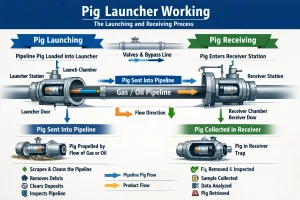
    If you look at a schematic of a pig launcher, you will see a large, oversized pipe section called the barrel, which narrows down to match the diameter of the main pipeline through a concentric reducer.

    At the rear end of the barrel sits the heavy-duty closure door used for loading. A smaller pipe, controlled by the kicker valve, connects to the barrel near the closure door. This pipe supplies the driving pressure. At the front end, a large main isolation valve separates the launcher from the active pipeline. A bypass line allows normal flow to continue when the launcher is isolated. When the kicker valve opens, flow redirects behind the pig in the barrel, pushing it through the open main isolation valve and into the primary flow of the pipeline.

    Key Components in Pig Launcher Working Operation

    A successful pipeline pigging process relies on several heavy-duty components working together seamlessly.

    • Launcher Barrel: This oversized, heavy-walled cylindrical vessel holds the pig before launch. It is built larger than the main pipeline to make loading easy and features a reducer to guide the pig into the main pipe.
    • Closure Door: This is a high-pressure, quick-opening mechanical door located at the rear of the barrel. It features safety locks to prevent opening under pressure and provides access for inserting the pig.
    • Valves: The system relies on multiple valves to control pressure and flow. The main isolation valve separates the launcher from the pipeline, the kicker valve introduces pressure behind the pig, and drain/vent valves release trapped pressure.
    • Pipeline: The main transport pipe acts as the track for the pig. Its internal diameter dictates the size of the pig used, and its flow provides the motive force.

    Applications of Pig Launcher Working in Pipeline Systems

    Pig launcher systems play a critical role in maintaining pipeline efficiency, safety, and performance across multiple industries. From cleaning and inspection to product separation, pipeline pigging is widely used in modern industrial operations.

    • Oil and Gas: Pipeline pigging is extensively used in crude oil and natural gas pipelines to remove paraffin wax buildup, sludge, and debris. Pig launchers help insert cleaning and smart pigs into pipelines without interrupting operations. Additionally, pigging removes trapped water that can cause internal corrosion. Smart pigs are also used for pipeline inspection, detecting cracks, leaks, and structural weaknesses—ensuring safe and continuous operations.
    • Chemical Processing: In chemical industries, multiple products are often transported through the same pipeline. Pigging allows efficient separation of different chemicals, preventing contamination between batches. This batching process improves product purity, reduces wastage, and ensures compliance with industrial quality standards. Pig launcher systems make this process safe and controlled.
    • Water Pipelines: Municipal and industrial water pipelines use pigging to remove sediment, sludge, biofouling, and mineral deposits. This ensures smooth water flow and maintains pipeline hygiene. Regular pigging also reduces pumping costs and prevents blockages, making it essential for long-term water infrastructure maintenance.
    • Food and Beverage Industry: Pigging systems are used to recover leftover product (like sauces, dairy, or beverages) from pipelines. This minimizes product loss and ensures maximum yield. It also helps maintain hygiene standards by cleaning pipelines effectively between production cycles.
    • Pharmaceutical Industry: In pharmaceutical manufacturing, maintaining purity is critical. Pigging helps avoid cross-contamination between different formulations and ensures strict hygiene standards are met. This improves production efficiency and reduces cleaning time between batches.
    • Mining and Slurry Pipelines: Mining industries use pigging to clean slurry pipelines carrying minerals and waste materials. Pig launchers help remove solid deposits and prevent pipeline clogging, ensuring uninterrupted operations.
    • Power Plants & Industrial Utilities: Power plants use pigging systems in pipelines carrying fuel, water, or steam-related fluids. Regular pigging improves flow efficiency and reduces maintenance downtime in critical utility pipelines.

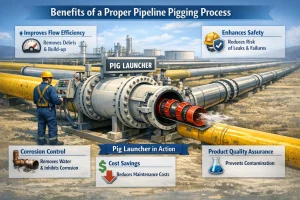
    Pig Launcher Working: Benefits of a Proper Pipeline Pigging Process

    Pipeline Pigging Process

    Executing a consistent pigging program delivers several major advantages for pipeline operators.

    • Improved Flow Efficiency: Pigging removes internal deposits such as wax, sludge, and scale buildup. This restores the original internal diameter of the pipeline, reducing friction and allowing smoother fluid movement. As a result, operators experience improved throughput and reduced energy consumption.
    • Reduced Blockage & Downtime: Routine pigging prevents the accumulation of debris and solid particles that can lead to severe blockages. By maintaining a clean pipeline, industries can avoid unexpected shutdowns and costly production interruptions.
    • Corrosion Prevention & Pipeline Protection: Pigging helps eliminate stagnant water, corrosive chemicals, and sediments that settle inside pipelines. This significantly reduces internal corrosion risks and extends the service life of the pipeline infrastructure.
    • Enhanced Operational Safety: A properly maintained pigging system minimizes the risk of pressure build-up, leaks, and pipeline failures. This ensures safer operations for workers and reduces environmental hazards, especially in oil & gas industries.
    • Accurate Inspection & Monitoring: Pipeline pigging enables the use of intelligent pigs (smart pigs) equipped with sensors to detect cracks, corrosion, and structural weaknesses. This allows early detection of issues and prevents major failures.
    • Cost Savings in Maintenance: Regular pigging reduces the need for expensive repairs and emergency maintenance. It also lowers pumping costs by improving flow efficiency, leading to long-term operational savings.
    • Improved Product Quality: In industries like oil, gas, and food processing, pigging prevents cross-contamination between batches. This ensures consistent product quality and meets industry standards.
    • Increased Pipeline Lifespan: By preventing corrosion, buildup, and mechanical damage, pigging significantly extends the lifespan of pipelines, reducing capital expenditure on replacements.

    Pig Launcher Working: Safety Considerations for Pipeline Pigging

    Handling pressurized vessels requires extreme caution. Operators must prioritize safety during every pig launcher operation.

    • Pressure Handling: Operators must never open a closure door until they verify the barrel is at zero internal pressure. Vent valves and pressure gauges must be double-checked before any physical access.
    • Proper Sealing: The closure door O-rings and seals must be inspected before every launch. A damaged seal can cause a catastrophic blowout when the kicker valve introduces pipeline pressure.
    • Operational Checks: Teams must follow strict valve sequencing checklists. Opening or closing valves in the wrong order can trap pressure, damage the pig, or disrupt the main pipeline flow.

    Pig Launcher Working: Final Thoughts and Next Steps

    A thorough understanding of pig launcher working is crucial for ensuring industrial pipelines stay efficient, safe, and reliable. Every aspect— from carefully loading the pig to monitoring pressure and pig movement inside the pipeline— plays a role in the success of the pipeline pigging process. When you follow a systematic, step-by-step approach to pig launcher working, you not only protect vital infrastructure from blockages and corrosion but also extend the operational life of your entire pipeline system. Relying on best practices for pig launcher working allows industrial engineers to maintain optimal flow, minimize maintenance risks, and achieve superior results in every pigging operation.

    Looking for pig launcher manufacturer in India? Get custom fabrication solutions from industry experts.

    Pig Launcher Working: Frequently Asked Questions (FAQ)

    The pigging process involves sending a mechanical device through a pipeline to clean debris, separate different products, or inspect the pipe walls without stopping the product flow.

    Pigging is important because it maintains optimal flow efficiency, prevents dangerous blockages, and removes corrosive materials that could otherwise damage the pipeline over time.

    Pig movement in a pipeline is driven entirely by the pressure of the fluid or gas flowing behind it. The snug fit of the pig ensures the pressure pushes it forward continuously.

    Pig launcher operation is the mechanical procedure of safely loading a pig, equalizing pressure with the main line, and manipulating valves to launch the pig into an active pipeline.

  • Pig Launcher: Complete Guide to Pipeline Pigging Systems, Design, Types, Working & Industrial Applications 2026

    Pig Launcher: Complete Guide to Pipeline Pigging Systems, Design, Types, Working & Industrial Applications 2026

    Industrial pipelines are essential assets across industries such as oil & gas, petrochemicals, chemicals, water treatment, power generation, and food processing. These pipelines transport fluids, gases, and slurries over long distances and often operate under high pressure and temperature conditions.

    While pipelines are designed for durability and efficiency, the internal environment of a pipeline is rarely stable. Over time, various substances accumulate inside the pipeline. These may include wax deposits, scale formation, corrosion residues, sludge, sand particles, and product remnants.

    This internal buildup creates serious operational challenges:

    • Reduced pipeline capacity
    • Increased pressure drop
    • Higher energy consumption
    • Increased wear and tear
    • Risk of corrosion and leakage
    • Product contamination

    If not addressed, these issues can lead to major operational failures, production losses, and costly shutdowns.

    Traditional cleaning methods require pipeline shutdown and manual intervention, which is expensive and time-consuming. This is why industries use pipeline pigging systems, where the Pig Launcher plays a critical role.

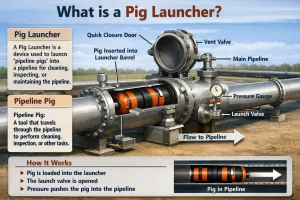
    What is a Pig Launcher?

    What is a Pig Launcher

    A Pig Launcher is a specialized pressure vessel used to introduce a device called a “pig” into a pipeline. The pig travels through the pipeline to perform cleaning, inspection, or separation tasks.

    Simple Definition:

    A Pig Launcher is the starting point of pigging operations, allowing the safe insertion of pigs into a pressurized pipeline system.

    Key Functions of a Pig Launcher:

    • Launch cleaning pigs into pipelines
    • Insert inspection tools (smart pigs)
    • Remove internal deposits
    • Maintain flow efficiency
    • Enable product separation

    The Pig Launcher allows this process to happen without shutting down the pipeline, which is critical for industrial operations.

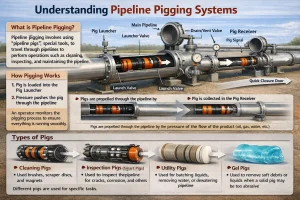
    Understanding Pipeline Pigging Systems

    Pipeline Pigging Systems

    A pipeline pigging system consists of three main components that work together to maintain pipeline health.

    1. Pig Launcher

    The Pig Launcher is used to insert the pig into the pipeline. It acts as a pressurized chamber where the pig is loaded and launched.

    2. Pipeline Pig

    The pig is a device that travels through the pipeline. Types of pigs include:

    • Foam pigs
    • Brush pigs
    • Scraper pigs
    • Smart pigs (inspection tools)

    Each pig serves a specific purpose such as cleaning, inspection, or separation.

    3. Pig Receiver

    The Pig Receiver collects the pig after it completes its journey through the pipeline. It ensures safe removal and disposal or reuse.

    How the System Works:

    1. Pig is loaded into the Pig Launcher
    2. Pressure pushes the pig into the pipeline
    3. Pig travels through the pipeline
    4. Cleaning or inspection is performed
    5. Pig reaches the receiver

    This system ensures continuous and efficient pipeline maintenance.

    Why Pig Launcher Systems Are Critical

    Pigging systems are essential for maintaining industrial pipeline performance.

    1. Improves Flow Efficiency

    Deposits reduce the effective diameter of the pipeline. Pigging removes these deposits and restores optimal flow.

    2. Enhances Safety

    Corrosion and damage often occur beneath accumulated deposits. Pigging removes these layers and prevents failures.

    3. Reduces Maintenance Costs

    • Minimizes downtime
    • Reduces manual cleaning
    • Extends pipeline life

    4. Maintains Product Quality

    Pigging prevents mixing of different products, ensuring purity and consistency.

    How a Pig Launcher Works (Detailed Step-by-Step Process)

    Pig Launcher In India

    The working process of a Pig Launcher involves a controlled sequence of operations that ensures safe insertion, movement, and retrieval of pigs within a pipeline. This process is designed to maintain pipeline efficiency without interrupting operations.

    Step 1: Isolation

    The Pig Launcher is first isolated from the main pipeline using isolation valves.

    • Ensures no active flow enters the launcher during loading
    • Creates a safe working environment for operators
    • Prevents pressure-related hazards

    Step 2: Venting and Draining

    The internal pressure of the Pig Launcher is reduced, and residual fluids are removed.

    • Vent valves release trapped pressure
    • Drain valves remove leftover liquids or gases
    • Prepares the system for safe opening

    Step 3: Pig Loading

    The closure door is opened, and the pig is inserted into the barrel.

    • Pig is placed correctly inside the launcher
    • Alignment is checked to ensure smooth movement
    • Closure area is inspected before sealing

    Step 4: Closure Sealing

    The closure is securely locked to handle high pressure conditions.

    • Quick Opening Closure (QOC) is tightly sealed
    • Safety locks ensure no accidental opening
    • System is prepared for pressurization

    Step 5: Pressurization

    Fluid is introduced behind the pig to match the pipeline pressure.

    • Pressure is gradually increased
    • Ensures smooth transition into the pipeline
    • Prevents sudden pressure shocks

    Step 6: Launching

    The pig is pushed into the pipeline using fluid flow.

    • Kicker valve directs flow behind the pig
    • Pig enters the pipeline smoothly
    • Flow carries the pig forward

    Step 7: Pig Travel

    The pig moves through the pipeline to perform its function.

    • Removes deposits like wax, scale, and debris
    • Performs inspection in case of smart pigs
    • Maintains pipeline efficiency

    Step 8: Reception

    The pig reaches the Pig Receiver at the end of the pipeline.

    • Safely collected in the receiver unit
    • Removed for reuse or disposal
    • Confirms successful pigging operation

    Key Components of a Pig Launcher

    Pig Launcher

    A Pig Launcher consists of several critical components that work together to ensure safe, efficient, and controlled pigging operations in industrial pipelines. Each component is designed to handle high pressure, ensure operational safety, and maintain system reliability.

    Barrel

    The barrel is the main cylindrical chamber of the Pig Launcher where the pig is loaded before launching.

    • Primary Loading Section:
      Acts as the housing unit for inserting pigs into the pipeline.
    • Heavy-Duty Construction:
      Designed to withstand high pressure and harsh operating conditions.
    • Size Compatibility:
      Manufactured according to pipeline diameter and pig dimensions for smooth operation.

    Quick Opening Closure (QOC)

    The Quick Opening Closure is a critical safety component that allows fast and secure access to the barrel.

    • Safe Access Mechanism:
      Enables operators to open and close the launcher quickly without compromising safety.
    • Pressure Lock System:
      Prevents opening under pressure, ensuring operator protection.
    • Time-Saving Operation:
      Reduces loading time and improves operational efficiency.

    Valves System

    The valve system controls the flow and pressure within the Pig Launcher during operation.

    • Isolation Valve:
      Separates the Pig Launcher from the main pipeline during loading and maintenance.
    • Kicker Valve:
      Introduces fluid pressure behind the pig to push it into the pipeline.
    • Vent & Drain Valves:
      Used to release pressure and remove residual fluids before opening the closure.

    Instrumentation

    Instrumentation ensures monitoring, control, and safety during pigging operations.

    • Pressure Gauges:
      Monitor internal pressure levels to maintain safe operating conditions.
    • Pig Signallers:
      Detect and indicate the movement or passage of the pig within the pipeline.
    • Safety Valves:
      Automatically release excess pressure to prevent system failure.

    Nozzles and Piping

    Nozzles and piping connect the Pig Launcher to the main pipeline system.

    • Flow Connection:
      Facilitate smooth entry of the pig into the pipeline.
    • System Integration:
      Ensure proper alignment and compatibility with existing pipeline infrastructure.
    • Leak-Proof Design:
      Designed to handle high pressure without leakage.

    Types of Pig Launchers

    Different types of Pig Launchers are designed based on pipeline configuration, space availability, pressure conditions, and operational requirements. Selecting the right type ensures efficient pigging operations, safety, and long-term performance.

    Horizontal Pig Launcher

    Horizontal Pig Launchers are the most commonly used configuration in industrial pipeline systems.

    • Most Widely Used Design:
      Preferred for onshore pipeline networks due to ease of installation and operation.
    • Easy Operation & Maintenance:
      Provides convenient access for loading and unloading pigs.
    • Suitable for Large Pipelines:
      Ideal for long-distance pipelines in oil & gas, water, and chemical industries.
    • Better Handling Efficiency:
      Simplifies pig insertion and reduces operational complexity.

    Vertical Pig Launcher

    Vertical Pig Launchers are used in environments where horizontal space is limited.

    • Space-Saving Design:
      Ideal for offshore platforms, refineries, and compact industrial setups.
    • Common in Offshore Applications:
      Widely used in oil rigs and marine pipeline systems.
    • Efficient in Limited Layouts:
      Helps optimize plant layout without compromising functionality.
    • Requires Skilled Operation:
      Handling and loading may require more precision compared to horizontal systems.

    Skid Mounted Pig Launcher

    Skid Mounted Pig Launchers are pre-engineered and assembled systems for quick deployment.

    • Pre-Assembled Unit:
      Delivered as a ready-to-install module, reducing on-site fabrication time.
    • Easy Installation:
      Minimizes civil work and simplifies integration into existing systems.
    • Reduced Site Work:
      Saves installation cost and time, especially in remote or industrial locations.
    • Ideal for Modular Projects:
      Suitable for temporary setups or fast-track industrial projects.

    High Pressure Pig Launcher

    High Pressure Pig Launchers are specifically designed for demanding pipeline conditions.

    • Designed for High Pressure Systems:
      Built to withstand extreme pressure and temperature conditions.
    • Used in Critical Industries:
      Common in oil & gas, petrochemical, and high-performance industrial pipelines.
    • Enhanced Safety Design:
      Equipped with advanced safety features and robust construction.
    • Long-Term Durability:
      Suitable for continuous operation in harsh environments.

    Pig Launcher vs Pig Receiver

    Feature Pig Launcher Pig Receiver
    Function Launch pig Receive pig
    Position Upstream Downstream
    Role Start of operation End of operation

    Both are essential for a complete pigging system.

    Design & Engineering Considerations

    Designing a Pig Launcher requires careful planning.

    Key Factors:

    • Pipeline diameter
    • Operating pressure
    • Fluid characteristics
    • Pig size and type
    • Environmental conditions

    Engineering Focus:

    • Structural strength
    • Flow efficiency
    • Safety compliance
    • Ease of operation

    Materials Used in Pig Launcher Manufacturing

    Pig Launcher Manufacturing India

    The selection of materials in Pig Launcher manufacturing plays a crucial role in determining performance, durability, corrosion resistance, and pressure-handling capability. Different materials are chosen based on operating conditions such as pressure, temperature, and the type of fluid being transported.

    Carbon Steel

    Carbon steel is the most commonly used material in Pig Launcher fabrication due to its strength and affordability.

    • Widely Used in Industrial Applications:
      Suitable for oil & gas, water pipelines, and general-purpose applications.
    • Cost-Effective Solution:
      Offers a balance between strength and cost, making it ideal for large-scale projects.
    • Good Mechanical Strength:
      Handles moderate pressure and temperature conditions efficiently.

    Stainless Steel

    Stainless steel is preferred in environments where corrosion resistance and hygiene are critical.

    • Excellent Corrosion Resistance:
      Ideal for handling chemicals, corrosive fluids, and harsh environments.
    • Used in Chemical & Food Industries:
      Ensures contamination-free operations in pharma, food processing, and chemical plants.
    • Low Maintenance Requirement:
      Reduces long-term maintenance costs due to resistance to rust and scaling.

    Alloy Steel

    Alloy steel is used in high-performance applications where superior strength and durability are required.

    • High Strength & Pressure Resistance:
      Designed for high-pressure and high-temperature pipeline systems.
    • Enhanced Durability:
      Performs well in extreme industrial conditions such as petrochemical and offshore operations.
    • Customizable Properties:
      Alloy composition can be tailored for specific mechanical and thermal requirements.

    Pig Launcher Manufacturing Process

    The manufacturing process of a Pig Launcher involves precision engineering, strict quality control, and adherence to industrial standards. Each stage is critical to ensure the system can withstand high pressure, harsh environments, and long-term industrial use.

    Fabrication

    Fabrication is the initial stage where the structural body of the Pig Launcher is formed.

    • Plate Cutting & Rolling:
      High-grade steel plates are cut and rolled into cylindrical shapes based on required dimensions.
    • Shell Formation:
      The rolled plates are aligned and prepared for welding to form the main barrel.
    • Dimensional Accuracy:
      Ensures correct diameter, thickness, and alignment as per design specifications.

    Welding

    Welding is a critical step that ensures the strength and pressure integrity of the Pig Launcher.

    • Precision Welding Techniques:
      Methods like MIG, TIG, or submerged arc welding are used depending on material and thickness.
    • Joint Strength Assurance:
      Welds are designed to handle high pressure and mechanical stress.
    • Quality Checks:
      Weld joints are later tested using NDT methods to ensure defect-free construction.

    Assembly

    In this stage, all components are integrated to complete the Pig Launcher system.

    • Installation of Components:
      Valves (isolation, vent, drain), quick opening closures (QOC), and nozzles are installed.
    • Instrumentation Setup:
      Pressure gauges, safety valves, and pig signallers are fitted.
    • System Integration:
      Ensures compatibility with pipeline systems and smooth operation during pigging.

    Surface Treatment

    Surface treatment enhances durability and protects the Pig Launcher from corrosion.

    • Anti-Corrosion Coating:
      Internal and external coatings are applied based on operating environment.
    • Painting & Finishing:
      Industrial-grade paints are used for additional protection and identification.
    • Long-Term Protection:
      Extends equipment life, especially in offshore, chemical, and humid environments.

    Testing & Quality Control in Pig Launcher Manufacturing

    pig launcher manufacturers

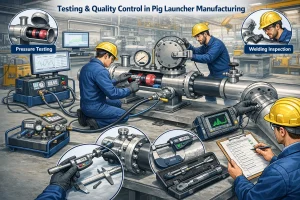
    Testing and quality control are critical processes in Pig Launcher manufacturing to ensure safety, durability, and compliance with industrial standards. Since Pig Launchers operate under high pressure and harsh conditions, strict testing protocols are essential before deployment.

    Hydro Testing

    Hydro testing is performed to verify the pressure-holding capability of the Pig Launcher system.

    • Pressure Integrity Check:
      The system is filled with water and tested at pressures higher than operating limits to ensure structural strength.
    • Leak Detection:
      Identifies any leakage points in weld joints, valves, or connections.
    • Safety Assurance:
      Confirms that the Pig Launcher can safely operate under real industrial conditions.

    Non-Destructive Testing (NDT)

    NDT methods are used to detect internal and surface defects without damaging the equipment.

    • Ultrasonic Testing (UT):
      Detects internal flaws, cracks, and thickness variations in metal components.
    • Radiographic Testing (RT):
      Uses X-rays or gamma rays to inspect weld quality and internal defects.
    • Magnetic Particle Testing (MPT):
      Identifies surface and near-surface cracks in ferromagnetic materials.
    • Dye Penetrant Testing (Optional):
      Used for detecting fine surface cracks in non-magnetic materials.

    Inspection & Quality Assurance

    Final inspection ensures that the Pig Launcher meets design specifications and safety standards.

    • Dimensional Accuracy Check:
      Verifies alignment, diameter, and component fit as per engineering drawings.
    • Material Verification:
      Confirms the use of specified materials like carbon steel, stainless steel, or alloy steel.
    • Compliance with Standards:
      Ensures adherence to industry codes such as ASME, API, and ISO.
    • Functional Testing:
      Checks valves, closures, and instrumentation for proper operation.

    Safety Measures in Pigging Operations

    Safety is critical in pigging operations.

    Key Practices:

    • Ensure zero pressure before opening
    • Use safety interlocks
    • Monitor pressure continuously
    • Train operators

    Industrial Applications of Pig Launchers

    Oil & Gas Industry

    Pig Launchers are extensively used in the oil & gas sector for cleaning crude oil and gas pipelines, removing wax, sludge, and debris buildup. They also enable internal inspection using smart pigs, helping detect corrosion, cracks, and blockages. This ensures uninterrupted flow, improves pipeline efficiency, and reduces the risk of costly failures or leaks in high-pressure systems.

    Chemical Industry

    In chemical processing plants, Pig Launchers play a critical role in product recovery and contamination prevention. They help clear residual chemicals from pipelines between batches, ensuring product purity and minimizing material loss. This is especially important for handling hazardous or reactive chemicals where safety and precision are essential.

    Water & Wastewater

    Pigging systems are widely used in water supply and wastewater pipelines to remove scale, biofilm, and sediment deposits. Pig Launchers help maintain consistent flow rates, improve pipeline hygiene, and prevent clogging. Regular pigging also extends pipeline lifespan and reduces maintenance costs in municipal and industrial water systems.

    Food & Pharma Industry

    n food and pharmaceutical industries, Pig Launchers are used for hygienic fluid transfer and cleaning of pipelines carrying sensitive products like milk, beverages, syrups, or pharmaceutical liquids. They ensure minimal product wastage, maintain strict hygiene standards, and prevent cross-contamination, which is critical for regulatory compliance and product quality.

    Benefits of Pig Launcher Systems

    Pig Launcher systems play a crucial role in maintaining pipeline efficiency, safety, and cost-effectiveness across industries such as oil & gas, chemical processing, and water treatment. Below are the key benefits categorized for better understanding:

    Operational Benefits

    Pigging operations significantly improve day-to-day pipeline performance.

    • Improved Flow Efficiency:
      Removes internal deposits like wax, scale, and sludge, restoring the pipeline’s original diameter and ensuring smooth fluid flow.
    • Reduced Downtime:
      Enables cleaning and maintenance without shutting down the pipeline, ensuring continuous operations and higher uptime.
    • Extended Pipeline Life:
      Prevents internal corrosion and wear, increasing the lifespan of pipeline infrastructure.

    Technical Benefits

    From an engineering perspective, pigging enhances system accuracy and reliability.

    • Accurate Pipeline Inspection:
      Supports the use of smart pigs for detecting corrosion, cracks, leaks, and structural defects.
    • Effective Cleaning Performance:
      Ensures complete removal of contaminants, residues, and buildup that impact system performance.
    • Process Optimization:
      Maintains consistent pressure and flow conditions, improving overall system efficiency.

    Business Benefits

    Pig Launcher systems directly impact operational costs and productivity.

    • Lower Operational Costs:
      Reduces maintenance expenses, minimizes manual cleaning, and prevents costly pipeline failures.
    • Higher Productivity:
      Ensures uninterrupted production cycles by eliminating frequent shutdowns.
    • Improved Product Quality:
      Prevents contamination between batches, especially in chemical, food, and pharma industries.

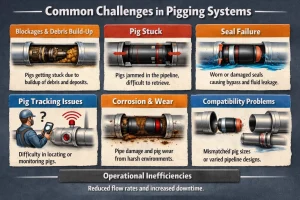
    Common Challenges in Pigging Systems

    Pigging Systems

    Despite their efficiency, pigging systems can face several operational and technical challenges if not properly designed, maintained, or operated. Identifying and addressing these issues is essential to ensure smooth and safe pipeline operations.

    Pig Getting Stuck

    One of the most common issues in pigging operations is the pig getting stuck inside the pipeline.

    • Causes:
      Incorrect pig size, excessive deposits, pipeline bends, or obstructions
    • Impact:
      Flow blockage, pressure buildup, and potential pipeline damage
    • Solution:
      Proper pig selection, regular cleaning schedules, and pipeline inspection before pigging

    Pressure Imbalance

    Pressure mismatch during pigging can disrupt operations and affect pig movement.

    • Causes:
      Improper valve operation, sudden pressure changes, or incorrect system setup
    • Impact:
      Incomplete pig travel or operational inefficiency
    • Solution:
      Controlled pressurization and monitoring using pressure gauges and automation systems

    Leakage Issues

    Leakage can occur in valves, closures, or pipeline joints during pigging operations.

    • Causes:
      Poor sealing, worn-out components, or improper installation
    • Impact:
      Safety risks, product loss, and environmental hazards
    • Solution:
      Regular inspection, proper sealing systems, and maintenance of valves and closures

    Improper Pig Selection

    Choosing the wrong type of pig can reduce effectiveness and cause operational issues.

    • Causes:
      Lack of understanding of pipeline conditions or application requirements
    • Impact:
      Ineffective cleaning, pig damage, or pipeline blockage
    • Solution:
      Selecting pigs based on pipeline diameter, fluid type, and specific cleaning or inspection needs

    How to Choose the Right Pig Launcher

    Selecting the right Pig Launcher is critical for ensuring efficient pipeline operations, long-term reliability, and safety. The choice depends on multiple technical and operational factors such as pressure, material compatibility, and application requirements.

    Check Pressure Rating

    The Pig Launcher must be designed to handle the operating pressure of the pipeline.

    • Match Operating Conditions:
      Ensure the launcher can withstand both normal and peak pressure levels.
    • High-Pressure Applications:
      Use specially designed high-pressure Pig Launchers for oil & gas or petrochemical pipelines.
    • Safety Compliance:
      Always verify design codes such as ASME standards for pressure vessels.

    Select Appropriate Material

    Material selection directly impacts durability and corrosion resistance.

    • Carbon Steel:
      Suitable for standard applications with cost efficiency.
    • Stainless Steel:
      Ideal for corrosive environments and hygienic industries like food and pharma.
    • Alloy Steel:
      Recommended for high-pressure and high-temperature conditions.

    Ensure Compatibility

    The Pig Launcher must be fully compatible with the pipeline system and pigging requirements.

    • Pipeline Diameter Matching:
      Ensure correct sizing for smooth pig movement.
    • Fluid Characteristics:
      Consider the type of fluid (gas, liquid, slurry) being transported.
    • Pig Type Compatibility:
      Select a launcher that supports foam pigs, scraper pigs, or smart pigs as required.

    Choose an Experienced Manufacturer

    The manufacturer plays a key role in system performance and reliability.

    • Proven Industry Experience:
      Choose manufacturers with expertise in industrial pipeline systems.
    • Customization Capability:
      Ensure they can provide tailored solutions based on project requirements.
    • Quality Assurance:
      Look for certifications, testing standards, and past project references.

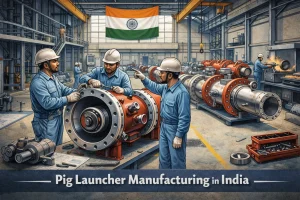
    Pig Launcher Manufacturing in India

    Pig Launcher Manufacturing in India

    India has emerged as a leading hub for Pig Launcher manufacturing, offering high-quality engineering solutions at competitive prices. With a strong industrial base and growing demand from sectors like oil & gas, petrochemicals, and water treatment, Indian manufacturers are delivering globally competitive pigging systems.

    Why India is a Preferred Manufacturing Hub

    • Skilled Workforce:
      India has a large pool of experienced engineers, fabricators, and technicians specializing in pressure vessel and pipeline equipment manufacturing.
    • Advanced Fabrication Capabilities:
      Modern manufacturing facilities use advanced welding techniques, CNC cutting, and precision engineering to ensure high-quality production.
    • Competitive Pricing:
      Cost-effective labor and manufacturing processes make India an attractive option for both domestic and international clients.

    Strong Industry Demand

    • Growing infrastructure projects in oil & gas, water, and chemical industries
    • Increasing need for pipeline maintenance and efficiency
    • Expansion of petrochemical and energy sectors

    Export Capability

    Many Indian Pig Launcher manufacturers export to global markets, including the Middle East, Africa, and Southeast Asia.

    • International quality standards
    • Timely delivery and project execution
    • Competitive global pricing

    Custom Pig Launcher Fabrication

    Custom Pig Launcher solutions provide:

    • Better integration
    • Improved performance
    • Reduced maintenance

    Cost Factors of Pig Launcher

    • Size and diameter
    • Pressure rating
    • Material type
    • Design complexity

    Latest Trends in Pigging Technology

    • Smart pigs with sensors
    • Automated pigging systems
    • Real-time monitoring

    Maintenance Tips for Pig Launchers

    • Regular inspection
    • Valve maintenance
    • Cleaning after operations
    • Periodic testing

    Conclusion

    A Pig Launcher is not just a supporting component but a vital system that ensures the long-term efficiency, safety, and reliability of industrial pipelines. By enabling seamless pigging operations without interrupting flow, it helps industries minimize downtime, reduce operational costs, and maintain product integrity. With increasing demand for automation, smart monitoring, and high-performance pipeline systems, pig launcher technology continues to evolve rapidly. Choosing the right design, material, and manufacturer plays a crucial role in achieving optimal performance. In modern industrial operations, investing in a robust pigging system is no longer optional—it is essential for sustainable and efficient pipeline management.

    Also, Read: Industrial Pressure Vessel Selection Guide for Process Plants

    Frequently Asked Question

    A pipeline pigging system consists of a Pig Launcher, pig, and Pig Receiver that work together to clean, inspect, and maintain pipeline efficiency.

    Pig Launcher systems improve flow efficiency, reduce downtime, enable accurate inspection, lower maintenance costs, and ensure safe pipeline operations.

    A Pig Launcher works by loading a pig into a pressurized chamber and using fluid pressure to push it through the pipeline for cleaning or inspection.

    A Pig Launcher includes a barrel, quick opening closure, valves, instrumentation, and connecting nozzles for safe pigging operations.

    Pig Launchers are made from carbon steel, stainless steel, and alloy steel depending on pressure, corrosion resistance, and application requirements.

    Pig Launchers are used in oil & gas, chemical, water treatment, food processing, and pharmaceutical industries for pipeline maintenance.

    Pig Launchers undergo hydro testing, non-destructive testing (UT, RT, MPT), and inspection to ensure safety, strength, and compliance.

    The manufacturing process includes fabrication, welding, assembly, and surface treatment to ensure durability and pressure resistance.

    Pig Launcher systems are important because they maintain pipeline efficiency, prevent corrosion, reduce downtime, and improve overall operational safety.