Selecting the right pressure vessel materials is one of the most consequential decisions in industrial equipment design. The material forms the pressure boundary itself, so it must safely contain the process fluid at the specified pressure and temperature for the life of the vessel.
An incorrect choice among pressure vessel materials does not just raise cost. It can lead to corrosion, leakage, cracking, reduced service life, product contamination, higher maintenance spend, pressure-boundary failure, and non-compliance with the applicable design code.
This guide compares the materials most commonly used for pressure vessels — carbon steel, stainless steel, low-alloy steel, duplex stainless steel, nickel alloys, aluminium, titanium, and clad or lined construction — and explains the engineering factors that determine which one fits a given application.
None of these materials is universally “best.” The right pressure vessel material comparison always depends on design pressure, temperature, process fluid chemistry, corrosion risk, fabrication requirements, and the project specification governing the vessel.
What Are Pressure Vessel Materials?
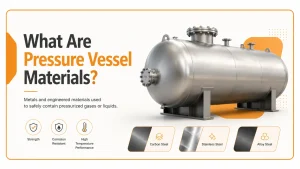
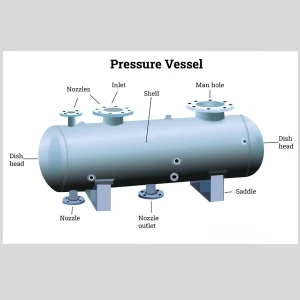
Pressure vessel materials are the metals and alloys used to fabricate the pressure-retaining and structural parts of a vessel: shells, heads, nozzles, flanges, reinforcement pads, supports, and certain internal components.
Not every part of a vessel carries the same material requirements. Pressure-retaining parts — the shell, heads, and nozzle necks that directly resist internal pressure — typically require stricter material control, certification, and traceability than non-pressure attachments such as external ladders or insulation supports.
Material selection for pressure vessel construction is never based on strength alone. Corrosion resistance, weldability, fracture toughness, allowable temperature range, availability, cost, and chemical compatibility with the process fluid all factor into the decision.
Why Pressure Vessel Material Selection Is Important
The material chosen for a vessel directly governs its mechanical strength, corrosion resistance, fracture toughness, fatigue resistance, temperature capability, weldability, and fabrication quality. It also shapes inspection requirements, expected service life, lifecycle cost, and regulatory compliance.
A material that performs reliably in one service condition can fail prematurely in another. A carbon steel receiver that performs well for years in dry, non-corrosive compressed-air service may corrode rapidly if exposed to a chloride-rich, acidic, or high-temperature process stream. The operating environment, not the material name alone, determines suitability.
Factors to Consider When Selecting Pressure Vessel Materials
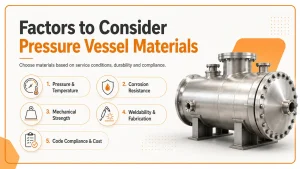
Pressure vessel material selection is a multi-factor engineering exercise. The following factors are reviewed together, not in isolation, before a material is finalized for pressure vessel construction.
Design Pressure
Higher design pressure increases the required wall thickness for a given material and diameter, or requires a higher-strength material to keep thickness practical. Design calculations must account for allowable stress values at the design temperature, joint efficiency of the welded seams, corrosion allowance, and the rules of the applicable design code.
Design and Operating Temperature
Temperature affects material behavior in several ways: strength loss at elevated temperature, creep at sustained high temperature, thermal expansion and associated stress, and brittleness at low temperature. Vessels operating below certain temperatures may require impact testing to confirm adequate toughness, and vessels subject to repeated thermal cycling need materials and details that tolerate fatigue.
Process Fluid Compatibility
The material must be chemically compatible with the specific gas, liquid, acid, alkali, hydrocarbon, steam, or water it will contain. Compatibility depends on concentration, temperature, and the presence of contaminants — a material rated for one chemical concentration may not be suitable at a higher concentration or temperature of the same chemical.
Corrosion Risk
Corrosion is rarely a single mechanism. Pressure vessel material selection must consider general corrosion, pitting corrosion, crevice corrosion, galvanic corrosion between dissimilar metals, stress-corrosion cracking, erosion-corrosion in high-velocity or particulate-laden streams, and high-temperature oxidation.
Mechanical Properties
Tensile strength, yield strength, elongation, hardness, toughness, fatigue resistance, and creep resistance all influence how a material behaves under the design loads and operating cycles the vessel will experience.
Weldability and Fabrication
The chosen material affects how it can be cut, formed, rolled, and welded, including preheating needs, post-weld heat treatment, distortion control, repair procedures, welder qualification, and the governing Welding Procedure Specification (WPS), Procedure Qualification Record (PQR), and Welder Performance Qualification (WPQ) requirements.
Material Availability and Traceability
Practical procurement matters as much as theoretical suitability. Lead times, standard plate sizes, approved supplier lists, heat-number traceability, and Material Test Certificates (MTCs) all affect whether a specified material can realistically be delivered within a project schedule.
Applicable Design Codes and Client Specifications
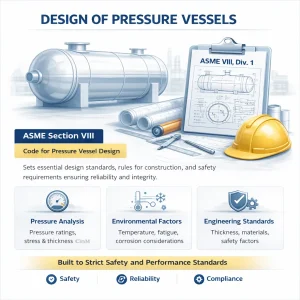
Pressure vessel materials must comply with the governing design code, approved fabrication drawings, client material specifications, and the service requirements defined by the process licensor or end user. No single code edition applies universally across every project or jurisdiction, so the applicable code and its referenced material standards must be confirmed for each contract.
Also Read: Custom Pressure Vessels by National Engineers & Steel Fabricators
Carbon Steel for Pressure Vessel Construction
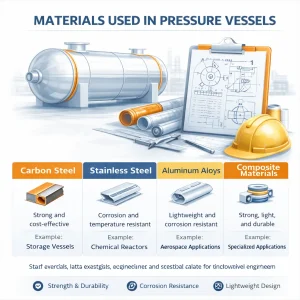
Carbon steel remains one of the most widely used pressure vessel construction materials because it combines adequate strength, good weldability, wide availability, and comparatively low cost.
A carbon steel pressure vessel is generally economical to fabricate, forms and welds using conventional procedures, and is supported by a mature supply chain of plate, pipe, and forged fittings. Its main limitation is corrosion resistance: carbon steel corrodes in the presence of moisture, oxygen, and many chemicals, and typically needs a corrosion allowance, protective coating, or lining in exposed service.
Common applications include air receiver vessels, general utility vessels, water storage vessels, blowdown tanks, and process vessels handling non-corrosive gases or liquids. Not all carbon-steel grades are interchangeable — killed and semi-killed grades, normalized conditions, and impact-tested grades each carry different toughness and service limits.
When Is Carbon Steel a Suitable Choice?
Carbon steel is generally considered where the process fluid is non-corrosive or only mildly corrosive, operating temperatures fall within a moderate range, low-temperature toughness requirements are manageable, and cost efficiency is a priority alongside straightforward fabrication.
When May Carbon Steel Be Inadequate?
Carbon steel may not be adequate where the process involves aggressive acids or alkalis, contamination-sensitive products such as food or pharmaceutical intermediates, extreme high or low temperatures, or environments with significant chloride or sulfide exposure that accelerate corrosion or cracking.
Stainless Steel for Pressure Vessel Construction
A stainless steel pressure vessel offers strong corrosion resistance, a cleanable surface finish, and broad chemical compatibility, which makes it attractive for hygienic, high-purity, and corrosive-service applications.
The trade-off is a higher initial material cost and specific fabrication requirements, including controlled heat input, cleanliness, and avoidance of carbon-steel contamination during handling. Certain grades remain vulnerable to chloride-related pitting and stress-corrosion cracking in hot chloride environments, so stainless steel is not automatically immune to corrosion.
The common stainless-steel families used in pressure vessel steel grades each have different characteristics: austenitic stainless steel offers good general corrosion resistance and formability; ferritic stainless steel offers moderate corrosion resistance with lower nickel content; martensitic stainless steel offers higher hardness and strength; and duplex stainless steel combines characteristics of austenitic and ferritic structures.
Typical applications include pharmaceutical process equipment, food and beverage processing vessels, chemical process vessels, water treatment systems, and high-purity systems where product contamination must be minimized.
When Is Stainless Steel Preferred?
Stainless steel is generally preferred where hygiene, cleanability, or product purity are critical, where the process fluid is corrosive to carbon steel, or where the client specification requires a smooth, low-maintenance internal surface finish.
What Are the Limitations of Stainless Steel?
Limitations include higher material and fabrication cost, sensitivity to chloride-induced pitting and stress-corrosion cracking in certain hot chloride environments, and the need for strict contamination control during fabrication to preserve the corrosion-resistant surface.
Low-Alloy Steel for High-Temperature and High-Pressure Service
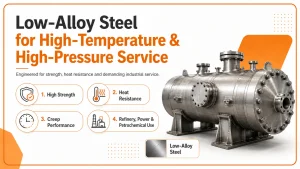
Alloying elements such as chromium, molybdenum, and vanadium are added to carbon steel to improve strength, hardenability, elevated-temperature performance, and resistance to specific degradation mechanisms such as hydrogen attack.
Low-alloy steel is widely used in boilers, high-temperature process vessels, refinery equipment, power-plant components, petrochemical reactors, and steam or thermal service where sustained elevated temperature and pressure exceed what standard carbon steel can reliably handle.
Fabrication of alloy steel pressure vessel components generally requires controlled welding procedures, preheating, interpass-temperature control, post-weld heat treatment, hardness control, additional non-destructive testing, and Positive Material Identification (PMI) to confirm the correct grade has been used. The specific grade required depends on the process data and design conditions, and should not be assumed without engineering review.
Duplex Stainless Steel Pressure Vessels
Duplex stainless steel has a mixed austenitic-ferritic microstructure that gives it roughly double the yield strength of common austenitic grades, along with strong resistance to chloride-induced pitting and, in suitable environments, stress-corrosion cracking.
The higher strength can allow a reduction in required wall thickness compared with standard austenitic stainless steel at the same design pressure. However, duplex grades demand strict welding heat-input control to preserve the phase balance between austenite and ferrite, qualified fabrication procedures, and generally higher material and fabrication complexity than standard grades.
Duplex stainless steel is frequently considered for offshore and marine equipment, chemical process vessels, and other chloride-containing service where standard austenitic grades would be vulnerable to pitting or cracking.
Nickel-Alloy Pressure Vessels
Nickel alloys are considered for the most severe corrosion, high-temperature, or aggressive chemical services where stainless steel and duplex grades do not provide adequate resistance.
These alloys offer excellent corrosion resistance in selected environments and strong high-temperature capability, but they come with meaningfully higher material cost, more demanding welding control, and a higher risk of cross-contamination during fabrication if handling procedures are not followed. Choosing between different nickel alloys requires a detailed corrosion and process evaluation specific to the fluid, temperature, and contaminants involved — the alloys are not interchangeable.
Aluminium Pressure Vessels
Aluminium offers low density, good corrosion resistance in suitable environments, ease of handling, and favorable thermal conductivity, which benefits certain low-temperature and transport-related vessel applications.
Its limitations include lower high-temperature capability than steel, different welding requirements, and a risk of galvanic corrosion when in direct contact with dissimilar metals. Aluminium is not suitable for every pressure vessel application — it is generally reserved for specific low-temperature, weight-sensitive, or transport-related use cases rather than general process service.
Titanium Pressure Vessels
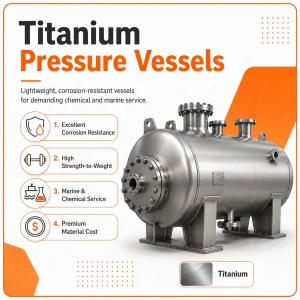
Titanium provides a high strength-to-weight ratio and excellent corrosion resistance in selected aggressive chemical and marine environments, making it a candidate material where these specific conditions justify the cost.
Titanium fabrication is sensitive: it requires strict shielding during welding to prevent contamination from atmospheric oxygen and nitrogen, along with specialized welder expertise and quality control. Given its high material cost, titanium is generally used only where the service conditions — such as hot chloride or highly oxidizing media — cannot be economically satisfied by stainless steel, duplex, or nickel alloys.
Clad and Lined Pressure Vessels
Clad and lined construction combines a structural base material, typically carbon steel or low-alloy steel, with a thinner corrosion-resistant layer of stainless steel, duplex, or nickel alloy that contacts the process fluid.
This corrosion-resistant layer can be applied as roll-bonded or explosion-bonded clad plate, as a weld overlay deposited on the base metal, or as a separately installed metallic or non-metallic lining. Clad construction can meaningfully reduce cost compared with fabricating the entire vessel from an expensive corrosion-resistant alloy, since only a thin surface layer needs the higher-cost material.
The trade-offs include added fabrication complexity, the need for specialized inspection of the clad interface bond, risk of lining damage during service or maintenance, and more complex repair procedures if the corrosion-resistant layer is breached.
Pressure Vessel Material Comparison Table
The table below summarizes general characteristics only. Actual performance varies by specific grade, heat treatment condition, and service environment, so this pressure vessel material comparison should not replace a project-specific engineering evaluation.
Carbon Steel vs Stainless Steel Pressure Vessels
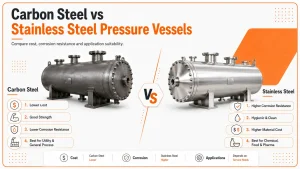
Carbon steel generally offers a lower initial cost, straightforward fabrication, and adequate service life in non-corrosive general applications, but it requires more maintenance, protective coating, or corrosion allowance in exposed service.
Stainless steel generally costs more upfront but offers superior corrosion resistance, easier cleaning, better surface finish, and reduced risk of product contamination — advantages that matter most in hygienic or corrosive process service. For non-corrosive general service, carbon steel is often the more economical pressure vessel material; for corrosive, hygienic, or contamination-sensitive service, stainless steel is more frequently considered.
Stainless Steel vs Duplex Stainless Steel
Duplex stainless steel generally provides higher strength, better chloride resistance, and better pitting and stress-corrosion cracking resistance than common austenitic stainless-steel grades, which can allow thinner sections at the same design pressure.
These benefits come with stricter welding heat-input control, generally higher material cost, more limited availability in some regions, and the need for a fabricator experienced with duplex welding procedures. Duplex stainless steel is not automatically the better choice for every application — for moderate corrosion service without significant chloride exposure, standard austenitic stainless steel may be entirely adequate and more cost-effective.
Solid Alloy vs Clad Pressure Vessel Construction
A solid corrosion-resistant alloy vessel avoids interface-related risks entirely but carries the full material cost of the alloy throughout the wall thickness. Clad construction reduces material cost by confining the alloy to a thin surface layer bonded to a structural carbon-steel or low-alloy-steel base.
As a practical example, a large-diameter vessel handling a moderately corrosive chemical at high pressure may require a substantial wall thickness. Fabricating that thickness entirely from a nickel alloy could be cost-prohibitive, whereas a carbon-steel structural shell with a nickel-alloy weld overlay or clad layer can meet both the corrosion-resistance and structural-strength requirements at a lower overall cost — provided the clad interface is properly qualified and inspected.
How Material Selection Affects Pressure Vessel Wall Thickness
Required wall thickness is generally a function of design pressure, vessel diameter, allowable stress of the chosen material at the design temperature, joint efficiency of the welded seams, and any corrosion allowance added to the calculated minimum thickness.
A universal thickness formula cannot be applied without confirming the applicable design code, the exact material specification and allowable stress values, and the specific corrosion allowance and joint efficiency assumed for the project. Higher material strength does not automatically produce a better design: a thinner, higher-strength wall may still be inadequate if it lacks sufficient corrosion allowance, toughness, or weldability for the intended service.
Also Read: Air Receiver Vessels Manufacturer
Material Traceability and Quality-Control Requirements
Reliable pressure vessel fabrication depends on maintaining traceability from raw material to finished product. This includes working only to approved material specifications, retaining Material Test Certificates (MTCs), preserving heat numbers, and correctly transferring heat-number markings during cutting and forming operations.
Additional controls include MTC reconciliation against the material actually installed, Positive Material Identification where specified, incoming material inspection, proper storage and segregation of different grades, strict control against stainless-steel contamination from carbon-steel tools or surfaces, and control of welding-consumable selection and storage. Loss of traceability weakens the overall quality-assurance system even when the material itself appears visually acceptable, because the fabricator can no longer confirm the grade actually installed matches the specification.
Welding Considerations for Different Pressure Vessel Materials
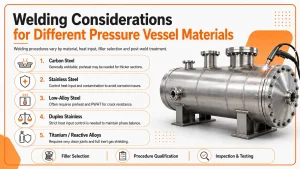
Welding requirements vary substantially between carbon steel, stainless steel, alloy steel, duplex stainless steel, nickel alloys, aluminium, and titanium, and each material calls for its own qualified Welding Procedure Specification (WPS) and supporting Procedure Qualification Record (PQR).
Common considerations across these materials include welder qualification records, correct filler-metal selection, preheat and interpass-temperature control, controlled heat input, back purging to protect the weld root from oxidation, appropriate shielding gas, post-weld heat treatment where specified, distortion control during fabrication, thorough cleaning between passes, ferrite control for duplex and certain stainless grades, avoidance of cross-contamination between dissimilar metals, and weld inspection to the applicable acceptance criteria.
Inspection and Testing Requirements
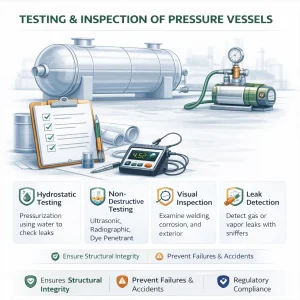
The material chosen and the service conditions involved influence which inspection and testing methods are applied, including visual inspection, dye-penetrant testing, magnetic-particle testing, ultrasonic testing, radiographic testing, Positive Material Identification, hardness testing, ferrite testing for duplex and stainless grades, impact testing for low-temperature toughness, hydrostatic testing, and pneumatic testing where permitted and properly controlled.
The specific inspection plan must always follow the applicable design code, client specification, approved quality plan, and the risk profile of the intended service — a single inspection regime cannot be assumed to satisfy every project.
Also Read: Pressure Vessel Manufacturers in India
Common Mistakes in Pressure Vessel Material Selection
Certain recurring mistakes undermine pressure vessel material selection even on otherwise well-engineered projects:
- Selecting a material based only on initial purchase price, which can increase lifecycle maintenance cost.
- Ignoring the full process-fluid chemistry, including trace contaminants that accelerate corrosion.
- Using a generic material name without confirming the exact grade, which can lead to an unsuitable substitution.
- Overlooking low-temperature toughness requirements, which risks brittle fracture during startup or cold conditions.
- Underestimating chloride exposure, which can trigger pitting or stress-corrosion cracking in susceptible grades.
- Assuming stainless steel cannot corrode, when certain environments actively promote localized corrosion.
- Failing to plan for welding controls and post-weld heat treatment, which can compromise weld integrity.
- Specifying insufficient corrosion allowance, shortening the effective service life of the vessel.
- Mixing incompatible metals in contact, which creates galvanic corrosion risk.
- Losing material traceability during fabrication, which weakens quality assurance.
- Finalizing the material before process data is confirmed, forcing costly late-stage changes.
- Ignoring material availability and procurement lead time, which can delay the project schedule.
- Using a lining or coating system not qualified for the specific process fluid and temperature.
How to Choose the Best Material for a Pressure Vessel
A structured, step-by-step approach reduces the risk of an unsuitable material selection:
- Define the process fluid and its exact chemical composition, including trace contaminants.
- Confirm design pressure and temperature, including margins built into the design basis.
- Identify normal, startup, shutdown, and upset operating conditions the vessel may experience.
- Evaluate corrosion and erosion risks specific to the fluid, velocity, and temperature.
- Review strength and toughness requirements across the full operating temperature range.
- Check compatibility of the candidate material with available welding and fabrication processes.
- Review the applicable design code and all project-specific material specifications.
- Compare material availability, standard sizes, and realistic procurement lead time.
- Estimate lifecycle cost, including maintenance and inspection, not only purchase cost.
- Confirm the inspection, testing, and maintenance regime the material and service will require.
- Obtain approval from competent process, mechanical, materials, and corrosion specialists.
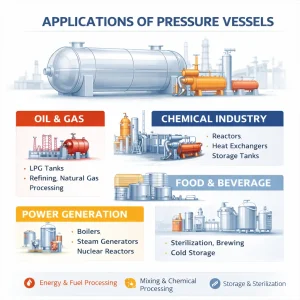
Typical Material Selection by Industry
The following table offers general guidance drawn from common industry practice. It does not constitute a final material recommendation for any specific project — process data and a qualified engineering review remain necessary in every case.
Why Fabricator Capability Matters
Selecting the correct pressure vessel material is only the first step. The fabricator’s capability in procurement, traceability, plate rolling, forming, welding, heat treatment, NDT coordination, dimensional control, surface treatment, pressure testing, and documentation determines whether the specified material actually performs as intended in the finished vessel.
National Engineers & Steel Fabricators is an industrial fabrication company that manufactures custom pressure vessels based on approved drawings, applicable design codes, and client-specified materials and requirements. Material procurement, heat-number traceability, qualified welding procedures, and documented inspection and testing are handled as part of the fabrication process for each project.
Conclusion
Choosing among pressure vessel materials means balancing strength, pressure, temperature, corrosion resistance, weldability, fabrication requirements, availability, inspection needs, maintenance, lifecycle cost, and the applicable design code.
Carbon steel, stainless steel, low-alloy steel, duplex stainless steel, nickel alloys, aluminium, titanium, and clad construction each bring distinct advantages and limitations to pressure vessel construction. None is universally best — the right pressure vessel materials for a given project are the ones that safely and reliably meet its specific process, mechanical, and regulatory requirements.
Frequently Asked Questions
Is carbon steel suitable for pressure vessel construction?
Carbon steel is suitable for many pressure vessel applications, particularly non-corrosive or mildly corrosive services within moderate temperature ranges. It generally needs a corrosion allowance, protective coating, or lining where exposure to moisture, chemicals, or aggressive process fluids is expected.
When should stainless steel be used for a pressure vessel?
Stainless steel is generally considered when the process demands corrosion resistance, hygienic cleanability, or a contamination-sensitive product, such as pharmaceutical, food, or high-purity chemical service. The specific grade must still be checked against chloride exposure and temperature to confirm suitability.
What is the difference between carbon steel and stainless steel pressure vessels?
Carbon steel generally costs less and fabricates more easily but has lower corrosion resistance, while stainless steel costs more upfront but offers stronger corrosion resistance, better surface finish, and lower contamination risk. The right choice depends on the process fluid, hygiene requirements, and lifecycle cost expectations.
Which pressure vessel material offers the best corrosion resistance?
Corrosion resistance is service-dependent rather than absolute. Nickel alloys and titanium generally offer the highest corrosion resistance in aggressive, high-temperature, or chloride-rich environments, but the specific alloy must be matched to the exact process fluid and contaminants through a corrosion evaluation.
Can aluminium be used for pressure vessels?
Aluminium can be used for pressure vessels in specific applications such as low-temperature or weight-sensitive equipment, where its low density and good corrosion resistance in suitable environments are advantageous. It is not generally suitable for high-temperature process service or environments prone to galvanic corrosion.
Why are alloy steels used in high-temperature pressure vessels?
Low-alloy steels contain elements such as chromium and molybdenum that improve strength retention, hardenability, and resistance to specific high-temperature degradation mechanisms. This makes them well suited to boilers, refinery equipment, and other high-temperature, high-pressure service where standard carbon steel would not perform adequately.
What is a clad pressure vessel?
A clad pressure vessel combines a structural base metal, typically carbon or low-alloy steel, with a thinner corrosion-resistant layer of stainless steel, duplex, or nickel alloy bonded to the surface exposed to the process fluid. This construction can reduce material cost compared with a solid corrosion-resistant alloy vessel.
How does operating temperature affect material selection?
Operating temperature affects strength, creep behavior, thermal expansion, and low-temperature toughness. High temperatures may require alloy steels rated for creep resistance, while low temperatures may require impact-tested materials to avoid brittle fracture risk.
Are all stainless-steel grades suitable for pressure vessels?
Not all stainless-steel grades are interchangeable for pressure vessel service. Austenitic, ferritic, martensitic, and duplex grades each have different strength, corrosion resistance, and weldability characteristics, so the grade must be selected to match the specific design and process conditions.
What are ASME pressure vessel materials?
ASME pressure vessel materials refer to the metals and alloys listed in the applicable ASME Boiler and Pressure Vessel Code sections and their referenced material specifications, which set allowable stress values and other requirements for use in vessels designed to that code.
How is pressure vessel material traceability maintained?
Traceability is maintained through Material Test Certificates, heat-number marking that is correctly transferred during cutting and forming, controlled material storage and segregation, and reconciliation procedures that confirm the material actually installed matches the specification.
Does higher material strength always reduce vessel thickness?
Higher material strength can allow a thinner calculated wall in some cases, but thickness is also governed by corrosion allowance, joint efficiency, and code-required margins. A thinner, higher-strength wall is not automatically a better design if it compromises corrosion allowance or long-term reliability.
Who should approve the final pressure vessel material?
Final material selection should be reviewed and approved by competent, authorized process, mechanical, materials, and corrosion engineering professionals, in line with the applicable design code and project specification.
Can a pressure vessel manufacturer help with material selection?
An experienced pressure vessel manufacturer can provide practical fabrication input — covering weldability, availability, and lead time — alongside the client’s engineering team, though final material approval remains the responsibility of the qualified engineers overseeing the project.