Category: Storage Tank

  • Top 10 Carbon Steel Storage Tank Manufacturers in India – Industrial Buying Guide 2026

    Top 10 Carbon Steel Storage Tank Manufacturers in India – Industrial Buying Guide 2026

    Carbon steel storage tank manufacturers in India supply industrial storage solutions for water, petroleum products, process liquids, utility systems and selected chemicals. These tanks are widely used in manufacturing facilities, chemical processing plants, refineries, water treatment facilities and other industrial applications.

    Choosing the right carbon steel storage tank manufacturer is important because tank performance depends on material compatibility, storage capacity, fabrication quality, welding, corrosion protection and operating conditions.

    India has several manufacturers offering vertical, horizontal and custom-engineered carbon steel storage tanks. However, the right supplier depends on the project’s technical specifications, inspection requirements and installation conditions.

    This guide covers the top 10 carbon steel storage tank manufacturers in India, tank types, industrial applications, material selection, manufacturing standards, pricing considerations and important factors to evaluate before purchasing.

    What Are Carbon Steel Storage Tanks?

    Carbon steel storage tanks are industrial containers manufactured using suitable carbon steel plates and fabricated components. They are designed to store liquids or process materials under specified operating conditions.

    Carbon steel storage tanks are commonly selected for their structural strength, fabrication flexibility and competitive initial material cost compared with many stainless steel alternatives.

    They can be manufactured in different configurations, including vertical cylindrical tanks, horizontal tanks, above-ground storage tanks and custom-designed industrial vessels.

    Depending on the application, carbon steel tanks may require protective coatings, internal linings, insulation, corrosion allowance or additional safety accessories.

    The suitability of a carbon steel tank depends on the chemical properties of the stored liquid, storage temperature, pressure conditions, corrosion environment and applicable engineering standards.

    For many industrial projects, carbon steel provides a practical solution when the storage medium is compatible with the selected material and corrosion protection system.

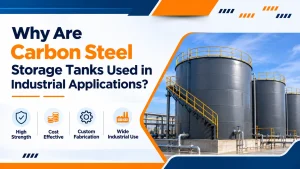
    Why Are Carbon Steel Storage Tanks Used in Industrial Applications?
    Carbon Steel Storage Tanks

    Industrial carbon steel storage tanks are used because they offer a combination of mechanical strength, manufacturing flexibility and cost efficiency.

    1. Structural Strength

    Carbon steel has mechanical properties suitable for many engineered industrial storage applications.

    Properly designed tanks can withstand specified liquid loads, environmental loads and installation conditions.

    2. Cost-Effective Material Selection

    Carbon steel is often more economical than stainless steel for applications where high corrosion resistance is not required.

    However, the total ownership cost should include coatings, inspection, maintenance and expected service life.

    3. Custom Fabrication Options

    A carbon steel storage tank manufacturer can fabricate tanks according to project-specific capacity, dimensions, nozzle arrangements, supports and installation requirements.

    This makes carbon steel suitable for a range of standard and custom industrial projects.

    4. Multiple Storage Configurations

    Carbon steel can be used for vertical, horizontal, cylindrical, rectangular and other engineered tank configurations.

    The final construction type depends on the design requirements and applicable fabrication standards.

    5. Maintenance and Repair Options

    Many carbon steel tanks can be inspected, repaired, recoated or modified using established industrial fabrication procedures, subject to engineering evaluation and applicable codes.

    Types of Carbon Steel Storage Tanks

    Different industries require different tank designs depending on storage capacity, available space, installation conditions and operating requirements.

    1. Vertical Carbon Steel Storage Tanks

    Vertical carbon steel storage tanks have an upright cylindrical configuration and are commonly used for bulk liquid storage.

    They are often selected where large storage capacities and efficient use of available ground area are important.

    Common applications include:

    • Industrial water storage
    • Firewater and utility water systems
    • Fuel and oil storage
    • Process liquid storage
    • Selected chemical storage applications

    Vertical tanks may use flat bottoms, cone roofs, dome roofs, open tops or other engineered arrangements.

    Learn more about vertical storage tank manufacturers in India and the technical factors that affect tank selection.

    2. Horizontal Carbon Steel Storage Tanks

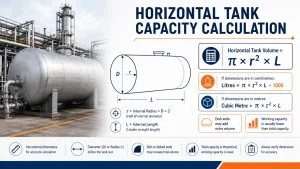
    Horizontal carbon steel storage tanks are cylindrical tanks installed in a horizontal position, commonly using engineered saddle supports.

    They are suitable for installations with limited height or specific plant layout requirements.

    Typical applications include industrial utility storage, diesel storage, process liquids and intermediate storage systems.

    Horizontal tanks may include manholes, vents, drains, level measurement connections, inspection openings and protective coating systems.

    3. Above-Ground Carbon Steel Storage Tanks

    Above-ground carbon steel tanks are installed on suitable foundations or support structures.

    They offer accessible external inspection surfaces and are commonly used in industrial tank farms, utility installations and processing facilities.

    Their design must consider foundation loading, environmental exposure, corrosion protection, drainage and applicable safety requirements.

    4. Underground Carbon Steel Storage Tanks

    Underground carbon steel storage tanks are designed for below-ground installation where land availability or project requirements justify buried storage.

    These tanks require careful consideration of soil corrosion, external loading, anchoring, groundwater conditions, leak detection and regulatory requirements.

    External coating and appropriate corrosion protection are especially important for buried steel tanks.

    5. Lined Carbon Steel Storage Tanks

    Lined carbon steel tanks combine the structural properties of carbon steel with an internal protective lining.

    Depending on the stored substance and operating conditions, suitable lining systems may include epoxy, rubber or other engineered materials.

    Important: No lining is universally suitable for every chemical. Compatibility must be verified against the actual chemical concentration, temperature and exposure conditions.

    Vertical vs Horizontal Carbon Steel Storage Tanks
    Carbon Steel Storage Tank Manufacturers in India

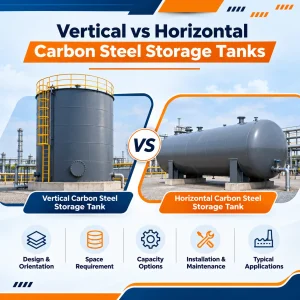
    Both configurations are widely used in industrial projects, but their advantages depend on installation and operating requirements.

    Feature Vertical Carbon Steel Tank Horizontal Carbon Steel Tank
    Orientation Upright Horizontal
    Ground footprint Often smaller for equivalent capacity Usually requires greater length
    Installation height Greater Lower
    Typical support Engineered foundation or supports Saddle supports
    Common applications Bulk liquids, water, process storage Fuel, utilities, intermediate storage
    Inspection access May require elevated access Some connections are closer to ground level
    Customization Available Available
    Design considerations Foundation, roof, wind and seismic loads Saddle design, shell stresses and transport

    Which type should you choose?

    A vertical carbon steel storage tank is often preferred for larger bulk-storage requirements where ground area is limited.

    A horizontal carbon steel storage tank may be more suitable where height restrictions, transportation limitations or site layout favour a lower-profile design.

    Neither type is universally better.

    The final selection should be based on capacity, stored media, site dimensions, foundation conditions, operating pressure and maintenance accessibility.

    Top 10 Carbon Steel Storage Tank Manufacturers in India (2026)

    India has multiple industrial engineering companies offering carbon steel tank fabrication, storage vessels and related equipment.

    The following list features manufacturers with published storage tank or relevant fabrication capabilities. It is an editorial supplier comparison, not an independently audited ranking of manufacturing quality, revenue or market leadership.

    1. National Engineers & Steel Fabricators – Surat, Gujarat

    National Engineers Logo

    National Engineers & Steel Fabricators (NESF) is an industrial fabrication and process equipment manufacturer based in Sachin GIDC, Surat, Gujarat.

    Established in 1990, the company has experience in industrial storage tanks, pressure vessels, heat exchangers, process equipment, piping systems and custom steel fabrication.

    For businesses searching for a carbon steel storage tank manufacturer in India, NESF offers project-specific fabrication solutions based on client drawings, operating conditions, required capacities and material specifications.

    Its storage tank manufacturing capabilities cover vertical and horizontal tank configurations for various industrial storage applications.

    Carbon Steel Storage Tank Manufacturing Capabilities

    • Vertical and horizontal carbon steel storage tanks
    • Industrial water and utility storage tanks
    • Process liquid storage tanks
    • Custom-fabricated industrial tanks
    • Mild steel and carbon steel tank fabrication
    • Internal lining and external coating options
    • Manholes, nozzles, vents and drainage connections
    • Tank supports and project-specific accessories
    • Fabrication according to approved drawings and specifications
    • Inspection and testing according to agreed project requirements

    Why Consider National Engineers & Steel Fabricators?

    NESF combines storage tank manufacturing with wider industrial fabrication capabilities.

    Its experience in pressure vessels, heavy fabrication and process equipment makes it relevant to projects requiring custom dimensions, nozzle arrangements, support designs and coordination with existing plant infrastructure.

    The company supports manufacturing requirements for industries such as chemicals, petrochemicals, oil and gas, fertilizers, water treatment and general industrial processing.

    Location: Sachin GIDC, Surat, Gujarat, India.

    Suitable for: Custom carbon steel storage tanks, industrial liquid storage, utility tanks, process equipment and project-specific fabrication requirements.

    2. Vijay Tanks & Vessels Pvt. Ltd. – Vadodara, Gujarat

    Vijay-Tanks-Logo

    Vijay Tanks & Vessels is an Indian industrial engineering company specializing in storage tank construction and process equipment.

    The company has an established background in engineering, procurement and construction projects for energy and process industries.

    Its operations include atmospheric storage tanks, storage terminals and specialized tank systems.

    Vijay Tanks & Vessels is relevant for buyers evaluating suppliers for large industrial storage infrastructure and complex storage terminal projects.

    Suitable for: Storage terminals, large industrial tanks, oil and gas storage projects and EPC requirements.

    3. Fabri-Tek Engineers – Pune, Maharashtra

    Fabri-Tek Engineers manufactures industrial storage tanks and process equipment for chemical, pharmaceutical, water treatment, oil and gas and other industrial applications.

    The company’s published capabilities include carbon steel, stainless steel and special material fabrication.

    It offers vertical, horizontal, above-ground and underground tank configurations.

    Fabri-Tek also lists engineering coordination, welding, inspection and testing support for custom storage projects.

    Suitable for: Custom fabricated storage tanks, chemical processing equipment and industrial tank applications.

    4. Sparkon EPC India Pvt. Ltd. – Pune, Maharashtra

    Sparkon EPC India is involved in engineering, industrial fabrication and turnkey project execution.

    The company lists chemical storage tanks and silos manufactured using materials including carbon steel, mild steel, stainless steel and alloys.

    Its capabilities include vertical and horizontal industrial storage configurations, together with fabrication and inspection support.

    Sparkon is relevant for companies requiring storage equipment within wider process plant or EPC projects.

    Suitable for: Chemical storage tanks, industrial process equipment and integrated engineering projects.

    5. Akshar Dies & Tools – Vadodara, Gujarat

    Akshar Dies & Tools offers industrial metal fabrication and storage tank manufacturing services.

    Its published storage tank range includes carbon steel and stainless steel tanks.

    The company lists vertical and horizontal configurations, single-wall and double-wall arrangements, nozzles, manways and coating options.

    It also identifies engineering standards and testing methods that may be specified for particular projects.

    Suitable for: Industrial liquid storage, custom metal tanks and fabricated storage equipment.

    6. M Eight Engitech Pvt. Ltd. – Morbi, Gujarat

    Meight

    M Eight Engitech manufactures industrial storage tanks and fabricated equipment for various processing industries.

    Its published product portfolio includes vertical, horizontal, underground and above-ground storage tanks.

    The company identifies carbon steel, stainless steel and other materials among its available construction options.

    M Eight can be considered for projects requiring customized tank arrangements and industrial storage equipment.

    Suitable for: Industrial liquid storage, fuel storage and custom tank configurations.

    7. Tecnicon Engineering Pvt. Ltd. – Ahmedabad, Gujarat

    Tecnicon Engineering designs and manufactures industrial process equipment, including storage tanks, reactors, heat exchangers and pressure vessels.

    Its storage tank range includes carbon steel and stainless steel construction options.

    The company offers vertical, horizontal, jacketed and insulated configurations according to application requirements.

    Tecnicon is relevant for industrial buyers requiring customized storage equipment and integration with process systems.

    Suitable for: Chemical processing, industrial storage tanks and customized process equipment.

    8. BS Energy India – Chennai, Tamil Nadu

    BS Energy India Logo

    BS Energy India manufactures industrial storage tanks, process vessels and fabricated engineering equipment.

    Its published capabilities include heavy carbon steel and stainless steel tank fabrication.

    The company serves industrial applications involving process liquids, utilities, water and other selected storage requirements.

    Its fabrication activities include plate forming, welding and project-specific tank manufacturing.

    Suitable for: Industrial utility storage, carbon steel tank fabrication and process plant equipment.

    9. Chetan Enterprises – Maharashtra

    Chetan Enterprises manufactures and fabricates industrial equipment, storage tanks and process vessels.

    The company provides shop-fabricated and site-fabricated tank solutions.

    Its published scope includes storage tank fabrication for chemical processing, petrochemical and other industrial applications.

    Chetan Enterprises can be considered where on-site tank fabrication or project-specific storage requirements are important.

    Suitable for: Site-fabricated storage tanks, process plants and industrial storage projects.

    10. Shree Samarth Tech (SSTech) – Pune, Maharashtra

    logo

    Shree Samarth Tech supplies engineered industrial storage solutions and process equipment.

    The company lists atmospheric, low-pressure and custom storage tanks in materials including carbon steel and stainless steel.

    Its capabilities include engineering review, fabrication, protective coatings, inspection and testing according to project requirements.

    SSTech is relevant for industrial buyers seeking storage equipment as part of plant engineering projects.

    Suitable for: Custom storage tanks, industrial storage systems and engineered process equipment.

    Comparison of Carbon Steel Tank Manufacturers in India

    The following table helps industrial buyers compare the published capabilities of carbon steel tank manufacturers in India.

    Manufacturer Location Published Storage Capabilities Potential Project Fit
    National Engineers & Steel Fabricators Surat Vertical, horizontal, custom CS tanks Custom industrial fabrication
    Vijay Tanks & Vessels Vadodara Atmospheric tanks, storage terminals Large storage infrastructure
    Fabri-Tek Engineers Pune Vertical, horizontal, chemical tanks Custom process storage
    Sparkon EPC India Pune CS tanks, silos, process equipment Industrial and EPC projects
    Akshar Dies & Tools Vadodara CS and SS liquid storage tanks Fabricated industrial tanks
    M Eight Engitech Morbi Vertical, horizontal, above-ground tanks Customized storage
    Tecnicon Engineering Ahmedabad CS, SS, jacketed and insulated tanks Process industry tanks
    BS Energy India Chennai CS and SS storage vessels Industrial utility and process tanks
    Chetan Enterprises Maharashtra Shop and site-fabricated tanks Site-specific tank projects
    Shree Samarth Tech Pune Atmospheric and low-pressure tanks Engineered storage solutions

    Note: Actual materials, available fabrication dimensions, design-code capability, inspection scope and delivery commitments should be confirmed directly with each manufacturer before procurement.

    Industrial Applications of Carbon Steel Storage Tanks

    Industrial carbon steel storage tanks are used in multiple sectors, provided their materials and protective systems are compatible with the stored substance.

    Oil and Gas Industry

    Carbon steel tanks are commonly used in suitable petroleum and hydrocarbon storage applications.

    Tank design must consider the stored product, vapour characteristics, operating temperature, fire protection, venting and relevant regulatory requirements.

    Chemical Processing Industry

    Chemical plants use fabricated storage tanks for process liquids, intermediates and industrial chemicals.

    Unlined carbon steel is not suitable for every chemical.

    For corrosive applications, engineers must evaluate chemical compatibility and determine whether a lining, coating or alternative material is necessary.

    Water Treatment Plants

    Carbon steel tanks can be used for industrial water storage, utility water and selected treatment applications.

    Internal coatings or linings may be required to control corrosion and protect water quality.

    Power Generation

    Industrial power facilities use storage tanks for utility systems, water management and certain fuel-handling applications.

    Material and coating requirements depend on the specific stored liquid and operating conditions.

    Manufacturing Industries

    General manufacturing plants use storage tanks for process liquids, utility fluids, intermediate storage and plant support systems.

    Custom fabrication can accommodate available floor space, equipment arrangements and piping connections.

    Carbon Steel vs Stainless Steel Storage Tanks
    carbon steel storage tank manufacturer in Gujarat

    Material selection is one of the most important decisions when purchasing industrial storage tanks.

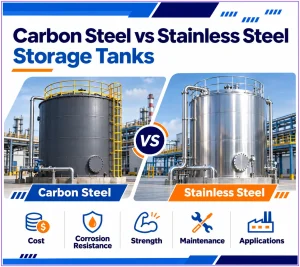
    Carbon steel and stainless steel provide different advantages, especially in corrosion resistance, initial material cost and maintenance requirements.

    Parameter Carbon Steel Stainless Steel
    Initial material cost Generally lower Generally higher
    Structural strength Suitable when correctly engineered Suitable when correctly engineered
    Corrosion resistance Often requires protection Grade-dependent corrosion resistance
    Maintenance May require periodic recoating Depends on grade and service
    Industrial water storage Suitable with appropriate protection Suitable with compatible grade
    Chemical storage Requires compatibility assessment Requires grade-specific compatibility assessment
    Fabrication Widely established Widely established
    Common applications Utility, oil and industrial storage Hygienic and selected corrosive services

    Which Material Is Better?

    Carbon steel is often preferred when the stored liquid is compatible with the material and the lower initial material cost justifies any coating or maintenance requirements.

    Stainless steel may be more suitable when corrosion resistance, cleaning requirements or product purity are important.

    However, stainless steel is not automatically resistant to every chemical.

    The correct choice depends on chemical concentration, temperature, chloride content, corrosion conditions, service life and lifecycle cost.

    Is Mild Steel the Same as Carbon Steel?

    Mild steel is generally a low-carbon category of carbon steel.

    In industrial procurement, the terms mild steel and carbon steel may sometimes be used interchangeably, but they should not replace an exact material specification.

    Buyers should always request the required grade, material standard and material test certificates rather than relying only on the terms MS or CS.

    How Are Carbon Steel Storage Tanks Manufactured?

    Carbon steel storage tank manufacturing involves multiple engineering, fabrication and inspection stages.

    The exact manufacturing sequence depends on tank type, design code and project requirements.

    Step 1: Technical Requirement Review

    The manufacturer reviews the stored medium, required storage capacity, operating conditions, material specifications, installation location and customer drawings.

    This information helps establish the appropriate tank configuration and fabrication scope.

    Step 2: Engineering and Design

    Engineers evaluate the tank geometry, shell thickness, bottom and roof design, structural supports, nozzles and applicable operating loads.

    For relevant applications, wind, seismic, foundation and thermal conditions must also be considered.

    Step 3: Material Procurement

    Approved carbon steel plates and fabricated components are sourced according to the required material specifications.

    Material test certificates and traceability records should be checked against the project requirements.

    Step 4: Cutting and Plate Forming

    Steel plates are cut and formed into the required shell sections, roof components, bottom plates or other parts.

    Plate rolling is commonly used for cylindrical tank construction.

    Step 5: Welding and Assembly

    Fabricated components are assembled using suitable welding procedures and qualified personnel.

    Welding requirements depend on material thickness, joint configuration, applicable standards and project inspection specifications.

    Step 6: Inspection and Quality Control

    Depending on the design code and inspection plan, quality checks may include:

    • Material identification and traceability
    • Visual welding inspection
    • Dimensional inspection
    • Ultrasonic testing
    • Radiographic testing
    • Magnetic particle or liquid penetrant testing
    • Vacuum box testing for relevant weld joints
    • Hydrostatic or leak testing

    Not every inspection method is required for every tank. The inspection scope must follow the applicable code and agreed inspection and test plan.

    Step 7: Surface Preparation and Coating

    After fabrication and required inspection, the tank may undergo surface preparation and application of suitable coating or lining systems.

    Coating selection depends on the stored medium, environmental exposure and maintenance requirements.

    Step 8: Final Documentation and Dispatch

    Final checks may include dimensions, nozzles, accessories, coating inspection and completion of required test reports.

    The manufacturer prepares the tank for transportation, site installation or further assembly according to the agreed supply scope.

    What Standards Apply to Carbon Steel Storage Tank Manufacturing?
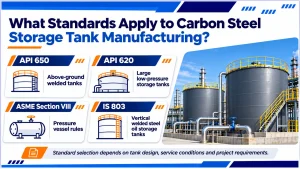
    Industrial Carbon Steel Storage Tanks

    Industrial tanks must be designed and manufactured according to the standards applicable to their construction type, pressure, temperature, stored substance and location.

    API 650 – Welded Tanks for Oil Storage

    API 650 is used for specified types of welded, vertical, cylindrical, above-ground storage tanks operating at approximately atmospheric pressure.

    It covers engineering requirements for materials, design, fabrication, erection and inspection.

    For detailed information, refer to the American Petroleum Institute’s API 650 standard information.

    API 620 – Large Welded Low-Pressure Storage Tanks

    API 620 is relevant to certain large welded low-pressure storage tank applications.

    Its applicability depends on the specified pressure, temperature, construction type and code scope.

    ASME Section VIII – Pressure Vessels

    When a storage vessel operates under pressure conditions within the applicable pressure-vessel code scope, ASME Section VIII may be relevant.

    Atmospheric storage tanks and pressure vessels should not automatically be treated as interchangeable equipment.

    For more details, review the ASME Section VIII Division 1 requirements.

    Indian Standards and Regulatory Requirements

    IS 803 and other relevant Indian standards may be considered where appropriate to the tank design and project specification.

    Certain petroleum, flammable liquid or pressurized storage applications may also fall under applicable PESO requirements and other statutory approvals.

    Important: A manufacturer should not be assumed to hold a particular certification merely because it works with equipment covered by that standard.

    Buyers should verify certifications, approvals, design calculations and inspection documents for the specific project.

    Important Technical Specifications of Carbon Steel Storage Tanks

    Before ordering a tank, industrial buyers should confirm the essential technical parameters.

    Specification What Buyers Should Confirm
    Tank capacity Gross and required working capacity
    Material Exact carbon steel grade and standard
    Storage medium Liquid name, composition and concentration
    Specific gravity Maximum operating liquid density
    Tank orientation Vertical or horizontal
    Design pressure Internal and external pressure or vacuum
    Design temperature Minimum and maximum design temperature
    Shell thickness Approved engineering design
    Corrosion allowance As specified by design requirements
    Nozzle arrangement Size, rating, orientation and quantity
    Coating or lining Compatible protective system
    Supports Foundation or engineered saddle supports
    Testing Applicable code and inspection requirements
    Documentation Drawings, MTCs and required reports

    A well-prepared tank specification reduces misunderstandings during procurement and helps manufacturers provide more accurate quotations.

    How to Calculate Carbon Steel Storage Tank Capacity

    The required storage tank capacity depends on process consumption, supply frequency, operating reserve and available installation space.

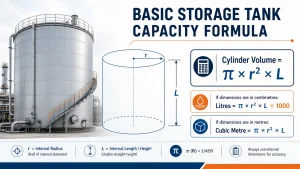
    For a simple vertical cylindrical tank, the geometric volume can be calculated using:

    Volume (m³) = π × D² × H ÷ 4

    Where:

    • D = Internal tank diameter in metres
    • H = Liquid height in metres
    • π ≈ 3.1416

    Example Calculation

    Consider a vertical cylindrical tank with:

    Internal diameter: 3 metres

    Liquid height: 4 metres

    Volume = 3.1416 × 3² × 4 ÷ 4

    Calculated volume ≈ 28.27 m³, or 28,270 litres.

    This is the geometric volume up to the specified liquid height.

    The actual usable storage capacity may be lower because of freeboard, operational level limits, internal components and other design requirements.

    For horizontal cylindrical tanks, liquid volume at a particular level requires a different geometric calculation.

    Final sizing should be reviewed by the responsible engineer.

    How Much Do Carbon Steel Storage Tanks Cost in India?

    The price of a carbon steel storage tank depends on design, fabrication scope, material quantity and project requirements.

    There is no single fixed price that accurately represents every industrial carbon steel tank.

    Factors Affecting Carbon Steel Storage Tank Prices

    1. Storage capacity: Larger or more complex tanks generally require additional material, fabrication and installation work.

    2. Steel grade and thickness: Material specifications, plate thickness and project-specific requirements affect material cost.

    3. Tank configuration: Vertical, horizontal, underground and special tank designs have different fabrication requirements.

    4. Coating and lining: Protective systems can add initial cost but may reduce corrosion-related maintenance.

    5. Design standards: Code requirements, documentation and inspection scope affect engineering and manufacturing costs.

    6. Accessories: Manholes, nozzles, platforms, ladders, vents, level instruments and other components affect the quotation.

    7. Transportation and installation: Large tank dimensions, delivery distance, site access and erection requirements may add costs.

    How Can You Get an Accurate Tank Price?

    Send the manufacturer a detailed requirement covering tank capacity, storage medium, material, design conditions, drawings and inspection requirements.

    A technical quotation is more reliable than a generic price per litre because two tanks of identical capacity can have very different engineering and fabrication costs.

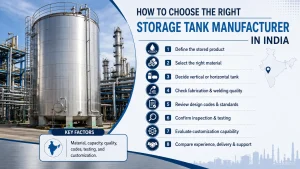
    How to Choose the Right Carbon Steel Storage Tank Manufacturer in India
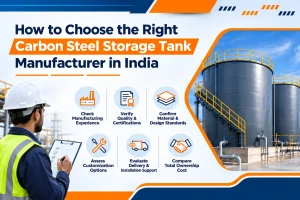
    Carbon Steel Storage Tank Manufacturer

    Choosing the right supplier involves more than comparing the initial quoted price.

    A dependable carbon steel storage tank manufacturer should be able to explain its fabrication scope, inspection process, documentation and ability to meet project requirements.

    Evaluate Manufacturing Experience

    Review the supplier’s experience with industrial storage tanks and similar fabrication projects.

    Relevant project references can help determine whether the manufacturer has handled comparable capacities and operating conditions.

    Verify Material Compatibility

    Confirm that the proposed material and corrosion protection system are suitable for the stored substance.

    The manufacturer should work with the customer’s process and engineering specifications rather than selecting materials using storage capacity alone.

    Review Engineering Capabilities

    Check whether the supplier can work from approved drawings, technical datasheets, nozzle schedules and project-specific design requirements.

    Check Quality Assurance Procedures

    Ask about material traceability, welding procedures, inspection plans and testing documentation.

    Confirm Customization Options

    Industrial projects frequently require custom dimensions, supports, nozzles and access arrangements.

    Ensure the manufacturer can accommodate those requirements before ordering.

    Evaluate Delivery and Installation Scope

    Confirm whether the quotation includes fabrication only, transportation, site erection, coating, testing or additional commissioning support.

    Compare Total Ownership Cost

    A lower initial price may not be the best long-term choice if the tank requires frequent coating repairs, difficult maintenance or early replacement.

    What Information Should You Send to a Carbon Steel Storage Tank Manufacturer for a Quote?

    Providing complete technical requirements can help suppliers prepare accurate and comparable quotations.

    Required Information Example or Explanation
    Tank type Vertical / horizontal / custom
    Required capacity 10 KL, 20 KL or project-specific
    Stored medium Industrial water, oil or identified chemical
    Material Specified carbon steel grade
    Design temperature Required operating and design range
    Design pressure Atmospheric or specified pressure/vacuum
    Liquid density Maximum specific gravity
    Coating requirement Internal and external protection
    Nozzle details Inlet, outlet, vent, drain and instruments
    Installation details Indoor, outdoor, underground or elevated
    Applicable standard As determined by engineering specification
    Inspection requirement NDT, hydro test, third-party inspection
    Delivery location Plant address and unloading constraints
    Drawings GA drawing, datasheet or P&ID, if available

    Buyers can also explore horizontal storage tank manufacturing solutions when preparing project-specific requirements.

    How to Prevent Corrosion in Carbon Steel Storage Tanks

    Corrosion control is essential for many carbon steel storage applications.

    Without suitable protection, exposure to moisture, oxygen, aggressive chemicals or the surrounding environment may reduce tank service life.

    Internal Protective Coatings

    Internal coatings can help protect the steel surface when the coating is compatible with the stored liquid.

    Surface preparation, application quality and coating inspection are important to coating performance.

    External Protective Painting

    External painting systems can protect tanks exposed to weather, humidity and industrial environments.

    The coating system should be selected according to the expected exposure conditions.

    Suitable Corrosion Allowance

    Where required by design, an appropriate corrosion allowance may be considered based on the expected service environment and engineering assessment.

    Regular Inspection

    Periodic tank inspection helps identify coating damage, corrosion, leaks and other developing defects.

    Inspection frequency should follow applicable codes, regulations, service conditions and the owner’s inspection programme.

    Proper Drainage and Maintenance

    Avoiding unnecessary standing water, maintaining drains and repairing coating defects can help reduce certain corrosion risks.

    For buried tanks, suitable external corrosion protection and monitoring arrangements may also be required.

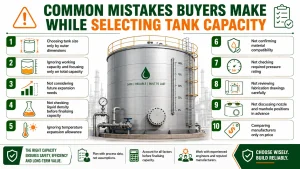
    Common Mistakes to Avoid When Buying Carbon Steel Storage Tanks

    Industrial buyers should avoid several common procurement mistakes.

    Selecting tanks based only on price: A lower purchase price does not guarantee lower lifetime cost.

    Ignoring stored-liquid compatibility: Incorrect material or lining selection can lead to premature deterioration.

    Ordering without approved drawings: Missing nozzle, support or dimensional information can create installation problems.

    Overlooking venting requirements: Atmospheric and low-pressure tanks require suitable venting and protection based on the operating scenario and applicable design requirements.

    Ignoring inspection documentation: Missing material or test records may complicate project acceptance and future maintenance.

    Assuming every tank follows the same code: The correct engineering code depends on the tank’s actual design and operating conditions.

    A properly specified tank helps reduce procurement uncertainty and supports safe industrial operation.

    Why Consider National Engineers & Steel Fabricators for Carbon Steel Storage Tanks?

    Industrial buyers looking for custom storage equipment can consider National Engineers & Steel Fabricators for its engineering fabrication capabilities and experience with industrial process equipment.

    The company operates from Surat, Gujarat, and manufactures storage tanks and other fabricated equipment for project-specific requirements.

    NESF’s industrial manufacturing portfolio includes storage tanks, pressure vessels, heat exchangers, process equipment, piping systems and heavy steel fabrication.

    Its carbon steel tank fabrication offering can accommodate customer specifications involving tank orientation, construction material, nozzles, supports, coatings and required inspection scope.

    For projects requiring customized equipment rather than a fixed standard tank, technical coordination between the buyer and manufacturer is particularly important.

    National Engineers & Steel Fabricators can review project requirements against its available manufacturing scope and provide a quotation based on the submitted specifications.

    For more information about industrial fabrication capabilities and storage equipment, visit National Engineers & Steel Fabricators.

    Conclusion

    Carbon steel storage tanks remain an important part of industrial infrastructure because they offer structural strength, design flexibility and competitive material costs for suitable storage applications.

    However, selecting the right tank requires careful evaluation of material compatibility, capacity, operating conditions, fabrication quality, corrosion protection and engineering standards.

    When comparing carbon steel storage tank manufacturers in India, industrial buyers should prioritize technical suitability, documented manufacturing capabilities, inspection requirements and long-term operating performance.

    For businesses requiring custom-fabricated industrial tanks, National Engineers & Steel Fabricators offers vertical, horizontal and project-specific storage tank manufacturing solutions from Surat, Gujarat.

    Request a Carbon Steel Storage Tank Quotation

    Planning to purchase a vertical, horizontal or custom carbon steel storage tank for your industrial project?

    Share your tank capacity, stored liquid, design conditions, material requirements, drawings and delivery details with National Engineers & Steel Fabricators.

    Company: National Engineers & Steel Fabricators

    Location: Plot No. 1022, Cross Road No. 87, Sachin GIDC, Surat – 394230, Gujarat, India

    Phone: +91 95740 11132

    Email: admin@nationalengrs.com

    Website: https://nationalengrs.com/

    Contact the team to discuss your requirements and request a project-specific industrial storage tank quotation.

    Frequently Asked Questions About Carbon Steel Storage Tanks

    A carbon steel storage tank is an engineered container fabricated from suitable carbon steel materials for storing liquids or other specified industrial media. It may be designed as a vertical, horizontal or custom tank depending on the application.

    Carbon steel storage tanks are used in industrial water systems, oil and fuel storage, utility systems, process plants and selected chemical applications. Their suitability depends on material compatibility and operating conditions.

    Carbon steel may be more economical for compatible industrial storage applications, while stainless steel can offer better corrosion resistance in certain services. The right choice depends on the stored medium, temperature, required hygiene, corrosion conditions and total lifecycle cost.

    Yes, carbon steel tanks can store certain chemicals when the material, coating or lining is suitable for the specific chemical concentration and temperature. They should not be used for incompatible chemicals without appropriate engineering evaluation.

    Mild steel is generally a low-carbon type of carbon steel. In tank procurement, the required material grade and manufacturing standard should be clearly specified rather than relying only on the terms MS or CS.

    The price depends on capacity, material grade, plate thickness, tank design, coating, accessories, testing and delivery scope. Manufacturers generally require technical specifications to provide accurate project quotations.

    API 650, API 620, relevant Indian standards and ASME Section VIII may apply to different tank or vessel designs. The correct standard depends on operating pressure, temperature, tank configuration and project requirements.

    Yes. Many industrial carbon steel tank manufacturers offer customization involving tank dimensions, capacity, orientation, supports, nozzle arrangements, coatings, linings and inspection requirements.

    Yes, appropriately designed carbon steel tanks can be installed outdoors. Environmental loads, foundations, external corrosion protection, access and applicable safety requirements must be considered.

    Service life depends on design, material selection, corrosion conditions, coating performance, maintenance and inspection. No single service-life figure applies to every carbon steel storage tank.

    Gujarat has industrial tank fabrication companies in locations such as Surat, Vadodara, Ahmedabad and Morbi. National Engineers & Steel Fabricators is based in Sachin GIDC, Surat, and offers custom industrial storage tank fabrication capabilities.
  • Stainless Steel Storage Tank Manufacturers in India: Top 10 Companies, Types, Grades & Buying Guide (2026)

    Stainless Steel Storage Tank Manufacturers in India: Top 10 Companies, Types, Grades & Buying Guide (2026)

    Stainless steel storage tanks are widely used in chemical processing, pharmaceuticals, food production, water treatment, dairy, and other industrial applications. These tanks provide corrosion resistance, durability, and hygienic storage when the correct material grade and design are selected.

    Choosing reliable ss storage tank manufacturers in India is important for businesses that require safe liquid storage, custom tank capacities, and dependable industrial equipment.

    Manufacturers offer different configurations, including vertical tanks, horizontal tanks, insulated vessels, jacketed tanks, and custom-designed storage systems. Materials such as SS 304, SS 316, and SS 316L are commonly considered according to operating conditions.

    This guide covers 10 stainless steel tank manufacturers in India, important technical specifications, material comparisons, manufacturing processes, pricing factors, and practical tips for selecting a suitable supplier.

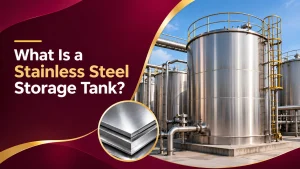
    What Is a Stainless Steel Storage Tank?

    SS Storage Tank Manufacturers in India

    A stainless steel storage tank is an industrial vessel designed to store liquids, chemicals, water, food ingredients, or process materials under specified operating conditions.

    These tanks are manufactured using stainless steel plates, sheets, fittings, and fabricated components. Their design depends on storage capacity, liquid properties, operating temperature, pressure, and installation requirements.

    Unlike ordinary carbon steel tanks, stainless steel tanks contain chromium, which helps form a protective passive layer on the metal surface. This improves resistance to many forms of corrosion.

    However, stainless steel is not completely corrosion-proof. Its suitability depends on the chemical being stored, concentration, temperature, chloride content, and cleaning conditions.

    Industrial stainless steel storage tanks are commonly selected for applications where corrosion resistance, product cleanliness, and long-term reliability are important.

    Types of SS Storage Tanks Used in Industrial Plants

    Different industrial processes require different storage tank designs. Experienced SS storage tank manufacturers in India may offer several configurations depending on project requirements.

    1. Vertical Stainless Steel Storage Tanks

    Vertical stainless steel storage tanks have a cylindrical body positioned upright. They are commonly used where floor space is limited or large storage capacities are required.

    These tanks can be designed with flat, conical, or dished bottoms depending on drainage, structural support, and process requirements.

    Typical applications include industrial water storage, chemical solutions, food ingredients, and process liquids.

    2. Horizontal Stainless Steel Storage Tanks

    Horizontal stainless steel storage tanks have a cylindrical body installed horizontally, usually on engineered saddle supports.

    They are suitable for installations with height restrictions, certain transportation requirements, and specific process layouts.

    Horizontal tanks require careful consideration of support loads, liquid levels, drainage, and maintenance access.

    3. Stainless Steel Chemical Storage Tanks

    Stainless steel chemical storage tanks are designed for compatible industrial chemicals, solutions, and process liquids.

    Material selection is particularly important because some chemicals can attack stainless steel even when a higher grade is used.

    For example, SS 316 generally provides better resistance to chloride-related pitting than SS 304, but it is not suitable for every acid or chemical concentration.

    4. Stainless Steel Water Storage Tanks

    Stainless steel water storage tanks are used for potable water, process water, treated water, and other industrial water applications.

    SS 304 may be suitable for many general water storage conditions, while SS 316 or other materials may be considered where water chemistry creates additional corrosion risks.

    5. Jacketed and Insulated Stainless Steel Tanks

    Jacketed tanks allow heating or cooling media to circulate around the vessel to help control product temperature.

    Insulated tanks reduce heat transfer between the stored product and the surrounding environment.

    These configurations are useful in food processing, pharmaceuticals, chemical manufacturing, and temperature-sensitive applications.

    6. Custom SS Storage Tanks

    Custom stainless steel storage tanks are manufactured according to specific process requirements, engineering drawings, and site conditions.

    Customisation may include tank dimensions, material grades, nozzles, manholes, agitators, insulation, instrumentation, supports, and surface finishes.

    The final configuration should be approved through an appropriate engineering design and quality assurance process.

    Top 10 Stainless Steel Storage Tank Manufacturers in India (2026)

    Stainless Steel Tank Manufacturers in India

    India has numerous industrial fabrication companies supplying stainless steel tanks for chemical, pharmaceutical, food processing, water treatment, and manufacturing applications.

    The following list highlights 10 companies relevant to different stainless steel tank requirements.

    Editorial note: This is a manufacturer comparison shortlist, not an independently audited ranking of product quality, revenue, or market share. National Engineers & Steel Fabricators is presented first as the featured company.

    1. National Engineers & Steel Fabricators (NESF) – Surat, Gujarat

    National Engineers & Steel Fabricators (NESF) is an industrial engineering and steel fabrication company based in Surat, Gujarat, India.

    The company focuses on industrial fabrication and equipment-related requirements, including storage tank applications and custom fabrication work.

    For businesses searching for stainless steel storage tank manufacturers in India, NESF is a company to consider when discussing project-specific fabrication requirements.

    Industrial buyers can approach NESF with technical drawings, material requirements, tank dimensions, nozzle arrangements, and other project specifications to discuss manufacturing feasibility.

    Relevant capabilities to discuss:

    • Custom industrial storage tank fabrication

    • Stainless steel and other metal fabrication requirements

    • Vertical and horizontal storage tank projects

    • Fabrication based on client drawings and specifications

    • Industrial equipment and structural fabrication support

    The availability of specific stainless steel grades, design codes, inspection procedures, and certification requirements should be confirmed directly with the company before ordering.

    Location: Surat, Gujarat, India

    Website: https://nationalengrs.com/

    Suitable for: Industrial buyers looking to discuss custom-fabricated equipment and storage tank requirements.

    2. Umasons Steelfab Pvt. Ltd. – Maharashtra

    Umasons Steelfab Pvt. Ltd. manufactures stainless steel products and process equipment for pharmaceutical, chemical, food processing, and related industries.

    Its storage tank offerings include SS 304 and SS 316 vessels, jacketed tanks, insulated tanks, and custom storage configurations.

    The company also describes fabrication capabilities for horizontal and vertical vessels, including tanks with pressure or vacuum requirements.

    Umasons is relevant for buyers who require stainless steel storage and processing equipment with application-specific configurations.

    Suitable for: Pharmaceutical processing, industrial liquids, and customised storage vessels.

    3. Reta Engineering Works – Bhiwadi, Rajasthan

    Reta Engineering Works manufactures industrial storage tanks, reactors, pressure vessels, and other process equipment.

    Its stainless steel tank range includes SS 304, SS 316, and SS 316L options for chemical, pharmaceutical, food processing, and water treatment applications.

    The company offers vertical, horizontal, and custom storage tank configurations with different capacities and surface finishes.

    Reta Engineering Works is relevant to buyers requiring engineered industrial tanks in North India.

    Suitable for: Chemical processing, water treatment, and custom industrial storage.

    4. Beltecno India Pvt. Ltd. – Neemrana, Rajasthan

    Beltecno India manufactures stainless steel water storage solutions using SS 304 and SS 316L materials.

    Its product portfolio includes modular panel tanks, cylindrical storage tanks, and thermal energy storage tanks.

    The company serves commercial, industrial, pharmaceutical, infrastructure, and water storage applications.

    Beltecno is particularly relevant for buyers comparing hygienic water storage and modular stainless steel tank systems.

    Suitable for: Water storage, commercial infrastructure, and process water applications.

    5. Shree Bhagwati Machtech (India) Pvt. Ltd. – Ahmedabad, Gujarat

    Shree Bhagwati Machtech manufactures stainless steel storage vessels and process equipment for pharmaceutical, chemical, food, beverage, and related industries.

    Its product range includes bulk storage vessels, jacketed tanks, insulated tanks, mixing vessels, and horizontal storage configurations.

    The company also offers accessories such as heating and cooling jackets, mixers, and clean-in-place arrangements.

    It is relevant for industrial buyers seeking stainless steel storage tanks integrated with liquid processing equipment.

    Suitable for: Pharmaceutical processing, food production, and industrial liquid storage.

    6. Tecnicon Engineering Pvt. Ltd. – Ahmedabad, Gujarat

    Tecnicon Engineering manufactures industrial storage tanks and process equipment for chemical, pharmaceutical, food processing, and other industrial applications.

    Its storage tank portfolio includes SS 304, SS 316, SS 316L, carbon steel, and other material options.

    The company describes vertical, horizontal, jacketed, and insulated storage tank configurations, with custom engineering available for different operating conditions.

    Tecnicon is relevant for buyers comparing stainless steel tank fabrication services and process equipment manufacturing in Gujarat.

    Suitable for: Custom industrial tanks, chemical processing, and engineered storage vessels.

    7. Saini Aquatech – India

    Saini Aquatech manufactures stainless steel water storage tanks under its SAINTRO brand.

    Its product range includes vertical tanks manufactured using SS 304, SS 316, and Duplex 2205 materials, depending on the selected product and application.

    The company offers capacities from 250 litres to 5,000 litres and focuses on residential, commercial, institutional, and industrial water storage.

    Saini Aquatech is relevant for buyers looking for relatively compact stainless steel water storage systems.

    Suitable for: Industrial water storage, commercial buildings, and water treatment applications.

    8. SS Fab Tech – Bengaluru, Karnataka

    SS Fab Tech is a Bengaluru-based manufacturer offering stainless steel tanks and food processing equipment.

    Its publicly listed product range includes stainless steel tanks, mixing equipment, steam-jacketed kettles, and related fabrication products.

    The company may be worth evaluating for smaller stainless steel tank and processing equipment requirements. Buyers should confirm available capacities, material grades, and design specifications directly.

    Suitable for: Stainless steel tanks and food processing equipment requirements.

    9. Rudraksh Steel Pvt. Ltd. – Vadodara, Gujarat

    Rudraksh Steel Pvt. Ltd. is another company included in industrial storage tank manufacturer comparisons.

    Its relevant product categories include stainless steel, mild steel, and chemical storage tank applications.

    For projects involving industrial stainless steel storage tanks, buyers should request current product specifications, fabrication details, and material certificates before shortlisting the company.

    Suitable for: Industrial storage tank procurement, subject to confirmation of current stainless steel manufacturing capabilities.

    10. Fabri-Tek Engineers – Pune, Maharashtra

    Fabri-Tek Engineers is associated with custom industrial tank and fabrication requirements.

    The company can be considered during supplier discovery for engineered storage tank projects, particularly where custom dimensions and industrial fabrication requirements are involved.

    Before procurement, buyers should verify its current stainless steel tank range, manufacturing facilities, inspection capabilities, and project experience.

    Suitable for: Custom industrial tank enquiries, subject to technical and commercial verification.

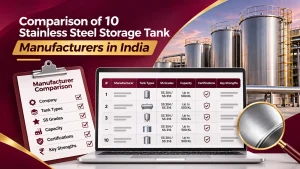
    Comparison of 10 Stainless Steel Storage Tank Manufacturers in India

    Industrial Stainless Steel Storage Tanks

    No. Manufacturer Location / Region Relevant focus
    1 National Engineers & Steel Fabricators Surat, Gujarat Custom industrial fabrication
    2 Umasons Steelfab Maharashtra SS 304/316 process tanks
    3 Reta Engineering Works Bhiwadi, Rajasthan SS chemical and industrial tanks
    4 Beltecno India Neemrana, Rajasthan Stainless steel water tanks
    5 Shree Bhagwati Machtech Ahmedabad, Gujarat SS storage and process vessels
    6 Tecnicon Engineering Ahmedabad, Gujarat Custom SS industrial tanks
    7 Saini Aquatech India Vertical SS water tanks
    8 SS Fab Tech Bengaluru, Karnataka SS tanks and mixing equipment
    9 Rudraksh Steel Vadodara, Gujarat Industrial tank fabrication*
    10 Fabri-Tek Engineers Pune, Maharashtra Custom industrial tanks*

    Current stainless steel product availability for Rudraksh Steel and Fabri-Tek Engineers requires additional confirmation. The table is for supplier discovery, not a verified performance ranking.

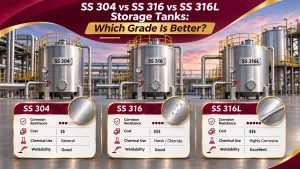
    SS 304 vs SS 316 vs SS 316L Storage Tanks: Which Grade Is Better?

    Stainless Steel Tank Fabrication

    Choosing the correct stainless steel grade is one of the most important decisions when purchasing an industrial storage tank.

    Different materials offer different levels of corrosion resistance, fabrication characteristics, and cost.

    Parameter SS 304 SS 316 SS 316L
    Main alloy characteristics Chromium-nickel Chromium-nickel-molybdenum Low-carbon chromium-nickel-molybdenum
    Corrosion resistance Good in many mild environments Improved resistance to chloride pitting Similar general resistance to SS 316
    Weld-related sensitisation resistance Standard Standard Improved due to low carbon
    Common applications Water, food and mild process liquids Selected chemicals and chloride-containing environments Welded pharmaceutical and process vessels
    Relative material cost Generally lower Generally higher Generally similar to or higher than 316
    Selection priority General-purpose applications Greater corrosion resistance Welded construction and corrosion requirements

    When Should You Choose SS 304?

    SS 304 is commonly used for general industrial water storage, food processing, and compatible mild chemical applications.

    It is often a cost-effective stainless steel option when the stored liquid and environmental conditions do not require higher alloy grades.

    Buyers looking for SS 304 storage tank manufacturers should check the material test certificate, welding quality, and internal surface finish.

    When Should You Choose SS 316?

    SS 316 contains molybdenum, which improves resistance to pitting and crevice corrosion in many chloride-containing environments.

    It is frequently considered for pharmaceutical, chemical, and specialised process applications.

    However, SS 316 should not automatically be selected for every corrosive chemical. Material compatibility must be evaluated for the actual service conditions.

    Buyers comparing SS 316 storage tank manufacturers should provide the chemical composition, concentration, temperature, and cleaning requirements.

    When Should You Choose SS 316L?

    SS 316L is a low-carbon version of SS 316.

    Its reduced carbon content helps minimise sensitisation during welding, making it useful for welded storage tanks and process equipment where corrosion performance is important.

    SS 316L is commonly considered for pharmaceutical equipment, hygienic processing, and specialised industrial storage.

    Material selection tip: Always obtain engineering approval before finalising the grade. In certain environments, duplex stainless steel, higher alloys, or non-metallic materials may be more suitable.

    Vertical vs Horizontal Stainless Steel Storage Tanks

    The orientation of a tank affects installation space, structural design, drainage, and maintenance.

    Feature Vertical Tank Horizontal Tank
    Installation Upright Horizontal
    Floor space Generally smaller footprint Generally larger footprint
    Height requirement Higher Lower
    Typical supports Base, skirt, legs or foundation Saddles or engineered supports
    Drainage Depends on bottom design Depends on slope and nozzle location
    Maintenance Requires suitable vertical access Requires suitable side and top access
    Common use Bulk and process storage Height-restricted and process installations

    Vertical tanks are often preferred where available floor space is limited.

    Horizontal tanks may be more suitable where building height, transportation, or process layout creates restrictions.

    Neither configuration is universally better. The correct selection depends on tank capacity, site layout, foundation design, operating conditions, and project requirements.

    For a more detailed comparison, read our guide on Horizontal Storage Tank Manufacturers in India.

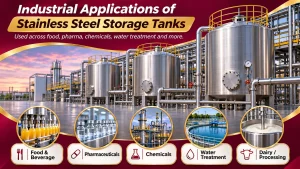
    Industrial Applications of Stainless Steel Storage Tanks

    stainless steel storage tank manufacturers in India

    Stainless steel tank manufacturers in India supply storage solutions for a wide range of industrial sectors.

    Chemical Processing Industry

    Stainless steel tanks are used for storing compatible chemical solutions, intermediates, and process liquids.

    The correct material must be selected according to chemical concentration, operating temperature, and corrosion behaviour.

    Pharmaceutical Industry

    Pharmaceutical facilities use stainless steel storage vessels for purified water, process liquids, intermediates, and other applications.

    Hygienic design may require controlled surface roughness, sanitary fittings, appropriate drainage, and documented cleaning procedures.

    Food and Beverage Industry

    Stainless steel tanks are used for edible liquids, beverage ingredients, syrups, dairy products, and other food processing applications.

    Smooth internal surfaces and hygienic welding can help support cleaning and contamination control.

    Water Treatment Industry

    Stainless steel water storage tanks are used for treated water, process water, and selected purification applications.

    Water chemistry should be evaluated before choosing between SS 304, SS 316, and other materials.

    Dairy Industry

    Dairy processing facilities use stainless steel tanks for milk storage, processing, and temperature-controlled operations.

    Insulated or jacketed configurations may be required depending on the product and process.

    Cosmetics and Personal Care Industry

    Stainless steel tanks are used for storing compatible liquid ingredients, formulations, and intermediate products.

    Surface finish, cleaning access, and product compatibility are important selection factors.

    How Are Stainless Steel Storage Tanks Manufactured?

    Professional stainless steel tank fabrication involves multiple engineering and manufacturing stages.

    Step 1: Engineering Design

    The manufacturer reviews tank capacity, operating pressure, temperature, stored material, dimensions, and installation requirements.

    Engineering calculations and drawings are prepared according to the applicable design standard.

    Step 2: Material Selection

    Suitable stainless steel grades are selected based on corrosion resistance, mechanical properties, and process conditions.

    Material certificates should be reviewed to confirm compliance with the required specification.

    Step 3: Cutting and Forming

    Stainless steel plates are cut and formed into shell sections, heads, bottoms, and other components.

    Dimensional accuracy is important for proper assembly and welding.

    Step 4: Welding and Assembly

    Tank components are assembled using qualified welding procedures where required.

    Processes such as TIG or MIG welding may be used depending on material thickness, joint design, and project specifications.

    Step 5: Surface Finishing

    The internal and external surfaces are finished according to application requirements.

    Finishing may include grinding, polishing, pickling, passivation, or electropolishing.

    Step 6: Inspection and Testing

    The completed tank undergoes applicable dimensional checks, weld inspections, and leak or pressure testing.

    The exact inspection plan depends on the tank design, service conditions, and applicable standards.

    Step 7: Final Documentation and Dispatch

    After acceptance, the manufacturer prepares the required quality documents and dispatches the tank according to the agreed delivery scope.

    Quality Standards and Testing for Stainless Steel Storage Tanks

    Quality assurance is essential when selecting SS storage tank manufacturers in India.

    Depending on the application, relevant engineering standards may include:

    • API 650: Welded tanks for oil storage and other applications within its scope.

    • ASME Section VIII: Pressure vessels designed within the applicable code scope.

    • IS 803: Design, fabrication, and erection requirements for specified vertical mild steel cylindrical welded storage tanks; it is not a general stainless steel tank design code.

    • ASTM A240/A240M: Stainless steel plate, sheet, and strip material specifications.

    Stainless steel plates used in industrial tank fabrication may be specified according to the ASTM A240/A240M Standard, while pressure-rated vessels may require compliance with the applicable ASME Boiler and Pressure Vessel Code.

    The applicable code must be selected based on the actual tank design and service. Atmospheric storage tanks and pressure vessels should not be treated as interchangeable equipment.

    Common quality checks include weld visual inspection, liquid penetrant testing, radiographic or ultrasonic testing where specified, dimensional inspection, material verification, and hydrostatic or leak testing.

    Buyers should request a project-specific inspection and test plan rather than assuming every manufacturer performs the same tests.

    Stainless Steel Storage Tank Price in India: What Affects the Cost?

    The stainless steel storage tank price in India depends on multiple technical and commercial factors.

    1. Storage Capacity

    Larger tanks generally require more material, fabrication work, structural support, and transportation planning.

    However, price does not always increase in direct proportion to capacity.

    2. Stainless Steel Grade

    SS 316 and SS 316L generally cost more than SS 304 due to their alloy composition and market pricing.

    The material grade should be selected according to service requirements rather than price alone.

    3. Tank Thickness

    Shell and bottom thickness influence material weight and fabrication cost.

    Thickness must be determined through engineering calculations, not simply by choosing the lowest-cost plate.

    4. Tank Design

    Vertical, horizontal, jacketed, insulated, and pressure-rated tanks have different fabrication requirements.

    Additional features such as dished ends, reinforcement, supports, and internal components may increase cost.

    5. Surface Finish

    A standard industrial finish generally requires less processing than a polished or electropolished hygienic finish.

    6. Inspection and Documentation

    Special testing, third-party inspection, material traceability, and certification requirements can affect the final quotation.

    7. Transportation and Installation

    Oversized tanks may require specialised transportation, lifting arrangements, and site installation planning.

    Pricing recommendation: Request a detailed quotation based on approved specifications instead of relying on generic per-litre pricing.

    How to Choose the Right Stainless Steel Storage Tank Manufacturer in India

    Stainless Steel Storage Tank Manufacturer in India

    Selecting a suitable manufacturer involves more than comparing prices.

    Evaluate Technical Experience

    Check whether the manufacturer has experience with similar tank capacities, materials, and industrial applications.

    Review Material Quality

    Ask for material test certificates and confirm that the supplied grade matches the purchase specification.

    Check Engineering Capabilities

    The manufacturer should be able to review drawings, design conditions, nozzle arrangements, and structural requirements.

    Verify Welding and Inspection Procedures

    Discuss welding qualifications, inspection methods, testing requirements, and documentation before placing an order.

    Compare Customisation Options

    A suitable supplier should understand project-specific requirements such as insulation, agitation, surface finish, and instrumentation.

    Review Delivery and Installation Scope

    Confirm manufacturing lead time, transportation responsibilities, installation support, and site access requirements.

    Compare Total Project Cost

    The lowest initial quotation may not represent the best long-term value.

    Consider material suitability, fabrication quality, inspection requirements, maintenance, and expected service life.

    What Information Should You Send to a Stainless Steel Storage Tank Manufacturer for a Quote?

    Providing complete technical information helps manufacturers prepare more accurate quotations and reduces unnecessary communication.

    Before contacting stainless steel storage tank manufacturers in India, prepare the following details:

    Requirement Information to provide
    Storage medium Water, chemical, food ingredient, or process liquid
    Tank capacity Required working and total capacity in litres or KL
    Material grade SS 304, SS 316, SS 316L, or engineering recommendation
    Tank orientation Vertical or horizontal
    Operating conditions Design pressure, vacuum, and temperature
    Tank dimensions Diameter, height, length, and space restrictions
    Connections Nozzles, valves, manholes, vents, and drains
    Surface finish Industrial, polished, or specified hygienic finish
    Accessories Insulation, heating jacket, agitator, instruments
    Testing Inspection, NDT, leak testing, documentation
    Delivery location Plant address and installation requirements

    For chemical applications, include the chemical name, concentration, density, temperature, and relevant safety information.

    For hygienic applications, provide the required cleaning procedures, surface finish, and product-contact specifications.

    Complete specifications allow suppliers to assess technical feasibility and prepare a quotation that reflects actual project requirements.

    Why Consider National Engineers & Steel Fabricators for Industrial Storage Tank Requirements?

    National Engineers & Steel Fabricators is a Surat-based industrial engineering and fabrication company serving industrial equipment and custom manufacturing requirements.

    Industrial projects often require more than a standard storage tank. Site limitations, process conditions, material selection, and equipment connections can make custom fabrication necessary.

    NESF can be considered by buyers looking to discuss industrial storage tanks and project-specific fabrication requirements.

    Custom Fabrication Requirements

    Custom tank projects may involve specialised dimensions, support structures, nozzle configurations, and equipment interfaces.

    Discussing these requirements during the initial enquiry helps establish whether the proposed fabrication scope is technically feasible.

    Industrial Equipment Requirements

    Storage tanks are frequently connected to piping systems, pumps, process equipment, and plant structures.

    Proper coordination between tank specifications and associated equipment is important for safe installation and operation.

    Project-Specific Material Selection

    For stainless steel applications, buyers should confirm the required grade, plate specifications, corrosion considerations, and welding requirements.

    The final material selection should follow the approved engineering specification.

    Technical Enquiries and Quotations

    Businesses can contact NESF with project drawings, tank capacity, operating conditions, and material requirements to discuss available fabrication options.

    For industrial storage tank enquiries, visit National Engineers & Steel Fabricators and share your technical requirements with the team.

    Contact Information

    Company: National Engineers & Steel Fabricators

    Location: Surat, Gujarat, India

    Phone: +91 95740 11132

    Email: admin@nationalengrs.com

    Website: https://nationalengrs.com/

    Conclusion

    Selecting suitable stainless steel storage tank manufacturers in India requires careful consideration of material grades, fabrication quality, storage capacity, operating conditions, and long-term maintenance requirements.

    SS 304, SS 316, and SS 316L tanks serve different industrial applications. Vertical, horizontal, insulated, and jacketed designs provide additional flexibility for plant-specific requirements.

    Buyers should compare manufacturers based on technical suitability, verified experience, quality documentation, and the ability to meet project specifications.

    For businesses planning industrial storage equipment, National Engineers & Steel Fabricators is one company to consider for discussing custom fabrication requirements in Surat, Gujarat.

    Sharing complete engineering specifications at the quotation stage helps buyers evaluate suppliers and select a suitable storage tank solution.

    Frequently Asked Questions About Stainless Steel Storage Tank Manufacturers in India

    SS 304 is commonly used for general water and mild process applications. SS 316 offers improved resistance to chloride-related corrosion, while SS 316L is useful for welded equipment requiring reduced sensitisation risk. The best grade depends on the stored medium and operating conditions.

    SS 316 contains molybdenum, which generally improves resistance to chloride-induced pitting and crevice corrosion compared with SS 304. SS 304 is often more economical for compatible general-purpose applications.

    Prices vary according to capacity, stainless steel grade, plate thickness, tank configuration, surface finish, testing, and transportation. A detailed technical quotation is necessary for an accurate project price.

    Yes. Many manufacturers offer custom stainless steel storage tanks with specific capacities, dimensions, nozzles, supports, insulation, jackets, and surface finishes. Customisation depends on the manufacturer’s engineering and fabrication capabilities.

    Stainless steel tanks can be suitable for many chemicals, but not all. Chemical compatibility depends on concentration, temperature, contamination, and the stainless steel grade. Material selection should be verified before manufacturing.

    Industrial stainless steel storage tanks are used for compatible chemicals, process water, pharmaceutical liquids, food ingredients, dairy products, and other industrial materials requiring suitable corrosion resistance or hygienic storage.

    Vertical tanks generally occupy less floor space but require more installation height. Horizontal tanks require more floor area but can be suitable for height-restricted installations. The correct configuration depends on engineering and site requirements.

    Check the manufacturer’s relevant experience, material certifications, welding capabilities, design standards, quality testing, customisation options, delivery scope, and technical documentation.

    Stainless steel tank fabrication involves cutting, forming, welding, assembly, surface finishing, and inspection. Proper fabrication helps achieve dimensional accuracy, structural integrity, and suitable corrosion performance.

    Service life depends on material grade, operating conditions, fabrication quality, maintenance, and corrosion exposure. A correctly specified and maintained tank may operate for many years, but no universal service-life figure applies to every installation.

    Industrial buyers in Gujarat can contact relevant fabrication companies, including National Engineers & Steel Fabricators in Surat, to discuss custom tank requirements. Confirm material availability, technical specifications, and manufacturing feasibility before placing an order.

  • Top 15 Chemical Storage Tank Manufacturers in India – Complete Industrial Buying Guide (2026)

    Top 15 Chemical Storage Tank Manufacturers in India – Complete Industrial Buying Guide (2026)

    Choosing the right chemical storage tank manufacturers in India is essential for industries that handle corrosive, reactive, hazardous or sensitive chemical liquids.

    Chemical storage tanks are widely used in chemical processing plants, pharmaceutical facilities, petrochemical industries, water treatment plants, fertilizer production units and industrial manufacturing facilities.

    Unlike general-purpose water storage tanks, chemical storage tanks must be selected according to the characteristics of the stored liquid.

    Chemical concentration, operating temperature, specific gravity, corrosion resistance, material compatibility and pressure conditions all influence the tank design.

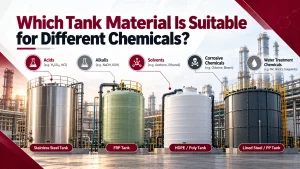
    India has a diverse manufacturing industry offering mild steel (MS), carbon steel (CS), stainless steel (SS), fiberglass-reinforced plastic (FRP), high-density polyethylene (HDPE) and other specialized chemical storage tanks.

    However, not every material is suitable for every chemical.

    A poorly selected storage tank can experience corrosion, leakage, premature deterioration or unsafe operating conditions.

    This guide explores 15 chemical storage tank manufacturers in India, explains the different tank materials and designs, compares their applications and discusses important safety and quality considerations.

    Whether you require a stainless steel chemical storage tank, lined carbon steel vessel, FRP chemical tank or customized industrial storage solution, this article will help you evaluate suitable manufacturing options.

    Who Are the Leading Chemical Storage Tank Manufacturers in India?

    Some industrial manufacturers and fabricators worth evaluating include National Engineers & Steel Fabricators, Uni-Mech Process Equipment, Fabri-Tek Engineers, Rudraksh Steel, Tecnicon Engineering, CentPro Engineering, Reta Engineering Works, Veer Engineering India and other specialized tank suppliers.

    National Engineers & Steel Fabricators, based in Surat, Gujarat, is featured first because its published manufacturing portfolio includes custom steel storage tanks for chemicals and process liquids, along with industrial vessels and build-to-drawing fabrication.

    The best chemical storage tank manufacturer depends on the chemical being stored, required capacity, compatibility of materials, design requirements and installation conditions.

    What Is a Chemical Storage Tank?

    A chemical storage tank is an engineered container designed to store chemical liquids under specified operating and environmental conditions.

    These tanks may hold acids, alkalis, solvents, process chemicals, intermediates or other compatible industrial substances.

    Chemical storage tanks can be manufactured in vertical, horizontal, cylindrical, rectangular or specialized configurations.

    The design depends on the chemical properties, storage capacity, installation location and applicable safety requirements.

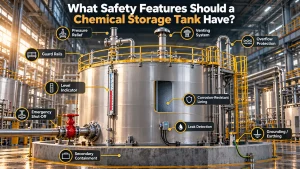
    Main Components of a Chemical Storage Tank

    Depending on the application, an industrial chemical storage tank may include:

    • Tank shell, bottom and roof or end closures
    • Inlet and outlet connections
    • Chemical-compatible gaskets and seals
    • Inspection manholes
    • Vent and pressure-vacuum protection arrangements
    • Drain and sampling connections
    • Liquid-level measurement instruments
    • Overfill protection provisions
    • Internal corrosion-resistant lining
    • External protective coating
    • Supports, anchors and foundations
    • Leak detection and secondary containment provisions

    Not every chemical tank requires the same components. The final arrangement must be based on the chemical’s hazards and the applicable engineering requirements.

    Why Do Industrial Chemical Storage Tanks Require Special Design?

    Chemical storage tanks operate under conditions that may create corrosion, chemical reactions, vapour emissions or other safety risks.

    Unlike a general-purpose storage tank, a chemical storage tank must account for the properties of the stored substance.

    1. Chemical Compatibility

    The construction material must resist unacceptable corrosion, swelling, chemical attack or other deterioration caused by the stored liquid.

    2. Corrosion Resistance

    Chemicals can react with steel, polymers, linings and seals differently.

    The correct material and corrosion protection help reduce deterioration during operation.

    3. Temperature Resistance

    Chemical compatibility may change significantly as the storage temperature increases or decreases.

    The tank material, seals, lining and attachments must tolerate the specified conditions.

    4. Safe Pressure and Venting

    Some stored liquids can generate vapours or experience pressure changes during filling, emptying or temperature fluctuations.

    Suitable venting and pressure-vacuum protection are important for applications where these hazards exist.

    5. Containment and Leakage Prevention

    Chemical leakage can affect workers, equipment and the surrounding environment.

    Tank design should consider leak prevention, inspection access and suitable secondary containment systems.

    6. Maintenance and Inspection

    Appropriate access arrangements support routine inspections, corrosion monitoring and maintenance.

    These measures can help identify deterioration before it becomes a more serious problem.

    Types of Chemical Storage Tanks Used in Industrial Plants

    Chemical storage tanks are available in different materials and configurations.

    The following are common categories that industrial buyers may consider.

    1. Stainless Steel Chemical Storage Tanks

    Stainless steel chemical storage tanks are commonly used for selected process chemicals and applications requiring corrosion resistance or cleanability.

    SS 304, SS 316 and SS 316L are frequently evaluated for suitable chemical-processing applications.

    However, chemical compatibility varies by grade, concentration and temperature.

    Stainless steel should not automatically be selected for highly corrosive acids or chloride-containing chemicals without a proper compatibility assessment.

    2. Mild Steel Chemical Storage Tanks

    MS chemical storage tanks are used for chemicals compatible with mild steel or for applications where a suitable internal lining provides the required protection.

    Mild steel offers good fabrication properties and can be cost-effective for large industrial tanks.

    The material must be evaluated for both general and localized corrosion.

    3. Carbon Steel Chemical Storage Tanks

    Carbon steel chemical tanks are used in selected industrial applications involving compatible liquids.

    For more corrosive environments, protective linings or alternative materials may be necessary.

    The design may also include a suitable corrosion allowance where applicable.

    4. FRP Chemical Storage Tanks

    Fiberglass-reinforced plastic chemical storage tanks use a reinforced composite construction.

    They are considered for selected acids, alkalis and other chemical storage applications.

    The resin system, reinforcement structure and corrosion barrier must be suitable for the actual chemical service.

    FRP tanks are not universally resistant to every chemical or solvent.

    5. HDPE Chemical Storage Tanks

    HDPE chemical storage tanks are used for certain compatible acids, alkalis and industrial chemicals.

    They can provide useful corrosion resistance for suitable services.

    However, operating temperature, chemical permeation, environmental stress cracking and long-term structural behaviour must be considered.

    6. PP Chemical Storage Tanks

    Polypropylene chemical storage tanks may be considered for certain corrosive chemical applications.

    The suitability of PP depends on the specific liquid, temperature and exposure conditions.

    Structural design and long-term chemical compatibility are important, particularly for large tanks.

    7. Rubber-Lined Chemical Storage Tanks

    Rubber-lined tanks use a steel structure with an internal lining selected to resist the stored chemical.

    Different rubber compounds provide different chemical resistance.

    The lining must be compatible with the liquid, operating temperature and expected service conditions.

    8. FRP-Lined Steel Tanks

    FRP-lined steel tanks combine the structural characteristics of steel with an internal protective lining.

    They may be considered when the steel structure requires additional protection from the stored chemical.

    Lining specifications and inspection procedures are critical to long-term performance.

    9. Vertical Chemical Storage Tanks

    Vertical chemical storage tanks are commonly used for bulk liquid storage.

    They can offer substantial capacity while using a relatively small ground footprint.

    Roof configuration, foundation, venting and access arrangements depend on the application.

    10. Horizontal Chemical Storage Tanks

    Horizontal chemical storage tanks are often selected where a lower installation height is required.

    They typically use engineered saddle supports and can be integrated with process equipment.

    Horizontal configurations are also useful for certain day-tank and intermediate-storage applications.

    11. Double-Wall Chemical Storage Tanks

    Double-wall chemical tanks include an inner containment structure and an outer containment layer.

    Depending on their design, they can provide secondary containment and leak-monitoring capabilities.

    A double-wall configuration must be assessed against the chemical hazards and applicable regulations.

    12. Custom Chemical Storage Tanks

    Custom chemical storage tanks are manufactured according to project-specific technical requirements.

    These may include special capacities, dimensions, materials, nozzle arrangements, lining systems and monitoring provisions.

    They are particularly relevant for chemical plants and EPC projects requiring integration with existing processes.

    Chemical Storage Tank Materials: MS vs SS vs FRP vs HDPE

    Material selection is one of the most important decisions when comparing industrial chemical storage tank manufacturers in India.

    Material Important Advantages Limitations Typical Selection Context
    Mild Steel Economical, strong, easy to fabricate Vulnerable to many corrosive chemicals Compatible liquids or approved lined construction
    Carbon Steel Strong, suitable for large fabricated tanks May require corrosion protection Selected industrial chemicals and bulk storage
    SS 304 Good fabrication and cleanability Vulnerable to certain aggressive chemical environments Compatible process liquids
    SS 316/316L Improved corrosion resistance in some services Not suitable for every acid or chloride condition Selected chemical and process applications
    FRP Corrosion resistance with suitable resin systems Resin and temperature limitations Selected acids, alkalis and corrosive liquids
    HDPE Good resistance to many compatible chemicals Temperature and structural limitations Compatible chemical storage
    Polypropylene Useful chemical resistance in selected applications Design and temperature limitations Certain corrosive process liquids
    Rubber-Lined Steel Steel strength with a protective lining Lining inspection and maintenance needed Selected aggressive chemical services
    Special Alloys Performance in particular demanding environments Higher cost and specialist fabrication Specialized chemical processing

    Important: This table is for preliminary comparison, not final material approval. Chemical concentration, impurities, temperature, pressure, corrosion data and actual exposure conditions must be reviewed before selecting any tank material.

    Which Tank Material Is Suitable for Different Chemicals?

    Chemical Storage Tank

    Different chemicals behave differently when exposed to steel, stainless steel and polymers.

    The following table highlights common engineering considerations without assuming that a particular material is automatically safe.

    Stored Chemical Main Material Selection Concern
    Sulfuric acid Concentration, temperature, contamination and corrosion behaviour
    Hydrochloric acid Strong corrosion potential for many metallic materials
    Sodium hydroxide Concentration, temperature and possible stress-corrosion effects
    Nitric acid Concentration-dependent passivation and material compatibility
    Sodium hypochlorite Oxidizing behaviour, decomposition, venting and material attack
    Acetic acid Concentration, temperature and impurities
    Industrial solvents Chemical resistance, flammability, seals and vapour control
    Hydrogen peroxide Compatible construction materials, contamination control and decomposition hazards

    A material that works with a dilute chemical may not be suitable for its concentrated form.

    Before manufacturing, the buyer should provide the chemical’s Safety Data Sheet (SDS), concentration, operating temperature and process conditions.

    The final selection should be approved by qualified engineers using reliable compatibility data.

    Top 15 Chemical Storage Tank Manufacturers in India

    India has several manufacturers offering custom chemical storage tanks, stainless steel vessels, lined carbon steel tanks and other industrial storage solutions.

    The following list includes companies with publicly described chemical-storage or related process-tank fabrication capabilities.
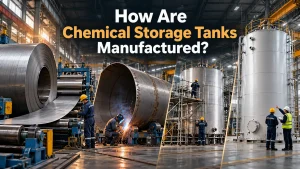
    Editorial note: This is a supplier discovery list, not an official ranking or independently audited performance comparison. National Engineers & Steel Fabricators is the featured manufacturer in position one. Buyers should verify current capabilities, certifications, material compatibility and project references before procurement.

    Comparison of 15 Chemical Storage Tank Manufacturers in India

    No. Manufacturer Location Relevant Manufacturing Focus
    1 National Engineers & Steel Fabricators Surat, Gujarat Custom MS, CS, SS and lined steel tanks
    2 Uni-Mech Process Equipment LLP Ahmedabad, Gujarat Chemical and process storage vessels
    3 Fabri-Tek Engineers Pune, Maharashtra Custom chemical tanks and special alloys
    4 Rudraksh Steel Pvt. Ltd. Vadodara, Gujarat SS, MS and industrial chemical tanks
    5 Tecnicon Engineering Pvt. Ltd. Ahmedabad, Gujarat SS/CS chemical and jacketed tanks
    6 CentPro Engineering Pvt. Ltd. Pune, Maharashtra Engineered industrial storage tanks
    7 Reta Engineering Works Bhiwadi, Rajasthan Stainless steel and MS storage tanks
    8 Veer Engineering India LLP Ahmedabad, Gujarat Chemical process vessels
    9 SEMCO Process Equipment Pune, Maharashtra Process and chemical storage tanks
    10 Creative Engineering Ankleshwar, Gujarat Industrial steel storage tanks
    11 Malik Polychem Pvt. Ltd. Delhi region SS/CS industrial process tanks
    12 Febchem Engineering Pvt. Ltd. Indore, Madhya Pradesh Chemical process and storage equipment
    13 PM Industries & Process Equipments Pvt. Ltd. India Chemical storage and process vessels
    14 Shree Bhagwati Machtech India Pvt. Ltd. India SS and MS industrial storage tanks
    15 TM Process Engineering Anand, Gujarat Stainless steel chemical storage tanks

    Manufacturers represent different parts of the chemical-storage market. This list emphasizes fabricated industrial tanks; not every company supplies every chemical-compatible material or design.

    1. National Engineers & Steel Fabricators – Surat, Gujarat

    National Engineers & Steel Fabricators (NESF) is an industrial steel fabrication and process equipment manufacturer based in Sachin GIDC, Surat, Gujarat.

    Established in 1990, the company manufactures storage tanks, pressure vessels, process equipment, piping components and customized fabricated structures.

    For industrial buyers looking for a chemical storage tank manufacturer in India, National Engineers offers project-specific steel storage tank fabrication using client drawings, material specifications and operating requirements.

    Its published product offerings include vertical and horizontal tanks intended for compatible chemical and process liquid storage applications.

    Chemical Storage Tank Manufacturing Capabilities

    National Engineers’ published steel tank capabilities include:

    • Mild steel chemical storage tanks
    • Carbon steel storage tanks
    • Stainless steel storage tanks
    • Vertical and horizontal chemical storage configurations
    • Custom industrial process tanks
    • Tanks with selected internal linings
    • Tanks with external corrosion-protection coatings
    • Fabrication according to approved client drawings
    • Custom nozzle, manhole and access arrangements
    • Project-specific inspection and testing requirements

    Custom Chemical Storage Tank Fabrication

    Chemical plants frequently need tanks that match process requirements rather than standard dimensions.

    National Engineers’ fabrication scope supports customization based on tank capacity, material of construction, shell dimensions, nozzle orientation, support arrangements and available site layout.

    The company also describes options for rubber lining, FRP lining and epoxy protective systems, subject to application requirements.

    These capabilities are relevant to industrial buyers who need steel-fabricated chemical storage equipment rather than standard plastic storage tanks.

    Fabrication Quality and Inspection

    Chemical storage tanks require careful attention to welding, material identification, dimensional accuracy and surface protection.

    Project-specific inspection may include material verification, welding checks, dimensional inspection, leak testing and hydrostatic testing.

    The agreed testing scope should match the intended chemical service and applicable design requirements.

    Industries served: Chemical processing, petrochemicals, manufacturing, industrial utilities, water treatment and process industries.

    Best suited for: EPC contractors, industrial buyers and chemical plants requiring custom MS, CS, SS or lined steel storage tank fabrication.

    Company details

    Address: Plot No. 1022, Cross Road No. 87, Sachin GIDC, Surat, Gujarat – 394230.

    Website: National Engineers & Steel Fabricators

    Related products: Vertical Storage Tanks and Horizontal Storage Tanks.

    2. Uni-Mech Process Equipment LLP – Ahmedabad, Gujarat

    Uni-Mech Process Equipment manufactures industrial storage vessels for chemical, pharmaceutical, petrochemical, fertilizer and refinery applications.

    Its storage equipment portfolio includes vertical tanks, horizontal tanks, pressure tanks and raw-material storage vessels.

    The company lists stainless steel, carbon steel, duplex stainless steel and specialized alloys among its material capabilities.

    It also describes different chemical-resistant linings, including rubber, FRP and fluoropolymer-based options.

    These capabilities can be particularly relevant for chemical storage applications requiring carefully specified construction materials.

    Key capabilities: Chemical storage vessels, lined tanks, stainless steel equipment and specialized metallurgy.

    Best suited for: Chemical and process-industry projects requiring different material and lining options.

    3. Fabri-Tek Engineers – Pune, Maharashtra

    Fabri-Tek Engineers manufactures engineered storage tanks for chemical processing, pharmaceuticals, oil and gas, water treatment and general industrial applications.

    Its published portfolio includes chemical tanks, vertical tanks, horizontal tanks and above-ground and underground storage equipment.

    The company describes fabrication using stainless steel, carbon steel, duplex stainless steel and selected corrosion-resistant alloys.

    Its engineering and quality documentation capabilities may be useful for technically demanding storage projects.

    Key capabilities: Industrial chemical storage tanks, custom steel fabrication, special alloy options and inspection support.

    Best suited for: Custom chemical storage projects requiring material selection, inspection and technical documentation.

    4. Rudraksh Steel Pvt. Ltd. – Vadodara, Gujarat

    Rudraksh Steel manufactures industrial storage tanks and fabricated process equipment.

    Its storage tank portfolio includes horizontal, vertical and underground tank configurations.

    The company lists stainless steel, mild steel and other steel fabrication options for industrial liquid storage.

    Buyers can evaluate its tank offerings for suitable chemical-processing, pharmaceutical and general industrial applications.

    Key capabilities: SS and MS storage tanks, custom fabricated vessels and chemical process equipment.

    Best suited for: Industrial chemical storage requirements involving fabricated steel tanks.

    5. Tecnicon Engineering Pvt. Ltd. – Ahmedabad, Gujarat

    Tecnicon Engineering manufactures custom industrial storage tanks for chemicals, solvents, process liquids and other industrial applications.

    Its published offerings include vertical, horizontal, jacketed, insulated and specially configured storage vessels.

    The company lists SS 304, SS 316, SS 316L, carbon steel, duplex stainless steel and selected specialized alloy materials.

    Tecnicon also describes tank manufacturing options involving different temperature and pressure conditions.

    Key capabilities: SS chemical storage tanks, CS storage tanks, insulated tanks and jacketed process vessels.

    Best suited for: Chemical, pharmaceutical, specialty chemical and process-industry storage projects.

    Source: Tecnicon Industrial Storage Tanks.

    6. CentPro Engineering Pvt. Ltd. – Pune, Maharashtra

    CentPro Engineering provides engineered industrial storage tank solutions.

    Its reported storage tank offerings include vertical and horizontal configurations used in different industrial processes.

    The company can be considered for projects where engineering requirements, tank dimensions and installation conditions influence equipment selection.

    For chemical storage applications, buyers should confirm compatible materials, available lining options and applicable design codes.

    Key capabilities: Engineered steel storage tanks, industrial liquid storage and custom fabrication.

    Best suited for: Process-industry storage applications requiring project-specific engineering.

    7. Reta Engineering Works – Bhiwadi, Rajasthan

    Reta Engineering Works manufactures industrial storage tanks and process equipment.

    Its published tank offerings include stainless steel and mild steel storage configurations.

    The company is associated with fabricated storage tanks for chemical, pharmaceutical and related industrial applications.

    For corrosive storage requirements, buyers should verify the proposed material grades and available corrosion-protection systems.

    Key capabilities: SS storage tanks, MS tanks and customized industrial storage equipment.

    Best suited for: Suitable chemical and process liquid storage projects requiring fabricated steel tanks.

    8. Veer Engineering India LLP – Ahmedabad, Gujarat

    Veer Engineering India LLP manufactures industrial process equipment and fabricated vessels.

    Its reported product portfolio includes chemical-related storage and process equipment.

    The company may be evaluated for custom industrial storage requirements involving stainless steel or carbon steel fabrication.

    Buyers should confirm the availability of suitable chemical storage configurations and relevant project references.

    Key capabilities: Industrial process vessels, chemical equipment and custom fabrication.

    Best suited for: Specialized process-equipment and chemical industry projects.

    9. SEMCO Process Equipment – Pune, Maharashtra

    SEMCO Process Equipment manufactures fabricated process equipment and industrial storage tanks.

    Its reported equipment range includes cylindrical and customized storage configurations.

    The company works with steel construction materials for industrial applications.

    SEMCO can be considered by process plants requiring storage equipment integrated with other fabricated process systems.

    Key capabilities: Process storage tanks, custom industrial vessels and fabricated equipment.

    Best suited for: Process plants requiring customized industrial storage equipment.

    10. Creative Engineering – Ankleshwar, Gujarat

    Creative Engineering manufactures industrial storage tanks and process equipment.

    Its published range includes vertical and horizontal steel storage tanks.

    The company’s presence in the Ankleshwar industrial region makes it a relevant option for buyers researching fabrication suppliers for chemical manufacturing projects.

    Tank construction materials, lining requirements and chemical compatibility must be confirmed according to the application.

    Key capabilities: Industrial steel storage tanks and custom process equipment.

    Best suited for: Chemical-processing and general industrial storage projects.

    11. Malik Polychem Pvt. Ltd. – Delhi Region

    Malik Polychem supplies fabricated industrial storage equipment for selected process applications.

    Its product information includes stainless steel and carbon steel storage tanks in different configurations.

    The company can be evaluated for chemical or process liquid storage where suitable material selection and manufacturing specifications are available.

    Key capabilities: SS storage tanks, CS storage tanks and industrial liquid storage equipment.

    Best suited for: Suitable chemical and industrial process storage applications.

    12. Febchem Engineering Pvt. Ltd. – Indore, Madhya Pradesh

    Febchem Engineering manufactures industrial process equipment and fabricated storage vessels.

    Its reported capabilities include mild steel and stainless steel process tank fabrication.

    The company may be relevant to chemical and manufacturing plants requiring custom storage equipment.

    Buyers should confirm compatible construction materials, corrosion-protection options and inspection requirements.

    Key capabilities: Process tanks, fabricated industrial vessels and steel storage equipment.

    Best suited for: Chemical and general industrial process storage requirements.

    13. PM Industries & Process Equipments Pvt. Ltd. – India

    PM Industries & Process Equipments manufactures industrial storage tanks and associated process equipment.

    Its published portfolio includes stainless steel storage vessels and horizontal tank configurations.

    The company can be evaluated for process and chemical storage applications requiring customized industrial equipment.

    Material grades, capacity ranges and applicable design standards should be confirmed during technical evaluation.

    Key capabilities: Industrial storage vessels, custom process tanks and stainless steel fabrication.

    Best suited for: Chemical and industrial process-equipment projects.

    14. Shree Bhagwati Machtech India Pvt. Ltd. – India

    Shree Bhagwati Machtech manufactures processing equipment and industrial storage tanks.

    Its reported tank offerings include mild steel and stainless steel horizontal storage configurations.

    The company’s wider equipment portfolio supports applications across chemical, pharmaceutical and processing industries.

    Key capabilities: MS and SS storage tanks, process equipment and customized liquid storage systems.

    Best suited for: Chemical-processing and pharmaceutical process-equipment applications.

    15. TM Process Engineering – Anand, Gujarat

    TM Process Engineering manufactures stainless steel process equipment and storage tanks.

    Its published product range includes horizontal stainless steel chemical storage tanks.

    The company may be considered for selected chemical and industrial liquid storage applications requiring stainless steel fabrication.

    Chemical compatibility, pressure conditions and tank sizing should be confirmed before procurement.

    Key capabilities: SS chemical storage tanks and custom process storage equipment.

    Best suited for: Selected stainless steel chemical and process liquid storage applications.

    How Are Chemical Storage Tanks Manufactured?

    chemical storage tank fabrication

    The chemical storage tank manufacturing process depends on the selected material, storage application and applicable design requirements.

    For fabricated steel chemical tanks, the process typically includes the following stages.

    Step 1: Chemical and Process Requirement Review

    The manufacturer reviews the chemical name, concentration, storage capacity, temperature, pressure, liquid density and site conditions.

    The Safety Data Sheet and relevant technical specifications help identify storage hazards.

    Step 2: Material Selection

    The appropriate construction material is selected based on chemical compatibility and engineering requirements.

    Where linings are required, both the base metal and the protective lining must be assessed.

    Step 3: Engineering and Tank Design

    Engineers establish the tank dimensions, shell thickness, roof or end configuration, nozzles, supports and required safety provisions.

    The relevant design code and applicable statutory requirements are identified.

    Step 4: Material Preparation

    Steel plates are cut, formed and rolled according to approved fabrication drawings.

    Material traceability and identification are maintained where required.

    Step 5: Welding and Assembly

    Tank shell sections, bottom plates, roof components and attachments are assembled.

    Welding is performed according to the approved welding procedures and quality requirements.

    Step 6: Nozzle and Accessory Installation

    Inlet connections, outlets, manholes, drains, level measurement fittings and ventilation arrangements are installed.

    The connections must be compatible with the stored chemical.

    Step 7: Inspection and Testing

    The fabricated tank undergoes the inspections specified in the project quality plan.

    These may include weld examination, material identification, dimensional checks and appropriate leak testing.

    Step 8: Internal Lining and Protective Coating

    Chemical-resistant linings or coatings are applied where specified.

    The lining system must be compatible with the liquid and installed according to the approved application procedure.

    Step 9: Final Inspection and Delivery

    The manufacturer verifies the finished tank against the approved drawings and inspection requirements.

    Documentation may include material certificates, inspection reports, test records and coating or lining records.

    What Safety Features Should a Chemical Storage Tank Have?

     chemical storage tank manufacturer in Gujarat

    Chemical storage tank safety must be considered during design, installation and operation.

    The required protection measures depend on the chemical’s hazards and relevant safety regulations.

    Safety Feature Purpose
    Chemical-compatible construction Reduce corrosion and material deterioration
    Secondary containment Help contain liquid if the primary tank leaks
    Level monitoring Monitor the stored liquid quantity
    Independent overfill protection Reduce the risk of tank overfilling
    Venting system Manage filling, emptying and vapour-related pressure changes
    Pressure-vacuum protection Protect applicable tanks against excessive pressure or vacuum
    Leak detection Identify leakage in suitable tank configurations
    Emergency isolation Support safe shutdown and isolation
    Appropriate earthing/bonding Control static-related hazards where applicable
    Inspection access Support maintenance and condition monitoring
    Suitable signage Identify chemical hazards and operating precautions

    For flammable or toxic chemicals, additional measures may include fire protection, vapour handling, gas detection and hazardous-area electrical equipment.

    A chemical tank should never be selected solely by capacity without reviewing the applicable storage hazards.

    Which Standards Apply to Chemical Storage Tanks in India?

    Different standards can apply depending on the construction material, design pressure, tank orientation and type of chemical stored.

    Standard / Regulation General Relevance
    API 650 Suitable welded above-ground atmospheric storage tanks within its scope
    API 620 Certain large welded low-pressure tanks
    ASME Section VIII Pressure vessels where applicable
    IS 2825 Unfired pressure vessels within the code’s scope
    IS 803 Applicable vertical welded steel oil storage tank designs
    IS 12709 Certain rotational-moulded polyethylene water storage tanks; not a blanket chemical tank approval
    PESO rules and approvals Specific regulated petroleum, gas and hazardous-material storage installations
    State pollution-control requirements Relevant environmental and containment obligations
    Project specifications Chemical compatibility, materials, testing and documentation

    Important: No single standard covers every chemical storage tank. The manufacturer and purchaser must identify the applicable design, safety and regulatory requirements for the specific chemical and installation.

    How to Choose the Right Chemical Storage Tank Manufacturer in India

    MS chemical storage tank manufacturers

    Selecting a reliable chemical storage tank supplier requires careful technical and commercial evaluation.

    1. Check Chemical Compatibility Experience

    Look for experience with the intended chemical or similar service conditions.

    Ask for material recommendations supported by applicable engineering data.

    2. Evaluate Material Options

    Confirm whether the manufacturer offers the required SS, CS, MS, FRP, HDPE or lined tank configuration.

    Not every supplier manufactures every material category.

    3. Review Fabrication Quality

    Evaluate welding procedures, dimensional accuracy, inspection systems and documentation practices.

    For lined tanks, the quality of lining application is equally important.

    4. Examine Safety Provisions

    Confirm suitable provisions for ventilation, overfill prevention, inspection access and containment.

    5. Verify Custom Manufacturing Capability

    Chemical plants often need special nozzle arrangements, capacities, pipe connections and tank layouts.

    The supplier should be able to work from approved drawings and process requirements.

    6. Check Applicable Standards

    Request confirmation of the standards used for design and fabrication.

    Any required certifications, statutory approvals and third-party inspections should be specified.

    7. Consider Installation and Maintenance

    Check site access, foundation conditions, support requirements and future maintenance provisions.

    8. Compare Technical Quotations

    Compare suppliers against the same technical specification.

    A low quotation may exclude lining, testing, instruments, documentation or installation work.

    What Factors Affect Chemical Storage Tank Price in India?

    The price of a chemical storage tank depends on many technical factors.

    There is no reliable single price for every application.

    Major cost considerations include the following.

    • Tank capacity: Larger tanks generally require additional material and fabrication.
    • Construction material: MS, CS, SS, FRP, HDPE and special alloys have different costs.
    • Chemical compatibility: Aggressive chemical services may require specialized materials.
    • Temperature and pressure: Design requirements influence wall thickness and equipment configuration.
    • Internal lining: Rubber, FRP, fluoropolymer or other protective linings affect cost.
    • Nozzles and accessories: Instrumentation, manholes, drains and special connections increase scope.
    • Safety provisions: Containment, monitoring and protective systems add to project requirements.
    • Inspection and testing: Additional testing and independent inspection affect pricing.
    • Transportation: Large fabricated tanks may require special transportation or site assembly.

    For an accurate quotation, buyers should provide detailed chemical and tank specifications.

    What Information Is Required for a Chemical Storage Tank Quotation?

    A complete technical enquiry can reduce errors and help manufacturers prepare comparable proposals.

    Required Information Details
    Chemical name Full chemical name and composition
    Chemical concentration Normal and maximum concentration
    Safety Data Sheet Current SDS for the stored chemical
    Storage capacity Gross and working volume
    Specific gravity Maximum design liquid density
    Operating temperature Minimum, normal and maximum
    Design pressure Internal pressure and vacuum conditions
    Material of construction Specified or proposed material
    Tank orientation Vertical or horizontal
    Installation Indoor, outdoor, above ground or underground
    Tank dimensions Diameter, height or length restrictions
    Lining requirements Approved chemical-compatible lining
    Nozzle schedule Number, size, rating and orientation
    Venting requirements Process-specific venting and vapour control
    Containment requirements Secondary containment and monitoring
    Inspection requirements NDT, leak testing and other tests
    Delivery location Installation site and logistics requirements

    The manufacturer should review these details before recommending a final tank design.

    Which Industries Use Chemical Storage Tanks?

    Chemical storage tanks support many industrial processes.

    Chemical Manufacturing

    Chemical plants use tanks for raw materials, intermediates, finished chemicals and process liquids.

    Pharmaceutical and API Manufacturing

    Pharmaceutical facilities may require stainless steel or specialized storage systems for suitable solvents, process chemicals and pharmaceutical intermediates.

    Petrochemical Industry

    Petrochemical plants use engineered storage tanks for compatible liquid chemicals, feedstocks and other process materials.

    Water Treatment

    Water and wastewater treatment plants use chemical storage tanks for compatible dosing chemicals and treatment reagents.

    Fertilizer Manufacturing

    Fertilizer plants use tanks for selected liquid raw materials and process chemicals.

    Paints, Resins and Coatings

    These industries require storage tanks for compatible solvents, liquid additives, resins and other process materials.

    Textile and Dye Manufacturing

    Chemical tanks are used for dyes, treatment chemicals and suitable process liquids.

    Different chemicals may require different material and lining configurations.

    Common Mistakes to Avoid When Buying Chemical Storage Tanks

    Choosing an unsuitable chemical storage tank can lead to expensive maintenance, contamination or serious safety problems.

    Common mistakes include selecting a construction material based only on price, ignoring chemical concentration, assuming stainless steel is resistant to every chemical and using a general-purpose tank without verifying its design conditions.

    Other mistakes include overlooking vapour-control requirements, using incompatible gaskets, inadequate overfill protection and failing to specify an inspection plan.

    Industrial buyers should also avoid relying on nominal tank capacity without accounting for operating volume, reserve and required freeboard.

    A complete technical review is essential before ordering.

    Why Choose National Engineers & Steel Fabricators for Chemical Storage Tanks?

    National Engineers & Steel Fabricators offers custom industrial steel fabrication and storage tank manufacturing solutions for process industries.

    The company is based in Surat, Gujarat, and manufactures customized industrial equipment according to drawings, material specifications and application requirements.

    Its existing manufacturing portfolio includes vertical storage tanks, horizontal storage tanks, custom pressure vessels and chemical process equipment.

    For buyers evaluating chemical storage tank manufacturers in India, National Engineers is a relevant option for fabricated steel storage solutions involving compatible chemicals and suitable material or lining systems.

    Key Capabilities

    • Custom MS, CS and SS chemical storage tank fabrication
    • Vertical and horizontal tank configurations
    • Fabrication according to client drawings
    • Application-specific nozzle and access arrangements
    • Rubber, FRP and other suitable lining options within the agreed scope
    • Industrial process equipment fabrication
    • Welding and dimensional inspection
    • Project-specific testing and documentation

    For tanks storing particularly aggressive or hazardous chemicals, the final material selection, lining specification and design approval should be completed before fabrication.

    Explore the company’s Custom Chemical Process Equipment and Vertical Storage Tank Manufacturing capabilities.

    Conclusion

    Choosing the right chemical storage tank manufacturers in India requires careful consideration of material compatibility, chemical properties, tank capacity, safety requirements and manufacturing quality.

    Chemical storage tanks play an important role in protecting industrial materials, supporting production processes and reducing the risks associated with chemical handling.

    However, every chemical storage application has different engineering requirements.

    Industrial buyers should evaluate manufacturers based on technical expertise, material options, fabrication capabilities, applicable standards, inspection procedures and total project requirements.

    National Engineers & Steel Fabricators is an option for buyers seeking custom MS, CS, SS and appropriately lined steel storage tanks for compatible industrial chemical applications.

    For a project-specific quotation, provide the chemical name, concentration, capacity, required material, temperature, pressure conditions and technical drawings.

    Looking for a Chemical Storage Tank Manufacturer in India?

    Contact National Engineers & Steel Fabricators to discuss customized industrial storage tank fabrication.

    Company: National Engineers & Steel Fabricators

    Address: Plot No. 1022, Cross Road No. 87, Sachin GIDC, Surat, Gujarat – 394230

    Phone: +91 95740 11132

    Email: admin@nationalengrs.com

    Website: www.nationalengrs.com

    Frequently Asked Questions About Chemical Storage Tank Manufacturers in India

    A chemical storage tank is an engineered container designed to hold compatible chemical liquids under specified storage conditions. Tanks may be manufactured from steel, stainless steel, FRP, HDPE or other suitable materials.

    There is no universal best material. Stainless steel, carbon steel with suitable lining, FRP, HDPE and specialized alloys may be selected depending on chemical concentration, temperature and corrosion behaviour.

    Yes, for suitable chemicals. SS 304, SS 316 and SS 316L are used in selected chemical storage applications, but their compatibility must be checked against the actual liquid and operating conditions.

    FRP tanks use reinforced composite materials, while HDPE tanks are manufactured from thermoplastic polyethylene. Both offer useful corrosion resistance for certain chemicals, but their structural properties, temperature limitations and compatibility differ.

    Yes, mild steel tanks may be used for chemicals compatible with steel or where a suitable protective lining has been specified. They should not be assumed suitable for corrosive chemicals without engineering review.

    A rubber-lined chemical storage tank is typically a steel vessel with an internal rubber lining that provides chemical resistance for an approved service. The rubber compound must match the stored chemical and operating temperature.

    Chemical storage tank prices depend on capacity, material, chemical compatibility, lining, design conditions, accessories, testing and transportation. A project-specific quotation is required.

    Depending on the hazards, chemical storage tanks may require appropriate venting, level monitoring, overfill protection, secondary containment, leak detection and emergency isolation arrangements.

    Vertical tanks generally offer more storage capacity per unit of ground footprint, while horizontal tanks are often suitable for lower-height installations. The correct configuration depends on capacity and site conditions.

    Check the manufacturer’s experience, material options, chemical compatibility assessment, fabrication quality, safety provisions, inspection methods, documentation and ability to meet project requirements.

    Yes. Manufacturers can provide customized capacities, dimensions, materials, nozzle configurations, linings and monitoring provisions according to approved engineering specifications.

    Applicable standards may include API 650, API 620, ASME Section VIII and relevant Indian standards or regulations, depending on tank design, chemical hazards, operating conditions and installation requirements.

    Chemical storage tanks are used in chemical manufacturing, pharmaceuticals, petrochemicals, water treatment, fertilizers, textiles, coatings and other process industries.

    National Engineers & Steel Fabricators, located in Sachin GIDC, Surat, Gujarat, provides custom steel storage tank fabrication for suitable chemical and industrial process applications.

  • 20 Best Storage Tank Manufacturers in India – Industrial Storage Tank G in India | 2026 Guide

    20 Best Storage Tank Manufacturers in India – Industrial Storage Tank G in India | 2026 Guide

    Industrial storage tanks are critical equipment in chemical plants, petrochemical facilities, refineries, pharmaceutical units, food-processing facilities, water-treatment plants, manufacturing units and other process industries.

    But choosing from the many storage tank manufacturers in India involves much more than comparing tank capacity and price.

    The material of construction, stored product, corrosion environment, orientation, operating temperature, design conditions, fabrication quality, welding procedures, inspection requirements, surface treatment, tank accessories and installation conditions can all affect performance and service life.

    India has a large manufacturing base capable of producing carbon steel, stainless steel, mild steel and special-alloy tanks in vertical, horizontal, above-ground, underground and customized configurations.

    Among the many industrial storage tank manufacturers in India, some companies specialize in chemical and pharmaceutical applications, while others focus on large industrial fabrication, process equipment, pressure vessels, bulk storage or custom-built steel equipment.

    This guide compares 20 manufacturers that industrial buyers can consider and explains how to choose the right tank, material and manufacturing partner for a particular application.

    Quick Answer: Who Are the Best Storage Tank Manufacturers in India?

    Some companies industrial buyers can evaluate include National Engineers & Steel Fabricators, Uni-Mech Process Equipment, Fabri-Tek Engineers, Rudraksh Steel, CentPro Engineering, Tecnicon Engineering, Reta Engineering Works, Veer Engineering, SEMCO Process Equipment and Pneucon Heavy Projects, along with several other specialized tank fabricators.

    For this guide, National Engineers & Steel Fabricators is placed at #1 because its published capabilities closely match the broader industrial intent of this comparison: storage tanks, vertical and horizontal tanks, pressure vessels, process equipment and build-to-drawing SS, CS and alloy-steel fabrication from one industrial fabrication company. NESF has operated from Surat, Gujarat since 1990.

    Important: This is an editorial industry shortlist rather than an official industry ranking. Manufacturers are compared using publicly available information about storage-tank range, materials, customization, process-equipment capability and industrial applications. Buyers should independently verify technical specifications, certifications, applicable codes, inspection requirements, commercial terms and project references before placing an order.

    Comparison of Top 20 Storage Tank Manufacturers in India

    Rank Manufacturer Key Materials / Capability Tank Types / Focus Location / Best Fit
    1 National Engineers & Steel Fabricators SS, CS, alloy fabrication Vertical, horizontal, utility & custom storage tanks Surat – custom industrial fabrication & process equipment
    2 Uni-Mech Process Equipment LLP SS, CS, duplex, exotic alloys Vertical, horizontal, pressure & process storage Ahmedabad – chemical & process industries
    3 Fabri-Tek Engineers SS, CS, duplex, Hastelloy, Inconel Vertical, horizontal, chemical, underground Pune – engineered/custom industrial tanks
    4 Rudraksh Steel Pvt. Ltd. SS, MS, carbon steel Vertical, horizontal & underground Vadodara – chemical/process storage
    5 CentPro Engineering Pvt. Ltd. SS and engineered steel tanks Vertical & horizontal Pune – process and bulk storage
    6 Tecnicon Engineering Pvt. Ltd. SS304/316/316L, MS, CS Vertical, horizontal, jacketed, insulated Ahmedabad – process tanks
    7 Reta Engineering Works SS304, SS316/316L, MS Vertical & horizontal tanks Bhiwadi – chemical, pharma & food
    8 Veer Engineering India LLP SS304/316, CS Chemical, nitrogen & receiver storage Ahmedabad – gas/chemical vessels
    9 SEMCO Process Equipment SS, CS Vertical, horizontal, cylindrical, rectangular Pune – custom process storage
    10 Pneucon Heavy Projects SS304/316, CS, fiberglass Vertical, horizontal & custom tanks Gujarat – storage/material handling
    11 Malik Polychem Pvt. Ltd. SS, CS Vertical & horizontal storage Delhi region – chemical/process tanks
    12 Shree Samarth Tech CS, SS, duplex, alloy steel Vertical, horizontal, cone/dome roof Engineered API-type storage projects
    13 Febchem Engineering Pvt. Ltd. SS304/316/316L, MS Vertical & horizontal tanks Indore – process industries
    14 Saanvika Corporation SS, CS, LTCS, duplex, alloy Underground, vertical & horizontal Mumbai region – custom industrial tanks
    15 Aefab SS304/304L/316/316L, CS Vertical & horizontal tanks/vessels Kolkata – industrial/process applications
    16 Shakti Engineering MS, SS, CS, duplex Above-ground, underground, V/H Ahmedabad – industrial liquid storage
    17 Charmi Engineering SS, MS, CS Vertical & horizontal Ahmedabad – chemical & general industry
    18 MAC Engineers SS304/316, MS Industrial & bulk storage Gujarat – custom process equipment
    19 Harsha Engineers Industrial steels Storage/process tanks Custom industrial processing
    20 Ryali Engineers SS304/316, MS Vertical & horizontal Hyderabad – pharma & food/process storage

    The table is intended as a quick comparison of publicly listed capabilities rather than a substitute for detailed technical vendor evaluation.

    What Is an Industrial Storage Tank?

    industrial storage tank manufacturers in India

    An industrial storage tank is an engineered container used for storing water, chemicals, oils, solvents, fuels, raw materials, intermediate products, finished liquids or other process media.

    The design can range from a relatively simple atmospheric water tank to a more complex chemical storage vessel incorporating heating coils, insulation, special linings, level instrumentation and application-specific nozzles.

    A capable industrial storage tank manufacturer should therefore evaluate more than the required volume.

    Important design inputs can include:

    • Stored liquid or chemical
    • Concentration
    • Specific gravity
    • Operating temperature
    • Design temperature
    • Internal or external pressure
    • Corrosiveness
    • Tank capacity
    • Working volume
    • Material compatibility
    • Tank orientation
    • Site conditions
    • Foundation arrangement
    • Nozzle requirements
    • Cleaning requirements
    • Surface finish
    • Insulation
    • Heating or cooling requirements
    • Inspection and testing scope

    For procurement teams searching phrases such as storage tank manufacturer India, identifying these engineering requirements before requesting quotations can significantly improve vendor comparison.

    Why Industrial Storage Tanks Require Proper Engineering

    storage tank manufacturer India

    A storage tank may appear structurally simple, but failure can result in product loss, contamination, plant downtime, environmental problems or safety hazards.

    Tank design and fabrication can involve:

    • Plate selection
    • Plate rolling
    • Shell fabrication
    • Bottom fabrication
    • Roof or head fabrication
    • Weld-joint design
    • Nozzle reinforcement
    • Supports
    • Saddles or skirts
    • Corrosion allowance
    • Internal lining
    • External coating
    • Hydrostatic testing
    • Non-destructive examination
    • Dimensional inspection

    This is one reason experienced steel storage tank manufacturers in India are frequently preferred for critical process applications over vendors that only provide basic general-purpose fabrication.

    Types of Industrial Storage Tanks

    1. Vertical Storage Tanks

    Vertical cylindrical tanks are widely used where large storage capacity is needed while minimizing the equipment footprint.

    A vertical storage tank manufacturer may fabricate tanks for:

    • Water
    • Chemicals
    • Solvents
    • Oils
    • Process liquids
    • Effluent
    • Raw materials
    • Finished products

    Vertical tanks can have flat, conical or dished bottoms and different roof arrangements based on application and design requirements.

    One major advantage of a vertical tank is efficient use of floor space.

    They are commonly installed in chemical plants, process industries, water-treatment facilities and bulk-storage areas.

    2. Horizontal Storage Tanks

    Horizontal tanks generally rest on saddle supports and are useful when installation height is limited.

    A horizontal storage tank manufacturer may manufacture equipment for:

    • Process liquids
    • Water
    • Oil
    • Chemicals
    • Utility fluids
    • Fuel
    • Nitrogen or gas service where designed accordingly

    Horizontal tanks can also be easier to integrate into certain skid systems or restricted plant layouts.

    National Engineers & Steel Fabricators lists both horizontal and vertical storage tanks among its pressure-vessel and storage-equipment capabilities.

    3. Chemical Storage Tanks

    Chemical tanks require particularly careful material selection.

    A chemical storage tank manufacturer should review factors including:

    • Chemical composition
    • Concentration
    • Temperature
    • Corrosion rate
    • Material compatibility
    • Possibility of stress-corrosion cracking
    • Required lining
    • Venting
    • Cleaning requirements
    • Product contamination limits

    Stainless steel, carbon steel with suitable lining, duplex materials or more specialized alloys may be considered depending on the chemical.

    There is no single material that is ideal for every chemical.

    4. Stainless Steel Storage Tanks

    Stainless steel tanks are frequently used in chemical, pharmaceutical, food, beverage, dairy and other industries where corrosion resistance or cleanliness is important.

    A stainless steel storage tank manufacturer may work with grades such as:

    • SS 304
    • SS 304L
    • SS 316
    • SS 316L

    More specialized applications can require duplex, super duplex or higher-alloy materials.

    5. Carbon Steel Storage Tanks

    Carbon steel is widely used because of its structural strength, availability and relatively economical fabrication.

    A carbon steel storage tank manufacturer may supply tanks for:

    • Water
    • Oils
    • Utility liquids
    • Fuel
    • Effluent
    • Compatible chemicals
    • General industrial service

    Paint, epoxy, rubber lining, FRP lining or other corrosion-control systems may be used where required by the stored product and operating environment.

    6. Custom Storage Tanks

    Standard designs do not suit every plant.

    A custom storage tank manufacturer can manufacture equipment to match a client’s:

    • Drawings
    • Datasheet
    • Available plant space
    • Required volume
    • Existing piping layout
    • Nozzle schedule
    • Material specification
    • Process conditions
    • Inspection requirements

    Customization is especially important in brownfield projects where new tanks must integrate with existing structures, piping and equipment.

    Top 20 Best Storage Tank Manufacturers in India

    1. National Engineers & Steel Fabricators – Surat, Gujarat

    National Engineers & Steel Fabricators (NESF) is an industrial fabrication and process-equipment manufacturer based in Sachin GIDC, Surat, Gujarat.

    The company was established in 1990 and lists storage tanks, pressure vessels, air receivers, heat exchangers, process equipment, piping systems, silos and custom fabricated equipment among its manufacturing capabilities.

    For buyers comparing storage tank manufacturers in India, NESF is particularly relevant because storage tanks form part of a wider heavy-engineering and fabrication capability rather than being an isolated product category.

    Storage Tank and Fabrication Capabilities

    National Engineers lists capabilities including:

    • Horizontal storage tanks
    • Vertical storage tanks
    • Water holding and utility vessels
    • Custom storage tanks
    • Pressure vessels
    • Process vessels
    • Silos
    • SS fabrication
    • Carbon-steel fabrication
    • Alloy-steel fabrication
    • Heavy-plate fabrication
    • Build-to-drawing manufacturing

    Its current product information also states that storage tanks can be supplied for water, chemicals and process fluids and that custom fabricated equipment can be manufactured according to client drawings and application-specific requirements.

    Industrial Experience

    NESF states that it serves industries including:

    • Oil & gas
    • Chemicals
    • Petrochemicals
    • Fertilizers
    • Effluent treatment
    • Steel
    • Shipbuilding
    • Man-made fibre

    Its published company information also highlights QA/QC systems, qualified welding procedures, material traceability and fabrication according to applicable industry requirements.

    Why National Engineers & Steel Fabricators Is #1 in This List

    NESF takes the first position in this editorial comparison because it combines:

    • Storage-tank manufacturing
    • Vertical and horizontal configurations
    • Custom build-to-drawing work
    • Stainless-steel fabrication
    • Carbon-steel fabrication
    • Alloy-steel fabrication
    • Pressure-vessel capability
    • Process-equipment manufacturing
    • Heavy industrial fabrication
    • Pan-India project support

    For EPC contractors and industrial plants requiring more than an off-the-shelf tank, working with a storage tank fabrication company that can also handle associated fabricated process equipment can simplify vendor coordination.

    National Engineers also maintains a manufacturing project gallery showing storage tanks, pressure equipment, structural assemblies, skid systems and other industrial fabrication work.

    Best suited for: Custom industrial storage tanks, process equipment, SS/CS fabrication, EPC requirements and build-to-drawing heavy fabrication.

    2. Uni-Mech Process Equipment LLP – Ahmedabad, Gujarat

    Uni-Mech Process Equipment manufactures storage tanks and vessels for pharmaceutical, chemical, petrochemical, fertilizer, refinery, dairy and food-processing industries.

    Its published storage-equipment range includes horizontal tanks, vertical storage tanks, pressure tanks, raw-material tanks and process-storage equipment.

    The company lists stainless steel, carbon steel, duplex, super duplex, Hastelloy, titanium, Monel and clad materials among its metallurgy capabilities. Its storage-equipment information references API 650, IS 803, IS 2825 and ASME Section VIII for applicable projects.

    Best suited for: Chemical and process-industry tanks requiring broader metallurgy options.

    3. Fabri-Tek Engineers – Pune, Maharashtra

    Fabri-Tek Engineers manufactures storage tanks for chemical processing, oil and gas, water treatment, pharmaceutical and other industrial applications.

    Its published range includes:

    • Vertical tanks
    • Horizontal tanks
    • Above-ground tanks
    • Underground tanks
    • Chemical tanks
    • Water tanks
    • Process tanks
    • Storage silos

    Materials listed include stainless steel, carbon steel, duplex, Hastelloy and Inconel.

    Fabri-Tek also publishes capabilities relating to NDT, hydro/leak testing and third-party inspection support.

    Best suited for: Engineered custom storage tanks and special-material fabrication.

    4. Rudraksh Steel Pvt. Ltd. – Vadodara, Gujarat

    Rudraksh Steel manufactures industrial storage tanks in vertical, horizontal and underground configurations.

    Its published product information lists SS304, SS316, mild steel and other fabricated steel materials for chemical, pharmaceutical, food and industrial applications.

    The company’s broader process-equipment portfolio includes pressure vessels, reactors, heat exchangers and receiver tanks.

    Best suited for: Chemical and general process-industry storage applications.

    5. CentPro Engineering Pvt. Ltd. – Pune, Maharashtra

    CentPro Engineering manufactures vertical and horizontal industrial storage tanks.

    Its published storage-tank information references API 650 and API 620 for applicable applications and describes above-ground as well as underground configurations.

    CentPro also lists supplied stainless-steel tanks with different support and bottom arrangements based on customer process requirements.

    Best suited for: Process-industry and engineered bulk-liquid-storage projects.

    6. Tecnicon Engineering Pvt. Ltd. – Ahmedabad, Gujarat

    Tecnicon Engineering manufactures industrial storage and mixing tanks.

    Its listed tank configurations include:

    • Vertical
    • Horizontal
    • Jacketed
    • Limpet coil
    • Insulated

    Materials include SS304, SS316, SS316L, mild steel and carbon steel.

    Tecnicon also offers tank customization based on capacity, process and site requirements, including heating coils, jackets and insulation where required.

    Best suited for: Process-storage tanks requiring heating, cooling or insulation.

    7. Reta Engineering Works – Bhiwadi, Rajasthan

    Reta Engineering Works manufactures stainless-steel and mild-steel storage tanks.

    Its current range includes:

    • MS tanks
    • SS304 tanks
    • SS316/316L tanks
    • Vertical tanks
    • Horizontal tanks
    • Chemical tanks
    • Water tanks
    • Fuel tanks
    • Custom industrial vessels

    The company lists applications in chemical, pharmaceutical, food and beverage, water treatment, paint and other process industries.

    Best suited for: SS/MS tanks for chemical, pharmaceutical, food and water-treatment applications.

    8. Veer Engineering India LLP – Ahmedabad, Gujarat

    Veer Engineering manufactures air receivers and storage vessels.

    Its chemical and nitrogen storage-tank range includes SS304, SS316 and lined carbon-steel construction, with customized nozzle and support arrangements.

    The company lists chemical, gas and nitrogen applications among its storage-vessel capabilities.

    Best suited for: Chemical, nitrogen and pressure-related storage-vessel requirements.

    9. SEMCO Process Equipment – Pune, Maharashtra

    SEMCO manufactures custom fabricated storage tanks in stainless steel and carbon steel.

    Its tank configurations include:

    • Vertical
    • Horizontal
    • Cylindrical
    • Rectangular

    The tanks are promoted for chemical, food-product, petrochemical and other process-storage applications, with heating or cooling coil options available where required.

    Best suited for: Custom storage and process tanks requiring integration with process equipment.

    10. Pneucon Heavy Projects Pvt. Ltd. – Gujarat

    Pneucon Heavy Projects manufactures storage tanks alongside silos and bulk-material-handling equipment.

    Its tank materials include SS304, SS316, carbon steel and fiberglass, with vertical, horizontal, cylindrical and rectangular configurations listed.

    Coating options and accessories such as sensors, agitators and mixing systems can also be incorporated according to project needs.

    Best suited for: Storage tanks integrated with silos and material-handling systems.

    11. Malik Polychem Pvt. Ltd.

    Malik Polychem supplies stainless-steel and carbon-steel storage tanks for chemical, pharmaceutical, food processing, dairy, beverage, water-treatment and process industries.

    Its range includes vertical and horizontal designs with flat, conical or dished-end options depending on the application.

    Best suited for: SS and CS tanks for general chemical and process-storage requirements.

    12. Shree Samarth Tech

    Shree Samarth Tech publishes industrial storage-tank capabilities covering vertical, horizontal, cone-roof, dome-roof, open-top and custom configurations.

    Materials listed include:

    • Carbon steel
    • Stainless steel
    • Duplex stainless steel
    • Alloy steel
    • Special materials

    Its engineering information references API 650, API 620, API 653, ASME and AWWA standards where applicable.

    Best suited for: Engineered steel-storage projects requiring API-oriented fabrication capability.

    13. Febchem Engineering Pvt. Ltd. – Indore, Madhya Pradesh

    Febchem Engineering manufactures industrial storage vessels and tanks.

    Its listed range includes SS304, SS316, SS316L and mild-steel construction with vertical and horizontal options.

    The company serves chemical, pharmaceutical, food processing, water-treatment, oil and gas, dairy and general process industries.

    Best suited for: Medium-scale custom process storage tanks.

    14. Saanvika Corporation – Mumbai Region, Maharashtra

    Saanvika Corporation manufactures oil, gas, chemical, food and custom industrial storage tanks.

    Its published material range includes:

    • Stainless steel
    • Carbon steel
    • Low-temperature carbon steel
    • Mild steel
    • Duplex steel
    • Alloy steel

    It manufactures underground, vertical and horizontal tanks and references API 650, API 620 and IS 803 for applicable storage-tank designs.

    Best suited for: Customized storage tanks requiring multiple material options.

    15. Aefab – Kolkata, West Bengal

    Aefab manufactures stainless-steel and carbon-steel tanks and vessels.

    Its listed stainless-steel grades include SS304, SS304L, SS316 and SS316L, while carbon-steel material options are also available.

    Both vertical and horizontal orientations are offered for process and storage applications.

    Best suited for: Stainless-steel water, utility and industrial process-storage tanks.

    16. Shakti Engineering – Ahmedabad, Gujarat

    Shakti Engineering manufactures industrial storage tanks in mild steel, stainless steel, carbon steel and duplex steel.

    Its published configurations include above-ground and underground tanks in vertical and horizontal arrangements.

    The company lists applications including chemical storage, water treatment, oil and fuel storage, pharmaceutical processing, food processing and industrial utilities.

    Best suited for: General industrial and chemical liquid-storage projects.

    17. Charmi Engineering – Ahmedabad, Gujarat

    Charmi Engineering supplies storage tanks in stainless steel, mild steel and carbon steel.

    The company’s listed configurations include vertical and horizontal tanks, with SS304, SS316, SS304L and SS316L material options for different applications.

    Best suited for: Customized SS/MS storage requirements in chemical and general industries.

    18. MAC Engineers – Gujarat

    MAC Engineers designs and fabricates industrial storage tanks, silos, mixers and related process equipment.

    Its published storage-tank capability includes SS304, SS316 and mild-steel options for bulk-liquid, chemical and food-grade applications.

    Best suited for: Storage tanks integrated with mixers, silos and process systems.

    19. Harsha Engineers

    Harsha Engineers manufactures storage and process tanks for industrial applications including chemical processing, water treatment, food and beverage, pharmaceutical and petroleum operations.

    The company highlights custom fabrication based on process capacity, material and application requirements.

    Best suited for: Custom industrial processing and storage equipment.

    20. Ryali Engineers – Hyderabad, Telangana

    Ryali Engineers manufactures storage tanks for pharmaceutical, chemical, food, beverage and biotechnology applications.

    Its published specifications list:

    • SS304
    • SS316
    • Mild steel
    • Vertical configuration
    • Horizontal configuration

    The company also provides custom-capacity process tanks for industrial applications.

    Best suited for: Pharma, food and hygienic process-storage applications.

    Stainless Steel vs Carbon Steel Storage Tanks

    Selecting the correct material is often more important than selecting the tank shape.

    Factor Stainless Steel Storage Tank Carbon Steel Storage Tank
    Corrosion Resistance Generally higher in compatible environments May require coating or lining
    Common Grades SS304, 304L, 316, 316L Application-specific CS grades
    Initial Cost Usually higher Usually lower
    Surface Cleanliness Excellent Depends on coating/lining
    Hygienic Applications Commonly preferred Less common without specialized protection
    Maintenance Often lower in compatible service Protective coating may require maintenance
    Chemical Service Depends on grade and chemical Depends on chemical and lining
    Water / Utility Service Suitable Often economical
    Fabrication Cost Generally higher Generally economical
    Typical Industries Pharma, food, chemicals, specialty process Oil, water, utilities, chemical and general industry

    When Should You Choose Stainless Steel?

    stainless steel storage tank manufacturer

    A stainless steel storage tank manufacturer may be the preferred supplier when the application requires:

    • High cleanliness
    • Corrosion resistance
    • Easy cleaning
    • Smooth internal surfaces
    • Product-purity protection
    • Food or pharmaceutical service
    • Compatibility with specific chemicals

    SS316 or SS316L can offer improved resistance compared with SS304 in many chloride-containing and more aggressive environments, although material selection must always be based on actual chemical compatibility.

    When Should You Choose Carbon Steel?

    A carbon steel storage tank manufacturer may offer a more economical option when:

    • The stored product is compatible with carbon steel
    • Structural strength is important
    • Hygienic surface requirements are limited
    • Protective coatings can be used
    • Large tank size makes stainless steel uneconomical

    The lowest initial material price should not be the only consideration. Buyers should compare total lifecycle cost, including corrosion protection and maintenance.

    Vertical vs Horizontal Storage Tanks

    Factor Vertical Storage Tank Horizontal Storage Tank
    Orientation Upright Horizontal
    Floor Space Usually lower footprint Requires greater floor area
    Height Requirement Higher Lower
    Typical Support Legs, skirt or base Saddles/skid
    Large-Volume Storage Very common Application dependent
    Restricted Height Sites Less suitable Often suitable
    Process Skid Integration Possible Often convenient
    Typical Use Water, chemical, bulk liquids Process liquids, oils, chemicals, utilities

    A qualified vertical storage tank manufacturer should evaluate the foundation, hydrostatic loading, wind/seismic conditions where relevant, nozzle loads and operating requirements.

    Similarly, an experienced horizontal storage tank manufacturer should consider saddle locations, shell stresses, nozzle orientation and transportation or lifting requirements.

    Neither configuration is automatically superior.

    The correct choice depends on the plant.

    How to Choose the Right Storage Tank Manufacturer in India

    custom storage tank manufacturer

    Selecting the right supplier requires more than searching for the lowest quotation among storage tank suppliers in India.

    1. Start With the Stored Product

    Tell the manufacturer exactly what the tank will hold.

    Provide:

    • Chemical/product name
    • Concentration
    • Density
    • Specific gravity
    • Temperature
    • Corrosion characteristics
    • Solids content
    • Hygiene requirements

    The stored product drives material selection and many design decisions.

    2. Specify Required Capacity Correctly

    Clearly distinguish between:

    • Gross capacity
    • Working capacity
    • Usable capacity

    Working capacity can be lower than geometric tank capacity because headspace or safe filling margin may be required.

    National Engineers’ own tank-capacity guidance also emphasizes that working capacity can differ from total geometric capacity and that tank ends and configuration affect actual volume.

    3. Select the Correct Material of Construction

    Common options include:

    • Mild steel
    • Carbon steel
    • SS304
    • SS304L
    • SS316
    • SS316L
    • Duplex
    • Special alloys
    • Lined carbon steel

    Material selection should consider both corrosion resistance and lifecycle economics.

    4. Confirm Vertical or Horizontal Orientation

    Plant layout can strongly influence orientation.

    Discuss:

    • Available floor space
    • Available height
    • Foundation
    • Maintenance access
    • Piping arrangement
    • Installation path
    • Transportation limitations

    5. Evaluate Fabrication Capability

    A professional storage tank fabrication company should have suitable capabilities for:

    • Plate cutting
    • Rolling
    • Welding
    • Forming
    • Nozzle fabrication
    • Structural supports
    • Dimensional control
    • Surface finishing
    • Testing

    For specialized equipment, also evaluate experience with your required material and welding process.

    6. Review Welding Quality

    Important items may include:

    • Approved welding procedures
    • Qualified welders
    • Weld identification
    • Material traceability
    • Fit-up inspection
    • Visual weld inspection
    • Required NDT

    Poor welding can reduce tank life even when high-quality raw material is used.

    7. Confirm Applicable Design Standards

    Depending on the application, capacity, pressure and project specification, standards may include:

    • API 650
    • API 620
    • IS 803
    • IS 10987
    • IS 2825
    • ASME requirements where applicable
    • EPC/client-specific standards

    Not every standard applies to every storage tank.

    The project engineer and manufacturer should establish the correct design basis before fabrication.

    8. Check Inspection and Testing Requirements

    Depending on project requirements, inspection may include:

    • Visual inspection
    • Dimensional inspection
    • Dye penetrant testing
    • Ultrasonic testing
    • Radiographic testing
    • Vacuum-box testing
    • Hydrostatic testing
    • Leak testing
    • PMI
    • Material certificate review

    Testing should be specified according to the applicable design and project requirements rather than added arbitrarily.

    9. Review Coating and Lining Requirements

    Carbon-steel or mild-steel tanks may require:

    • Epoxy coating
    • Rubber lining
    • FRP lining
    • Specialized chemical lining
    • External paint system

    The lining must be compatible with the stored medium.

    10. Evaluate Customization Capability

    A capable custom storage tank manufacturer should be able to work from:

    • Client drawings
    • Process datasheets
    • Nozzle schedules
    • General arrangement drawings
    • Site dimensions
    • Existing piping layouts

    This is especially important in retrofit projects.

    Important Accessories for Industrial Storage Tanks

    Depending on the application, a tank may include:

    • Manhole
    • Inlet nozzle
    • Outlet nozzle
    • Drain
    • Overflow
    • Vent
    • Level gauge
    • Level transmitter connection
    • Temperature connection
    • Pressure/vacuum vent
    • Sampling connection
    • Agitator
    • Heating coil
    • Cooling coil
    • Limpet coil
    • Jacket
    • Insulation
    • Ladder
    • Platform
    • Handrails
    • Lifting lugs
    • Earthing lugs
    • Saddles
    • Legs
    • Skirt
    • Structural supports

    These accessories should be finalized during engineering rather than improvised after fabrication.

    Industries That Use Industrial Storage Tanks

    The demand for industrial storage tank manufacturers in India comes from a wide range of sectors.

    Chemical and Petrochemical

    Used for:

    • Solvents
    • Acids
    • Alkalis
    • Raw chemicals
    • Intermediate chemicals
    • Finished products

    Material compatibility is particularly important.

    Oil & Gas

    Storage tanks can be used for:

    • Oils
    • Hydrocarbon products
    • Utility liquids
    • Process liquids

    Applicable codes and safety requirements depend on the specific service.

    Pharmaceutical

    Pharmaceutical facilities commonly require stainless-steel tanks with controlled surface finish, hygienic fittings and appropriate cleaning arrangements.

    Food and Beverage

    Typical storage includes:

    • Water
    • Syrups
    • Food ingredients
    • Dairy liquids
    • Beverages

    Stainless steel is widely used where hygienic performance is important.

    Water & Wastewater Treatment

    Applications include:

    • Process water
    • Treated water
    • Chemical dosing
    • Effluent
    • Utility water

    Fertilizers

    Storage tanks are used for process chemicals, water and intermediate products.

    General Manufacturing

    Factories use storage tanks for lubricants, coolants, utility fluids, process liquids and water.

    Custom Storage Tank vs Standard Storage Tank

    Requirement Standard Tank Custom Storage Tank
    Capacity Predetermined Project specific
    Dimensions Standard Site specific
    Material Limited options Application based
    Nozzles Standard arrangement Customized
    Supports Standard Customized
    Heating/Cooling Limited Can be integrated
    Lining Limited Application specific
    Existing Plant Integration May require modification Can be designed around plant
    Engineering Flexibility Low to moderate High

    A custom storage tank manufacturer is generally more suitable when the equipment needs to integrate precisely with an existing process plant.

    What Information Should You Send for a Storage Tank Quotation?

    A good RFQ helps manufacturers submit comparable quotations.

    Include:

    Basic Information

    • Tank quantity
    • Gross capacity
    • Working capacity
    • Vertical or horizontal orientation
    • Installation location

    Process Information

    • Stored medium
    • Concentration
    • Specific gravity
    • Operating temperature
    • Design temperature
    • Operating pressure
    • Design pressure

    Material Information

    • Required material
    • Corrosion allowance
    • Internal lining
    • External coating
    • Surface finish

    Mechanical Information

    • Diameter
    • Height or length
    • Bottom type
    • Roof/head type
    • Supports
    • Nozzle schedule
    • Manhole
    • Ladder/platform requirement

    Quality Information

    • Design standard
    • NDT requirement
    • Hydro/leak testing
    • Third-party inspection
    • Documentation requirements
    • Material certificates

    Commercial Information

    • Delivery location
    • Quantity
    • Required delivery schedule
    • Installation/erection scope

    Providing complete data helps storage tank manufacturers in India provide technically comparable proposals instead of assumptions.

    Questions to Ask Before Selecting a Storage Tank Supplier

    Before releasing a purchase order, ask potential vendors:

    1. Have you manufactured tanks for this stored medium before?
    2. Which material do you recommend and why?
    3. Which design standard will apply?
    4. Can you manufacture according to our drawings?
    5. Which welding procedures will be used?
    6. What material traceability will be provided?
    7. Which NDT will be performed?
    8. Is hydrostatic or leak testing included?
    9. Which documents will be supplied?
    10. Can you manufacture our required nozzle arrangement?
    11. Can you provide coating or lining?
    12. Do you provide installation or erection support?
    13. Can your facility handle the required tank dimensions?
    14. How will the tank be transported?
    15. What information is excluded from the quotation?

    These questions make comparisons between storage tank suppliers in India more meaningful.

    Why Buyers Choose Custom Steel Storage Tanks

    Steel remains one of the most important materials for industrial storage because it can provide:

    • Structural strength
    • Large-capacity fabrication
    • Welded construction
    • Custom dimensions
    • Multiple material grades
    • Repairability
    • Long service life when correctly designed

    However, not all steel storage tank manufacturers in India have the same capability.

    A supplier experienced only in simple water tanks may not be suitable for a corrosive chemical application requiring special metallurgy, NDT and detailed project documentation.

    The manufacturer should be selected according to the technical complexity of the project.

    Looking for a Custom Industrial Storage Tank?

    National Engineers & Steel Fabricators supports custom storage-tank and industrial fabrication requirements for chemical plants, process industries, EPC projects and manufacturing facilities.

    Share the following details for a technical discussion:

    • Required capacity
    • Stored medium
    • Material of construction
    • Vertical or horizontal configuration
    • Operating and design conditions
    • Nozzle requirements
    • Drawings or datasheet
    • Testing requirements
    • Delivery location

    National Engineers & Steel Fabricators
    Plot No. 1022, Cross Road No. 87
    Sachin GIDC, Surat – 394230, Gujarat, India

    Industrial Storage Tanks | Process Equipment | Custom Steel Fabrication

    The company’s current contact page invites buyers to submit equipment type, material of construction, capacity, operating conditions and available drawings/specifications for project enquiries.

    Also, Read: Process Equipment Manufacturers in India: Types, Capabilities and Buyer Selection Guide

    Frequently Asked Questions

    Several companies provide custom fabrication. National Engineers & Steel Fabricators manufactures storage tanks and custom fabricated process equipment from its Surat facility and lists build-to-drawing SS, CS and alloy-steel fabrication among its capabilities.

    For customized industrial projects, buyers should prioritize manufacturers with experience in storage tanks, material selection, welding, QA/QC, process equipment and build-to-drawing fabrication.

    National Engineers & Steel Fabricators, Uni-Mech, Fabri-Tek and other manufacturers in this guide offer different levels of custom engineering and fabrication capability.

    Common materials include:

    • Mild steel
    • Carbon steel
    • SS304
    • SS304L
    • SS316
    • SS316L
    • Duplex stainless steel
    • Special alloys
    • Lined steel

    Material selection depends on chemical compatibility, operating temperature, corrosion and hygiene requirements.

    There is no universal best material.

    A chemical storage tank manufacturer should evaluate the specific chemical, concentration, temperature and corrosion environment before recommending carbon steel, stainless steel, lined steel or another material.

    Not always.

    A stainless steel storage tank manufacturer may recommend SS where corrosion resistance, hygiene or product purity is important.

    A carbon steel storage tank manufacturer may recommend carbon steel when the stored product is compatible and structural strength and cost efficiency are priorities.

    Vertical tanks stand upright and generally use floor space efficiently.

    Horizontal tanks sit on saddles and can be suitable where installation height is restricted.

    The appropriate choice should be determined according to capacity, site layout, supports and process connections.

    Yes.

    A professional custom storage tank manufacturer can fabricate according to client drawings, specifications, process datasheets and nozzle schedules.

    NESF specifically lists custom build-to-drawing fabrication among its current manufacturing capabilities.

    A storage tank is generally intended primarily for storage and is often atmospheric or relatively low pressure depending on the application.

    A pressure vessel is specifically engineered for internal or external pressure conditions governed by the applicable design code.

    A tank should not automatically be treated as a pressure vessel—or vice versa—without reviewing its design conditions.

    Depending on the project, standards can include API 650, API 620, IS 803, IS 10987 and other project-specific or international requirements.

    The correct standard depends on the tank design and service.

    Evaluate:

    • Similar project experience
    • Material capability
    • Welding quality
    • QA/QC
    • Design support
    • Inspection capability
    • NDT
    • Testing
    • Documentation
    • Custom fabrication
    • Delivery capability

    Price should be compared only after the technical scope is aligned.

    Yes.

    Depending on the process, tanks can include:

    • Internal coils
    • Limpet coils
    • Jackets
    • Insulation
    • Heating systems
    • Cooling systems

    Tecnicon, for example, publicly lists jacketed, limpet-coil and insulated storage-tank configurations.

    Capacity should be determined from:

    • Daily consumption
    • Production requirement
    • Delivery frequency
    • Buffer requirement
    • Safe filling level
    • Future expansion
    • Process cycle

    Do not size a tank only from nominal production output.

    Several companies in this guide manufacture vertical tanks, including National Engineers & Steel Fabricators, Uni-Mech, Fabri-Tek, Rudraksh Steel, CentPro, Tecnicon and others.

    Horizontal storage tanks are also available from National Engineers & Steel Fabricators, Uni-Mech, Fabri-Tek, Rudraksh Steel, CentPro, Tecnicon, Reta Engineering and other industrial fabricators.

  • Storage Tank Capacity Calculation Guide: Formula, Safety Factors & Manufacturer Tips

    Storage Tank Capacity Calculation Guide: Formula, Safety Factors & Manufacturer Tips

    If you are planning to buy or install an industrial storage tank, getting the storage tank capacity calculation right is one of the most important steps in the entire project. A wrong capacity estimate can lead to storage shortage, process delay, overfilling risk, space planning issues, and incorrect fabrication cost estimation.

    Many plant owners, project engineers, and purchase managers rely on rough size guesses instead of proper tank capacity calculation. This often creates problems later, especially when the tank is already fabricated and installed on site.

    This guide is written for industrial buyers, fabrication buyers, project engineers, and manufacturing companies who want a clear, practical understanding of tank capacity formula, litres conversion, working capacity, safety factors, and how to choose the right storage tank manufacturer in India.

    By the end of this article, you will be able to estimate approximate tank volume yourself, understand the difference between total and working capacity, and know exactly what details to share with a manufacturer for accurate, custom tank design.

    What Is Storage Tank Capacity?

    Storage tank capacity simply means the internal volume of a tank that is available to hold liquid, gas, or process material. It tells you how much a tank can physically store, based on its internal dimensions.

    Storage tank capacity is usually measured in litres, kilolitres (KL), or cubic metres. In some technical documents, it is also referred to as water capacity, especially for pressure vessels and air receiver tanks where capacity is tested using water filling methods.

    Storage tanks are used across many industrial applications, including liquid storage, air receiver vessels, pressure vessels, chemical process tanks, and general industrial storage tanks. The purpose of the tank often decides the shape, orientation, and design of the vessel.

    It is also important to understand that design capacity and usable capacity are not always the same. Design capacity refers to the full internal volume based on tank dimensions, while usable capacity is the actual safe volume available for daily operation, after accounting for safe filling limits and internal fittings.

    Why Storage Tank Capacity Calculation Is Important?

    Storage Tank Capacity Calculation

    Getting your storage tank capacity calculation right at the planning stage saves time, money, and operational headaches later. Here is why this step matters so much for industrial buyers.

    • Correct storage planning: You can plan how much raw material or liquid your plant can hold at any given time.
    • Process continuity: Adequate capacity keeps your production line running without frequent refilling or supply interruptions.
    • Safety: Proper capacity calculation avoids overfilling, pressure build-up, and related safety risks.
    • Cost estimation: Fabrication cost depends directly on tank size, material quantity, and thickness, all linked to capacity.
    • Material selection: Larger capacity tanks may need different shell thickness or material grade.
    • Space planning: Knowing the exact dimensions helps in planning the installation area and civil foundation.
    • Fabrication drawing approval: Capacity figures are a key part of the general arrangement drawing that gets approved before fabrication.
    • Avoiding overfilling: Working capacity limits prevent liquid overflow and related safety hazards.
    • Future capacity expansion: Understanding current capacity helps in planning any future expansion of storage requirement.

    Where Can You Find Tank Capacity?

    If you already own a tank or are reviewing an existing installation, tank capacity information is usually available in more than one place. You do not always need to calculate it from scratch.

    • Name plate fixed on the tank body
    • Manufacturer drawing or general arrangement drawing
    • Design document submitted during fabrication approval
    • Test certificate, especially for pressure vessels
    • Technical datasheet shared by the manufacturer
    • Compliance plate, where applicable, as per statutory requirement
    • Previous purchase record or order documentation
    • Original fabrication drawing kept in your project file

    If none of these documents are available, a basic tank volume calculation, explained in the next sections, can help you estimate approximate capacity. However, the final design and confirmed capacity should always be verified by the manufacturer or a qualified engineer before ordering a new tank or planning any modification.

    Basic Storage Tank Capacity Formula

    Basic Storage Tank Capacity Formula

    Most industrial storage tanks, whether horizontal or vertical, are cylindrical in shape. This makes the basic storage tank capacity formula fairly simple to apply.

    The standard formula for cylinder volume is:

    Cylinder Volume = π × r² × L

    Where:

    r = internal radius of the tank

    L = internal length (for horizontal tanks) or height (for vertical tanks)

    π = 3.142 (approximate value)

    This tank capacity formula gives you the volume in cubic units, based on whatever unit you use for radius and length. To get a usable answer in litres, you need one more conversion step.

    If your dimensions are in centimetres:

    Litres = π × r² × L ÷ 1000

    If your dimensions are in metres:

    Cubic Metre = π × r² × L

    Litres = Cubic Metre × 1000

    This tank capacity calculation approach works well for a quick estimate. It is commonly used to check horizontal tank capacity calculation, vertical tank sizing, and general cylinder tank capacity calculation before approaching a manufacturer for a detailed design.

    Example of Storage Tank Capacity Calculation

    Let us walk through a simple, practical example so the formula becomes easy to apply on your own tank dimensions.

    Suppose you have a cylindrical tank with the following dimensions:

    3.142 × 50 × 50 × 320 ÷ 1000

    = approx. 2514 litres

    • Tank diameter = 100 cm (so radius = 50 cm)
    • Tank length = 320 cm

    Applying the formula:

    This figure of approximately 2514 litres is the approximate internal capacity of the tank. In real-world use, actual usable capacity may be somewhat lower, because of factors like dish end shape, shell thickness, nozzle level, safe filling limit, and the specific application requirement. This is exactly why a rough tank capacity calculation should always be treated as a starting estimate, not the final number used for ordering or fabrication.

    Horizontal Tank Capacity Calculation

    Horizontal Tank Capacity Calculation

    Horizontal tank capacity calculation follows the same basic cylinder formula, using diameter and length as the two key measurements.

    Horizontal storage tanks are widely used for industrial liquid storage, air receiver vessels, chemical tanks, and various process applications where floor height is limited but floor area is available.

    One important detail buyers often miss is the effect of dish ends. Most horizontal tanks have curved (dished) ends rather than flat ends, and these dish ends add some extra volume beyond the straight cylindrical length. This is why a manufacturer’s calculation may show slightly higher capacity than a simple straight-length estimate.

    It is also worth remembering that working capacity is usually lower than total capacity, since a safe filling margin is kept at the top of the tank. For industrial storage tank capacity planning, always ask the manufacturer for both total and working figures.

    For projects requiring a horizontal storage tank manufacturer in India, National Engineers & Steel Fabricators designs and fabricates horizontal tanks based on exact site and process requirements, including diameter, length, dish end type, and nozzle placement suited to your application.

    Vertical Tank Capacity Calculation

    Vertical tank capacity calculation uses the same cylinder formula, but here the key dimensions are diameter and height instead of diameter and length.

    Vertical tanks are a good fit where floor space is limited but vertical height is available. They are commonly used in process plants, chemical storage areas, and facilities where a smaller footprint is preferred.

    For vertical tanks, height, foundation design, and installation site conditions matter a great deal. Wind load, seismic considerations, and support structure design are additional factors that a manufacturer will usually evaluate before finalizing the tank design, especially for taller vertical vessels.

    Total Capacity vs Working Capacity

    One of the most common points of confusion for buyers is the difference between total capacity and working capacity. These two figures serve different purposes, and mixing them up can lead to storage planning mistakes.

    Parameter Total Capacity Working Capacity
    Meaning Full internal volume Usable safe volume
    Used For Design reference Daily operation
    Safety Margin Not always included Includes safe filling space
    Buyer Importance Size understanding Practical storage planning

    As a general rule, buyers should always ask the manufacturer for working capacity, not just the total capacity figure, since working capacity reflects what the tank can practically and safely hold during day-to-day operation.

    Tank Capacity in Liters, KL and Cubic Meters

    Storage tank capacity is expressed in different units depending on the industry and tank size. Understanding the basic conversion helps you compare quotations and technical datasheets easily.

    Here are the standard conversions:

    • 1 cubic metre = 1000 litres
    • 1000 litres = 1 KL (kilolitre)
    • 10,000 litres = 10 KL
    Liters Kiloliters (KL) Cubic Meters
    1,000 1 1
    5,000 5 5
    10,000 10 10
    25,000 25 25
    50,000 50 50

    Factors That Affect Industrial Storage Tank Capacity

    Industrial Storage Tank Capacity

    A basic formula gives you an estimate, but real-world industrial storage tank capacity depends on several additional design factors. Understanding these helps buyers ask the right questions during the ordering process.

    • Tank diameter: A larger diameter significantly increases volume, since radius is squared in the formula.
    • Tank length or height: Longer horizontal tanks or taller vertical tanks directly increase capacity.
    • Shell thickness: Thicker shells slightly reduce internal volume compared to outer dimensions.
    • Dish end type: Curved dish ends add extra volume beyond straight cylindrical length.
    • Nozzle placement: Nozzle position can affect safe filling level and usable capacity.
    • Manhole position: Manhole location influences internal fittings and access design.
    • Safe filling limit: A margin is always kept below full capacity for safety.
    • Liquid type: Different liquids have different density and handling requirements affecting design.
    • Temperature expansion: Liquids expand with temperature, so allowance is built into design capacity.
    • Pressure rating: Higher pressure requirements often mean different shell design and thickness.
    • Internal coating or lining: Coating thickness can marginally affect usable internal volume.
    • Application requirement: Chemical, water, or process liquid storage each have specific design needs.
    • Site installation condition: Foundation, space, and access at site can influence final tank dimensions.
    • Future storage requirement: Buyers planning expansion often request additional capacity margin upfront.

    Capacity Calculation for Pressure Vessels

    Pressure vessel capacity calculation is more involved than a simple storage tank, because it is not only about internal volume. A pressure vessel must be designed to safely handle specific operating conditions.

    Along with basic tank volume calculation, a pressure vessel manufacturer in India will also evaluate the following before finalising a design:

    • Operating pressure the vessel will experience during normal use
    • Design pressure, which includes a safety margin above operating pressure
    • Design temperature and its effect on material behaviour
    • Material grade suitable for the application and pressure rating
    • Shell thickness calculated as per applicable design code
    • Welding quality and joint efficiency requirements
    • Testing requirement, such as hydrostatic testing before dispatch
    • Safety standard and applicable statutory compliance
    • Application type, such as air receiver, liquid receiver, or process vessel

    This is why pressure vessel fabrication should always be handled by an experienced custom pressure vessel manufacturer in India who understands both the volume requirement and the pressure design requirement together, rather than treating capacity as a standalone number.

    Common Mistakes Buyers Make While Selecting Tank Capacity

    pressure vessel capacity calculation

    Many buyers unintentionally make small mistakes while finalising tank capacity, which later create operational or fabrication issues. Being aware of these can save significant time and cost.

    • Choosing tank size only by outer dimensions instead of internal volume
    • Ignoring working capacity and focusing only on total capacity
    • Not considering future expansion needs at the planning stage
    • Not checking liquid density before finalising capacity
    • Ignoring temperature expansion allowance for the stored liquid
    • Not confirming material compatibility with the stored liquid or gas
    • Not checking pressure rating required for the application
    • Not reviewing the fabrication drawing carefully before approval
    • Not discussing nozzle and manhole positions in advance
    • Comparing manufacturers only on price instead of design and fabrication quality

    What Details Should You Share With a Tank Manufacturer?

    To get an accurate quotation and design, buyers should share complete technical details with the manufacturer right at the enquiry stage. This avoids repeated back-and-forth and design revisions.

    • Required storage capacity, both total and working
    • Liquid or gas type to be stored
    • Operating pressure requirement
    • Operating temperature requirement
    • Material preference, if any
    • Available space at the installation site
    • Whether a horizontal or vertical tank is preferred
    • Nozzle details and quantity required
    • Manhole requirement and preferred position
    • Coating or internal lining requirement
    • Installation location and site conditions
    • Industry application, such as chemical, water, or process use
    • Inspection or testing requirement expected before dispatch

    How to Choose the Right Storage Tank Manufacturer in India

    Selecting the right storage tank manufacturer in India directly affects the quality, safety, and long-term performance of your industrial tank. Here are the key points to evaluate.

    • Fabrication experience across different tank types and industries
    • Technical design support offered during the planning stage
    • Material quality used in shell, dish ends, and internal fittings
    • Welding quality and adherence to fabrication standards
    • Testing process followed before dispatch
    • Custom fabrication capability for non-standard requirements
    • Industry experience relevant to your specific application
    • Delivery timeline commitment for project planning
    • After-sales support for maintenance and future modification
    • Ability to manufacture tanks strictly as per client requirement, not just standard sizes

    Buyers evaluating an industrial fabrication company in India or a steel fabrication company in India should look beyond price alone and focus on overall fabrication capability, design support, and consistency of quality across projects.

    How National Engineers & Steel Fabricators Helps With Custom Tank Design

    National Engineers & Steel Fabricators, based in Sachin GIDC, Surat, Gujarat, manufactures custom industrial storage tanks, pressure vessels, horizontal storage tanks, liquid receiver tanks, and other fabricated process equipment as per each client’s specific requirement.

    As an experienced industrial fabrication company in Gujarat, the team supports buyers right from the capacity-based design stage, helping translate raw requirements such as expected storage volume, liquid type, and site conditions into a practical, fabrication-ready design.

    The scope of work at National Engineers & Steel Fabricators includes material selection, shell and dish end fabrication, welding, finishing, testing, and delivery, all handled under one roof. This integrated approach helps reduce coordination delays that buyers often face when working with multiple vendors.

    • Custom capacity design based on your process and storage requirement
    • Horizontal and vertical tank fabrication for varied site conditions
    • Pressure vessel fabrication as per applicable design and safety requirements
    • Industrial steel fabrication for tanks, structures, and process equipment
    • Process equipment manufacturing for chemical, water, and industrial applications
    • Custom fabrication for a wide range of industrial applications
    • Supply capability across Gujarat and other regions of India

    Whether you need a single custom storage tank or ongoing fabrication support for multiple projects, National Engineers & Steel Fabricators works closely with buyers to ensure the final capacity, design, and build quality match the actual application requirement.

    When Should You Contact a Custom Storage Tank Manufacturer?

    There are several situations where reaching out to an experienced custom storage tank manufacturer makes practical sense, rather than relying only on a rough in-house estimate.

    • Setting up a new plant or production facility
    • Planning capacity expansion for an existing facility
    • Replacing an old or worn-out storage tank
    • Sourcing new process equipment for a changed application
    • Requiring a pressure vessel for a specific operating condition
    • Needing chemical or liquid storage suited to a particular material
    • Requiring a customized nozzle layout for your process line
    • General industrial fabrication requirement beyond standard products
    • Needing a site-specific tank design due to space or layout constraints

    Quick Answer

    Q: How do you calculate storage tank capacity?

    A: Storage tank capacity can be calculated using the cylinder volume formula: π × radius² × length or height. If the dimensions are in centimetres, divide the result by 1,000 to get the capacity in litres. However, the actual working capacity may be lower because of dish ends, nozzle position, safe filling limits, and other design factors.

    Helpful Resources

    For related reading and product details, explore:

    Conclusion

    Storage tank capacity calculation gives you a practical starting point to understand approximate tank volume, using a simple, reliable formula that works for both horizontal and vertical tanks. This is genuinely useful during early project planning, budgeting, and space evaluation.

    However, the final capacity, pressure rating, material thickness, nozzle placement, and overall design should always be verified and finalised by an experienced manufacturer or engineer before fabrication begins. This ensures the tank performs safely and reliably for your specific application, well beyond what a basic formula alone can confirm.

    Looking for a custom storage tank manufacturer in India? Contact National Engineers & Steel Fabricators for storage tanks, pressure vessels, horizontal tanks, and industrial fabrication solutions designed as per your project requirement.

    Looking for a custom storage tank manufacturer in India?
    Contact National Engineers & Steel Fabricators for storage tanks, pressure vessels, horizontal tanks, and industrial fabrication solutions designed as per your project requirements.

    FAQs

    The basic tank capacity formula for a cylindrical tank is π × r² × L, where r is the internal radius and L is the internal length or height, depending on whether the tank is horizontal or vertical. Multiplying this by 3.142 gives the volume, which can then be converted into litres or cubic metres as needed.

    Horizontal tank capacity calculation uses diameter and length as the main measurements, applied in the same cylinder volume formula. However, since most horizontal tanks have curved dish ends, actual capacity is often slightly higher than a straight-length estimate, which is why manufacturers add a separate allowance for dish end volume.

    Total capacity refers to the full internal volume of the tank, while working capacity refers to the usable, safe volume available during actual operation. Working capacity is generally lower than total capacity, since a safety margin is maintained near the top of the tank to avoid overfilling.

    Litres and kilolitres (KL) are practical, easy-to-understand units for expressing liquid storage volume, especially for industrial and commercial applications. Larger tanks are often expressed in KL or cubic metres simply because the litre figures would otherwise become very large and harder to read quickly.

    Yes, industrial storage tank capacity can be fully customized based on your specific process requirement, available site space, liquid type, and future expansion plans. A custom storage tank manufacturer will design the tank dimensions, material, and fittings around your exact capacity requirement rather than offering only standard, fixed sizes.

    Before ordering a storage tank, you should share the required capacity, liquid or gas type, operating pressure and temperature, preferred material, available installation space, horizontal or vertical orientation, nozzle and manhole requirements, and any coating or testing needs. Sharing complete details upfront helps the manufacturer prepare an accurate design and quotation.

    There are several capable manufacturers in India, and the right choice depends on your specific application, budget, and location. National Engineers & Steel Fabricators, based in Sachin GIDC, Surat, Gujarat, is a reliable custom storage tank manufacturer in India, known for handling storage tanks, pressure vessels, and industrial fabrication solutions designed around each client’s exact requirement.