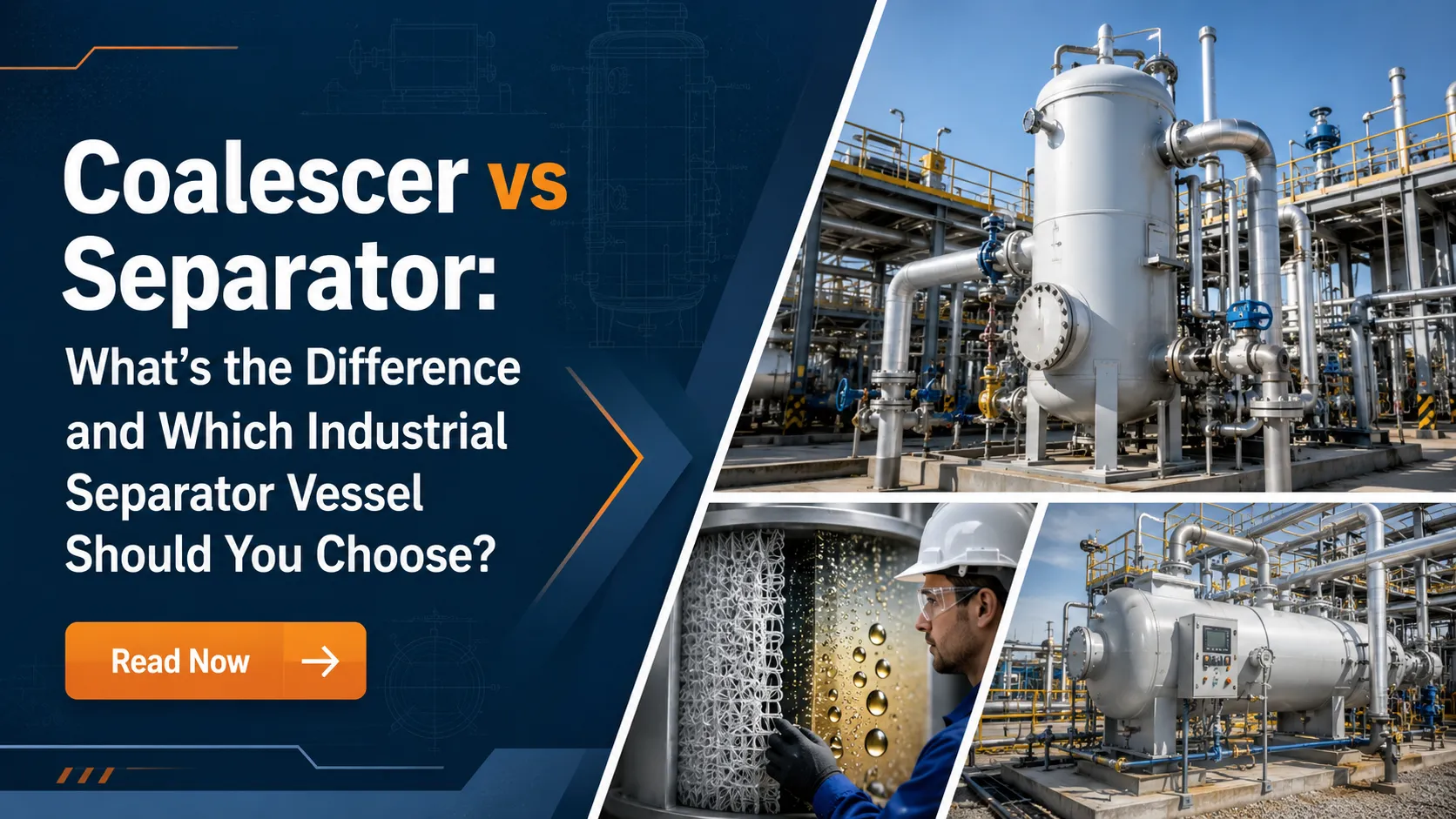
Every gas or liquid stream in an industrial plant carries something it should not. Compressed air carries moisture. Natural gas carries oil mist. Process water carries free oil. Left untreated, these contaminants corrode pipelines, damage compressors, and increase unplanned downtime.
That is why oil & gas plants, chemical units, power stations, and compressed air systems depend on separation equipment. Two terms come up constantly in this space: coalescer and separator. Many buyers use them interchangeably, but they are built differently and solve different problems.
Understanding the coalescer and separator difference helps you pick the right industrial separator vessel for your process, and avoid an expensive redesign later. This guide walks through the complete coalescer vs separator comparison, how each one works, where it fits, and how to select and fabricate a filter separator vessel for your plant.
Quick Answer
A coalescer merges fine liquid droplets into larger drops for easy removal.
A separator splits bulk gas, liquid, and solid phases using gravity, baffles,
or centrifugal force. Most plants use both together inside one filter separator vessel.
What is a Coalescer?
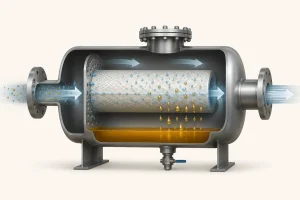
A coalescer is process equipment that merges tiny, suspended liquid droplets in a gas or liquid stream into larger droplets that settle and drain out easily. It handles the fine mist that gravity alone cannot remove.
How a Coalescer Works
The gas or liquid passes through a coalescing element made of fine fibres, mesh, or specially engineered media. Tiny droplets collide inside this media and combine, or “coalesce”, into bigger drops. These heavier drops fall by gravity into a sump or drain, while the cleaned gas or liquid continues downstream.
- Applications: compressed air dryers, natural gas processing, fuel and lube oil filtration, and removing oil mist from air lines.
- Advantages: very high removal efficiency for sub-micron droplets, compact footprint, and strong protection for downstream equipment such as compressors and turbines.
- Limitations: coalescing elements need periodic replacement, can clog if solids are present, and are not designed to handle bulk liquid slugs.
- Suitable industries: oil & gas, compressed air systems, power generation, and chemical processing.
What is a Separator?
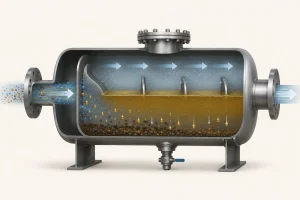
A separator is broader process equipment that splits bulk quantities of gas, liquid, and solids using physical separation principles rather than fine coalescing media. It is usually the first stage of treatment in a process line.
Working Principle
- Gravity separation: the heavier liquid settles at the bottom of the vessel while gas rises to the top, based on density difference.
- Mechanical separation: internal baffles, vanes, and mist eliminators redirect flow to improve phase separation.
- Centrifugal separation: cyclonic action flings heavier liquid and solid particles outward against the vessel wall.
- Applications: wellhead gas separation, compressor suction scrubbers, knockout drums, and three-phase oil-water-gas separation.
Industrial examples include oil & gas wellhead separators, steam-condensate separators, and inlet scrubbers ahead of gas compressors.
Coalescer vs Separator
The table below breaks down the coalescer vs separator comparison across the factors that matter most to procurement and process engineers.
Coalescer and Separator Difference Explained
The coalescer and separator difference becomes clearer when you look at how each performs across real industrial streams.
- Compressed Air: a separator removes bulk condensate after the compressor aftercooler, while a coalescer polishes the air to remove residual oil mist before it reaches instruments.
- Natural Gas: an inlet separator removes free liquids and slugs from wellhead gas, and a coalescer downstream captures fine liquid mist to protect compressors and meters.
- Steam: a moisture separator removes condensate from steam lines to protect turbines, improving efficiency and preventing water hammer.
- Oil & Gas Processing: three-phase separators split oil, water, and gas in bulk, while coalescers refine the water-in-oil or oil-in-water content to meet discharge limits.
- Chemical Plant: separators handle bulk solvent recovery streams, and coalescers remove trace water from organic solvents before reuse.
- Water Treatment: oil water separators remove free and dispersed oil from effluent, and coalescing plates inside them speed up oil droplet growth for faster skimming.
Coalescer vs Separator Filter
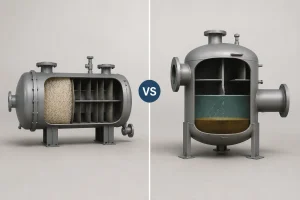
A filter removes solid particles from a gas or liquid stream using a physical barrier. A separator removes bulk liquid or solid phases using gravity or mechanical force. A coalescer removes fine liquid droplets by merging them into larger drops.
In real plants, these three functions rarely work alone. A single filter separator vessel usually combines a filter stage for solids, a coalescing stage for fine liquid mist, and a separator section for bulk liquid knockout, all inside one shell.
This combination is common in natural gas processing, where the incoming stream carries solids, water, and hydrocarbon liquids together, and a single-purpose vessel simply cannot handle all three.
What is a Filter Separator Vessel?
A filter separator vessel is a combination unit that filters solids, coalesces fine liquid droplets, and separates bulk liquid, all in a single pressure vessel. It is widely used in natural gas gathering and processing systems.
Key Internal Components
- Coalescing element: merges fine liquid droplets and traps solid particles.
- Separator element or vane pack: removes larger liquid droplets carried over from the first stage.
- Mist eliminator: a final wire-mesh or vane-type pad that catches residual mist before the gas outlet.
- Drain system: automatic or manual drain valves that remove collected liquid without shutting down the vessel.
- Applications: gas gathering stations, gas metering skids, compressor inlet protection, and gas processing plants.
- Advantages: handles solids, fine mist, and bulk liquid together, saving space and installation cost compared to three separate units.
- Maintenance: periodic element replacement, drain valve testing, and internal inspection during scheduled shutdowns.
Types of Industrial Separator Vessels
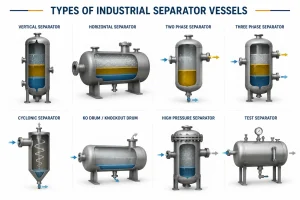
Industrial separator vessel is a broad category. Here are the common types you will come across when specifying equipment:
- Gas Liquid Separator: removes liquid carryover from a gas stream.
- Oil Water Separator: splits free and dispersed oil from water for treatment or discharge.
- Filter Separator Vessel: combines filtration, coalescing, and separation in one unit.
- Vertical Separator: suits smaller footprints and lower liquid volumes.
- Horizontal Separator: handles higher liquid volumes and longer residence time.
- Two Phase Separator: separates gas from a single liquid phase.
- Three Phase Separator: separates gas, oil, and water in one vessel.
- Cyclonic Separator: uses centrifugal force for compact, high-velocity separation.
- Knock Out Drum: protects downstream compressors or flares from liquid slugs.
- Slug Catcher: absorbs large liquid slugs from multiphase pipelines before processing.
Gas Liquid Separator
A gas liquid separator removes entrained liquid droplets from a gas stream before it reaches compressors, meters, or flare systems. It typically uses gravity settling followed by a mist eliminator pad.
- Applications: compressor suction protection, gas metering skids, and flare knockout drums.
- Industries: oil & gas, power generation, and chemical processing.
- Advantages: protects rotating equipment, improves gas quality, and reduces maintenance costs downstream.
- Selection tip: size the vessel for peak flow rate and expected liquid loading, not just average flow.
Oil Water Separator
An oil water separator removes free and dispersed oil from wastewater before discharge or reuse. Most designs use parallel or corrugated plate packs that speed up oil droplet coalescence and rise rate.
- Industrial applications: refineries, workshops, tank farms, and stormwater treatment at industrial sites.
- Environmental benefit: helps plants meet discharge norms for oil and grease content in effluent.
- Maintenance: regular sludge and oil skimming, plate pack cleaning, and inlet screen checks.
Industrial Filtration Equipment
Separator vessels are one part of a wider industrial filtration equipment family. Understanding where each piece fits helps you design a complete treatment train:
- Filters and strainers remove solid particles using a physical barrier.
- Coalescers merge and remove fine liquid droplets.
- Scrubbers remove gaseous contaminants and fine particulates using a liquid wash.
- Separator vessels remove bulk liquid or solid phases.
- Pressure vessels house all of the above under safe operating pressure and temperature.
How to Select the Right Separator Vessel
Choosing the correct industrial separator vessel comes down to matching equipment design to your actual process conditions. Consider these factors:
- Flow rate: peak and average gas or liquid flow determine vessel diameter.
- Pressure and temperature: define the design code, wall thickness, and material grade.
- Fluid properties: density, viscosity, and droplet size distribution affect separation efficiency.
- Required efficiency: downstream equipment sensitivity decides how fine the separation needs to be.
- Operating conditions: continuous or intermittent flow, slug potential, and turndown ratio.
- Maintenance access: davit arms, quick-opening closures, and drain valve placement.
- Material of construction: carbon steel, stainless steel, or clad material based on corrosion risk.
- Applicable codes: ASME Section VIII or relevant IS standards depending on jurisdiction.
- Budget and lead time: balance upfront cost against long-term maintenance and replacement cost.
- Future expansion: specify enough margin in the design to handle future capacity increases.
Separator Vessel Fabrication Process
Separator vessel fabrication follows a controlled sequence to meet ASME and IS standard requirements. A typical workflow looks like this:
- Raw material selection and mill test certificate verification.
- Plate cutting to design dimensions using CNC or plasma cutting.
- Rolling the plate into the required shell diameter.
- Shell fabrication and longitudinal seam welding.
- Dish end forming and fitment at both vessel ends.
- Nozzle fabrication and welding as per the nozzle schedule.
- Full welding of all shell, dish end, and nozzle joints.
- Post Weld Heat Treatment (PWHT), where the design code requires it.
- Non-Destructive Testing (NDT), including radiography and dye penetrant checks.
- Hydro testing at the specified test pressure to confirm structural integrity.
- Surface preparation and painting as per the specified paint system.
- Final dimensional and quality inspection before dispatch.
- Dispatch with test certificates and quality documentation.
Reputed manufacturers follow ASME Section VIII and relevant IS standards through every stage, backed by documented quality control at each checkpoint.
Industries Using Separator Vessels
Separator vessels are used wherever a process stream mixes gas, liquid, or solids, including:
- Oil & Gas and Refineries
- Chemical and Petrochemical plants
- Power Plants
- Food and Pharmaceutical processing
- Water Treatment facilities
- Fertilizer and Steel plants
- Paper mills
- Marine and Energy sectors
Common Problems and Maintenance Tips
- Pressure loss: check for clogged elements or scaling on internals.
- Filter clogging: replace coalescing or filter elements on a fixed schedule, not only on failure.
- Corrosion: inspect internals during shutdowns and monitor wall thickness with periodic UT checks.
- Moisture carryover: verify mist eliminator condition and check for vessel level control issues.
- Preventive steps: schedule regular inspection, timely cleaning, and planned element replacement to avoid unplanned shutdowns.
Why Choose a Custom Pressure Vessel Manufacturer in India?
Off-the-shelf equipment rarely matches every process condition exactly. A custom pressure vessel manufacturer in India can design around your actual flow rate, pressure, fluid, and space constraints, rather than forcing your process to fit a standard model.
- Customization: vessel size, nozzle layout, and internals matched to your process data sheet.
- Engineering and fabrication: in-house design review and code-compliant fabrication under one roof.
- Testing and quality: NDT, hydro testing, and documented quality control at every stage.
- Lead time and cost: domestic fabrication often reduces lead time and freight cost compared to imported vessels.
- After-sales support: easier access for spares, element replacement, and site support.
National Engineers & Steel Fabricators works with plant engineers and EPC contractors across India to design and fabricate separator vessels matched to real operating data, not generic catalogue sizes.
Why National Engineers is a Trusted Process Equipment Manufacturer in India
National Engineers & Steel Fabricators has over 35 years of experience in custom fabrication and pressure vessel manufacturing, based out of Sachin GIDC, Surat.
- Custom fabrication: pressure vessels, filter separator vessels, and heavy fabrication work built to customer specifications.
- Quality testing: hydro testing, NDT, and documented inspection at each production stage.
- Industrial standards: fabrication carried out in line with applicable ASME and IS code requirements.
- Experienced team: an engineering team familiar with process equipment for varied industrial applications.
- Industries served: oil & gas, chemical, power, and general industrial manufacturing sectors.
- Timely delivery: planned production scheduling to meet project timelines.
For plant engineers and procurement teams evaluating a process equipment manufacturer in India, National Engineers offers direct access to design, fabrication, and testing under a single point of contact.
Conclusion
Coalescers and separators solve different problems in the same process line. A separator handles bulk gas, liquid, and solid separation, while a coalescer refines the stream further by merging fine droplets for easy removal. Understanding this coalescer vs separator difference is the first step toward specifying the right industrial separator vessel.
The right choice always depends on your specific application: flow rate, pressure, fluid properties, and required efficiency. Rather than guessing, work with an experienced process equipment manufacturer who can review your process data and recommend the correct vessel type and configuration.
National Engineers & Steel Fabricators designs and fabricates custom separator vessels, filter separator vessels, and pressure vessels for clients across India. Contact the team to discuss your process requirements and get a vessel specification suited to your plant.
Also, Read: Top 10 Pressure Vessel Manufacturers in India: Complete Guide to Choosing the Best Supplier
Frequently Asked Questions
Which is better, a separator or a coalescer?
Neither is universally better; they serve different stages of treatment. A separator is better for removing large volumes of liquid quickly, while a coalescer is better for capturing fine, sub-micron droplets that gravity cannot settle. Most industrial systems use a separator first for bulk removal, followed by a coalescer for final polishing, rather than choosing one over the other.
What is a filter separator vessel?
A filter separator vessel is a combination unit that filters out solids, coalesces fine liquid droplets, and separates bulk liquid within a single pressure vessel. It is widely used in natural gas gathering and processing, where the stream carries solids, water, and hydrocarbon liquid together, and no single-purpose vessel can treat all three efficiently.
How does a gas liquid separator work?
A gas liquid separator uses gravity settling and internal baffles or mist eliminator pads to remove entrained liquid droplets from a gas stream. As the gas slows down inside the larger vessel diameter, heavier liquid droplets fall out of the flow and collect at the bottom for drainage, while the cleaned gas exits through the top outlet.
What industries use separator vessels?
Separator vessels are used across oil & gas, refineries, chemical and petrochemical plants, power generation, food and pharmaceutical processing, water treatment, fertilizer, steel, paper, and marine industries. Any process that mixes gas, liquid, or solids at some stage typically needs a separator vessel to protect downstream equipment and meet quality or discharge requirements.
What is an oil water separator?
An oil water separator is equipment that removes free and dispersed oil from wastewater before discharge or reuse. It typically uses parallel or corrugated plate packs to speed up oil droplet coalescence, allowing oil to rise and be skimmed off while treated water exits separately. It is common in refineries, workshops, and industrial effluent treatment systems.
How often should separator vessels be maintained?
Maintenance frequency depends on service conditions, but most plants inspect separator vessels every six to twelve months, with coalescing or filter elements replaced on a fixed schedule rather than waiting for failure. High-solids or high-liquid-loading services may need more frequent checks. A structured preventive maintenance plan reduces the risk of unplanned shutdowns and pressure drop issues.
What materials are used in separator vessel fabrication?
Carbon steel is the most common material for standard services, while stainless steel or clad materials are used where corrosion resistance is critical, such as in chemical or high-moisture environments. Material selection depends on the process fluid, operating pressure and temperature, and applicable design code, and is finalized during the engineering review stage.
Can separator vessels be customized?
Yes. Separator vessels are commonly custom-fabricated to match specific flow rates, pressure and temperature ratings, nozzle layouts, and internal configurations. Custom fabrication allows the vessel to fit actual process data rather than a generic catalogue size, which improves separation efficiency and avoids oversizing or undersizing the equipment for the application.
Who is a reliable custom pressure vessel manufacturer in India?
National Engineers & Steel Fabricators, based in Sachin GIDC, Surat, is a process equipment manufacturer with over 35 years of experience in custom pressure vessel and heavy fabrication work. The team handles engineering, fabrication, and quality testing under one roof for clients across oil & gas, chemical, and general industrial sectors.
What is industrial filtration equipment?
Industrial filtration equipment is a broad category that includes filters, strainers, coalescers, scrubbers, and separator vessels, all designed to remove unwanted solids, liquids, or gases from a process stream. Each type handles a different contaminant or particle size, and plants often combine several types into one treatment train to meet process and environmental requirements.
How do I choose the right separator vessel?
Start with your actual process data: flow rate, operating pressure and temperature, fluid properties, and required separation efficiency. From there, confirm the applicable design code, material of construction, and maintenance access needs. Working with an experienced process equipment manufacturer helps translate this data into a correctly sized and configured separator vessel.
What is the difference between a two-phase and three-phase separator?
A two-phase separator splits gas from a single liquid phase, such as gas and water, or gas and oil. A three-phase separator goes a step further and separates gas, oil, and water simultaneously within one vessel, using density differences and sufficient residence time. Three-phase separators are common in upstream oil & gas production.
Can a coalescer replace a separator?
No. A coalescer is designed for fine droplet removal and is not built to handle bulk liquid slugs or high liquid loading. Using a coalescer alone in a bulk-liquid service would overload the elements quickly and cause excessive pressure drop. Separators and coalescers are complementary, not interchangeable, and most systems use both in sequence.
What is the typical pressure drop across a coalescer?
Pressure drop across a clean coalescing element is usually low, but it rises gradually as the element loads with liquid and solids over time. Most manufacturers specify a maximum allowable pressure drop, beyond which the element should be replaced. Monitoring differential pressure is the simplest way to track coalescer condition between scheduled maintenance.