Industrial pipelines are essential assets across industries such as oil & gas, petrochemicals, chemicals, water treatment, power generation, and food processing. These pipelines transport fluids, gases, and slurries over long distances and often operate under high pressure and temperature conditions.
While pipelines are designed for durability and efficiency, the internal environment of a pipeline is rarely stable. Over time, various substances accumulate inside the pipeline. These may include wax deposits, scale formation, corrosion residues, sludge, sand particles, and product remnants.
This internal buildup creates serious operational challenges:
- Reduced pipeline capacity
- Increased pressure drop
- Higher energy consumption
- Increased wear and tear
- Risk of corrosion and leakage
- Product contamination
If not addressed, these issues can lead to major operational failures, production losses, and costly shutdowns.
Traditional cleaning methods require pipeline shutdown and manual intervention, which is expensive and time-consuming. This is why industries use pipeline pigging systems, where the Pig Launcher plays a critical role.
What is a Pig Launcher?
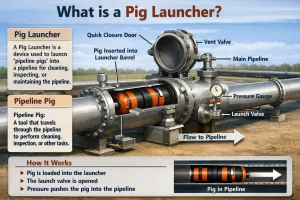
A Pig Launcher is a specialized pressure vessel used to introduce a device called a “pig” into a pipeline. The pig travels through the pipeline to perform cleaning, inspection, or separation tasks.
Simple Definition:
A Pig Launcher is the starting point of pigging operations, allowing the safe insertion of pigs into a pressurized pipeline system.
Key Functions of a Pig Launcher:
- Launch cleaning pigs into pipelines
- Insert inspection tools (smart pigs)
- Remove internal deposits
- Maintain flow efficiency
- Enable product separation
The Pig Launcher allows this process to happen without shutting down the pipeline, which is critical for industrial operations.
Understanding Pipeline Pigging Systems
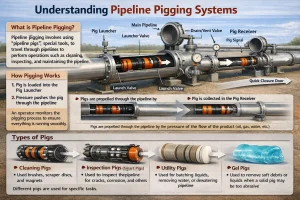
A pipeline pigging system consists of three main components that work together to maintain pipeline health.
1. Pig Launcher
The Pig Launcher is used to insert the pig into the pipeline. It acts as a pressurized chamber where the pig is loaded and launched.
2. Pipeline Pig
The pig is a device that travels through the pipeline. Types of pigs include:
- Foam pigs
- Brush pigs
- Scraper pigs
- Smart pigs (inspection tools)
Each pig serves a specific purpose such as cleaning, inspection, or separation.
3. Pig Receiver
The Pig Receiver collects the pig after it completes its journey through the pipeline. It ensures safe removal and disposal or reuse.
How the System Works:
- Pig is loaded into the Pig Launcher
- Pressure pushes the pig into the pipeline
- Pig travels through the pipeline
- Cleaning or inspection is performed
- Pig reaches the receiver
This system ensures continuous and efficient pipeline maintenance.
Why Pig Launcher Systems Are Critical
Pigging systems are essential for maintaining industrial pipeline performance.
1. Improves Flow Efficiency
Deposits reduce the effective diameter of the pipeline. Pigging removes these deposits and restores optimal flow.
2. Enhances Safety
Corrosion and damage often occur beneath accumulated deposits. Pigging removes these layers and prevents failures.
3. Reduces Maintenance Costs
- Minimizes downtime
- Reduces manual cleaning
- Extends pipeline life
4. Maintains Product Quality
Pigging prevents mixing of different products, ensuring purity and consistency.
How a Pig Launcher Works (Detailed Step-by-Step Process)
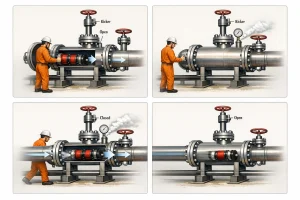
The working process of a Pig Launcher involves a controlled sequence of operations that ensures safe insertion, movement, and retrieval of pigs within a pipeline. This process is designed to maintain pipeline efficiency without interrupting operations.
Step 1: Isolation
The Pig Launcher is first isolated from the main pipeline using isolation valves.
- Ensures no active flow enters the launcher during loading
- Creates a safe working environment for operators
- Prevents pressure-related hazards
Step 2: Venting and Draining
The internal pressure of the Pig Launcher is reduced, and residual fluids are removed.
- Vent valves release trapped pressure
- Drain valves remove leftover liquids or gases
- Prepares the system for safe opening
Step 3: Pig Loading
The closure door is opened, and the pig is inserted into the barrel.
- Pig is placed correctly inside the launcher
- Alignment is checked to ensure smooth movement
- Closure area is inspected before sealing
Step 4: Closure Sealing
The closure is securely locked to handle high pressure conditions.
- Quick Opening Closure (QOC) is tightly sealed
- Safety locks ensure no accidental opening
- System is prepared for pressurization
Step 5: Pressurization
Fluid is introduced behind the pig to match the pipeline pressure.
- Pressure is gradually increased
- Ensures smooth transition into the pipeline
- Prevents sudden pressure shocks
Step 6: Launching
The pig is pushed into the pipeline using fluid flow.
- Kicker valve directs flow behind the pig
- Pig enters the pipeline smoothly
- Flow carries the pig forward
Step 7: Pig Travel
The pig moves through the pipeline to perform its function.
- Removes deposits like wax, scale, and debris
- Performs inspection in case of smart pigs
- Maintains pipeline efficiency
Step 8: Reception
The pig reaches the Pig Receiver at the end of the pipeline.
- Safely collected in the receiver unit
- Removed for reuse or disposal
- Confirms successful pigging operation
Key Components of a Pig Launcher
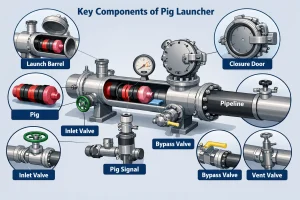
A Pig Launcher consists of several critical components that work together to ensure safe, efficient, and controlled pigging operations in industrial pipelines. Each component is designed to handle high pressure, ensure operational safety, and maintain system reliability.
Barrel
The barrel is the main cylindrical chamber of the Pig Launcher where the pig is loaded before launching.
- Primary Loading Section:
Acts as the housing unit for inserting pigs into the pipeline. - Heavy-Duty Construction:
Designed to withstand high pressure and harsh operating conditions. - Size Compatibility:
Manufactured according to pipeline diameter and pig dimensions for smooth operation.
Quick Opening Closure (QOC)
The Quick Opening Closure is a critical safety component that allows fast and secure access to the barrel.
- Safe Access Mechanism:
Enables operators to open and close the launcher quickly without compromising safety. - Pressure Lock System:
Prevents opening under pressure, ensuring operator protection. - Time-Saving Operation:
Reduces loading time and improves operational efficiency.
Valves System
The valve system controls the flow and pressure within the Pig Launcher during operation.
- Isolation Valve:
Separates the Pig Launcher from the main pipeline during loading and maintenance. - Kicker Valve:
Introduces fluid pressure behind the pig to push it into the pipeline. - Vent & Drain Valves:
Used to release pressure and remove residual fluids before opening the closure.
Instrumentation
Instrumentation ensures monitoring, control, and safety during pigging operations.
- Pressure Gauges:
Monitor internal pressure levels to maintain safe operating conditions. - Pig Signallers:
Detect and indicate the movement or passage of the pig within the pipeline. - Safety Valves:
Automatically release excess pressure to prevent system failure.
Nozzles and Piping
Nozzles and piping connect the Pig Launcher to the main pipeline system.
- Flow Connection:
Facilitate smooth entry of the pig into the pipeline. - System Integration:
Ensure proper alignment and compatibility with existing pipeline infrastructure. - Leak-Proof Design:
Designed to handle high pressure without leakage.
Types of Pig Launchers
Different types of Pig Launchers are designed based on pipeline configuration, space availability, pressure conditions, and operational requirements. Selecting the right type ensures efficient pigging operations, safety, and long-term performance.
Horizontal Pig Launcher
Horizontal Pig Launchers are the most commonly used configuration in industrial pipeline systems.
- Most Widely Used Design:
Preferred for onshore pipeline networks due to ease of installation and operation. - Easy Operation & Maintenance:
Provides convenient access for loading and unloading pigs. - Suitable for Large Pipelines:
Ideal for long-distance pipelines in oil & gas, water, and chemical industries. - Better Handling Efficiency:
Simplifies pig insertion and reduces operational complexity.
Vertical Pig Launcher
Vertical Pig Launchers are used in environments where horizontal space is limited.
- Space-Saving Design:
Ideal for offshore platforms, refineries, and compact industrial setups. - Common in Offshore Applications:
Widely used in oil rigs and marine pipeline systems. - Efficient in Limited Layouts:
Helps optimize plant layout without compromising functionality. - Requires Skilled Operation:
Handling and loading may require more precision compared to horizontal systems.
Skid Mounted Pig Launcher
Skid Mounted Pig Launchers are pre-engineered and assembled systems for quick deployment.
- Pre-Assembled Unit:
Delivered as a ready-to-install module, reducing on-site fabrication time. - Easy Installation:
Minimizes civil work and simplifies integration into existing systems. - Reduced Site Work:
Saves installation cost and time, especially in remote or industrial locations. - Ideal for Modular Projects:
Suitable for temporary setups or fast-track industrial projects.
High Pressure Pig Launcher
High Pressure Pig Launchers are specifically designed for demanding pipeline conditions.
- Designed for High Pressure Systems:
Built to withstand extreme pressure and temperature conditions. - Used in Critical Industries:
Common in oil & gas, petrochemical, and high-performance industrial pipelines. - Enhanced Safety Design:
Equipped with advanced safety features and robust construction. - Long-Term Durability:
Suitable for continuous operation in harsh environments.
Pig Launcher vs Pig Receiver
| Feature | Pig Launcher | Pig Receiver |
|---|---|---|
| Function | Launch pig | Receive pig |
| Position | Upstream | Downstream |
| Role | Start of operation | End of operation |
Both are essential for a complete pigging system.
Design & Engineering Considerations
Designing a Pig Launcher requires careful planning.
Key Factors:
- Pipeline diameter
- Operating pressure
- Fluid characteristics
- Pig size and type
- Environmental conditions
Engineering Focus:
- Structural strength
- Flow efficiency
- Safety compliance
- Ease of operation
Materials Used in Pig Launcher Manufacturing
The selection of materials in Pig Launcher manufacturing plays a crucial role in determining performance, durability, corrosion resistance, and pressure-handling capability. Different materials are chosen based on operating conditions such as pressure, temperature, and the type of fluid being transported.
Carbon Steel
Carbon steel is the most commonly used material in Pig Launcher fabrication due to its strength and affordability.
- Widely Used in Industrial Applications:
Suitable for oil & gas, water pipelines, and general-purpose applications. - Cost-Effective Solution:
Offers a balance between strength and cost, making it ideal for large-scale projects. - Good Mechanical Strength:
Handles moderate pressure and temperature conditions efficiently.
Stainless Steel
Stainless steel is preferred in environments where corrosion resistance and hygiene are critical.
- Excellent Corrosion Resistance:
Ideal for handling chemicals, corrosive fluids, and harsh environments. - Used in Chemical & Food Industries:
Ensures contamination-free operations in pharma, food processing, and chemical plants. - Low Maintenance Requirement:
Reduces long-term maintenance costs due to resistance to rust and scaling.
Alloy Steel
Alloy steel is used in high-performance applications where superior strength and durability are required.
- High Strength & Pressure Resistance:
Designed for high-pressure and high-temperature pipeline systems. - Enhanced Durability:
Performs well in extreme industrial conditions such as petrochemical and offshore operations. - Customizable Properties:
Alloy composition can be tailored for specific mechanical and thermal requirements.
Pig Launcher Manufacturing Process
The manufacturing process of a Pig Launcher involves precision engineering, strict quality control, and adherence to industrial standards. Each stage is critical to ensure the system can withstand high pressure, harsh environments, and long-term industrial use.
Fabrication
Fabrication is the initial stage where the structural body of the Pig Launcher is formed.
- Plate Cutting & Rolling:
High-grade steel plates are cut and rolled into cylindrical shapes based on required dimensions. - Shell Formation:
The rolled plates are aligned and prepared for welding to form the main barrel. - Dimensional Accuracy:
Ensures correct diameter, thickness, and alignment as per design specifications.
Welding
Welding is a critical step that ensures the strength and pressure integrity of the Pig Launcher.
- Precision Welding Techniques:
Methods like MIG, TIG, or submerged arc welding are used depending on material and thickness. - Joint Strength Assurance:
Welds are designed to handle high pressure and mechanical stress. - Quality Checks:
Weld joints are later tested using NDT methods to ensure defect-free construction.
Assembly
In this stage, all components are integrated to complete the Pig Launcher system.
- Installation of Components:
Valves (isolation, vent, drain), quick opening closures (QOC), and nozzles are installed. - Instrumentation Setup:
Pressure gauges, safety valves, and pig signallers are fitted. - System Integration:
Ensures compatibility with pipeline systems and smooth operation during pigging.
Surface Treatment
Surface treatment enhances durability and protects the Pig Launcher from corrosion.
- Anti-Corrosion Coating:
Internal and external coatings are applied based on operating environment. - Painting & Finishing:
Industrial-grade paints are used for additional protection and identification. - Long-Term Protection:
Extends equipment life, especially in offshore, chemical, and humid environments.
Testing & Quality Control in Pig Launcher Manufacturing
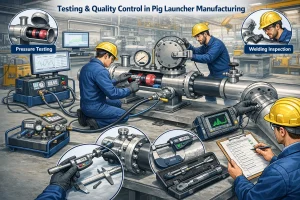
Testing and quality control are critical processes in Pig Launcher manufacturing to ensure safety, durability, and compliance with industrial standards. Since Pig Launchers operate under high pressure and harsh conditions, strict testing protocols are essential before deployment.
Hydro Testing
Hydro testing is performed to verify the pressure-holding capability of the Pig Launcher system.
- Pressure Integrity Check:
The system is filled with water and tested at pressures higher than operating limits to ensure structural strength. - Leak Detection:
Identifies any leakage points in weld joints, valves, or connections. - Safety Assurance:
Confirms that the Pig Launcher can safely operate under real industrial conditions.
Non-Destructive Testing (NDT)
NDT methods are used to detect internal and surface defects without damaging the equipment.
- Ultrasonic Testing (UT):
Detects internal flaws, cracks, and thickness variations in metal components. - Radiographic Testing (RT):
Uses X-rays or gamma rays to inspect weld quality and internal defects. - Magnetic Particle Testing (MPT):
Identifies surface and near-surface cracks in ferromagnetic materials. - Dye Penetrant Testing (Optional):
Used for detecting fine surface cracks in non-magnetic materials.
Inspection & Quality Assurance
Final inspection ensures that the Pig Launcher meets design specifications and safety standards.
- Dimensional Accuracy Check:
Verifies alignment, diameter, and component fit as per engineering drawings. - Material Verification:
Confirms the use of specified materials like carbon steel, stainless steel, or alloy steel. - Compliance with Standards:
Ensures adherence to industry codes such as ASME, API, and ISO. - Functional Testing:
Checks valves, closures, and instrumentation for proper operation.
Safety Measures in Pigging Operations
Safety is critical in pigging operations.
Key Practices:
- Ensure zero pressure before opening
- Use safety interlocks
- Monitor pressure continuously
- Train operators
Industrial Applications of Pig Launchers
Oil & Gas Industry
Pig Launchers are extensively used in the oil & gas sector for cleaning crude oil and gas pipelines, removing wax, sludge, and debris buildup. They also enable internal inspection using smart pigs, helping detect corrosion, cracks, and blockages. This ensures uninterrupted flow, improves pipeline efficiency, and reduces the risk of costly failures or leaks in high-pressure systems.
Chemical Industry
In chemical processing plants, Pig Launchers play a critical role in product recovery and contamination prevention. They help clear residual chemicals from pipelines between batches, ensuring product purity and minimizing material loss. This is especially important for handling hazardous or reactive chemicals where safety and precision are essential.
Water & Wastewater
Pigging systems are widely used in water supply and wastewater pipelines to remove scale, biofilm, and sediment deposits. Pig Launchers help maintain consistent flow rates, improve pipeline hygiene, and prevent clogging. Regular pigging also extends pipeline lifespan and reduces maintenance costs in municipal and industrial water systems.
Food & Pharma Industry
n food and pharmaceutical industries, Pig Launchers are used for hygienic fluid transfer and cleaning of pipelines carrying sensitive products like milk, beverages, syrups, or pharmaceutical liquids. They ensure minimal product wastage, maintain strict hygiene standards, and prevent cross-contamination, which is critical for regulatory compliance and product quality.
Benefits of Pig Launcher Systems
Pig Launcher systems play a crucial role in maintaining pipeline efficiency, safety, and cost-effectiveness across industries such as oil & gas, chemical processing, and water treatment. Below are the key benefits categorized for better understanding:
Operational Benefits
Pigging operations significantly improve day-to-day pipeline performance.
- Improved Flow Efficiency:
Removes internal deposits like wax, scale, and sludge, restoring the pipeline’s original diameter and ensuring smooth fluid flow. - Reduced Downtime:
Enables cleaning and maintenance without shutting down the pipeline, ensuring continuous operations and higher uptime. - Extended Pipeline Life:
Prevents internal corrosion and wear, increasing the lifespan of pipeline infrastructure.
Technical Benefits
From an engineering perspective, pigging enhances system accuracy and reliability.
- Accurate Pipeline Inspection:
Supports the use of smart pigs for detecting corrosion, cracks, leaks, and structural defects. - Effective Cleaning Performance:
Ensures complete removal of contaminants, residues, and buildup that impact system performance. - Process Optimization:
Maintains consistent pressure and flow conditions, improving overall system efficiency.
Business Benefits
Pig Launcher systems directly impact operational costs and productivity.
- Lower Operational Costs:
Reduces maintenance expenses, minimizes manual cleaning, and prevents costly pipeline failures. - Higher Productivity:
Ensures uninterrupted production cycles by eliminating frequent shutdowns. - Improved Product Quality:
Prevents contamination between batches, especially in chemical, food, and pharma industries.
Common Challenges in Pigging Systems
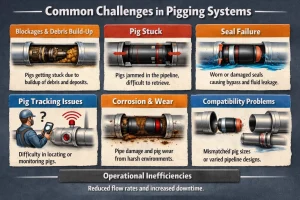
Despite their efficiency, pigging systems can face several operational and technical challenges if not properly designed, maintained, or operated. Identifying and addressing these issues is essential to ensure smooth and safe pipeline operations.
Pig Getting Stuck
One of the most common issues in pigging operations is the pig getting stuck inside the pipeline.
- Causes:
Incorrect pig size, excessive deposits, pipeline bends, or obstructions - Impact:
Flow blockage, pressure buildup, and potential pipeline damage - Solution:
Proper pig selection, regular cleaning schedules, and pipeline inspection before pigging
Pressure Imbalance
Pressure mismatch during pigging can disrupt operations and affect pig movement.
- Causes:
Improper valve operation, sudden pressure changes, or incorrect system setup - Impact:
Incomplete pig travel or operational inefficiency - Solution:
Controlled pressurization and monitoring using pressure gauges and automation systems
Leakage Issues
Leakage can occur in valves, closures, or pipeline joints during pigging operations.
- Causes:
Poor sealing, worn-out components, or improper installation - Impact:
Safety risks, product loss, and environmental hazards - Solution:
Regular inspection, proper sealing systems, and maintenance of valves and closures
Improper Pig Selection
Choosing the wrong type of pig can reduce effectiveness and cause operational issues.
- Causes:
Lack of understanding of pipeline conditions or application requirements - Impact:
Ineffective cleaning, pig damage, or pipeline blockage - Solution:
Selecting pigs based on pipeline diameter, fluid type, and specific cleaning or inspection needs
How to Choose the Right Pig Launcher
Selecting the right Pig Launcher is critical for ensuring efficient pipeline operations, long-term reliability, and safety. The choice depends on multiple technical and operational factors such as pressure, material compatibility, and application requirements.
Check Pressure Rating
The Pig Launcher must be designed to handle the operating pressure of the pipeline.
- Match Operating Conditions:
Ensure the launcher can withstand both normal and peak pressure levels. - High-Pressure Applications:
Use specially designed high-pressure Pig Launchers for oil & gas or petrochemical pipelines. - Safety Compliance:
Always verify design codes such as ASME standards for pressure vessels.
Select Appropriate Material
Material selection directly impacts durability and corrosion resistance.
- Carbon Steel:
Suitable for standard applications with cost efficiency. - Stainless Steel:
Ideal for corrosive environments and hygienic industries like food and pharma. - Alloy Steel:
Recommended for high-pressure and high-temperature conditions.
Ensure Compatibility
The Pig Launcher must be fully compatible with the pipeline system and pigging requirements.
- Pipeline Diameter Matching:
Ensure correct sizing for smooth pig movement. - Fluid Characteristics:
Consider the type of fluid (gas, liquid, slurry) being transported. - Pig Type Compatibility:
Select a launcher that supports foam pigs, scraper pigs, or smart pigs as required.
Choose an Experienced Manufacturer
The manufacturer plays a key role in system performance and reliability.
- Proven Industry Experience:
Choose manufacturers with expertise in industrial pipeline systems. - Customization Capability:
Ensure they can provide tailored solutions based on project requirements. - Quality Assurance:
Look for certifications, testing standards, and past project references.
Pig Launcher Manufacturing in India
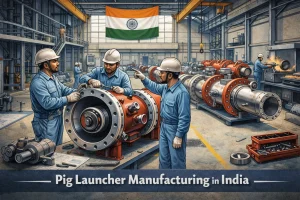
India has emerged as a leading hub for Pig Launcher manufacturing, offering high-quality engineering solutions at competitive prices. With a strong industrial base and growing demand from sectors like oil & gas, petrochemicals, and water treatment, Indian manufacturers are delivering globally competitive pigging systems.
Why India is a Preferred Manufacturing Hub
- Skilled Workforce:
India has a large pool of experienced engineers, fabricators, and technicians specializing in pressure vessel and pipeline equipment manufacturing. - Advanced Fabrication Capabilities:
Modern manufacturing facilities use advanced welding techniques, CNC cutting, and precision engineering to ensure high-quality production. - Competitive Pricing:
Cost-effective labor and manufacturing processes make India an attractive option for both domestic and international clients.
Strong Industry Demand
- Growing infrastructure projects in oil & gas, water, and chemical industries
- Increasing need for pipeline maintenance and efficiency
- Expansion of petrochemical and energy sectors
Export Capability
Many Indian Pig Launcher manufacturers export to global markets, including the Middle East, Africa, and Southeast Asia.
- International quality standards
- Timely delivery and project execution
- Competitive global pricing
Custom Pig Launcher Fabrication
Custom Pig Launcher solutions provide:
- Better integration
- Improved performance
- Reduced maintenance
Cost Factors of Pig Launcher
- Size and diameter
- Pressure rating
- Material type
- Design complexity
Latest Trends in Pigging Technology
- Smart pigs with sensors
- Automated pigging systems
- Real-time monitoring
Maintenance Tips for Pig Launchers
- Regular inspection
- Valve maintenance
- Cleaning after operations
- Periodic testing
Conclusion
A Pig Launcher is not just a supporting component but a vital system that ensures the long-term efficiency, safety, and reliability of industrial pipelines. By enabling seamless pigging operations without interrupting flow, it helps industries minimize downtime, reduce operational costs, and maintain product integrity. With increasing demand for automation, smart monitoring, and high-performance pipeline systems, pig launcher technology continues to evolve rapidly. Choosing the right design, material, and manufacturer plays a crucial role in achieving optimal performance. In modern industrial operations, investing in a robust pigging system is no longer optional—it is essential for sustainable and efficient pipeline management.
Also, Read: Industrial Pressure Vessel Selection Guide for Process Plants
Frequently Asked Question
What is a pipeline pigging system?
A pipeline pigging system consists of a Pig Launcher, pig, and Pig Receiver that work together to clean, inspect, and maintain pipeline efficiency.
What are the benefits of a Pig Launcher system?
Pig Launcher systems improve flow efficiency, reduce downtime, enable accurate inspection, lower maintenance costs, and ensure safe pipeline operations.
How does a Pig Launcher work?
A Pig Launcher works by loading a pig into a pressurized chamber and using fluid pressure to push it through the pipeline for cleaning or inspection.
What are the main components of a Pig Launcher?
A Pig Launcher includes a barrel, quick opening closure, valves, instrumentation, and connecting nozzles for safe pigging operations.
What materials are used in Pig Launcher manufacturing?
Pig Launchers are made from carbon steel, stainless steel, and alloy steel depending on pressure, corrosion resistance, and application requirements.
What industries use Pig Launchers?
Pig Launchers are used in oil & gas, chemical, water treatment, food processing, and pharmaceutical industries for pipeline maintenance.
What testing is done in Pig Launcher systems?
Pig Launchers undergo hydro testing, non-destructive testing (UT, RT, MPT), and inspection to ensure safety, strength, and compliance.
What is the manufacturing process of a Pig Launcher?
The manufacturing process includes fabrication, welding, assembly, and surface treatment to ensure durability and pressure resistance.
Why are Pig Launcher systems important?
Pig Launcher systems are important because they maintain pipeline efficiency, prevent corrosion, reduce downtime, and improve overall operational safety.