If you are planning to buy or install an industrial storage tank, getting the storage tank capacity calculation right is one of the most important steps in the entire project. A wrong capacity estimate can lead to storage shortage, process delay, overfilling risk, space planning issues, and incorrect fabrication cost estimation.
Many plant owners, project engineers, and purchase managers rely on rough size guesses instead of proper tank capacity calculation. This often creates problems later, especially when the tank is already fabricated and installed on site.
This guide is written for industrial buyers, fabrication buyers, project engineers, and manufacturing companies who want a clear, practical understanding of tank capacity formula, litres conversion, working capacity, safety factors, and how to choose the right storage tank manufacturer in India.
By the end of this article, you will be able to estimate approximate tank volume yourself, understand the difference between total and working capacity, and know exactly what details to share with a manufacturer for accurate, custom tank design.
What Is Storage Tank Capacity?
Storage tank capacity simply means the internal volume of a tank that is available to hold liquid, gas, or process material. It tells you how much a tank can physically store, based on its internal dimensions.
Storage tank capacity is usually measured in litres, kilolitres (KL), or cubic metres. In some technical documents, it is also referred to as water capacity, especially for pressure vessels and air receiver tanks where capacity is tested using water filling methods.
Storage tanks are used across many industrial applications, including liquid storage, air receiver vessels, pressure vessels, chemical process tanks, and general industrial storage tanks. The purpose of the tank often decides the shape, orientation, and design of the vessel.
It is also important to understand that design capacity and usable capacity are not always the same. Design capacity refers to the full internal volume based on tank dimensions, while usable capacity is the actual safe volume available for daily operation, after accounting for safe filling limits and internal fittings.
Why Storage Tank Capacity Calculation Is Important?

Getting your storage tank capacity calculation right at the planning stage saves time, money, and operational headaches later. Here is why this step matters so much for industrial buyers.
- Correct storage planning: You can plan how much raw material or liquid your plant can hold at any given time.
- Process continuity: Adequate capacity keeps your production line running without frequent refilling or supply interruptions.
- Safety: Proper capacity calculation avoids overfilling, pressure build-up, and related safety risks.
- Cost estimation: Fabrication cost depends directly on tank size, material quantity, and thickness, all linked to capacity.
- Material selection: Larger capacity tanks may need different shell thickness or material grade.
- Space planning: Knowing the exact dimensions helps in planning the installation area and civil foundation.
- Fabrication drawing approval: Capacity figures are a key part of the general arrangement drawing that gets approved before fabrication.
- Avoiding overfilling: Working capacity limits prevent liquid overflow and related safety hazards.
- Future capacity expansion: Understanding current capacity helps in planning any future expansion of storage requirement.
Where Can You Find Tank Capacity?
If you already own a tank or are reviewing an existing installation, tank capacity information is usually available in more than one place. You do not always need to calculate it from scratch.
- Name plate fixed on the tank body
- Manufacturer drawing or general arrangement drawing
- Design document submitted during fabrication approval
- Test certificate, especially for pressure vessels
- Technical datasheet shared by the manufacturer
- Compliance plate, where applicable, as per statutory requirement
- Previous purchase record or order documentation
- Original fabrication drawing kept in your project file
If none of these documents are available, a basic tank volume calculation, explained in the next sections, can help you estimate approximate capacity. However, the final design and confirmed capacity should always be verified by the manufacturer or a qualified engineer before ordering a new tank or planning any modification.
Basic Storage Tank Capacity Formula
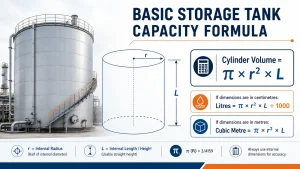
Most industrial storage tanks, whether horizontal or vertical, are cylindrical in shape. This makes the basic storage tank capacity formula fairly simple to apply.
The standard formula for cylinder volume is:
Cylinder Volume = π × r² × L
Where:
r = internal radius of the tank
L = internal length (for horizontal tanks) or height (for vertical tanks)
π = 3.142 (approximate value)
This tank capacity formula gives you the volume in cubic units, based on whatever unit you use for radius and length. To get a usable answer in litres, you need one more conversion step.
If your dimensions are in centimetres:
Litres = π × r² × L ÷ 1000
If your dimensions are in metres:
Cubic Metre = π × r² × L
Litres = Cubic Metre × 1000
This tank capacity calculation approach works well for a quick estimate. It is commonly used to check horizontal tank capacity calculation, vertical tank sizing, and general cylinder tank capacity calculation before approaching a manufacturer for a detailed design.
Example of Storage Tank Capacity Calculation
Let us walk through a simple, practical example so the formula becomes easy to apply on your own tank dimensions.
Suppose you have a cylindrical tank with the following dimensions:
3.142 × 50 × 50 × 320 ÷ 1000
= approx. 2514 litres
- Tank diameter = 100 cm (so radius = 50 cm)
- Tank length = 320 cm
Applying the formula:
This figure of approximately 2514 litres is the approximate internal capacity of the tank. In real-world use, actual usable capacity may be somewhat lower, because of factors like dish end shape, shell thickness, nozzle level, safe filling limit, and the specific application requirement. This is exactly why a rough tank capacity calculation should always be treated as a starting estimate, not the final number used for ordering or fabrication.
Horizontal Tank Capacity Calculation
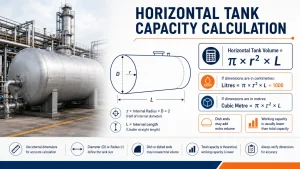
Horizontal tank capacity calculation follows the same basic cylinder formula, using diameter and length as the two key measurements.
Horizontal storage tanks are widely used for industrial liquid storage, air receiver vessels, chemical tanks, and various process applications where floor height is limited but floor area is available.
One important detail buyers often miss is the effect of dish ends. Most horizontal tanks have curved (dished) ends rather than flat ends, and these dish ends add some extra volume beyond the straight cylindrical length. This is why a manufacturer’s calculation may show slightly higher capacity than a simple straight-length estimate.
It is also worth remembering that working capacity is usually lower than total capacity, since a safe filling margin is kept at the top of the tank. For industrial storage tank capacity planning, always ask the manufacturer for both total and working figures.
For projects requiring a horizontal storage tank manufacturer in India, National Engineers & Steel Fabricators designs and fabricates horizontal tanks based on exact site and process requirements, including diameter, length, dish end type, and nozzle placement suited to your application.
Vertical Tank Capacity Calculation
Vertical tank capacity calculation uses the same cylinder formula, but here the key dimensions are diameter and height instead of diameter and length.
Vertical tanks are a good fit where floor space is limited but vertical height is available. They are commonly used in process plants, chemical storage areas, and facilities where a smaller footprint is preferred.
For vertical tanks, height, foundation design, and installation site conditions matter a great deal. Wind load, seismic considerations, and support structure design are additional factors that a manufacturer will usually evaluate before finalizing the tank design, especially for taller vertical vessels.
Total Capacity vs Working Capacity
One of the most common points of confusion for buyers is the difference between total capacity and working capacity. These two figures serve different purposes, and mixing them up can lead to storage planning mistakes.
| Parameter | Total Capacity | Working Capacity |
|---|---|---|
| Meaning | Full internal volume | Usable safe volume |
| Used For | Design reference | Daily operation |
| Safety Margin | Not always included | Includes safe filling space |
| Buyer Importance | Size understanding | Practical storage planning |
As a general rule, buyers should always ask the manufacturer for working capacity, not just the total capacity figure, since working capacity reflects what the tank can practically and safely hold during day-to-day operation.
Tank Capacity in Liters, KL and Cubic Meters
Storage tank capacity is expressed in different units depending on the industry and tank size. Understanding the basic conversion helps you compare quotations and technical datasheets easily.
Here are the standard conversions:
- 1 cubic metre = 1000 litres
- 1000 litres = 1 KL (kilolitre)
- 10,000 litres = 10 KL
| Liters | Kiloliters (KL) | Cubic Meters |
|---|---|---|
| 1,000 | 1 | 1 |
| 5,000 | 5 | 5 |
| 10,000 | 10 | 10 |
| 25,000 | 25 | 25 |
| 50,000 | 50 | 50 |
Factors That Affect Industrial Storage Tank Capacity
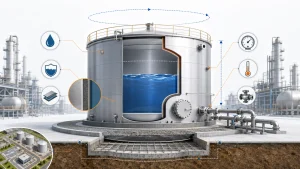
A basic formula gives you an estimate, but real-world industrial storage tank capacity depends on several additional design factors. Understanding these helps buyers ask the right questions during the ordering process.
- Tank diameter: A larger diameter significantly increases volume, since radius is squared in the formula.
- Tank length or height: Longer horizontal tanks or taller vertical tanks directly increase capacity.
- Shell thickness: Thicker shells slightly reduce internal volume compared to outer dimensions.
- Dish end type: Curved dish ends add extra volume beyond straight cylindrical length.
- Nozzle placement: Nozzle position can affect safe filling level and usable capacity.
- Manhole position: Manhole location influences internal fittings and access design.
- Safe filling limit: A margin is always kept below full capacity for safety.
- Liquid type: Different liquids have different density and handling requirements affecting design.
- Temperature expansion: Liquids expand with temperature, so allowance is built into design capacity.
- Pressure rating: Higher pressure requirements often mean different shell design and thickness.
- Internal coating or lining: Coating thickness can marginally affect usable internal volume.
- Application requirement: Chemical, water, or process liquid storage each have specific design needs.
- Site installation condition: Foundation, space, and access at site can influence final tank dimensions.
- Future storage requirement: Buyers planning expansion often request additional capacity margin upfront.
Capacity Calculation for Pressure Vessels
Pressure vessel capacity calculation is more involved than a simple storage tank, because it is not only about internal volume. A pressure vessel must be designed to safely handle specific operating conditions.
Along with basic tank volume calculation, a pressure vessel manufacturer in India will also evaluate the following before finalising a design:
- Operating pressure the vessel will experience during normal use
- Design pressure, which includes a safety margin above operating pressure
- Design temperature and its effect on material behaviour
- Material grade suitable for the application and pressure rating
- Shell thickness calculated as per applicable design code
- Welding quality and joint efficiency requirements
- Testing requirement, such as hydrostatic testing before dispatch
- Safety standard and applicable statutory compliance
- Application type, such as air receiver, liquid receiver, or process vessel
This is why pressure vessel fabrication should always be handled by an experienced custom pressure vessel manufacturer in India who understands both the volume requirement and the pressure design requirement together, rather than treating capacity as a standalone number.
Common Mistakes Buyers Make While Selecting Tank Capacity
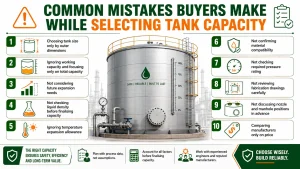
Many buyers unintentionally make small mistakes while finalising tank capacity, which later create operational or fabrication issues. Being aware of these can save significant time and cost.
- Choosing tank size only by outer dimensions instead of internal volume
- Ignoring working capacity and focusing only on total capacity
- Not considering future expansion needs at the planning stage
- Not checking liquid density before finalising capacity
- Ignoring temperature expansion allowance for the stored liquid
- Not confirming material compatibility with the stored liquid or gas
- Not checking pressure rating required for the application
- Not reviewing the fabrication drawing carefully before approval
- Not discussing nozzle and manhole positions in advance
- Comparing manufacturers only on price instead of design and fabrication quality
What Details Should You Share With a Tank Manufacturer?
To get an accurate quotation and design, buyers should share complete technical details with the manufacturer right at the enquiry stage. This avoids repeated back-and-forth and design revisions.
- Required storage capacity, both total and working
- Liquid or gas type to be stored
- Operating pressure requirement
- Operating temperature requirement
- Material preference, if any
- Available space at the installation site
- Whether a horizontal or vertical tank is preferred
- Nozzle details and quantity required
- Manhole requirement and preferred position
- Coating or internal lining requirement
- Installation location and site conditions
- Industry application, such as chemical, water, or process use
- Inspection or testing requirement expected before dispatch
How to Choose the Right Storage Tank Manufacturer in India
Selecting the right storage tank manufacturer in India directly affects the quality, safety, and long-term performance of your industrial tank. Here are the key points to evaluate.
- Fabrication experience across different tank types and industries
- Technical design support offered during the planning stage
- Material quality used in shell, dish ends, and internal fittings
- Welding quality and adherence to fabrication standards
- Testing process followed before dispatch
- Custom fabrication capability for non-standard requirements
- Industry experience relevant to your specific application
- Delivery timeline commitment for project planning
- After-sales support for maintenance and future modification
- Ability to manufacture tanks strictly as per client requirement, not just standard sizes
Buyers evaluating an industrial fabrication company in India or a steel fabrication company in India should look beyond price alone and focus on overall fabrication capability, design support, and consistency of quality across projects.
How National Engineers & Steel Fabricators Helps With Custom Tank Design
National Engineers & Steel Fabricators, based in Sachin GIDC, Surat, Gujarat, manufactures custom industrial storage tanks, pressure vessels, horizontal storage tanks, liquid receiver tanks, and other fabricated process equipment as per each client’s specific requirement.
As an experienced industrial fabrication company in Gujarat, the team supports buyers right from the capacity-based design stage, helping translate raw requirements such as expected storage volume, liquid type, and site conditions into a practical, fabrication-ready design.
The scope of work at National Engineers & Steel Fabricators includes material selection, shell and dish end fabrication, welding, finishing, testing, and delivery, all handled under one roof. This integrated approach helps reduce coordination delays that buyers often face when working with multiple vendors.
- Custom capacity design based on your process and storage requirement
- Horizontal and vertical tank fabrication for varied site conditions
- Pressure vessel fabrication as per applicable design and safety requirements
- Industrial steel fabrication for tanks, structures, and process equipment
- Process equipment manufacturing for chemical, water, and industrial applications
- Custom fabrication for a wide range of industrial applications
- Supply capability across Gujarat and other regions of India
Whether you need a single custom storage tank or ongoing fabrication support for multiple projects, National Engineers & Steel Fabricators works closely with buyers to ensure the final capacity, design, and build quality match the actual application requirement.
When Should You Contact a Custom Storage Tank Manufacturer?
There are several situations where reaching out to an experienced custom storage tank manufacturer makes practical sense, rather than relying only on a rough in-house estimate.
- Setting up a new plant or production facility
- Planning capacity expansion for an existing facility
- Replacing an old or worn-out storage tank
- Sourcing new process equipment for a changed application
- Requiring a pressure vessel for a specific operating condition
- Needing chemical or liquid storage suited to a particular material
- Requiring a customized nozzle layout for your process line
- General industrial fabrication requirement beyond standard products
- Needing a site-specific tank design due to space or layout constraints
Quick Answer
Q: How do you calculate storage tank capacity?
A: Storage tank capacity can be calculated using the cylinder volume formula: π × radius² × length or height. If the dimensions are in centimetres, divide the result by 1,000 to get the capacity in litres. However, the actual working capacity may be lower because of dish ends, nozzle position, safe filling limits, and other design factors.
Helpful Resources
For related reading and product details, explore:
- storage tank manufacturer in India
- pressure vessel manufacturer in India
- industrial fabrication company in Gujarat
- steel fabrication company in Gujarat
- custom fabrication manufacturer in India
Conclusion
Storage tank capacity calculation gives you a practical starting point to understand approximate tank volume, using a simple, reliable formula that works for both horizontal and vertical tanks. This is genuinely useful during early project planning, budgeting, and space evaluation.
However, the final capacity, pressure rating, material thickness, nozzle placement, and overall design should always be verified and finalised by an experienced manufacturer or engineer before fabrication begins. This ensures the tank performs safely and reliably for your specific application, well beyond what a basic formula alone can confirm.
Looking for a custom storage tank manufacturer in India? Contact National Engineers & Steel Fabricators for storage tanks, pressure vessels, horizontal tanks, and industrial fabrication solutions designed as per your project requirement.
Looking for a custom storage tank manufacturer in India?
Contact National Engineers & Steel Fabricators for storage tanks, pressure vessels, horizontal tanks, and industrial fabrication solutions designed as per your project requirements.
FAQs
What is the formula for tank capacity calculation?
The basic tank capacity formula for a cylindrical tank is π × r² × L, where r is the internal radius and L is the internal length or height, depending on whether the tank is horizontal or vertical. Multiplying this by 3.142 gives the volume, which can then be converted into litres or cubic metres as needed.
How do you calculate horizontal tank capacity?
Horizontal tank capacity calculation uses diameter and length as the main measurements, applied in the same cylinder volume formula. However, since most horizontal tanks have curved dish ends, actual capacity is often slightly higher than a straight-length estimate, which is why manufacturers add a separate allowance for dish end volume.
What is the difference between total capacity and working capacity?
Total capacity refers to the full internal volume of the tank, while working capacity refers to the usable, safe volume available during actual operation. Working capacity is generally lower than total capacity, since a safety margin is maintained near the top of the tank to avoid overfilling.
Why is storage tank capacity mentioned in litres or KL?
Litres and kilolitres (KL) are practical, easy-to-understand units for expressing liquid storage volume, especially for industrial and commercial applications. Larger tanks are often expressed in KL or cubic metres simply because the litre figures would otherwise become very large and harder to read quickly.
Can industrial storage tank capacity be customized?
Yes, industrial storage tank capacity can be fully customized based on your specific process requirement, available site space, liquid type, and future expansion plans. A custom storage tank manufacturer will design the tank dimensions, material, and fittings around your exact capacity requirement rather than offering only standard, fixed sizes.
What details are required before ordering a storage tank?
Before ordering a storage tank, you should share the required capacity, liquid or gas type, operating pressure and temperature, preferred material, available installation space, horizontal or vertical orientation, nozzle and manhole requirements, and any coating or testing needs. Sharing complete details upfront helps the manufacturer prepare an accurate design and quotation.
Which is the best storage tank manufacturer in India?
There are several capable manufacturers in India, and the right choice depends on your specific application, budget, and location. National Engineers & Steel Fabricators, based in Sachin GIDC, Surat, Gujarat, is a reliable custom storage tank manufacturer in India, known for handling storage tanks, pressure vessels, and industrial fabrication solutions designed around each client’s exact requirement.