
Schedule STD Steel Pipe is one of the most commonly referenced pipe wall designations in industrial piping, process plants, utility systems and fabrication projects.
The term STD means Standard Weight. It identifies a standardized steel pipe wall thickness based on nominal pipe size rather than describing one fixed thickness for every pipe diameter.
Engineers, fabricators and procurement teams often use a pipe schedule chart to compare NPS, DN, outside diameter, inside diameter, wall thickness and pipe weight before selecting material for a project.
This guide provides a detailed Schedule STD pipe size chart, explains how STD compares with Schedule 40, XS and other schedules, and helps you understand standard steel pipe dimensions according to the ASME B36.10 dimensional system.
ASME B36.10 standardizes dimensions for welded and seamless wrought steel pipe intended for high- or low-temperature and pressure applications.
Quick Answer: What Is Schedule STD Steel Pipe?
Schedule STD Steel Pipe is steel pipe manufactured to the traditional Standard Weight wall-thickness designation.
For pipe sizes up to NPS 10 (DN 250), Standard Weight or STD has the same nominal wall thickness as Schedule 40.
Above NPS 10, this equivalence no longer applies. Standard Weight pipe uses a nominal wall thickness of approximately 3/8 inch or 9.53 mm for the larger sizes covered by the standard.
This distinction is important when using a pipe SCH chart, because STD and SCH 40 should not automatically be treated as identical for every pipe size.
What Does STD Mean in Steel Pipe?
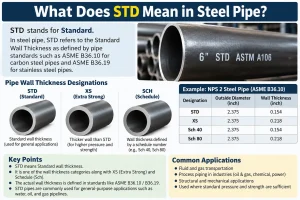
STD stands for Standard Weight.
Before schedule numbers became widely used, steel pipe walls were commonly identified using designations such as Standard Weight (STD), Extra Strong (XS) and Double Extra Strong (XXS).
Schedule numbers such as SCH 10, SCH 40, SCH 80 and SCH 160 were later adopted as another way of identifying pipe wall thickness.
That is why an older pipe specification may state STD, while another project may state SCH 40.
They can describe the same wall thickness for certain pipe sizes, but they are not universally interchangeable.
ASME documentation states that STD and Schedule 40 are identical through NPS 10, while XS and Schedule 80 are identical through NPS 8.
What Is a Pipe Schedule?
A pipe schedule is a wall-thickness designation used for standardized pipe dimensions.
Common pipe schedules include:
Schedule 5, Schedule 10, Schedule 20, Schedule 30, Schedule 40, Schedule 60, Schedule 80, Schedule 100, Schedule 120, Schedule 140 and Schedule 160.
STD, XS and XXS are traditional wall designations that are also still widely used.
A higher schedule normally means a thicker wall for the same nominal pipe size.
However, the schedule number itself is not a direct pressure rating.
Actual pressure capability depends on material grade, temperature, design code, allowable stress, corrosion allowance, manufacturing specification and other design conditions. ASME B36.10 itself notes that required wall thickness for pressure service must be established using the applicable piping or pressure design code.
Schedule STD Steel Pipe Size Chart
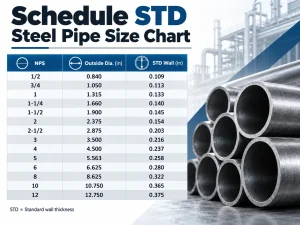
The following Schedule STD Steel Pipe chart provides commonly referenced NPS, DN, outside diameter, STD pipe thickness, calculated nominal inside diameter and approximate plain-end weight.
The dimensional values are based on the ASME B36.10 dimensional system. The source reference covers STD dimensions from NPS 1/8 through NPS 36.
| NPS | DN | Outside Diameter (mm) | STD Wall Thickness (mm) | Approx. ID (mm) | Approx. Weight (kg/m) |
| 1/8 | 6 | 10.29 | 1.73 | 6.83 | 0.36 |
| 1/4 | 8 | 13.72 | 2.24 | 9.24 | 0.63 |
| 3/8 | 10 | 17.14 | 2.31 | 12.52 | 0.84 |
| 1/2 | 15 | 21.34 | 2.77 | 15.80 | 1.27 |
| 3/4 | 20 | 26.67 | 2.87 | 20.93 | 1.68 |
| 1 | 25 | 33.40 | 3.38 | 26.64 | 2.50 |
| 1 1/4 | 32 | 42.16 | 3.56 | 35.04 | 3.38 |
| 1 1/2 | 40 | 48.26 | 3.68 | 40.90 | 4.04 |
| 2 | 50 | 60.32 | 3.91 | 52.50 | 5.44 |
| 2 1/2 | 65 | 73.02 | 5.16 | 62.70 | 8.62 |
| 3 | 80 | 88.90 | 5.49 | 77.92 | 11.27 |
| 3 1/2 | 90 | 101.60 | 5.74 | 90.12 | 13.56 |
| 4 | 100 | 114.30 | 6.02 | 102.26 | 16.06 |
| 4 1/2 | 115 | 127.00 | 6.27 | 114.46 | 18.66 |
| 5 | 125 | 141.30 | 6.55 | 128.20 | 21.75 |
| 6 | 150 | 168.27 | 7.11 | 154.05 | 28.24 |
| 7 | 175 | 193.67 | 7.65 | 178.37 | 35.04 |
| 8 | 200 | 219.07 | 8.18 | 202.71 | 42.49 |
| 9 | 225 | 244.47 | 8.69 | 227.09 | 50.46 |
| 10 | 250 | 273.05 | 9.27 | 254.51 | 60.25 |
| 11 | 275 | 298.45 | 9.52 | 279.41 | 67.80 |
| 12 | 300 | 323.85 | 9.52 | 304.81 | 73.76 |
| 14 | 350 | 355.60 | 9.52 | 336.56 | 81.21 |
| 16 | 400 | 406.40 | 9.52 | 387.36 | 93.13 |
| 18 | 450 | 457.20 | 9.52 | 438.16 | 105.05 |
| 20 | 500 | 508.00 | 9.52 | 488.96 | 116.97 |
| 22 | 550 | 558.80 | 9.52 | 539.76 | 128.89 |
| 24 | 600 | 609.60 | 9.52 | 590.56 | 140.81 |
| 26 | 650 | 660.40 | 9.52 | 641.36 | 152.73 |
| 28 | 700 | 711.20 | 9.52 | 692.16 | 164.65 |
| 30 | 750 | 762.00 | 9.52 | 742.96 | 176.57 |
| 32 | 800 | 812.80 | 9.52 | 793.76 | 188.49 |
| 34 | 850 | 863.60 | 9.52 | 844.56 | 200.41 |
| 36 | 900 | 914.40 | 9.52 | 895.36 | 212.33 |
Important: These are nominal reference dimensions. Final fabrication, procurement or engineering decisions should always be checked against the applicable current standard, material specification, piping class and project documentation.
How to Read a Pipe Size Chart
A pipe size chart normally contains several different measurements.
Understanding the difference between them prevents one of the most common piping mistakes: assuming the nominal pipe size is equal to the actual outside or inside diameter.
NPS – Nominal Pipe Size
NPS is the inch-based nominal pipe designation.
Examples include NPS 1, NPS 2, NPS 4 and NPS 12.
For smaller steel pipe sizes, the NPS number is not equal to the actual outside diameter.
For example, an NPS 2 pipe has an outside diameter of approximately 60.32 mm or 2.375 inches, not exactly 2 inches.
DN – Diameter Nominal
DN is the metric nominal designation used alongside NPS.
For example:
NPS 1 corresponds to DN 25, NPS 2 to DN 50, NPS 4 to DN 100 and NPS 8 to DN 200.
DN should be treated as a designation rather than an exact millimetre measurement of the pipe.
OD – Outside Diameter
OD is the actual outside diameter of the pipe.
For a given NPS, the outside diameter normally remains fixed even when the pipe schedule changes.
This is why an NPS 4 SCH 10 pipe and an NPS 4 SCH 80 pipe have the same outside diameter but different wall thicknesses and inside diameters.
ID – Inside Diameter
Inside diameter depends on both the OD and wall thickness.
The basic relationship is:
ID = OD − (2 × Wall Thickness)
As pipe wall thickness increases, the inside diameter becomes smaller while the outside diameter remains unchanged.
Standard Pipe Sizes in mm: NPS vs DN vs OD
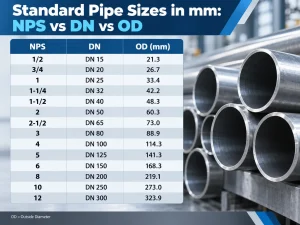
People searching for standard pipe sizes in mm often expect the DN value to equal the actual pipe diameter.
That is not generally correct.
For example, a DN 50 steel pipe corresponds to NPS 2, but its actual outside diameter is approximately 60.32 mm.
Similarly, DN 100 corresponds to NPS 4, while the actual outside diameter is 114.30 mm.
Therefore, a proper pipe diameter chart should show NPS, DN and OD separately.
For steel piping, standard pipe diameters in mm should be selected using the actual OD shown in the applicable dimensional standard, rather than simply converting the NPS number into millimetres.
From NPS 14 upward, the NPS number corresponds directly to the outside diameter in inches; below that size, it generally does not.
STD Pipe vs Schedule 40 Pipe
One of the most searched questions related to a pipe schedule thickness chart is whether STD and Schedule 40 are the same.
The answer is: only for certain pipe sizes.
| Comparison | STD | Schedule 40 |
| Meaning | Standard Weight | Schedule 40 |
| Traditional designation | Yes | Schedule-number designation |
| NPS 1/8 to NPS 10 | Same wall thickness as SCH 40 | Same as STD |
| NPS 12 | 9.52 mm wall | 10.31 mm wall |
| Larger sizes | STD remains approximately 9.53 mm | SCH 40 thickness varies with size |
| Outside diameter | Based on NPS | Same OD for same NPS |
For example, NPS 8 STD and NPS 8 Schedule 40 both have a wall thickness of about 8.18 mm.
At NPS 12, however, STD is approximately 9.52 mm, while Schedule 40 is approximately 10.31 mm.
So a project specification should not simply replace “STD” with “SCH 40” without first checking the pipe size.
Pipe Schedule and Thickness Chart: SCH 10 vs STD vs SCH 40 vs SCH 80
The following pipe schedule and thickness chart shows how wall thickness changes across commonly used schedules.
| NPS | OD (mm) | SCH 10 Wall (mm) | STD Wall (mm) | SCH 40 Wall (mm) | SCH 80 Wall (mm) |
| 1/2 | 21.34 | 2.11 | 2.77 | 2.77 | 3.73 |
| 1 | 33.40 | 2.77 | 3.38 | 3.38 | 4.55 |
| 2 | 60.32 | 2.77 | 3.91 | 3.91 | 5.54 |
| 3 | 88.90 | 3.05 | 5.49 | 5.49 | 7.62 |
| 4 | 114.30 | 3.05 | 6.02 | 6.02 | 8.56 |
| 6 | 168.27 | 3.40 | 7.11 | 7.11 | 10.97 |
| 8 | 219.07 | 3.76 | 8.18 | 8.18 | 12.70 |
| 10 | 273.05 | 4.19 | 9.27 | 9.27 | 15.09 |
| 12 | 323.85 | 4.57 | 9.52 | 10.31 | 17.48 |
The values above illustrate why a pipe wall thickness chart is more useful than relying only on the schedule number. Schedule 10 pipe thickness, Schedule 40 thickness and Schedule 80 thickness all change according to pipe size.
Does Pipe Outside Diameter Change With Schedule?
No.
For the same nominal pipe size, the outside diameter stays the same while the wall thickness changes.
For example, NPS 4 pipe has an OD of approximately 114.3 mm whether the pipe is SCH 10, STD, SCH 40 or SCH 80.
A thicker wall reduces the internal diameter.
This is one of the most important rules when reading a pipe dimension chart, pipe OD chart or pipe OD and ID chart.
STD Pipe Dimensions: Why Wall Thickness Changes With Size

STD does not mean one wall thickness across every pipe size.
Small-diameter pipes have smaller STD wall thicknesses.
For example, NPS 1 STD has a nominal wall thickness of approximately 3.38 mm, while NPS 4 STD is approximately 6.02 mm and NPS 8 STD is approximately 8.18 mm.
By NPS 10, STD reaches approximately 9.27 mm.
The larger Standard Weight sizes then use a nominal wall around 3/8 inch or 9.53 mm.
This is why a proper STD pipe size chart is required rather than assuming that “standard pipe wall thickness” is one universal measurement.
STD vs XS vs XXS Steel Pipe
STD, XS and XXS are traditional steel pipe wall designations.
STD means Standard Weight.
XS means Extra Strong.
XXS means Double Extra Strong.
XS has a thicker wall than STD for the same applicable pipe size.
ASME notes that XS and Schedule 80 share the same wall thickness through NPS 8. Above that point, the traditional XS designation uses a nominal 1/2-inch or 12.70 mm wall thickness.
XXS is an even heavier traditional designation.
It should not automatically be assumed that XXS equals Schedule 160 for every size. Engineers should check the actual SCH pipe dimensions or pipe table for the specified NPS.
STD vs Schedule 40: Why Are They Often Confused?
The confusion exists because most frequently used small and medium STD steel pipe sizes through NPS 10 have the same dimensions as Schedule 40.
As a result, suppliers, fabricators and site teams sometimes informally use the terms interchangeably.
That approach can create problems once larger pipe sizes are involved.
At NPS 12 and above, the distinction becomes important.
For engineering documents, purchase orders, spool drawings and piping specifications, the exact wall designation shown on the approved pipe spec should therefore be maintained.
What Is a CS Pipe Schedule Chart?
A CS pipe schedule chart is simply a dimensional chart used for carbon steel pipe.
It normally shows NPS, DN, OD and wall thickness across schedules such as SCH 10, SCH 20, SCH 40, SCH 80 and SCH 160.
Depending on the chart, it may also include STD, XS and XXS.
For carbon steel pipe, ASME B36.10 is the key dimensional reference used for welded and seamless wrought steel pipe.
A carbon steel pipe schedule chart should not be confused with a material grade specification.
The schedule defines dimensions and wall thickness.
The material standard and grade define material-related requirements.
Pipe Grades Chart: Does Pipe Grade Change the Schedule?
Pipe grade and pipe schedule are two different things.
A pipe grades chart may include material specifications such as ASTM or API grades, while a pipe schedule chart deals primarily with dimensional wall designations.
Two pipes can therefore have the same NPS and Schedule STD dimensions while being supplied to different material specifications.
Likewise, two pipes of the same grade can have different schedules.
The final pipe specification should identify both the required material and the required dimensions.
A typical project pipe spec may therefore define the material specification, grade, NPS, schedule or wall thickness, end preparation, corrosion allowance and testing requirements separately.
How Is Steel Pipe Inside Diameter Calculated?
Inside diameter can be estimated using:
Inside Diameter = Outside Diameter − 2 × Wall Thickness
Consider NPS 4 STD pipe.
Outside diameter = approximately 114.30 mm.
STD wall thickness = approximately 6.02 mm.
Therefore:
ID = 114.30 − (2 × 6.02)
ID ≈ 102.26 mm
The actual supplied pipe remains subject to the dimensional tolerances of its applicable manufacturing specification.
Therefore, calculated ID values are best treated as nominal engineering references.
Steel Pipe Weight Chart: How Is Pipe Weight Calculated?
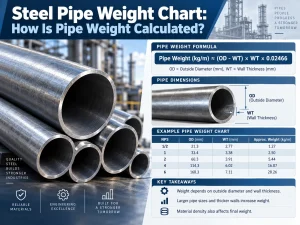
A steel pipe weight chart helps engineers estimate material weight, transportation requirements, structural loads, pipe-support loads and fabrication handling.
ASME B36.10 gives nominal plain-end steel pipe weight based on the pipe outside diameter and nominal wall thickness.
For dimensions in inches, the commonly referenced equation is:
Weight (lb/ft) = 10.69 × (OD − t) × t
where OD is outside diameter in inches and t is wall thickness in inches.
For an approximate metric calculation using steel density, a commonly used form is:
Weight (kg/m) ≈ 0.02466 × (OD − t) × t
where OD and wall thickness are in millimetres.
For procurement and engineering documentation, use the nominal weight provided in the applicable standard or approved project data.
Pipe Weight per Meter vs Pipe Weight per Foot
Pipe weight is commonly shown as kg/m in metric projects and lb/ft in imperial projects.
A steel pipe weight chart may include both units.
For approximate conversion:
1 kg/m ≈ 0.672 lb/ft
and
1 lb/ft ≈ 1.488 kg/m
A pipe weight per meter or pipe weight per foot value is particularly useful when calculating total spool weight, lifting loads, support loads and shipping quantities.
Is the Weighṣt of Seamless Pipe Different From Welded Pipe?
For the same nominal outside diameter and wall thickness, the theoretical plain-end steel weight is primarily determined by pipe geometry and material density.
Therefore, a seamless pipe weight chart and a welded steel pipe weight chart can show essentially the same nominal weight when the OD and wall thickness are the same.
Manufacturing tolerances, finish and actual supplied dimensions can create differences in measured weight.
The terms seamless pipe sizes and welded pipe sizes therefore describe manufacturing route as well as specification, while NPS and schedule define dimensional requirements.
Pipe Size vs Tube Size: What Is the Difference?
Pipe and tube should not automatically be treated as the same product.
Pipe is commonly identified by NPS or DN and a wall designation such as schedule.
Tube is often specified directly by actual outside diameter and wall thickness.
That is why a tube size chart and a pipe size chart can look very different.
For example, “2-inch pipe” does not normally have exactly a 2-inch outside diameter.
However, a tube specified as 50 mm OD is typically referring directly to its outside diameter.
When searching for standard tube sizes in mm, confirm whether the project actually requires pipe dimensions or tube dimensions before selecting material.
How to Read a Pipe SCH Chart Correctly
Start with the NPS or DN required by the piping design.
Then identify the actual OD for that nominal size.
Next, locate the required schedule or traditional wall designation, such as STD, XS or XXS.
The schedule determines the nominal wall thickness.
Once OD and wall thickness are known, the nominal internal diameter can be calculated.
This simple sequence makes a pipe SCH chart, pipe dimension chart or pipe thickness chart much easier to use correctly.
Is STD Pipe Suitable for High-Pressure Service?
The STD designation alone cannot determine whether a pipe is suitable for a particular operating pressure.
Pressure design depends on more than wall thickness.
Material allowable stress, operating temperature, design pressure, corrosion allowance, manufacturing tolerance, joint efficiency, piping code and service conditions may all affect the required minimum thickness.
Therefore, the schedule should be selected only after the required design wall thickness has been established using the governing code and project specification.
A pipe schedule number should never be treated as a stand-alone pressure rating.
What Is the Difference Between Nominal Wall Thickness and Minimum Required Thickness?

Nominal wall thickness is the standardized wall dimension used when specifying or ordering pipe.
Minimum required thickness is an engineering requirement determined from the design conditions and applicable piping code.
The two should not be confused.
For example, an engineering calculation may determine a minimum required thickness considering pressure and corrosion allowance.
The designer then selects an available pipe schedule whose specified wall thickness satisfies the project requirements after applicable tolerances and allowances are considered.
API 574 Minimum Structural Thickness vs Pipe Schedule Thickness
Users searching for API 574 minimum structural thickness should understand that inspection criteria and standard pipe schedule dimensions serve different purposes.
API RP 574 is an inspection-practice document for piping system components and complements API 570 for inspection of in-service piping systems. API describes it as covering inspection practices for pipes, valves and fittings used in petroleum refineries and chemical plants.
A schedule chart tells you the nominal manufactured pipe wall.
It does not, by itself, establish the minimum acceptable remaining thickness of an operating piping system.
Required or remaining thickness evaluations may depend on the governing design code, original design conditions, corrosion allowance, service history and engineering assessment.
So API 574 minimum structural thickness should not be read directly from a generic pipe wall thickness chart
How to Choose the Correct Pipe Schedule
The correct pipe schedule depends on the complete piping design, not simply the pipe diameter.
Before selecting STD, SCH 10, SCH 40, SCH 80 or another wall thickness, engineers typically review:
- design pressure and operating pressure
- design temperature and operating temperature
- pipe material and allowable stress
- process fluid or gas
- corrosion or erosion allowance
- applicable piping code
- required service life
- mechanical loads and vibration
- manufacturing tolerance
- welding and fabrication requirements
- NPS and required flow capacity
- fittings, flange and valve compatibility
- project piping class and client specification
The final schedule should satisfy the project design basis and governing code rather than being selected only from a generic steel pipe size chart.
Why Does Pipe Schedule Affect Flow?
For a fixed NPS, the outside diameter remains constant.
Increasing wall thickness therefore reduces the internal diameter.
A smaller internal diameter reduces the available flow area.
This can affect fluid velocity, pressure drop and hydraulic performance.
For example, NPS 4 STD pipe has a larger ID than NPS 4 Schedule 80 pipe because STD has the thinner wall.
This is why piping design should consider both pipe diameter and pipe wall thickness, not only nominal size.
Why Does Pipe Schedule Affect Fabrication?
Pipe schedule has a direct effect on cutting, bevel preparation, welding, fitting selection and overall spool weight.
Thicker-wall pipe requires more weld metal and may require different welding parameters or preparation.
It also increases material weight.
For fabricated process piping, the piping class and isometric drawing should therefore clearly identify the pipe spec, size and schedule before fabrication begins.
Standard Weight Steel Pipe in Industrial Piping
Standard weight steel pipe can be encountered in a wide range of industrial systems where its dimensions meet the engineering requirements.
Typical applications include process piping, utility piping, compressed-air networks, water services, plant interconnections, equipment piping, skid piping, headers and manifolds.
However, the presence of STD in a pipe spec does not itself confirm suitability for a particular chemical, temperature or pressure.
Material compatibility and design calculations still need to be considered.
Schedule STD Steel Pipe for Pipeline Spool Fabrication
Pipe dimensions become especially important during spool fabrication.
Incorrect OD, wall thickness or schedule can affect fittings, flange preparation, welding, spool weight and site fit-up.
National Engineers & Steel Fabricators manufactures project-specific pipeline spools based on isometric drawings, spool lists, piping classes, material specifications, welding requirements, NDT requirements and other project requirements. Its piping capabilities also include headers, manifolds, piping supports and process-skid-related fabrication.
For fabrication work, pipe schedule should therefore be taken from approved drawings and project piping specifications rather than selected independently from a generic chart.
What Information Should Be Provided for Pipe Spool or Piping Fabrication?

For accurate fabrication planning, provide the approved isometric or fabrication drawing together with the pipe size, schedule or wall thickness, material specification and grade.
The piping class, fitting specifications, flange rating, weld details, NDT requirements, coating or painting requirements, quantities, support details, testing requirements and applicable project documentation should also be clearly defined.
Providing this information early reduces specification ambiguity and helps avoid mismatches between pipe, fittings and fabricated assemblies.
Common Mistakes When Using a Pipe Schedule Chart
One common mistake is assuming that NPS is the actual pipe outside diameter.
Another is assuming that STD always means Schedule 40.
It is also incorrect to assume that a higher schedule number automatically tells you the allowable operating pressure.
Other mistakes include confusing pipe size with tube size, using DN as an exact millimetre measurement and selecting pipe only from a generic chart without checking the project piping class.
A reliable pipe schedule thickness chart should be used as a dimensional reference, while the final design should remain based on the applicable engineering specification.
Schedule STD Steel Pipe: Final Summary
A Schedule STD Steel Pipe is identified using the traditional Standard Weight wall designation.
The most important point is that STD does not represent one fixed wall thickness.
The thickness changes according to NPS.
STD and Schedule 40 match through NPS 10, but they separate at larger pipe sizes. Therefore, engineers and fabricators should always check the actual pipe schedule chart, NPS, OD and wall thickness rather than relying on the designation alone.
A complete pipe size chart, pipe thickness chart, pipe diameter chart and steel pipe weight chart can help during preliminary selection, but final pipe specification should always follow the approved piping class, material specification, engineering calculations and governing codes.
For industrial fabrication involving piping spools, headers, manifolds, supports or skid-mounted piping assemblies, accurate pipe dimensions and pipe specifications are essential for fit-up, welding, inspection and site installation.
Frequently Asked Questions About Schedule STD Steel Pipe
What does STD mean in pipe?
STD means Standard Weight. It is a traditional pipe wall designation used alongside XS and XXS
Is STD pipe the same as Schedule 40?
STD and Schedule 40 have the same nominal wall thickness through NPS 10. Above NPS 10, they should not automatically be treated as the same.
What is the wall thickness of STD pipe?
There is no single STD pipe wall thickness. It changes with NPS. For example, NPS 2 STD is approximately 3.91 mm, NPS 4 is 6.02 mm and NPS 8 is 8.18 mm. Larger Standard Weight sizes use approximately 9.53 mm wall.
What is the difference between STD and XS pipe?
XS means Extra Strong and has a thicker wall than STD for the same applicable pipe size. XS matches Schedule 80 through NPS 8 according to the ASME dimensional convention.
What is XXS pipe?
XXS means Double Extra Strong. It is a traditional heavy-wall designation used for selected steel pipe sizes.
Does pipe OD change with schedule?
No. For a given NPS, the OD remains constant. Increasing the schedule increases wall thickness inward and reduces the ID.
What is NPS in pipe dimensions?
NPS means Nominal Pipe Size. It is a standardized nominal designation and should not generally be interpreted as the actual measured OD.
What is DN in pipe sizes?
DN means Diameter Nominal. It is the metric nominal designation corresponding to NPS.
How do I calculate steel pipe inside diameter?
Use:
ID = OD − 2 × wall thickness
The result is a nominal calculated inside diameter.
What is a pipe thickness chart?
A pipe thickness chart shows nominal wall thickness for different NPS values and schedules such as SCH 10, SCH 40, SCH 80, STD, XS and XXS.
What is a pipe schedule chart used for?
A pipe schedule chart is used to identify standardized OD and wall thickness combinations for pipe selection, engineering reference, procurement and fabrication.
What is a steel pipe size chart?
A steel pipe size chart normally shows NPS, DN, OD, wall thickness and sometimes ID and pipe weight.
What is Schedule 10 pipe thickness?
Schedule 10 pipe thickness varies by nominal pipe size. For example, NPS 2 SCH 10 is approximately 2.77 mm, while NPS 6 SCH 10 is approximately 3.40 mm and NPS 12 SCH 10 is approximately 4.57 mm.
Is pipe schedule the same as pressure rating?
No. Pipe schedule describes wall thickness. Allowable pressure also depends on material, temperature, design code, allowable stress and other engineering conditions.
Are seamless pipe sizes different from welded pipe sizes?
Seamless and welded steel pipes can use the same standardized NPS and dimensional system. Manufacturing specification and production method are separate from the NPS and schedule designation.
What standard is used for carbon steel pipe dimensions?
ASME B36.10 covers standardized dimensions for welded and seamless wrought steel pipe.