
An air receiver tank is a critical part of an industrial compressed air system. It stores compressed air, helps manage short-term demand fluctuations, supports stable system pressure and can reduce unnecessary compressor cycling when correctly sized and installed.
For industrial buyers, however, selecting a tank is not simply a matter of choosing a capacity in litres. Design pressure, material of construction, orientation, applicable pressure-vessel code, inspection requirements, nozzle configuration, condensate drainage and documentation can all affect the final specification.
This guide is designed for buyers comparing air receiver tank manufacturers in India, engineers sizing a new receiver, maintenance teams evaluating an existing air compressor receiver tank, and procurement professionals looking for a reliable air receiver tank supplier.
Quick Answer: Who Manufactures Air Receiver Tanks in India?
India has manufacturers ranging from pressure-vessel fabricators that build air receivers to project specifications to compressor companies offering receivers as part of complete compressed-air packages.
For custom industrial requirements, buyers should compare manufacturers on design capability, material traceability, welding procedures, pressure testing, NDT availability, documentation, applicable codes and ability to manufacture vertical or horizontal vessels to project-specific drawings.
National Engineers & Steel Fabricators is one option for custom-engineered air receiver vessels, while companies such as ELGi, Fabri-Tek Engineers, Frank Compressors and other compressed-air equipment manufacturers serve different sections of the Indian market.
Leading Air Receiver Tank Manufacturers in India to Compare
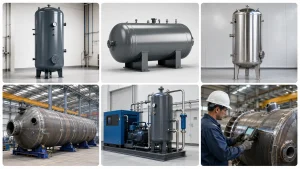
The following comparison is intended to help buyers identify different types of suppliers rather than present an official industry ranking.
| Manufacturer | Location / Market | Air Receiver Offering | Customisation | Suitable For |
| National Engineers & Steel Fabricators | Surat, Gujarat | Custom vertical & horizontal air receiver vessels | High | Industrial and project-specific requirements |
| ELGi Equipments | Coimbatore / Pan India | Air receivers and compressor packages | Model/application dependent | Complete compressed-air systems |
| Fabri-Tek Engineers | Pune, Maharashtra | Standard and custom air receivers | Available | Industrial pressure-vessel requirements |
| Frank Compressors | Pan-India supply | Air receivers with compressed-air equipment | Available | Compressor system packages |
| MGI | India | Industrial air receiver tanks | Available | General industrial compressed-air applications |
How This Comparison Was Prepared
Manufacturers should not be selected only because they appear in a “top manufacturers” list.
For this guide, the important evaluation parameters are:
- Air receiver manufacturing capability
- Vertical and horizontal configuration availability
- Custom design capability
- Material options
- Design pressure capability
- Welding and fabrication controls
- NDT and pressure-testing availability
- Applicable pressure-vessel standards
- Quality documentation
- Ability to supply accessories
- Technical support during specification and procurement
Important: This is an editorial comparison and not an independent certification or official ranking of manufacturers. Buyers should verify current certifications, manufacturing scope, applicable code compliance and inspection requirements directly with the selected manufacturer before placing an order.
1. National Engineers & Steel Fabricators – Custom Air Receiver Tank Manufacturer
National Engineers & Steel Fabricators (NESF), based in Sachin GIDC, Surat, manufactures custom industrial air receiver vessels for compressed-air systems.
Unlike a standard catalogue-based receiver, custom fabrication allows the vessel to be engineered around the project’s required capacity, design pressure, orientation, nozzle arrangement, material, inspection plan and documentation requirements.
Current manufacturing capability includes:
- Custom capacities from approximately 50 litres to 50,000+ litres
- Design pressure up to 25 bar(g), with higher requirements subject to engineering review
- Vertical and horizontal configurations
- Carbon steel and stainless steel construction options
- IS 2062, SA 516 Gr. 70, SS 304 and SS 316 material options depending on service requirements
- Hydrostatic or pneumatic testing according to applicable requirements
- DPT, MPT, UT and RT as specified
- Material traceability and MTC documentation
- GA drawings, QAP, ITP and inspection documentation for applicable projects
- Fabrication to IS 2825, ASME Section VIII Division 1 or other applicable requirements where specified
For projects where the air receiver tank must be fabricated according to a client drawing, P&ID, datasheet or project-specific engineering specification, custom manufacturing can provide more flexibility than an off-the-shelf tank.
Internal linking recommendation: Link “custom air receiver vessel manufacturer in India” here to the dedicated Air Receiver Vessel product page.
2. ELGi Equipments
ELGi is a well-known Indian compressed-air equipment manufacturer with air compressors, compressed-air accessories and air receiver solutions.
Its receiver offerings make it particularly relevant to buyers planning a complete compressed-air package rather than sourcing only an independently fabricated vessel.
ELGi provides air receivers for applications requiring temporary compressed-air storage, pressure stabilisation and integration with compressor systems.
When evaluating an ELGi receiver or any packaged compressor solution, buyers should check the required capacity, working pressure, orientation, installation arrangement and suitability for the intended compressor.
3. Fabri-Tek Engineers
Fabri-Tek Engineers in Pune manufactures air receivers and pressure-vessel equipment for industrial applications.
Its air receiver range includes standard as well as custom configurations and therefore provides another option for buyers comparing air receiver tank manufacturers in western India.
The company publishes receiver specifications covering material, pressure and different receiver volumes. Buyers with code-specific requirements should confirm the applicable certification and inspection scope for the particular vessel being ordered.
4. Frank Compressors
Frank Compressors supplies compressed-air equipment including air receivers and markets its solutions across India.
The company publishes multiple air receiver capacities and also serves industrial customers in markets such as Bengaluru.
This type of supplier may be useful where the buyer wants the compressor, receiver and associated compressed-air equipment to be sourced as a more integrated package.
5. Other Air Receiver Tank Suppliers in India
The Indian market also includes regional pressure-vessel fabricators, air compressor manufacturers, engineering companies and equipment distributors.
Because an air receiver tank supplier may either manufacture the vessel directly or source it from another manufacturer, procurement teams should establish the actual manufacturing source before evaluating the offer.
Ask clearly:
“Are you the manufacturer of this pressure vessel or a distributor?”
For critical industrial service, the answer matters because engineering documentation, material traceability, inspection records and manufacturing responsibility should remain clear.
What Is an Air Receiver Tank?
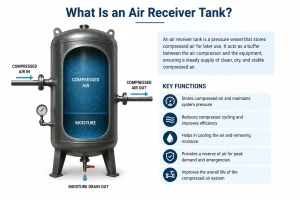
An air receiver tank is a pressure vessel used to temporarily store compressed air produced by an air compressor before the air is distributed to pneumatic equipment or plant processes.
Think of the air receiver as a buffer between compressed-air generation and variable demand.
When demand suddenly increases, stored compressed air can support the system. When demand falls, the receiver provides additional storage and helps smooth pressure fluctuations.
Depending on the compressed-air system design, an air receiver can help:
- Store compressed air
- Stabilise system pressure
- Reduce rapid compressor load/unload cycles
- Support short-duration peak demand
- Provide a cooling and settling zone for condensate
- Improve compressed-air system control
- Provide temporary air during specific operating events
An air receiver should always be selected and operated within its specified pressure, temperature and design limitations.
Air Receiver Tank vs Air Compressor Receiver Tank
The terms air receiver tank, air compressor receiver tank, compressed-air receiver, air vessel and compressed-air storage tank are often used for closely related equipment.
An air compressor receiver tank is simply the receiver associated with an air compressor system.
The compressor generates compressed air.
The receiver stores a volume of that compressed air.
The two perform different functions and should not be confused.
| Equipment | Main Function |
| Air Compressor | Produces compressed air |
| Air Receiver Tank | Stores compressed air and buffers demand |
| Air Dryer | Reduces moisture in compressed air |
| Filter | Removes particles, oil aerosols or contaminants depending on filter type |
| Drain Valve | Removes accumulated condensate |
In smaller compressor packages, the compressor may be physically mounted on the tank. In larger industrial installations, the air receiver is often a separate vertical or horizontal pressure vessel.
Why Is an Air Receiver Important in a Compressed Air System?
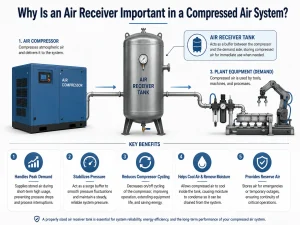
Compressed-air demand is rarely perfectly constant.
Pneumatic cylinders operate, valves open, machines start, tools are used and production equipment changes operating states throughout a shift.
Without sufficient system storage, these demand changes can contribute to pressure instability.
A correctly engineered air receiver provides a stored-air buffer between supply and demand.
1. Handles Short-Term Peak Demand
Some equipment consumes a high volume of air for only a few seconds.
Sizing storage for these events may be more practical than oversizing the compressor solely to meet a short intermittent peak.
2. Reduces Pressure Fluctuation
Stored compressed air can help maintain pressure during temporary changes in demand.
3. Supports Compressor Control
A suitably sized receiver may allow certain compressor-control systems to operate with longer, more stable cycles instead of excessively frequent switching.
4. Supports Moisture Separation
Compressed air contains water vapour.
As hot compressed air cools, some moisture can condense. An appropriately positioned receiver provides additional volume and residence time in which condensate can collect for drainage.
5. Creates Emergency or Process Buffer Storage
Some industrial processes need sufficient compressed air to finish a short operation or move equipment to a safe state when supply is interrupted.
Such requirements need to be considered during engineering rather than relying only on a generic litres-per-CFM rule.
Types of Air Receiver Tanks
Air receivers can be classified according to orientation, system position and application.
Vertical Air Receiver Tank
A vertical receiver has its cylindrical axis in a vertical orientation.
Advantages
- Requires less floor area
- Common for compressor rooms
- Convenient for large storage capacity where vertical clearance is available
- Condensate can collect near the bottom drain connection
Vertical receivers are widely used in manufacturing facilities, textile plants, engineering workshops, chemical plants and general industrial utility systems.
Horizontal Air Receiver Tank
A horizontal receiver is installed on saddle supports with its cylindrical shell positioned horizontally.
Advantages
- Suitable where height is restricted
- Can integrate well with skids and outdoor layouts
- Can be easier to accommodate under certain structures
- Useful where the project layout specifically requires horizontal orientation
Selection between vertical and horizontal tanks should be based on available space, supports, drainage, piping arrangement, maintenance access and engineering requirements.
Wet Air Receiver vs Dry Air Receiver
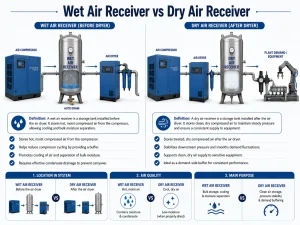
Receiver location is another important design decision.
Wet Air Receiver
A wet receiver is generally located upstream of the air dryer.
Because the compressed air is still moisture-laden, condensate management becomes important.
Wet storage can:
- Provide compressor-side buffer capacity
- Assist cooling
- Encourage moisture separation
- Reduce rapid compressor cycling depending on system design
An effective drain arrangement is especially important.
Dry Air Receiver
A dry receiver is installed downstream of compressed-air treatment equipment.
Its primary role is to store treated compressed air and provide a clean-air buffer for downstream demand.
Large or critical compressed-air systems may use both wet and dry storage.
Main Components of an Industrial Air Receiver Tank
Although construction varies according to design and applicable code, an industrial air receiver may include:
- Cylindrical shell
- Dished ends
- Air inlet connection
- Air outlet connection
- Safety relief valve connection
- Pressure gauge connection
- Condensate drain connection
- Vent connection
- Handhole or manhole where required
- Non-return valve connection
- Leg, skirt or saddle supports
- Lifting lugs
- Earthing lug where specified
- Instrument connections
- Nameplate
These components should be defined through approved drawings, engineering calculations and project specifications.
How to Calculate Air Receiver Tank Capacity
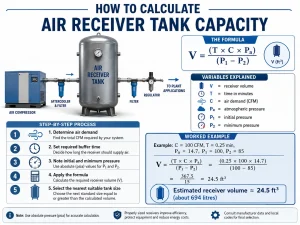
How to calculate air receiver tank capacity is one of the most common questions when planning a compressed-air system.
There is no single tank capacity that is correct for every compressor of a particular horsepower or CFM.
Receiver sizing depends on:
- Required air demand
- Duration of the peak demand
- Compressor capacity
- Initial receiver pressure
- Minimum acceptable system pressure
- Compressor control method
- Acceptable compressor cycling
- Wet or dry storage requirement
- Altitude
- Future demand
- System layout
For dedicated storage serving a temporary demand event, a commonly used preliminary relationship is:
Air Receiver Tank Sizing Formula
V = (T × C × Pₐ) / (P₁ − P₂)
Where:
- V = Required receiver volume in cubic feet
- T = Time allowed for pressure drop in minutes
- C = Free-air demand in CFM
- Pₐ = Atmospheric pressure in absolute units
- P₁ = Initial receiver pressure
- P₂ = Minimum acceptable receiver pressure
Pressure units must be used consistently.
Example Air Receiver Capacity Calculation
Assume a process needs:
- Air demand = 100 CFM
- Required support time = 15 seconds = 0.25 minute
- Initial pressure = 100 psig
- Minimum pressure = 85 psig
- Atmospheric pressure ≈ 14.7 psia
Then:
V = (0.25 × 100 × 14.7) / (100 − 85)
V = 24.5 ft³
24.5 cubic feet is approximately:
694 litres
Therefore, the preliminary receiver requirement is approximately 700 litres for the assumed event.
However, this is an engineering estimate—not a final pressure-vessel specification.
The final selection should consider compressor contribution during the event, actual demand profile, system controls, temperature, altitude, piping losses, safety margin and applicable design requirements.
For important industrial systems, tank sizing should be reviewed by a compressed-air specialist or qualified engineer.
Why Rules of Thumb Should Be Used Carefully
You may find recommendations online suggesting a fixed number of litres or gallons for every CFM of compressor capacity.
Such rules can be useful for an initial estimate, but they cannot account for every process.
For example, two plants may operate identical 100 CFM compressors:
Plant A: Continuous, relatively stable demand.
Plant B: Large pneumatic cylinders creating sudden 15-second demand spikes.
Their storage requirements may be very different.
For industrial projects, engineering the receiver around the actual demand event is more reliable than selecting capacity solely from compressor horsepower.
How to Calculate Volume of Air Receiver Tank
Another common search is how to calculate volume of air receiver tank.
There are two different questions that people sometimes mix together:
- How much compressed-air storage does the system require?
- What is the physical internal volume of an existing vessel?
The previous section covers required storage capacity.
For the physical geometric volume of a cylindrical vessel, start with the straight cylindrical shell.
Cylindrical Shell Volume
V = π × r² × L
Where:
- V = Cylindrical volume
- r = Internal radius
- L = Internal straight length of cylindrical shell
- π ≈ 3.1416
Example
Assume:
- Internal diameter = 1 metre
- Radius = 0.5 metre
- Straight shell length = 1.5 metres
Then:
V = 3.1416 × 0.5² × 1.5
V ≈ 1.178 m³
Since:
1 m³ = 1,000 litres
The cylindrical portion contains approximately:
1,178 litres
However, this is not necessarily the complete vessel capacity.
Industrial air receiver tanks usually have dished heads. Their internal volume must also be added.
Therefore:
Total Receiver Volume = Cylindrical Shell Volume + Top Head Volume + Bottom Head Volume
The exact head-volume calculation depends on whether the vessel uses ellipsoidal, torispherical, hemispherical or another head geometry.
For accurate volume verification, use the approved vessel drawing and actual internal dimensions instead of assuming that the complete tank is a simple cylinder.
Auto Drain Valve for Air Receiver Tank
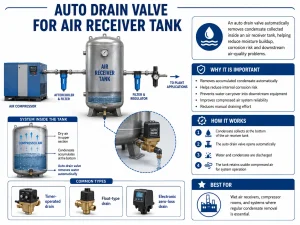
Condensate management is an important part of air receiver operation.
As compressed air cools, moisture can condense inside the system and collect at low points, including the receiver.
An auto drain valve for air receiver tank allows accumulated condensate to be discharged automatically instead of relying entirely on operators to open a manual drain.
Failure to remove condensate can contribute to:
- Internal corrosion
- Reduced available tank volume
- Water entering downstream piping
- Pneumatic equipment problems
- Increased maintenance
- Deterioration of air quality
Types of Automatic Drain Valves
1. Timer-Operated Drain
A timer drain opens at predetermined intervals.
Advantages:
- Simple
- Relatively economical
- Easy to configure
Limitation:
If opening time is excessive, compressed air may be wasted.
2. Float-Type Automatic Drain
The drain operates according to the condensate level.
It can reduce dependence on fixed timed drainage.
3. Electronic Zero-Loss Drain
A level sensor detects condensate and releases liquid while attempting to minimise compressed-air loss.
These drains are useful where energy efficiency and reliable condensate removal are priorities.
Where Should the Drain Be Installed?
The condensate drain should normally be connected at the lowest suitable collection point of the receiver according to the vessel and piping design.
Drain selection should consider:
- Working pressure
- Condensate quantity
- Oil content
- Operating environment
- Connection size
- Maintenance accessibility
- Drain reliability
- Condensate-treatment requirements
Automatic drains should still be inspected and maintained. “Automatic” does not mean maintenance-free.
Materials Used for Air Receiver Tanks
Material selection depends on operating pressure, design temperature, corrosion conditions, fabrication requirements and applicable code.
Carbon Steel Air Receiver Tank
Carbon steel is commonly used for industrial compressed-air receivers.
Typical project specifications may call for carbon steel plate grades selected according to vessel design requirements.
Advantages can include:
- Good fabrication characteristics
- Availability
- Cost effectiveness
- Suitability for many industrial compressed-air applications
Because compressed-air systems can generate condensate, corrosion allowance, coating and drainage must be considered where applicable.
Stainless Steel Air Receiver Tank
Stainless steel may be considered when:
- Corrosion resistance is important
- Higher cleanliness is required
- Process contamination must be controlled
- The plant specification requires stainless steel
- Environmental conditions justify an upgraded material
SS 304 and SS 316 are commonly considered, but the correct grade must be selected according to the service environment.
How to Choose the Right Air Receiver Tank Supplier
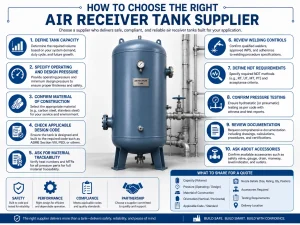
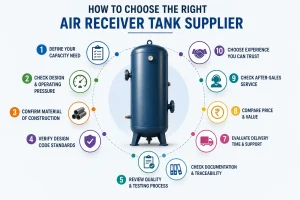
Selecting the right air receiver tank supplier requires more than comparing price per litre.
An air receiver is a pressure-containing component. Procurement should therefore include technical and quality evaluation.
1. Define Capacity
State the required storage volume or provide sufficient compressed-air data for sizing.
2. Specify Operating and Design Pressure
Do not provide only compressor horsepower.
The manufacturer needs pressure information for proper vessel engineering.
3. Confirm Material of Construction
Specify carbon steel, stainless steel or another required material.
4. Specify Applicable Design Code
Depending on project and regulatory requirements, the vessel may need to be designed and fabricated to an applicable pressure-vessel code or client specification.
5. Ask for Material Traceability
Critical materials should have appropriate documentation and traceability where required.
6. Review Welding Controls
Ask about:
- WPS
- PQR where applicable
- Welder qualifications
- Weld inspection
- Weld mapping where required
7. Define NDT Requirements
Depending on design and specification, testing may include:
- Visual inspection
- Dye Penetrant Testing
- Magnetic Particle Testing
- Ultrasonic Testing
- Radiographic Testing
The required extent should come from the applicable code, design and project specification—not a generic marketing checklist.
8. Confirm Pressure Testing
The manufacturer should follow the required hydrostatic or pneumatic testing procedure and document the results.
9. Review Documentation Before Purchase
Ask what documentation will be supplied.
Depending on project scope, this may include:
- GA drawing
- Material Test Certificates
- QAP
- ITP
- NDT reports
- Hydro-test report
- Dimensional inspection report
- Paint/coating report
- Third-party inspection report
10. Ask About Accessories
Confirm whether the supplier’s scope includes:
- Safety relief valve
- Pressure gauge
- Manual drain
- Automatic drain
- Isolation valves
- Non-return valve
- Pressure switches
- Transmitters
This prevents scope confusion during installation.
Air Receiver Tank Manufacturers in Bangalore: What Should Buyers Consider?
Companies searching for air receiver tank manufacturers in Bangalore often require receivers for engineering, automotive, aerospace, electronics, pharmaceutical, food-processing and other industrial applications in and around Bengaluru.
Local availability can be useful, but the closest fabrication shop is not automatically the best supplier.
Bengaluru buyers should compare:
- Required vessel capacity
- Design pressure
- Material
- Applicable code
- Manufacturer or reseller status
- NDT capability
- Documentation
- Custom fabrication capability
- Delivery cost
- Site-installation requirements
- After-sales support
Several compressed-air suppliers serve Bengaluru and industrial areas such as Peenya, Bommasandra and surrounding manufacturing zones.
At the same time, project-based equipment does not always need to be fabricated inside Bengaluru.
A custom pressure-vessel manufacturer located in another industrial region can manufacture the equipment according to approved drawings and ship it to Bangalore after inspection and testing.
Can National Engineers Supply Air Receiver Tanks to Bangalore?
National Engineers & Steel Fabricators manufactures air receiver vessels at its fabrication facility in Sachin GIDC, Surat, Gujarat.
For a Bengaluru project, buyers can share their:
- Required capacity
- Design pressure
- Operating pressure
- Material of construction
- Orientation
- Nozzle schedule
- Inspection requirement
- Applicable code
- Delivery location
The fabrication scope and delivery feasibility can then be reviewed according to the project requirement.
This approach keeps the content relevant for the keyword air receiver tank manufacturers in Bangalore without incorrectly claiming that the NESF manufacturing facility is located in Bengaluru.
Also, Read: Best Storage Tank Manufacturers in India
Applications of Air Receiver Tanks
Industrial air receivers are used wherever compressed-air demand requires storage or pressure buffering.
Common industries include:
Manufacturing
Compressed air for pneumatic tools, cylinders, actuators and automated machinery.
Automotive and Auto Components
Assembly equipment, paint-shop systems, pneumatic tools and production automation.
Textile Industry
Pneumatic equipment and compressed-air networks operating across production lines.
Chemical and Process Plants
Utility compressed air and instrument/service-air systems depending on process specifications.
Food and Beverage
Compressed-air applications where material selection and air quality may require additional consideration.
Pharmaceutical Industry
Compressed-air systems where cleanliness, material requirements and documentation can be particularly important.
Infrastructure and EPC Projects
Utility air stations, process packages, skid systems and project-specific compressed-air networks.
Engineering and Fabrication Facilities
General workshop air used for tools, machinery and production processes.
Information to Send an Air Receiver Tank Manufacturer for a Quote
A detailed enquiry usually produces a better quotation than simply asking:
“Price for 1000 litre air tank?”
Instead, provide:
| Requirement | Information to Share |
| Capacity | Litres or m³ |
| Operating Pressure | bar(g) |
| Design Pressure | bar(g) |
| Design Temperature | °C |
| Orientation | Vertical / Horizontal |
| Material | CS / SS / specified grade |
| Design Code | As applicable |
| Inlet Size | Required NB |
| Outlet Size | Required NB |
| Drain | Manual / Automatic |
| Safety Valve | Required / client scope |
| Pressure Gauge | Required / client scope |
| Manhole / Handhole | If required |
| NDT | As per specification |
| Inspection | In-house / TPI / client |
| Coating | Specify system |
| Delivery Location | City / state |
| Drawing | Attach if available |
A detailed specification allows the manufacturer to determine plate thickness, vessel geometry, nozzle schedule, testing and manufacturing scope more accurately.
Why Custom Air Receiver Tank Manufacturing Can Be Useful
Standard receivers are suitable for many compressed-air installations.
Custom manufacturing becomes useful when the project requires:
- Non-standard capacity
- Higher design pressure
- Special material
- Specific vessel diameter or height
- Restricted plant-room dimensions
- Horizontal orientation
- Custom supports
- Special nozzle locations
- Additional instrumentation
- Skid integration
- Client-specific painting
- Third-party inspection
- Specific documentation
- Design to project drawings
For EPC and industrial projects, the receiver often needs to integrate with existing piping and plant layouts. In these cases, dimensional and nozzle customisation can be as important as tank capacity.
Why Choose National Engineers & Steel Fabricators for a Custom Air Receiver?
National Engineers & Steel Fabricators focuses on custom industrial fabrication rather than only standard catalogue vessels.
For air receiver projects, buyers can submit a datasheet, drawing or operating requirement for engineering and manufacturing review.
Key capabilities include:
Custom Capacity
Air receiver vessels can be fabricated across a broad range of industrial capacities based on project requirements.
Vertical and Horizontal Fabrication
Configuration can be selected according to plant layout and engineering requirements.
Multiple Material Options
Carbon-steel and stainless-steel construction can be considered depending on project specifications.
Quality-Control Documentation
Project documentation can include material certificates, inspection records and pressure-test reports according to agreed scope.
NDT Options
DPT, MPT, UT and RT can be performed where specified by the design, code or client inspection plan.
Third-Party Inspection Support
Client-appointed or project-required third-party inspection can be incorporated into applicable orders.
Custom Nozzle Configuration
Inlet, outlet, drain, safety-valve branch, pressure-gauge connection, instrumentation and access openings can be positioned according to the approved drawing.
For buyers who need more than a standard compressor-mounted receiver, this project-specific approach allows the vessel to be matched more closely to the plant requirement.
Final Thoughts
Selecting an air receiver tank should begin with the compressed-air requirement—not simply with a standard tank size or the lowest quotation.
A properly specified receiver must match the required capacity, operating pressure, design conditions, material, orientation, inspection requirements and plant layout.
When comparing air receiver tank manufacturers in India, buyers should focus on actual manufacturing capability, engineering support, material traceability, welding controls, testing and documentation.
Similarly, companies searching for an air receiver tank supplier or air receiver tank manufacturers in Bangalore should verify whether the supplier is manufacturing the pressure vessel directly and whether the proposed receiver matches the technical requirements of the compressed-air system.
For custom industrial projects, National Engineers & Steel Fabricators can review the required capacity, pressure, material, orientation, drawings and inspection scope to determine an appropriate fabrication solution.
Need a custom air receiver tank for your plant? Share your capacity, design pressure, material, orientation, drawing or compressed-air requirement with National Engineers & Steel Fabricators for a project-specific fabrication review.
Frequently Asked Questions About Air Receiver Tanks
Is an air receiver the same as an air compressor?
No. An air compressor produces compressed air, while an air receiver stores compressed air. They work together but perform different functions.
What is an air compressor receiver tank?
An air compressor receiver tank is the compressed-air storage vessel associated with an air compressor system. It may be tank-mounted on smaller units or installed as a separate vessel in larger industrial systems.
How to calculate air receiver tank capacity?
A preliminary dedicated-storage calculation can use:
V = (T × C × Pₐ) / (P₁ − P₂)
where receiver size depends on air demand, required support time and allowable pressure drop. Final sizing should also consider compressor operation, demand pattern, control strategy and system conditions.
How to calculate volume of air receiver tank?
For the cylindrical section:
V = π × r² × L
Then add the internal volume of the vessel’s dished heads. Accurate capacity calculations should use the actual internal dimensions and head geometry shown on the vessel drawing.
Why is an auto drain valve required on an air receiver tank?
An auto drain valve for air receiver tank automatically removes condensate collected in the receiver. Effective drainage helps reduce moisture accumulation, internal corrosion risk and water carryover into downstream equipment.
Which type of automatic drain is best?
Timer drains, float-operated drains and electronic zero-loss drains are commonly used. Selection depends on condensate load, operating pressure, maintenance requirements and acceptable compressed-air loss.
Should I choose a vertical or horizontal air receiver tank?
Vertical receivers generally require less floor area, while horizontal receivers can suit locations with limited height or project-specific layouts. The best configuration depends on space, piping, supports, drainage and maintenance access.
How do I choose between air receiver tank manufacturers?
Compare engineering capability, design pressure, material, welding quality, code compliance, inspection, NDT, testing, documentation, customisation and previous manufacturing experience—not price alone.
Can an air receiver tank be customised?
Yes. Custom air receiver tank manufacturers can modify capacity, orientation, material, nozzles, supports, accessories, inspection requirements and documentation according to approved engineering specifications.
How do I find an air receiver tank supplier for Bangalore?
When evaluating air receiver tank manufacturers in Bangalore, consider both local compressed-air suppliers and qualified manufacturers capable of fabricating elsewhere and delivering to Bengaluru. Manufacturing capability and pressure-vessel quality controls should take priority over location alone.
What details should I send to an air receiver tank supplier?
Send required capacity, operating and design pressure, material, orientation, applicable code, design temperature, nozzle requirements, accessories, testing, inspection requirements and delivery location. Attach a datasheet or drawing whenever available.
Leave a Reply