Pipeline blockages and maintenance delays cost industrial facilities millions of dollars annually. When debris accumulates or internal corrosion goes unchecked, pipeline efficiency drops significantly. Engineers and plant managers constantly seek reliable methods to clean, inspect, and maintain these vital transportation networks without halting production.
This is where a robust pig launcher system becomes essential. By safely introducing maintenance “pigs” into active pipelines, these systems eliminate buildup and gather critical inspection data. Therefore, selecting the right equipment is a high-stakes decision for operational success.
Whether you operate in the oil and gas sector or manage a large-scale chemical processing plant, understanding pipeline pigging equipment is crucial. In this comprehensive guide, we will explore the exact features, components, and design principles you must evaluate when investing in an industrial pig launcher system.
What is a Pig Launcher System?
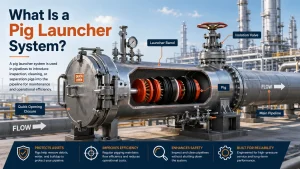
A pig launcher system is specialized mechanical equipment used to insert a pipeline pig into a pressurized pipeline without interrupting the flow of the product. The “pig” is a device used for cleaning, clearing, or inspecting the internal bore of the pipe.
The Basic Concept
The core concept revolves around safe entry. A pipeline operates under immense pressure. Opening it directly to insert a cleaning tool is impossible. The pig launcher acts as an intermediary airlock or pressure chamber. It allows operators to load the pig, seal the chamber, equalize the pressure, and then release the pig into the active product flow.
Role in Pipeline Systems
Pig launchers are the starting point of any pipeline pigging system. They play a critical role in maintaining flow assurance. By facilitating regular pigging, they prevent wax, scale, and debris buildup. Consequently, they protect the pipeline integrity and ensure the continuous, efficient transport of liquids and gases across vast distances.
How Does a Pig Launcher Work?
Understanding the pig launcher working principle helps engineers specify the right features for their application. The operation follows a strict, sequential process to ensure safety and efficiency.
Step-by-Step Process
First, operators isolate the launcher from the main pipeline using a series of heavy-duty valves. Once isolated and depressurized, they open the closure door and manually insert the pig into the oversized barrel.
Next, they shut and secure the closure door. Operators then gradually open the kicker valves. This introduces the pipeline fluid or gas behind the pig. As the pressure equalizes with the main line, the main isolation valve opens.
Finally, the pressure of the product pushes the pig out of the launcher, through the reducer, and into the main pipeline. The pig then travels the length of the pipe, performing its cleaning or inspection duties, until it reaches the pig receiver.
Key Components of a Pig Launcher System
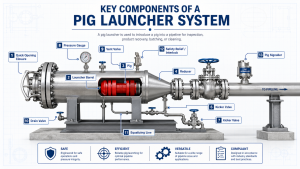
A standard pressure vessel pig launcher consists of several highly engineered parts. Each component must work flawlessly to maintain system integrity.
- Barrel: The enlarged section of the pipe where the pig is initially loaded. It is designed to be slightly larger than the pig itself.
- Closure Door: The quick-opening mechanical door that seals the barrel. It must withstand the maximum operating pressure of the pipeline.
- Valves: A complex pig launcher valve system includes isolation valves, kicker valves, vent valves, and drain valves to control fluid flow and pressure.
- Reducer: The tapered section connecting the oversized barrel to the standard diameter of the main pipeline.
- Instrumentation: Pressure gauges, pig signallers, and temperature monitors that track the pig’s location and the system’s operational status.
- Safety Locking System: Mechanical and pneumatic interlocks that prevent the closure door from opening while the vessel remains under pressure.
Top Features to Look for in a Pig Launcher System
Selecting a high-quality industrial pig launcher system requires careful evaluation of its design and manufacturing. Here are the most critical features to demand from a pigging equipment manufacturer.
1. Robust Design & Material Quality
The foundation of any pig launcher design is its structural integrity. The system must withstand extreme internal pressures and harsh environmental conditions. Look for launchers constructed from high-grade carbon steel, stainless steel, or specialized duplex alloys. The material must perfectly match the chemical properties of the transported product to prevent premature degradation.
2. Exceptional Pressure Handling Capacity
Pipelines operate at highly variable pressures. Your pig launcher must feature a pressure rating that exceeds the maximum allowable working pressure (MAWP) of your pipeline. Rigorous hydrostatic testing during the pig launcher fabrication process ensures the vessel can safely manage pressure surges without structural failure.
3. Advanced Corrosion Resistance
Industrial pipelines frequently transport corrosive materials like sour gas, crude oil, and harsh chemicals. Furthermore, offshore platforms expose equipment to saltwater environments. Therefore, a top-tier pig launcher must include corrosion-resistant cladding or high-performance industrial coatings. Internal epoxy linings and exterior polyurethane finishes significantly extend the equipment’s operational lifespan.
4. Foolproof Safety Features (Interlock Systems)
Safety is the most critical aspect of any pipeline maintenance equipment. A premium pig launcher system must feature a mechanical interlock system on the closure door. This prevents operators from accidentally opening the door while the barrel is still pressurized. Moreover, safety bleed valves ensure zero trapped pressure before maintenance begins.
5. Easy Operation & Maintenance
Time is money in industrial operations. The system should feature a quick-opening closure (QOC) mechanism. This allows a single operator to open and close the heavy door rapidly and safely, without needing specialized tools. Additionally, well-placed drain and vent valves make routine maintenance and fluid purging fast and highly efficient.
6. Extensive Customization Capability
Standardized, off-the-shelf solutions rarely fit complex industrial layouts. Look for manufacturers that offer custom engineering. The system should be adaptable to specific space constraints, pipeline diameters, and product types. Customization ensures the launcher integrates seamlessly into your existing infrastructure. [Explore industrial fabrication services here]
7. Leak-Proof Sealing System
Fugitive emissions and fluid leaks pose massive environmental and safety risks. High-quality launchers utilize advanced elastomer O-rings or lip seals on the closure door. These seals must remain resilient under extreme temperature fluctuations and aggressive chemical exposure, guaranteeing a 100% leak-proof environment during operation.
8. Strict Compliance with Industry Standards (ASME)
Never compromise on regulatory compliance. The equipment must be designed and built by an ASME certified pressure vessel manufacturer. Compliance with ASME Boiler and Pressure Vessel Code (Section VIII), API standards, and NACE MR0175 guarantees that the launcher meets the highest global safety and engineering benchmarks.
9. Automation Compatibility
Modern industrial facilities rely heavily on automated control systems. Advanced pig launchers come equipped with automated valve actuators, electronic pig signallers, and smart pressure transmitters. This automation compatibility allows operators to control the pigging sequence remotely from a central control room, minimizing human intervention in hazardous areas.
10. Efficient Pig Launching Mechanism
The internal geometry of the launcher dictates how smoothly the pig enters the pipeline. A high-quality reducer ensures a seamless transition from the barrel to the main line. This prevents the pig from getting stuck or damaged during the launch sequence, ensuring the pipeline cleaning system functions exactly as intended.
11. Durability & Long Service Life
Industrial equipment is a significant capital investment. The launcher must offer exceptional durability. Features like reinforced structural skid bases, heavy-duty hinges, and precision-machined threading contribute to a long service life. High-quality construction reduces the total cost of ownership over the pipeline’s operational lifespan.
12. Overall Cost Efficiency
While premium features have an upfront cost, they deliver massive long-term savings. A well-designed pig launcher reduces labor costs through faster operation, minimizes pipeline downtime, and prevents expensive environmental fines. Therefore, cost efficiency should be measured by reliability and operational uptime, rather than just the initial purchase price.
Types of Pig Launcher Systems
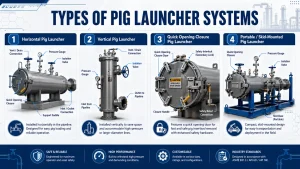
Pipelines vary drastically in layout and purpose. Consequently, engineers design different types of pig launchers to suit specific operational parameters.
Horizontal Pig Launcher
This is the most common configuration. The barrel sits parallel to the ground. Horizontal launchers are highly stable, easy to load, and ideal for standard onshore pipelines where space is not a limiting factor.
Vertical Pig Launcher
When ground space is severely limited, such as on offshore oil rigs or densely packed chemical plants, vertical pig launchers are utilized. The barrel stands upright, saving critical floor space. However, they require specialized lifting equipment to load heavy pigs.
Temporary Pig Launcher
Construction crews use temporary launchers during the initial commissioning or hydro-testing of a new pipeline. They are often mobile, skid-mounted units designed for rapid deployment. Once the pipeline is fully operational, the temporary launcher is removed.
Permanent Pig Launcher
Permanent launchers are welded directly into the facility’s infrastructure. They are built for continuous, lifetime use in operational pipelines that require frequent, scheduled maintenance and cleaning.
Pig Launcher vs Pig Receiver
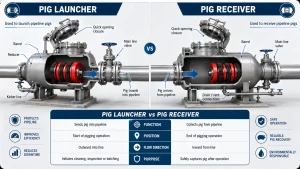
While they look similar, the pig launcher and receiver perform entirely opposite functions within the pipeline pigging system.
| Feature | Pig Launcher | Pig Receiver |
| Primary Function | Inserts the pig into the pipeline | Catches and retrieves the pig from the pipeline |
| Location | Beginning of the pipeline segment | End of the pipeline segment |
| Operation | Uses product pressure to push the pig out | Uses bypass valves to safely catch and halt the pig |
| Design Difference | Barrel tapers down (reducer) into the pipeline | Pipeline expands into a larger barrel to catch the pig |
Benefits of Using a High-Quality Pig Launcher System
Investing in top-tier pipeline maintenance equipment yields immediate and long-term dividends for industrial operators.
Improved Pipeline Efficiency
Regular pigging removes sludge, wax, and scale that cause friction inside the pipe. By maintaining a clean bore, the pipeline maintains optimal fluid dynamics. This reduces the energy required by pumps and compressors to push the product, dramatically improving overall system efficiency.
Reduced Maintenance Cost
Preventative maintenance is always cheaper than reactive repairs. A reliable pig launcher allows operators to deploy smart pigs that detect micro-cracks and corrosion before they cause catastrophic leaks. This proactive approach saves millions in emergency repair costs.
Better Safety Protocols
Automated launchers with strict interlock systems remove operators from harm’s way. By controlling pressure safely and preventing accidental openings, these systems protect personnel from high-pressure blowouts and exposure to toxic pipeline products.
Extended Pipeline Life
Pipelines are multi-decade investments. By consistently clearing corrosive water and debris, a high-quality pigging system prevents internal pipe degradation. Consequently, this extends the safe operational lifespan of the entire pipeline network by years or even decades.
Industries Using Pig Launcher Systems
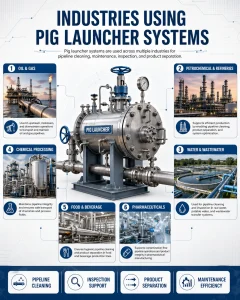
Almost any industry moving massive volumes of fluid or gas relies heavily on this technology.
Oil & Gas
This sector is the largest user of pigging equipment. From upstream wellheads to downstream refineries, an oil and gas pig launcher is essential for clearing wax from crude oil lines and liquid condensate from natural gas networks.
Chemical Processing
Chemical plants use pigging to recover highly valuable products left in the pipes between production batches. Furthermore, pigging prevents cross-contamination when a single pipeline transports different chemical formulas.
Water Treatment
Municipal water networks and industrial desalination plants use specialized pigs to clear bio-fouling, silt, and mineral scale from massive water mains, ensuring clean water delivery.
Petrochemical
Petrochemical facilities require absolute precision. Pigging ensures complex pipe networks remain free of polymerized debris, allowing for safe and continuous chemical synthesis.
Power Plants
Thermal and nuclear power plants use pigging systems to maintain the efficiency of massive cooling water intakes and discharge lines, preventing thermal blockages.
How to Choose the Right Pig Launcher System
Selecting the perfect system requires aligning engineering specifications with your exact operational needs. Here is a brief guide on how to choose a pig launcher system.
Material Selection
Assess your product’s chemical makeup. Carbon steel works for standard crude oil, but highly corrosive sour gas requires stainless steel or Inconel cladding. Always match the metallurgy to the internal environment.
Pressure Rating Assessment
Calculate your pipeline’s highest possible pressure surge. Choose a launcher with an ASME pressure class rating that comfortably exceeds this maximum limit. Safety margins are non-negotiable. [Learn more about types of pressure vessels here]
Application Type
Determine the frequency of pigging. If you pig daily, invest in automated valves and quick-opening closures. If you pig annually, a simpler, manual closure might suffice.
Manufacturer Expertise
Always partner with a proven pigging equipment manufacturer in India or globally. Verify their ASME certifications, ask for case studies in your specific industry, and ensure they offer robust after-sales support and spare parts.
Common Mistakes to Avoid
Procurement errors in pipeline engineering can lead to massive operational failures. Avoid these common pitfalls.
Wrong Sizing
A barrel that is too short cannot accommodate modern, elongated smart pigs. Always specify barrel dimensions based on the largest, most complex inspection tool you plan to run in the future.
Poor Material Selection
Choosing standard carbon steel for a highly corrosive application to save money upfront is a critical error. The launcher will corrode rapidly, leading to leaks, safety hazards, and premature replacement costs.
Ignoring Safety Standards
Never purchase uncertified equipment. Failing to verify ASME or ISO compliance puts your entire facility at risk of catastrophic failure and severe regulatory penalties.
Conclusion
The integrity of your pipeline network heavily depends on the quality of your maintenance equipment. A well-engineered pig launcher system is not just an accessory; it is a critical safeguard for your entire industrial operation. By prioritizing robust materials, strict ASME compliance, and advanced safety interlocks, you ensure seamless flow assurance and protect your personnel from hazardous high-pressure environments.
Do not compromise on your pipeline’s operational efficiency. When selecting your next industrial pig launcher system, demand excellence in fabrication, custom design capabilities, and rigorous testing standards. Reach out to a certified engineering manufacturer today to design a pigging solution that perfectly aligns with your facility’s long-term operational goals.
FAQs On Pig Launcher System
How does a pig launcher work?
It works as an airlock. Operators isolate the vessel, load the pig, seal the door, and equalize the internal pressure with the main pipeline. Once pressures match, valves are opened, and the pipeline fluid pushes the pig into the line.
What are the main components of a pig launcher?
The main components include the oversized barrel, a high-pressure quick-opening closure door, a reducer to match the pipe diameter, isolation and kicker valves, and safety interlock mechanisms.
What is the difference between pig launcher and receiver?
A pig launcher is located at the beginning of a pipeline segment and inserts the pig into the flow. A pig receiver is located at the end of the segment and is designed to safely catch, halt, and retrieve the pig.
Why is pigging important?
Pigging is vital because it clears debris, wax, and scale from the pipe, ensuring maximum flow efficiency. Additionally, smart pigs inspect the pipe walls for corrosion and cracks, preventing leaks and extending pipeline life.
How to choose pigging system?
Choose a pigging system by matching the vessel’s material to your product’s corrosiveness, ensuring the pressure rating exceeds your pipeline’s maximum pressure, and verifying the manufacturer holds strict ASME and ISO certifications.
Leave a Reply