Every piece of steel you see in a factory floor, every bridge girder overhead, every pressure vessel in an oil refinery, every staircase in an industrial plant — all of it starts as raw metal and ends as a finished structure through one fundamental process: metal fabrication.
Metal fabrication is the backbone of modern industry. Without it, construction projects would stall, manufacturing plants would not function, and critical infrastructure would not exist. From structural frameworks and storage tanks to precision machine components and industrial platforms, metal fabrication touches virtually every sector of the economy.
If you are a plant owner, procurement manager, civil engineer, construction company, or industrial buyer trying to understand metal fabrication — what it means, how it works, and how to choose the right metal fabricator — this guide covers everything you need to know.
What Is Metal Fabrication?
Metal fabrication is the process of cutting, shaping, bending, welding, and assembling raw metal materials into finished products, components, or structures. It transforms metal sheets, bars, rods, and profiles into functional items used in construction, manufacturing, infrastructure, and industrial applications.
In simpler words: if raw metal goes in and a useful structure or component comes out, that is metal fabrication at work.
Metal Fabrication Definition and Meaning
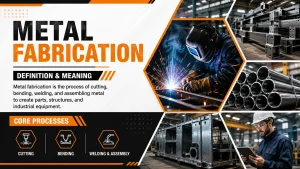
The metal fabrication definition, at its core, refers to any industrial activity that takes raw metallic materials and converts them into predetermined shapes, structures, or assemblies through a sequence of manufacturing operations.
The metal fabrication meaning goes beyond just cutting or welding. It encompasses the entire workflow — from engineering design and material procurement to the final quality-checked, ready-to-install product. When we say metal fabrication means converting raw metal into useful goods, we are describing both a craft and an industrial science.
What is fabricated metal? Fabricated metal refers to any metal product that has undergone one or more manufacturing processes — such as cutting, bending, welding, or machining — to achieve a desired shape or function. Examples include steel beams, pressure vessels, storage tanks, machine frames, industrial platforms, and stainless steel railings.
How Does Metal Fabrication Work?
Metal fabrication work follows a structured sequence that begins with a design requirement and ends with an inspected, finished product. Here is how the complete workflow looks in practice:
1. Design and Engineering
Every fabrication job starts with a design. Engineers or draftsmen prepare detailed drawings — using CAD (Computer-Aided Design) software — that define dimensions, tolerances, material grades, weld specifications, and finish requirements. This stage prevents costly errors downstream and ensures that the fabricated product meets the client’s exact specifications.
2. Material Selection
The right metal for fabrication is chosen based on load requirements, environmental exposure, corrosion resistance, weldability, and budget. Common choices include mild steel, stainless steel, structural steel, aluminum, and cast iron. Poor material selection at this stage leads to premature failure in the field.
3. Cutting
Raw metal stock — sheets, plates, bars, tubes — is cut to required dimensions using plasma cutting, laser cutting, waterjet cutting, shearing, or sawing. CNC-controlled cutting machines ensure high accuracy and repeatability, especially for complex profiles or large production runs.
4. Bending and Forming
Cut pieces are bent or formed into required shapes using press brakes, rolling machines, or hydraulic forming tools. Sheet metal can be bent at precise angles; pipes and plates can be rolled into cylindrical or curved forms. This step gives the component its three-dimensional shape before assembly.
5. Welding
Welding joins metal components by melting and fusing them together. It is one of the most critical steps in fabrication. Common welding processes include MIG (Metal Inert Gas), TIG (Tungsten Inert Gas), stick welding (SMAW), and submerged arc welding (SAW). Weld quality directly determines the strength and safety of the final product.
6. Machining
Some components require tight dimensional tolerances that welding or cutting alone cannot achieve. Machining operations — such as drilling, milling, turning, and grinding — are performed on CNC or conventional machines to produce holes, threads, flanges, and precision surfaces.
7. Assembly
Individual fabricated parts are assembled into the final structure or component. Assembly may involve bolting, welding, riveting, or mechanical fastening. This stage requires skilled fitters who can read engineering drawings and match tolerances accurately.
8. Surface Finishing
The completed assembly undergoes surface treatment to protect against corrosion, improve aesthetics, or meet regulatory standards. Common finishing methods include sandblasting, shot blasting, painting (epoxy, polyurethane), powder coating, galvanizing, and passivation for stainless steel.
9. Quality Inspection
Before dispatch, every fabricated product is inspected against the design specification. Inspection may include dimensional checks, weld inspection (visual, UT, RT, PT), pressure testing (for vessels), and surface finish evaluation. ISO-certified fabrication shops follow documented quality control procedures.
10. Installation
For structural and site-erected fabrications, the metal fabricator or their team handles erection, installation, and commissioning at the project site. This ensures the fabricated structure integrates correctly with the civil, mechanical, and process systems.
What Does a Metal Fabricator Do?
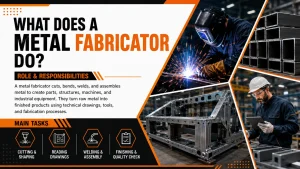
A metal fabricator is a skilled tradesperson or a company that takes raw metal materials and transforms them into usable structures, parts, or equipment through cutting, welding, forming, and finishing operations.
In practical terms, metal fabricators handle the following responsibilities:
- Reading and interpreting engineering drawings and specifications
- Selecting appropriate metals and material grades for the project
- Operating cutting, bending, welding, and machining equipment
- Assembling components into complete structures or products
- Performing quality checks and dimensional verification
- Applying surface treatments and protective coatings
- Coordinating with project engineers and site teams for installation
- Maintaining safety standards and certifications
Steel fabricators work specifically with structural steel, carbon steel, and stainless steel — the most widely used metals in heavy industry and construction. Large metal fabrication shops typically employ multiple specialists: fitters, welders, machinists, quality controllers, and project managers.
Types of Metal Fabrication
1. Industrial Metal Fabrication
Covers the manufacture of heavy equipment, process plant components, storage tanks, pressure vessels, heat exchangers, and industrial machinery. This is the most complex and demanding type of fabrication work, often governed by international standards like ASME, IS, or EN.
2. Structural Metal Fabrication
Structural metal fabrication involves creating load-bearing frameworks for buildings, bridges, industrial plants, warehouses, and infrastructure. This includes fabrication of beams, columns, trusses, staircase structures, platforms, walkways, pipe supports, and support frames. Steel is the primary material in structural fabrication. Accurate detailing and robust welding are critical here, as structural failures can have severe safety consequences.
3. Sheet Metal Fabrication
Sheet metal fabrication works with thin metal sheets (typically under 6 mm) to produce enclosures, ducts, panels, cabinets, covers, and housings. It is widely used in HVAC systems, electrical panel manufacturing, automotive bodywork, and kitchen equipment.
4. Steel Fabrication
Metal fabrication steel work is arguably the most common form. Structural steel fabrication spans everything from large industrial plant frameworks to pre-engineered buildings. Fabricated structural metal manufacturing involves large-scale production of standard profiles — I-beams, H-sections, angle iron, channels, and hollow sections — cut and assembled for specific projects.
5. Iron Fabrication
Iron fabrication refers specifically to working with cast iron and wrought iron. Though less common than steel fabrication today, iron fabrication is still used for decorative metalwork, counterweights, machine bases, manhole covers, and some structural castings.
6. Custom Metal Fabrication
When standard off-the-shelf products do not meet project requirements, custom metal fabrication fills the gap. Customers provide specifications or drawings, and the fabricator produces one-off or small-batch components tailored to exact dimensions, materials, and performance criteria.
7. Commercial Metal Fabrication
Commercial fabrication covers retail fixtures, signage frames, food service equipment, furniture frames, and architectural metalwork for commercial buildings. Though less technically demanding than industrial work, it requires precision in aesthetics and finish quality.
Materials Used in Metal Fabrication
The choice of metal for fabrication determines the performance, cost, and lifespan of the final product. Here are the most common materials:
- Mild Steel (Carbon Steel): The most widely used metal in fabrication due to its affordability, weldability, and strength. Suitable for structural frames, tanks, platforms, and general engineering.
- Stainless Steel: Highly resistant to corrosion and ideal for food processing equipment, pharmaceutical plants, chemical storage, and offshore applications.
- Structural Steel: High-strength steel grades (like IS 2062, ASTM A36) used in beams, columns, trusses, and heavy structural fabrication.
- Aluminum: Lightweight and corrosion-resistant. Used in aerospace, transport, and where weight reduction is critical.
- Copper and Brass: Used in electrical components, heat exchangers, plumbing fittings, and marine hardware.
- Cast Iron: Suitable for heavy-duty machine bases, counterweights, and components where vibration damping is needed.
- Duplex and Super Duplex Steel: High-performance alloys used in oil & gas, chemical processing, and offshore environments.
Tools and Machines Used in Metal Fabrication
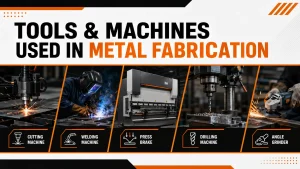
Modern metal fabrication shops are equipped with a range of specialized machines that enable precision work at scale:
- CNC Plasma and Laser Cutting Machines: For precise cutting of sheets and plates with complex profiles and tight tolerances.
- Press Brakes: Hydraulic or CNC-controlled machines used to bend sheet metal at precise angles.
- Welding Machines: MIG, TIG, SMAW, and SAW welding equipment for all joining applications.
- Rolling Machines (Plate Rolls): Form flat plates into cylinders or cones — essential for vessel and tank fabrication.
- Drilling Machines and Radial Drills: Create holes, counter-bores, and tapped threads in metal components.
- CNC Milling and Turning Centers: For precision machining of flanges, shafts, nozzles, and machined surfaces.
- Grinding and Polishing Machines: Used for surface preparation and finishing.
- Shearing Machines: Cut sheet metal in straight lines at high speed.
- Overhead Cranes and Material Handling Equipment: Move heavy fabricated structures safely within the shop.
- NDT Equipment: Ultrasonic testing (UT), radiography (RT), and dye penetrant (PT) equipment for weld inspection.
Applications of Metal Fabrication Across Industries
Metal fabrication works cuts across nearly every major industry. Here is where fabricated metal finds real-world application:
Construction and Infrastructure
Structural steel frameworks for buildings, bridges, flyovers, metro stations, and industrial sheds. Without structural metal fabrication, large-scale construction simply cannot proceed.
Oil and Gas Industry
Pressure vessels, heat exchangers, storage tanks, process skids, pipe supports, and flare stacks are all fabricated metal components critical to upstream, midstream, and downstream operations.
Power Plants and Energy
Steam drums, air receiver vessels, boiler components, structural platforms for turbines, and cable trays in thermal, solar, and nuclear power plants are all fabricated in metal fabrication manufacturing facilities.
Manufacturing and Heavy Industry
Machine bases, equipment housings, conveyors, material handling systems, and factory fitouts all rely on metal fabricating work. Custom-fabricated jigs, fixtures, and tooling are also common in manufacturing environments.
Automotive and Aerospace
Chassis components, body panels, exhaust systems, and precision aerospace structural parts are all products of specialized metal fabrication. Aerospace fabrication demands extremely tight tolerances and certified processes.
Food Processing and Pharmaceuticals
Stainless steel tanks, mixing vessels, conveyors, piping systems, and clean-room equipment are fabricated to food-grade or pharmaceutical-grade standards. Hygiene and surface finish are paramount in these applications.
Warehouses and Logistics
Pre-engineered steel structures, mezzanine floors, pallet racking systems, and dock levelers are all products of fabricated structural metal manufacturing.
Structural Metal Fabrication: The Foundation of Industrial Construction
Structural metal fabrication is a specialized subset that focuses exclusively on creating load-bearing components for civil and industrial structures. The goal is not just to shape metal, but to produce components that can withstand real-world forces — gravity, wind, seismic loads, dynamic equipment vibration, and thermal expansion.
Typical structural fabrication products include:
- I-beams, H-beams, and column sections for building frames
- Industrial staircases, handrails, and walkway platforms
- Bridge trusses and gantry structures
- Industrial sheds and pre-engineered building frames
- Pipe supports, anchor frames, and equipment plinths
- Mezzanine structures and elevated floors in factories
- Crane runway beams and monorail systems
Fabricated structural metal manufacturing is strictly governed by codes like IS 800 (Indian Standard), AISC (USA), or Eurocode 3 to ensure that all structures meet safety requirements.
What Is the Difference Between Welding and Metal Fabrication?
Welding is one step within the broader metal fabrication process. Fabrication is the complete journey — from raw material to finished product — while welding is specifically the joining operation within that journey.
Think of it this way: a car is not just welded — it is designed, cut, stamped, welded, painted, and assembled. All of that together is fabrication. Welding is just one of those steps, albeit a very important one.
A qualified welder can weld, but may not have the full fabrication skills of fitting, reading complex drawings, or machining. A metal fabricator typically has a broader skill set that includes welding along with other competencies.
Metal Fabrication vs Machining: What Is the Difference?
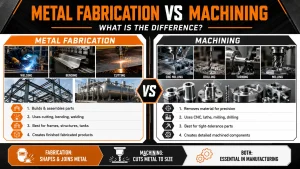
Both fabrication and machining transform metal, but they work differently. Metal fabrication primarily joins or reshapes metal pieces — cutting, bending, welding, forming. Machining removes material from a solid metal workpiece to create precise dimensions — turning, milling, drilling, grinding.
In practice, both processes are often used together. A fabricated vessel, for example, will have machined nozzle flanges to ensure leak-free connections. A fabricated machine frame will have machined mounting surfaces for motors and gearboxes.
Benefits of Metal Fabrication
- Strength and Durability: Properly fabricated metal structures last decades, even in harsh industrial environments.
- Customization: Every project can be fabricated to exact specifications — dimensions, material, finish, and performance requirements.
- Cost-Effectiveness: While initial costs can vary, fabricated metal structures offer excellent lifecycle value due to longevity and low maintenance.
- Design Flexibility: Complex geometries, multiple materials, and varied thicknesses can all be combined in a single fabricated assembly.
- Scalability: From one-off prototypes to large-scale batch production, fabrication adapts to any volume requirement.
- Safety: When fabricated to code and quality-inspected, metal structures provide reliable safety performance in high-risk industrial environments.
- Integration: Fabricated components can be designed to interface precisely with existing plant or machinery.
Common Challenges in Metal Fabrication
Not all fabrication work is equal. Buyers and project managers should be aware of these common pitfalls:
- Design Errors: Ambiguous or incomplete drawings lead to rework, delays, and cost overruns. Always work with fabricators who have in-house engineering capability.
- Poor Material Selection: Using a lower-grade or incorrect alloy may compromise strength, corrosion resistance, or weldability.
- Inaccurate Cutting and Forming: Cumulative dimensional errors in cutting and bending can make final assembly impossible or result in misaligned structures.
- Weak or Defective Welds: Inadequate welder qualification, wrong welding parameters, or skipped preheat can cause weld cracking or porosity — serious safety risks.
- Surface Finishing Failures: Inadequate surface preparation before painting leads to early coating failure and corrosion.
- Lack of Quality Control: Fabrication without proper inspection at each stage results in defective products that may only fail after installation.
How to Choose the Right Metal Fabrication Company
Choosing the right metal fabricator is one of the most important decisions on any industrial or construction project. Here is a practical checklist:
- Experience and Track Record: Look for fabricators with proven experience in your specific application — structural, pressure vessels, process equipment, etc.
- Machinery and Infrastructure: A well-equipped shop with CNC cutting, welding stations, and material handling equipment signals the ability to handle complex, large-scale work.
- Qualified and Skilled Team: Check for certified welders (ASME, BIS, or equivalent), qualified engineers, and experienced QC personnel.
- Material Knowledge: Good fabricators understand metallurgy, can advise on material grades, and source from reliable mills.
- Quality Control System: ISO 9001 certification or equivalent is a good indicator of a formal QC framework.
- Custom Fabrication Capability: Confirm the fabricator can handle your specific design requirements, not just off-the-shelf products.
- Delivery Timeline and Project Management: Fabrication delays can disrupt your entire project schedule. Assess the fabricator’s planning and execution track record.
- Safety Standards: A reputable shop follows OSHA or equivalent safety norms and has documented safety practices.
- Previous Project Portfolio: Ask for reference projects of similar scope and complexity.
- After-Sales Support: Does the fabricator provide installation, erection, or post-delivery support?
Why Quality Matters in Metal Fabrication
In metal fabrication, quality is not an optional add-on — it is a fundamental requirement. A structural beam that fails causes catastrophic collapse. A pressure vessel with a defective weld can rupture under operating conditions. A corroded platform endangers workers every single day.
High-quality fabrication delivers: greater safety for workers and plant assets, longer service life that reduces total cost of ownership, lower maintenance frequency and downtime, compliance with regulatory and statutory requirements, and the ability to withstand full design loads without compromise.
Investing in quality fabrication from a reputable fabricator consistently costs less in the long run than repairing or replacing substandard work.
The Future of Metal Fabrication
The metal fabrication industry is evolving rapidly. Here are the trends shaping its future:
- CNC and Automation: Computer-controlled cutting, bending, and welding reduce human error and dramatically increase repeatability and throughput.
- Robotic Welding: Automated welding robots are now deployed in high-volume fabrication for consistent weld quality at speed.
- Laser Cutting Technology: Fiber laser cutting machines offer unmatched precision, speed, and versatility for complex profiles.
- BIM Integration: Building Information Modelling (BIM) is enabling better coordination between fabricators, designers, and site teams — reducing errors and rework.
- AI-Based Design and Nesting: Artificial intelligence tools optimize cut nesting patterns to minimize material waste and reduce costs.
- Sustainable Fabrication: Growing focus on scrap recycling, energy-efficient machines, and low-VOC coatings to reduce environmental impact.
- 3D Metal Printing (Additive Manufacturing): For complex, one-off components, metal 3D printing is beginning to complement traditional fabrication.
Conclusion
Metal fabrication is the foundation on which modern industry is built — literally and figuratively. Whether it is a high-rise structural frame, a pressure vessel in a refinery, an industrial platform in a power plant, or a stainless steel tank in a food factory, it all comes back to skilled fabrication of metal performed to specification, quality-inspected, and properly installed.
Understanding what metal fabrication is, how it works, and what to look for in a fabricator empowers you to make better procurement decisions, design stronger projects, and build partnerships with the right suppliers.
If you are looking for a reliable, experienced metal fabrication company for your next industrial or construction project, partner with a team that brings proven expertise, certified quality processes, and the right infrastructure to deliver on time and to specification.
Frequently Asked Questions (FAQs)
What is the meaning of metal fabrication?
The meaning of metal fabrication is the industrial conversion of raw metal materials into functional structures or components through operations such as cutting, forming, welding, machining, and finishing.
What does a metal fabricator do?
A metal fabricator reads engineering drawings, selects materials, operates cutting and welding equipment, assembles components, performs quality checks, and delivers finished metal products or structures to specification.
What are the main types of metal fabrication?
The main types include structural metal fabrication, industrial fabrication, sheet metal fabrication, steel fabrication, iron fabrication, custom metal fabrication, and commercial fabrication.
What is structural metal fabrication?
Structural metal fabrication involves producing load-bearing components like beams, columns, trusses, platforms, staircases, and industrial frameworks for buildings, bridges, and industrial plants.
What is fabricated metal?
Fabricated metal refers to any metal product that has been processed through cutting, welding, forming, or machining to achieve a specific shape or function — such as a steel beam, pressure vessel, or tank.
Is welding the same as fabrication?
No. Welding is one step within the broader metal fabrication process. Fabrication covers the entire workflow from raw material to finished product, while welding is specifically the joining operation.
What materials are used in metal fabrication?
Common materials include mild steel, structural steel, stainless steel, cast iron, aluminum, copper, and brass. The choice depends on the application’s strength, corrosion resistance, and environmental requirements.
Where is metal fabrication used?
Metal fabrication is used in construction, oil & gas, power plants, manufacturing, automotive, aerospace, food processing, warehousing, and infrastructure projects worldwide.
How do I choose a metal fabrication company?
Evaluate experience, machinery, welder certifications, quality systems (ISO), custom fabrication ability, delivery track record, safety practices, and previous project portfolio before choosing a fabricator.
What is steel fabrication?
Steel fabrication is the manufacturing of components and structures from steel through cutting, welding, forming, and machining. It is the most common type of metal fabrication used in structural and industrial applications.
What is metal fabrication work?
Metal fabrication work refers to all the operations involved in converting raw metal into finished products — including design reading, material handling, cutting, welding, assembly, quality inspection, and surface finishing.
Leave a Reply