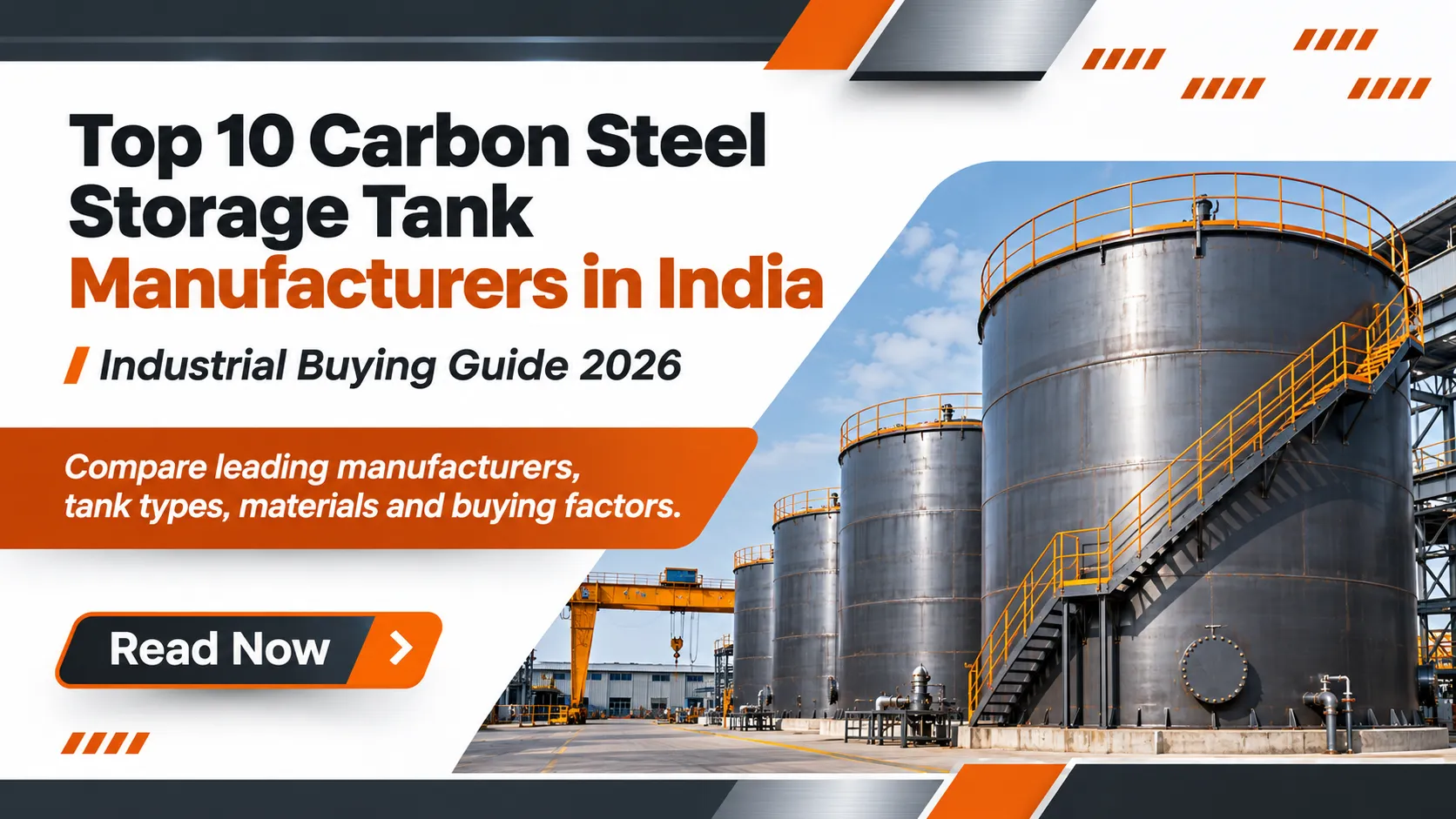
Carbon steel storage tank manufacturers in India supply industrial storage solutions for water, petroleum products, process liquids, utility systems and selected chemicals. These tanks are widely used in manufacturing facilities, chemical processing plants, refineries, water treatment facilities and other industrial applications.
Choosing the right carbon steel storage tank manufacturer is important because tank performance depends on material compatibility, storage capacity, fabrication quality, welding, corrosion protection and operating conditions.
India has several manufacturers offering vertical, horizontal and custom-engineered carbon steel storage tanks. However, the right supplier depends on the project’s technical specifications, inspection requirements and installation conditions.
This guide covers the top 10 carbon steel storage tank manufacturers in India, tank types, industrial applications, material selection, manufacturing standards, pricing considerations and important factors to evaluate before purchasing.
What Are Carbon Steel Storage Tanks?
Carbon steel storage tanks are industrial containers manufactured using suitable carbon steel plates and fabricated components. They are designed to store liquids or process materials under specified operating conditions.
Carbon steel storage tanks are commonly selected for their structural strength, fabrication flexibility and competitive initial material cost compared with many stainless steel alternatives.
They can be manufactured in different configurations, including vertical cylindrical tanks, horizontal tanks, above-ground storage tanks and custom-designed industrial vessels.
Depending on the application, carbon steel tanks may require protective coatings, internal linings, insulation, corrosion allowance or additional safety accessories.
The suitability of a carbon steel tank depends on the chemical properties of the stored liquid, storage temperature, pressure conditions, corrosion environment and applicable engineering standards.
For many industrial projects, carbon steel provides a practical solution when the storage medium is compatible with the selected material and corrosion protection system.
Why Are Carbon Steel Storage Tanks Used in Industrial Applications?
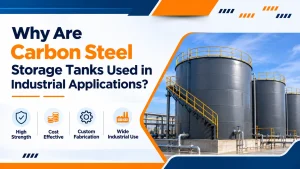
Industrial carbon steel storage tanks are used because they offer a combination of mechanical strength, manufacturing flexibility and cost efficiency.
1. Structural Strength
Carbon steel has mechanical properties suitable for many engineered industrial storage applications.
Properly designed tanks can withstand specified liquid loads, environmental loads and installation conditions.
2. Cost-Effective Material Selection
Carbon steel is often more economical than stainless steel for applications where high corrosion resistance is not required.
However, the total ownership cost should include coatings, inspection, maintenance and expected service life.
3. Custom Fabrication Options
A carbon steel storage tank manufacturer can fabricate tanks according to project-specific capacity, dimensions, nozzle arrangements, supports and installation requirements.
This makes carbon steel suitable for a range of standard and custom industrial projects.
4. Multiple Storage Configurations
Carbon steel can be used for vertical, horizontal, cylindrical, rectangular and other engineered tank configurations.
The final construction type depends on the design requirements and applicable fabrication standards.
5. Maintenance and Repair Options
Many carbon steel tanks can be inspected, repaired, recoated or modified using established industrial fabrication procedures, subject to engineering evaluation and applicable codes.
Types of Carbon Steel Storage Tanks
Different industries require different tank designs depending on storage capacity, available space, installation conditions and operating requirements.
1. Vertical Carbon Steel Storage Tanks
Vertical carbon steel storage tanks have an upright cylindrical configuration and are commonly used for bulk liquid storage.
They are often selected where large storage capacities and efficient use of available ground area are important.
Common applications include:
- Industrial water storage
- Firewater and utility water systems
- Fuel and oil storage
- Process liquid storage
- Selected chemical storage applications
Vertical tanks may use flat bottoms, cone roofs, dome roofs, open tops or other engineered arrangements.
Learn more about vertical storage tank manufacturers in India and the technical factors that affect tank selection.
2. Horizontal Carbon Steel Storage Tanks
Horizontal carbon steel storage tanks are cylindrical tanks installed in a horizontal position, commonly using engineered saddle supports.
They are suitable for installations with limited height or specific plant layout requirements.
Typical applications include industrial utility storage, diesel storage, process liquids and intermediate storage systems.
Horizontal tanks may include manholes, vents, drains, level measurement connections, inspection openings and protective coating systems.
3. Above-Ground Carbon Steel Storage Tanks
Above-ground carbon steel tanks are installed on suitable foundations or support structures.
They offer accessible external inspection surfaces and are commonly used in industrial tank farms, utility installations and processing facilities.
Their design must consider foundation loading, environmental exposure, corrosion protection, drainage and applicable safety requirements.
4. Underground Carbon Steel Storage Tanks
Underground carbon steel storage tanks are designed for below-ground installation where land availability or project requirements justify buried storage.
These tanks require careful consideration of soil corrosion, external loading, anchoring, groundwater conditions, leak detection and regulatory requirements.
External coating and appropriate corrosion protection are especially important for buried steel tanks.
5. Lined Carbon Steel Storage Tanks
Lined carbon steel tanks combine the structural properties of carbon steel with an internal protective lining.
Depending on the stored substance and operating conditions, suitable lining systems may include epoxy, rubber or other engineered materials.
Important: No lining is universally suitable for every chemical. Compatibility must be verified against the actual chemical concentration, temperature and exposure conditions.
Vertical vs Horizontal Carbon Steel Storage Tanks
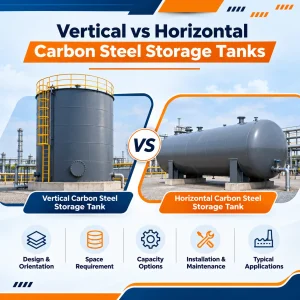
Both configurations are widely used in industrial projects, but their advantages depend on installation and operating requirements.
| Feature | Vertical Carbon Steel Tank | Horizontal Carbon Steel Tank |
|---|---|---|
| Orientation | Upright | Horizontal |
| Ground footprint | Often smaller for equivalent capacity | Usually requires greater length |
| Installation height | Greater | Lower |
| Typical support | Engineered foundation or supports | Saddle supports |
| Common applications | Bulk liquids, water, process storage | Fuel, utilities, intermediate storage |
| Inspection access | May require elevated access | Some connections are closer to ground level |
| Customization | Available | Available |
| Design considerations | Foundation, roof, wind and seismic loads | Saddle design, shell stresses and transport |
Which type should you choose?
A vertical carbon steel storage tank is often preferred for larger bulk-storage requirements where ground area is limited.
A horizontal carbon steel storage tank may be more suitable where height restrictions, transportation limitations or site layout favour a lower-profile design.
Neither type is universally better.
The final selection should be based on capacity, stored media, site dimensions, foundation conditions, operating pressure and maintenance accessibility.
Top 10 Carbon Steel Storage Tank Manufacturers in India (2026)
India has multiple industrial engineering companies offering carbon steel tank fabrication, storage vessels and related equipment.
The following list features manufacturers with published storage tank or relevant fabrication capabilities. It is an editorial supplier comparison, not an independently audited ranking of manufacturing quality, revenue or market leadership.
1. National Engineers & Steel Fabricators – Surat, Gujarat

National Engineers & Steel Fabricators (NESF) is an industrial fabrication and process equipment manufacturer based in Sachin GIDC, Surat, Gujarat.
Established in 1990, the company has experience in industrial storage tanks, pressure vessels, heat exchangers, process equipment, piping systems and custom steel fabrication.
For businesses searching for a carbon steel storage tank manufacturer in India, NESF offers project-specific fabrication solutions based on client drawings, operating conditions, required capacities and material specifications.
Its storage tank manufacturing capabilities cover vertical and horizontal tank configurations for various industrial storage applications.
Carbon Steel Storage Tank Manufacturing Capabilities
- Vertical and horizontal carbon steel storage tanks
- Industrial water and utility storage tanks
- Process liquid storage tanks
- Custom-fabricated industrial tanks
- Mild steel and carbon steel tank fabrication
- Internal lining and external coating options
- Manholes, nozzles, vents and drainage connections
- Tank supports and project-specific accessories
- Fabrication according to approved drawings and specifications
- Inspection and testing according to agreed project requirements
Why Consider National Engineers & Steel Fabricators?
NESF combines storage tank manufacturing with wider industrial fabrication capabilities.
Its experience in pressure vessels, heavy fabrication and process equipment makes it relevant to projects requiring custom dimensions, nozzle arrangements, support designs and coordination with existing plant infrastructure.
The company supports manufacturing requirements for industries such as chemicals, petrochemicals, oil and gas, fertilizers, water treatment and general industrial processing.
Location: Sachin GIDC, Surat, Gujarat, India.
Suitable for: Custom carbon steel storage tanks, industrial liquid storage, utility tanks, process equipment and project-specific fabrication requirements.
2. Vijay Tanks & Vessels Pvt. Ltd. – Vadodara, Gujarat

Vijay Tanks & Vessels is an Indian industrial engineering company specializing in storage tank construction and process equipment.
The company has an established background in engineering, procurement and construction projects for energy and process industries.
Its operations include atmospheric storage tanks, storage terminals and specialized tank systems.
Vijay Tanks & Vessels is relevant for buyers evaluating suppliers for large industrial storage infrastructure and complex storage terminal projects.
Suitable for: Storage terminals, large industrial tanks, oil and gas storage projects and EPC requirements.
3. Fabri-Tek Engineers – Pune, Maharashtra
Fabri-Tek Engineers manufactures industrial storage tanks and process equipment for chemical, pharmaceutical, water treatment, oil and gas and other industrial applications.
The company’s published capabilities include carbon steel, stainless steel and special material fabrication.
It offers vertical, horizontal, above-ground and underground tank configurations.
Fabri-Tek also lists engineering coordination, welding, inspection and testing support for custom storage projects.
Suitable for: Custom fabricated storage tanks, chemical processing equipment and industrial tank applications.
4. Sparkon EPC India Pvt. Ltd. – Pune, Maharashtra
Sparkon EPC India is involved in engineering, industrial fabrication and turnkey project execution.
The company lists chemical storage tanks and silos manufactured using materials including carbon steel, mild steel, stainless steel and alloys.
Its capabilities include vertical and horizontal industrial storage configurations, together with fabrication and inspection support.
Sparkon is relevant for companies requiring storage equipment within wider process plant or EPC projects.
Suitable for: Chemical storage tanks, industrial process equipment and integrated engineering projects.
5. Akshar Dies & Tools – Vadodara, Gujarat
Akshar Dies & Tools offers industrial metal fabrication and storage tank manufacturing services.
Its published storage tank range includes carbon steel and stainless steel tanks.
The company lists vertical and horizontal configurations, single-wall and double-wall arrangements, nozzles, manways and coating options.
It also identifies engineering standards and testing methods that may be specified for particular projects.
Suitable for: Industrial liquid storage, custom metal tanks and fabricated storage equipment.
6. M Eight Engitech Pvt. Ltd. – Morbi, Gujarat

M Eight Engitech manufactures industrial storage tanks and fabricated equipment for various processing industries.
Its published product portfolio includes vertical, horizontal, underground and above-ground storage tanks.
The company identifies carbon steel, stainless steel and other materials among its available construction options.
M Eight can be considered for projects requiring customized tank arrangements and industrial storage equipment.
Suitable for: Industrial liquid storage, fuel storage and custom tank configurations.
7. Tecnicon Engineering Pvt. Ltd. – Ahmedabad, Gujarat
Tecnicon Engineering designs and manufactures industrial process equipment, including storage tanks, reactors, heat exchangers and pressure vessels.
Its storage tank range includes carbon steel and stainless steel construction options.
The company offers vertical, horizontal, jacketed and insulated configurations according to application requirements.
Tecnicon is relevant for industrial buyers requiring customized storage equipment and integration with process systems.
Suitable for: Chemical processing, industrial storage tanks and customized process equipment.
8. BS Energy India – Chennai, Tamil Nadu

BS Energy India manufactures industrial storage tanks, process vessels and fabricated engineering equipment.
Its published capabilities include heavy carbon steel and stainless steel tank fabrication.
The company serves industrial applications involving process liquids, utilities, water and other selected storage requirements.
Its fabrication activities include plate forming, welding and project-specific tank manufacturing.
Suitable for: Industrial utility storage, carbon steel tank fabrication and process plant equipment.
9. Chetan Enterprises – Maharashtra
Chetan Enterprises manufactures and fabricates industrial equipment, storage tanks and process vessels.
The company provides shop-fabricated and site-fabricated tank solutions.
Its published scope includes storage tank fabrication for chemical processing, petrochemical and other industrial applications.
Chetan Enterprises can be considered where on-site tank fabrication or project-specific storage requirements are important.
Suitable for: Site-fabricated storage tanks, process plants and industrial storage projects.
10. Shree Samarth Tech (SSTech) – Pune, Maharashtra

Shree Samarth Tech supplies engineered industrial storage solutions and process equipment.
The company lists atmospheric, low-pressure and custom storage tanks in materials including carbon steel and stainless steel.
Its capabilities include engineering review, fabrication, protective coatings, inspection and testing according to project requirements.
SSTech is relevant for industrial buyers seeking storage equipment as part of plant engineering projects.
Suitable for: Custom storage tanks, industrial storage systems and engineered process equipment.
Comparison of Carbon Steel Tank Manufacturers in India
The following table helps industrial buyers compare the published capabilities of carbon steel tank manufacturers in India.
| Manufacturer | Location | Published Storage Capabilities | Potential Project Fit |
|---|---|---|---|
| National Engineers & Steel Fabricators | Surat | Vertical, horizontal, custom CS tanks | Custom industrial fabrication |
| Vijay Tanks & Vessels | Vadodara | Atmospheric tanks, storage terminals | Large storage infrastructure |
| Fabri-Tek Engineers | Pune | Vertical, horizontal, chemical tanks | Custom process storage |
| Sparkon EPC India | Pune | CS tanks, silos, process equipment | Industrial and EPC projects |
| Akshar Dies & Tools | Vadodara | CS and SS liquid storage tanks | Fabricated industrial tanks |
| M Eight Engitech | Morbi | Vertical, horizontal, above-ground tanks | Customized storage |
| Tecnicon Engineering | Ahmedabad | CS, SS, jacketed and insulated tanks | Process industry tanks |
| BS Energy India | Chennai | CS and SS storage vessels | Industrial utility and process tanks |
| Chetan Enterprises | Maharashtra | Shop and site-fabricated tanks | Site-specific tank projects |
| Shree Samarth Tech | Pune | Atmospheric and low-pressure tanks | Engineered storage solutions |
Note: Actual materials, available fabrication dimensions, design-code capability, inspection scope and delivery commitments should be confirmed directly with each manufacturer before procurement.
Industrial Applications of Carbon Steel Storage Tanks
Industrial carbon steel storage tanks are used in multiple sectors, provided their materials and protective systems are compatible with the stored substance.
Oil and Gas Industry
Carbon steel tanks are commonly used in suitable petroleum and hydrocarbon storage applications.
Tank design must consider the stored product, vapour characteristics, operating temperature, fire protection, venting and relevant regulatory requirements.
Chemical Processing Industry
Chemical plants use fabricated storage tanks for process liquids, intermediates and industrial chemicals.
Unlined carbon steel is not suitable for every chemical.
For corrosive applications, engineers must evaluate chemical compatibility and determine whether a lining, coating or alternative material is necessary.
Water Treatment Plants
Carbon steel tanks can be used for industrial water storage, utility water and selected treatment applications.
Internal coatings or linings may be required to control corrosion and protect water quality.
Power Generation
Industrial power facilities use storage tanks for utility systems, water management and certain fuel-handling applications.
Material and coating requirements depend on the specific stored liquid and operating conditions.
Manufacturing Industries
General manufacturing plants use storage tanks for process liquids, utility fluids, intermediate storage and plant support systems.
Custom fabrication can accommodate available floor space, equipment arrangements and piping connections.
Carbon Steel vs Stainless Steel Storage Tanks
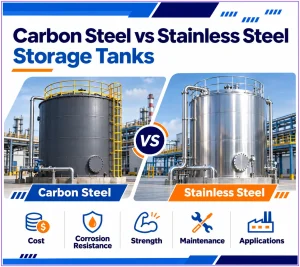
Material selection is one of the most important decisions when purchasing industrial storage tanks.
Carbon steel and stainless steel provide different advantages, especially in corrosion resistance, initial material cost and maintenance requirements.
| Parameter | Carbon Steel | Stainless Steel |
|---|---|---|
| Initial material cost | Generally lower | Generally higher |
| Structural strength | Suitable when correctly engineered | Suitable when correctly engineered |
| Corrosion resistance | Often requires protection | Grade-dependent corrosion resistance |
| Maintenance | May require periodic recoating | Depends on grade and service |
| Industrial water storage | Suitable with appropriate protection | Suitable with compatible grade |
| Chemical storage | Requires compatibility assessment | Requires grade-specific compatibility assessment |
| Fabrication | Widely established | Widely established |
| Common applications | Utility, oil and industrial storage | Hygienic and selected corrosive services |
Which Material Is Better?
Carbon steel is often preferred when the stored liquid is compatible with the material and the lower initial material cost justifies any coating or maintenance requirements.
Stainless steel may be more suitable when corrosion resistance, cleaning requirements or product purity are important.
However, stainless steel is not automatically resistant to every chemical.
The correct choice depends on chemical concentration, temperature, chloride content, corrosion conditions, service life and lifecycle cost.
Is Mild Steel the Same as Carbon Steel?
Mild steel is generally a low-carbon category of carbon steel.
In industrial procurement, the terms mild steel and carbon steel may sometimes be used interchangeably, but they should not replace an exact material specification.
Buyers should always request the required grade, material standard and material test certificates rather than relying only on the terms MS or CS.
How Are Carbon Steel Storage Tanks Manufactured?
Carbon steel storage tank manufacturing involves multiple engineering, fabrication and inspection stages.
The exact manufacturing sequence depends on tank type, design code and project requirements.
Step 1: Technical Requirement Review
The manufacturer reviews the stored medium, required storage capacity, operating conditions, material specifications, installation location and customer drawings.
This information helps establish the appropriate tank configuration and fabrication scope.
Step 2: Engineering and Design
Engineers evaluate the tank geometry, shell thickness, bottom and roof design, structural supports, nozzles and applicable operating loads.
For relevant applications, wind, seismic, foundation and thermal conditions must also be considered.
Step 3: Material Procurement
Approved carbon steel plates and fabricated components are sourced according to the required material specifications.
Material test certificates and traceability records should be checked against the project requirements.
Step 4: Cutting and Plate Forming
Steel plates are cut and formed into the required shell sections, roof components, bottom plates or other parts.
Plate rolling is commonly used for cylindrical tank construction.
Step 5: Welding and Assembly
Fabricated components are assembled using suitable welding procedures and qualified personnel.
Welding requirements depend on material thickness, joint configuration, applicable standards and project inspection specifications.
Step 6: Inspection and Quality Control
Depending on the design code and inspection plan, quality checks may include:
- Material identification and traceability
- Visual welding inspection
- Dimensional inspection
- Ultrasonic testing
- Radiographic testing
- Magnetic particle or liquid penetrant testing
- Vacuum box testing for relevant weld joints
- Hydrostatic or leak testing
Not every inspection method is required for every tank. The inspection scope must follow the applicable code and agreed inspection and test plan.
Step 7: Surface Preparation and Coating
After fabrication and required inspection, the tank may undergo surface preparation and application of suitable coating or lining systems.
Coating selection depends on the stored medium, environmental exposure and maintenance requirements.
Step 8: Final Documentation and Dispatch
Final checks may include dimensions, nozzles, accessories, coating inspection and completion of required test reports.
The manufacturer prepares the tank for transportation, site installation or further assembly according to the agreed supply scope.
What Standards Apply to Carbon Steel Storage Tank Manufacturing?
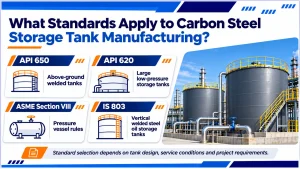
Industrial tanks must be designed and manufactured according to the standards applicable to their construction type, pressure, temperature, stored substance and location.
API 650 – Welded Tanks for Oil Storage
API 650 is used for specified types of welded, vertical, cylindrical, above-ground storage tanks operating at approximately atmospheric pressure.
It covers engineering requirements for materials, design, fabrication, erection and inspection.
For detailed information, refer to the American Petroleum Institute’s API 650 standard information.
API 620 – Large Welded Low-Pressure Storage Tanks
API 620 is relevant to certain large welded low-pressure storage tank applications.
Its applicability depends on the specified pressure, temperature, construction type and code scope.
ASME Section VIII – Pressure Vessels
When a storage vessel operates under pressure conditions within the applicable pressure-vessel code scope, ASME Section VIII may be relevant.
Atmospheric storage tanks and pressure vessels should not automatically be treated as interchangeable equipment.
For more details, review the ASME Section VIII Division 1 requirements.
Indian Standards and Regulatory Requirements
IS 803 and other relevant Indian standards may be considered where appropriate to the tank design and project specification.
Certain petroleum, flammable liquid or pressurized storage applications may also fall under applicable PESO requirements and other statutory approvals.
Important: A manufacturer should not be assumed to hold a particular certification merely because it works with equipment covered by that standard.
Buyers should verify certifications, approvals, design calculations and inspection documents for the specific project.
Important Technical Specifications of Carbon Steel Storage Tanks
Before ordering a tank, industrial buyers should confirm the essential technical parameters.
| Specification | What Buyers Should Confirm |
|---|---|
| Tank capacity | Gross and required working capacity |
| Material | Exact carbon steel grade and standard |
| Storage medium | Liquid name, composition and concentration |
| Specific gravity | Maximum operating liquid density |
| Tank orientation | Vertical or horizontal |
| Design pressure | Internal and external pressure or vacuum |
| Design temperature | Minimum and maximum design temperature |
| Shell thickness | Approved engineering design |
| Corrosion allowance | As specified by design requirements |
| Nozzle arrangement | Size, rating, orientation and quantity |
| Coating or lining | Compatible protective system |
| Supports | Foundation or engineered saddle supports |
| Testing | Applicable code and inspection requirements |
| Documentation | Drawings, MTCs and required reports |
A well-prepared tank specification reduces misunderstandings during procurement and helps manufacturers provide more accurate quotations.
How to Calculate Carbon Steel Storage Tank Capacity
The required storage tank capacity depends on process consumption, supply frequency, operating reserve and available installation space.
For a simple vertical cylindrical tank, the geometric volume can be calculated using:
Volume (m³) = π × D² × H ÷ 4
Where:
- D = Internal tank diameter in metres
- H = Liquid height in metres
- π ≈ 3.1416
Example Calculation
Consider a vertical cylindrical tank with:
Internal diameter: 3 metres
Liquid height: 4 metres
Volume = 3.1416 × 3² × 4 ÷ 4
Calculated volume ≈ 28.27 m³, or 28,270 litres.
This is the geometric volume up to the specified liquid height.
The actual usable storage capacity may be lower because of freeboard, operational level limits, internal components and other design requirements.
For horizontal cylindrical tanks, liquid volume at a particular level requires a different geometric calculation.
Final sizing should be reviewed by the responsible engineer.
How Much Do Carbon Steel Storage Tanks Cost in India?
The price of a carbon steel storage tank depends on design, fabrication scope, material quantity and project requirements.
There is no single fixed price that accurately represents every industrial carbon steel tank.
Factors Affecting Carbon Steel Storage Tank Prices
1. Storage capacity: Larger or more complex tanks generally require additional material, fabrication and installation work.
2. Steel grade and thickness: Material specifications, plate thickness and project-specific requirements affect material cost.
3. Tank configuration: Vertical, horizontal, underground and special tank designs have different fabrication requirements.
4. Coating and lining: Protective systems can add initial cost but may reduce corrosion-related maintenance.
5. Design standards: Code requirements, documentation and inspection scope affect engineering and manufacturing costs.
6. Accessories: Manholes, nozzles, platforms, ladders, vents, level instruments and other components affect the quotation.
7. Transportation and installation: Large tank dimensions, delivery distance, site access and erection requirements may add costs.
How Can You Get an Accurate Tank Price?
Send the manufacturer a detailed requirement covering tank capacity, storage medium, material, design conditions, drawings and inspection requirements.
A technical quotation is more reliable than a generic price per litre because two tanks of identical capacity can have very different engineering and fabrication costs.
How to Choose the Right Carbon Steel Storage Tank Manufacturer in India
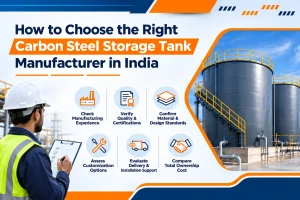
Choosing the right supplier involves more than comparing the initial quoted price.
A dependable carbon steel storage tank manufacturer should be able to explain its fabrication scope, inspection process, documentation and ability to meet project requirements.
Evaluate Manufacturing Experience
Review the supplier’s experience with industrial storage tanks and similar fabrication projects.
Relevant project references can help determine whether the manufacturer has handled comparable capacities and operating conditions.
Verify Material Compatibility
Confirm that the proposed material and corrosion protection system are suitable for the stored substance.
The manufacturer should work with the customer’s process and engineering specifications rather than selecting materials using storage capacity alone.
Review Engineering Capabilities
Check whether the supplier can work from approved drawings, technical datasheets, nozzle schedules and project-specific design requirements.
Check Quality Assurance Procedures
Ask about material traceability, welding procedures, inspection plans and testing documentation.
Confirm Customization Options
Industrial projects frequently require custom dimensions, supports, nozzles and access arrangements.
Ensure the manufacturer can accommodate those requirements before ordering.
Evaluate Delivery and Installation Scope
Confirm whether the quotation includes fabrication only, transportation, site erection, coating, testing or additional commissioning support.
Compare Total Ownership Cost
A lower initial price may not be the best long-term choice if the tank requires frequent coating repairs, difficult maintenance or early replacement.
What Information Should You Send to a Carbon Steel Storage Tank Manufacturer for a Quote?
Providing complete technical requirements can help suppliers prepare accurate and comparable quotations.
| Required Information | Example or Explanation |
|---|---|
| Tank type | Vertical / horizontal / custom |
| Required capacity | 10 KL, 20 KL or project-specific |
| Stored medium | Industrial water, oil or identified chemical |
| Material | Specified carbon steel grade |
| Design temperature | Required operating and design range |
| Design pressure | Atmospheric or specified pressure/vacuum |
| Liquid density | Maximum specific gravity |
| Coating requirement | Internal and external protection |
| Nozzle details | Inlet, outlet, vent, drain and instruments |
| Installation details | Indoor, outdoor, underground or elevated |
| Applicable standard | As determined by engineering specification |
| Inspection requirement | NDT, hydro test, third-party inspection |
| Delivery location | Plant address and unloading constraints |
| Drawings | GA drawing, datasheet or P&ID, if available |
Buyers can also explore horizontal storage tank manufacturing solutions when preparing project-specific requirements.
How to Prevent Corrosion in Carbon Steel Storage Tanks
Corrosion control is essential for many carbon steel storage applications.
Without suitable protection, exposure to moisture, oxygen, aggressive chemicals or the surrounding environment may reduce tank service life.
Internal Protective Coatings
Internal coatings can help protect the steel surface when the coating is compatible with the stored liquid.
Surface preparation, application quality and coating inspection are important to coating performance.
External Protective Painting
External painting systems can protect tanks exposed to weather, humidity and industrial environments.
The coating system should be selected according to the expected exposure conditions.
Suitable Corrosion Allowance
Where required by design, an appropriate corrosion allowance may be considered based on the expected service environment and engineering assessment.
Regular Inspection
Periodic tank inspection helps identify coating damage, corrosion, leaks and other developing defects.
Inspection frequency should follow applicable codes, regulations, service conditions and the owner’s inspection programme.
Proper Drainage and Maintenance
Avoiding unnecessary standing water, maintaining drains and repairing coating defects can help reduce certain corrosion risks.
For buried tanks, suitable external corrosion protection and monitoring arrangements may also be required.
Common Mistakes to Avoid When Buying Carbon Steel Storage Tanks
Industrial buyers should avoid several common procurement mistakes.
Selecting tanks based only on price: A lower purchase price does not guarantee lower lifetime cost.
Ignoring stored-liquid compatibility: Incorrect material or lining selection can lead to premature deterioration.
Ordering without approved drawings: Missing nozzle, support or dimensional information can create installation problems.
Overlooking venting requirements: Atmospheric and low-pressure tanks require suitable venting and protection based on the operating scenario and applicable design requirements.
Ignoring inspection documentation: Missing material or test records may complicate project acceptance and future maintenance.
Assuming every tank follows the same code: The correct engineering code depends on the tank’s actual design and operating conditions.
A properly specified tank helps reduce procurement uncertainty and supports safe industrial operation.
Why Consider National Engineers & Steel Fabricators for Carbon Steel Storage Tanks?
Industrial buyers looking for custom storage equipment can consider National Engineers & Steel Fabricators for its engineering fabrication capabilities and experience with industrial process equipment.
The company operates from Surat, Gujarat, and manufactures storage tanks and other fabricated equipment for project-specific requirements.
NESF’s industrial manufacturing portfolio includes storage tanks, pressure vessels, heat exchangers, process equipment, piping systems and heavy steel fabrication.
Its carbon steel tank fabrication offering can accommodate customer specifications involving tank orientation, construction material, nozzles, supports, coatings and required inspection scope.
For projects requiring customized equipment rather than a fixed standard tank, technical coordination between the buyer and manufacturer is particularly important.
National Engineers & Steel Fabricators can review project requirements against its available manufacturing scope and provide a quotation based on the submitted specifications.
For more information about industrial fabrication capabilities and storage equipment, visit National Engineers & Steel Fabricators.
Conclusion
Carbon steel storage tanks remain an important part of industrial infrastructure because they offer structural strength, design flexibility and competitive material costs for suitable storage applications.
However, selecting the right tank requires careful evaluation of material compatibility, capacity, operating conditions, fabrication quality, corrosion protection and engineering standards.
When comparing carbon steel storage tank manufacturers in India, industrial buyers should prioritize technical suitability, documented manufacturing capabilities, inspection requirements and long-term operating performance.
For businesses requiring custom-fabricated industrial tanks, National Engineers & Steel Fabricators offers vertical, horizontal and project-specific storage tank manufacturing solutions from Surat, Gujarat.
Request a Carbon Steel Storage Tank Quotation
Planning to purchase a vertical, horizontal or custom carbon steel storage tank for your industrial project?
Share your tank capacity, stored liquid, design conditions, material requirements, drawings and delivery details with National Engineers & Steel Fabricators.
Company: National Engineers & Steel Fabricators
Location: Plot No. 1022, Cross Road No. 87, Sachin GIDC, Surat – 394230, Gujarat, India
Phone: +91 95740 11132
Email: admin@nationalengrs.com
Website: https://nationalengrs.com/
Contact the team to discuss your requirements and request a project-specific industrial storage tank quotation.
Frequently Asked Questions About Carbon Steel Storage Tanks
What is a carbon steel storage tank?
A carbon steel storage tank is an engineered container fabricated from suitable carbon steel materials for storing liquids or other specified industrial media. It may be designed as a vertical, horizontal or custom tank depending on the application.
What are carbon steel storage tanks used for?
Carbon steel storage tanks are used in industrial water systems, oil and fuel storage, utility systems, process plants and selected chemical applications. Their suitability depends on material compatibility and operating conditions.
Which is better, carbon steel or stainless steel storage tanks?
Carbon steel may be more economical for compatible industrial storage applications, while stainless steel can offer better corrosion resistance in certain services. The right choice depends on the stored medium, temperature, required hygiene, corrosion conditions and total lifecycle cost.
Can carbon steel tanks store chemicals?
Yes, carbon steel tanks can store certain chemicals when the material, coating or lining is suitable for the specific chemical concentration and temperature. They should not be used for incompatible chemicals without appropriate engineering evaluation.
What is the difference between mild steel and carbon steel tanks?
Mild steel is generally a low-carbon type of carbon steel. In tank procurement, the required material grade and manufacturing standard should be clearly specified rather than relying only on the terms MS or CS.
What is the price of a carbon steel storage tank in India?
The price depends on capacity, material grade, plate thickness, tank design, coating, accessories, testing and delivery scope. Manufacturers generally require technical specifications to provide accurate project quotations.
Which standards are used for carbon steel storage tanks?
API 650, API 620, relevant Indian standards and ASME Section VIII may apply to different tank or vessel designs. The correct standard depends on operating pressure, temperature, tank configuration and project requirements.
Can carbon steel storage tanks be customized?
Yes. Many industrial carbon steel tank manufacturers offer customization involving tank dimensions, capacity, orientation, supports, nozzle arrangements, coatings, linings and inspection requirements.
Are carbon steel storage tanks suitable for outdoor installation?
Yes, appropriately designed carbon steel tanks can be installed outdoors. Environmental loads, foundations, external corrosion protection, access and applicable safety requirements must be considered.
How long does a carbon steel storage tank last?
Service life depends on design, material selection, corrosion conditions, coating performance, maintenance and inspection. No single service-life figure applies to every carbon steel storage tank.
Where can I find a carbon steel storage tank manufacturer in Gujarat?
Gujarat has industrial tank fabrication companies in locations such as Surat, Vadodara, Ahmedabad and Morbi. National Engineers & Steel Fabricators is based in Sachin GIDC, Surat, and offers custom industrial storage tank fabrication capabilities.
Leave a Reply