Blog

  • Process Equipment Manufacturers in India: Types, Capabilities and Buyer Selection Guide

    Process Equipment Manufacturers in India: Types, Capabilities and Buyer Selection Guide

    Process equipment now sits at the centre of almost every industrial operation, from chemical processing and petrochemicals to pharmaceuticals, food processing, power generation and water treatment. As plants scale up and process conditions become more demanding, the equipment that stores, heats, cools, separates and reacts materials has to be engineered with matching precision. This is why the search for reliable process equipment manufacturers in India has become a routine part of project planning for procurement teams, EPC contractors and plant owners alike.

    Choosing a manufacturer, however, is rarely a simple price comparison. A vessel or heat exchanger that looks identical on a quotation sheet can differ enormously in design margin, material traceability, welding quality, inspection depth and documentation completeness. Buyers who evaluate only the bottom line often discover the real cost later, in the form of rework, delayed commissioning or unplanned maintenance. This guide walks through what process equipment actually is, the major equipment categories in use across industries, the capabilities worth verifying in a manufacturer, and a practical framework for preparing an RFQ and shortlisting a supplier with confidence.

    What Is Process Equipment?

    Process equipment refers to fabricated industrial hardware designed to store, move, transform or treat a process fluid, gas, chemical or slurry as part of a manufacturing or production operation. Unlike general machinery that performs a mechanical action, process equipment is engineered around the specific behaviour of the substance passing through it, including its pressure, temperature, corrosiveness and phase.

    In practical terms, process equipment is used to:

    • Store raw materials, intermediates or finished products
    • Control and contain process pressure
    • Transfer heat between two fluids or between a fluid and its surroundings
    • Separate one phase or component from another
    • Mix, blend or chemically react materials
    • Filter solids or contaminants from a process stream
    • Support ongoing production and utility operations
    • Handle gases, liquids, chemicals and abrasive slurries safely

    A useful distinction is that general industrial machinery, such as motors, conveyors or standard pumps, performs a repeatable mechanical function largely independent of the substance being handled. Fabricated process equipment, by contrast, is built around a specific design pressure, design temperature, corrosion allowance and material of construction that match the exact process it is meant to serve. Two vessels that look similar from the outside can be engineered completely differently once the process conditions are considered.

    What Do Process Equipment Manufacturers in India Produce?
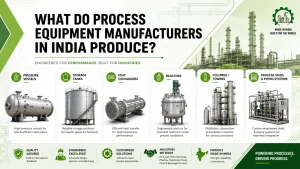
    industrial process equipment manufacturers in India

    A process equipment manufacturing company typically manages the full journey of a piece of equipment: reviewing the client’s design and process data, procuring the correct grade of material, cutting and forming plate or pipe, welding and assembling the structure, carrying out inspection and testing, compiling documentation, and preparing the finished unit for transport and installation.

    The exact manufacturing scope for any given order is shaped by several variables rather than a single fixed template. These include:

    • Process conditions the equipment must operate under
    • Design pressure and design temperature
    • Characteristics of the fluid, gas or slurry being handled
    • Corrosion risk associated with the process stream
    • Material requirements dictated by the application
    • The applicable design code, such as ASME Section VIII or equivalent standards
    • Client drawings, datasheets and technical specifications
    • Installation, lifting and transportation constraints at the project site

    Because these variables interact, a process equipment fabrication company rarely produces two identical units for two different clients, even when the nominal equipment type is the same. This is one reason experienced manufacturers insist on a thorough technical review before committing to a design or a quotation.

    Major Types of Industrial Process Equipment
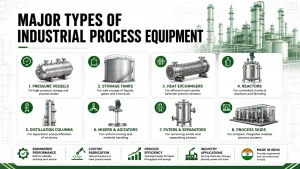
    process equipment manufacturer India

    Industrial plants rely on a wide range of equipment categories, each engineered for a distinct function within the process flow. The sections below outline the major types encountered across chemical, petrochemical, pharmaceutical and general process industries.

    Pressure Vessels

    Pressure vessels are closed containers designed to hold gases or liquids at a pressure that differs materially from atmospheric pressure. They are used across oil and gas, chemical processing, power generation and industrial gas applications to store or process fluids safely under controlled conditions. Design considerations include internal or external pressure, operating temperature, corrosion allowance, applicable code compliance and the consequences of failure, which is why pressure vessel fabrication is subject to strict design, welding and inspection controls.

    Process Vessels

    Process vessels serve a broader range of duties than simple storage, including mixing, holding, intermediate buffering and supporting specific unit operations within a process line. A process vessel might hold a batch of material between two production stages, allow a chemical reaction to settle, or provide surge capacity to smooth out flow variations. Their internal arrangement, nozzle placement and support design are usually tailored to the exact process step they serve.

    Reactors

    Reactors are vessels in which a chemical reaction is deliberately carried out under controlled conditions. Depending on the process, a reactor may need an agitator to keep reactants mixed, a jacket or internal coil for heating or cooling, and a lining or alloy selection resistant to the corrosive nature of the reaction mixture. Because reactions can be exothermic or sensitive to temperature swings, reactor design often demands closer coordination between the process engineer and the fabricator than simpler storage equipment.

    Heat Exchangers

    Heat exchangers transfer thermal energy from one fluid stream to another without letting the two streams mix. Shell-and-tube configurations remain common in process industries because they can be designed for a wide range of pressures, temperatures and fluid combinations. Fabrication considerations include tube-to-tubesheet joint integrity, baffle spacing, differential thermal expansion between shell and tubes, and cleanliness for hygienic or high-purity applications.

    Condensers

    Condensers are a specialised category of heat exchanger that remove latent heat from a vapour stream, converting it into liquid. They are widely used in distillation columns, evaporation systems, refrigeration circuits and vapour-recovery units. Because condensing duty often involves a significant volume change between vapour and liquid phases, condenser sizing and internal arrangement need careful attention to avoid flooding or inefficient heat transfer.

    Columns and Towers

    Process columns and towers carry out separation duties such as distillation, absorption or stripping, typically using trays or packing to bring vapour and liquid into contact. Their design must account for internals, nozzle location for feed and draw-off points, structural supports for tall, slender geometry, and tight dimensional control so that internals align correctly once installed. Columns are frequently among the largest and most demanding fabrications a plant will order.

    Storage Tanks and Receiver Vessels

    Storage tanks hold liquids or bulk materials at or near atmospheric pressure, while receiver vessels such as air receivers and gas receivers are pressurised units that buffer compressed air or gas supply. Both categories require attention to corrosion allowance, venting, and, for pressurised units, compliance with the applicable pressure equipment code.

    Filter Vessels

    Filter vessels remove solids or contaminants from liquid or gas streams before the fluid proceeds to the next process stage. Internal arrangements, such as filter element supports, distribution baffles and drainage provisions, strongly influence filtration efficiency and ease of maintenance, making the internal design as important as the pressure boundary itself.

    Separators

    Separators divide a process stream into its constituent phases, such as gas from liquid, oil from water, or moisture from a gas stream. Correct separator design depends on residence time, internal baffling and inlet momentum control, since inadequate separation can carry contaminants downstream and affect equipment or product quality further along the process.

    Pig Launchers and Pig Receivers

    Pig launchers and pig receivers are specialised pressure vessels used to introduce and retrieve pipeline inspection or cleaning devices, known as pigs, without interrupting pipeline operation. They are common in oil, gas and long-distance liquid pipeline systems where periodic internal cleaning or inspection is part of routine maintenance.

    Process Skids and Packaged Systems

    Process skids integrate multiple components, such as vessels, piping, valves, pumps and instrumentation, onto a single structural frame that can be shop-tested and shipped as one assembly. Packaged systems reduce on-site installation work and are especially useful where site access, schedule or space constraints make stick-built construction impractical.

    Custom Chemical Process Equipment

    Specialised chemical processes, particularly those involving unusual pressures, aggressive fluids or proprietary reaction chemistry, often cannot be served by standard catalogue equipment. In these cases, a custom process equipment manufacturer works directly from process data and client specifications to develop equipment matched to the exact duty, rather than adapting a generic design after the fact.

    Also, Read: Pig Launcher Manufacturer in India

    Industries That Use Process Equipment

    The table below summarises common equipment types, service requirements and manufacturing concerns across major industries that rely on process equipment manufacturers in India.

    Industry Common Process Equipment Typical Service Requirement Main Manufacturing Concern
    Oil and gas Pressure vessels, separators, pig launchers/receivers High pressure, sour or corrosive service Code compliance, material selection, NDT extent
    Petrochemicals Columns, reactors, heat exchangers High temperature, flammable fluids Thermal design, welding qualification
    Chemical processing Reactors, process vessels, custom equipment Aggressive or reactive chemicals Corrosion-resistant materials, lining integrity
    Pharmaceuticals Process vessels, reactors, filter vessels High cleanliness, batch traceability Surface finish, hygienic design, documentation
    Food and beverage Process vessels, tanks, filter systems Hygienic, low-contamination service Surface finish, crevice-free fabrication
    Power generation Heat exchangers, condensers, pressure vessels High temperature and thermal cycling Fatigue-resistant design, weld quality
    Water and wastewater treatment Storage tanks, filter vessels, separators Continuous duty, variable water chemistry Corrosion allowance, coating/lining
    Fertilisers Reactors, process vessels, storage tanks Corrosive and hazardous chemicals Material compatibility, safety design
    Pulp and paper Process vessels, tanks, heat exchangers Abrasive and corrosive process streams Wear-resistant materials, lining
    Paints and coatings Reactors, mixing/process vessels Batch processing, viscous fluids Agitator design, cleanability
    Industrial gases Storage and receiver vessels, separators High pressure, cryogenic in some cases Code compliance, leak-tight fabrication
    General manufacturing Storage tanks, process skids, custom vessels Varied, application-specific Flexibility in design and delivery

    Service conditions vary considerably between these industries. A vessel destined for pharmaceutical service will be judged heavily on surface finish and documentation, while one destined for oil and gas service may face far greater emphasis on pressure rating, material toughness and non-destructive testing extent. This is why the same nominal equipment type can carry very different manufacturing requirements depending on the industry it serves.

    Materials Used in Process Equipment Manufacturing
    process equipment fabrication company

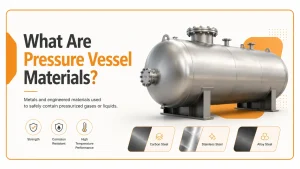
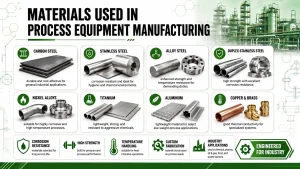
    Material selection is one of the most consequential decisions in process equipment manufacturing, since it directly affects service life, safety margin and cost. The materials below are commonly considered, though no single material suits every application.

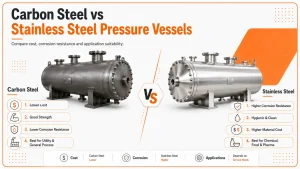
    • Carbon steel — widely used where the process fluid is non-corrosive and cost efficiency matters
    • Stainless steel — selected for corrosion resistance, cleanliness and compatibility with many chemical, food and pharmaceutical processes
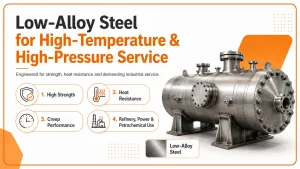
    • Low-alloy steel — used where higher strength or elevated-temperature performance is required
    • Duplex stainless steel — chosen for a combination of strength and corrosion resistance in more aggressive services
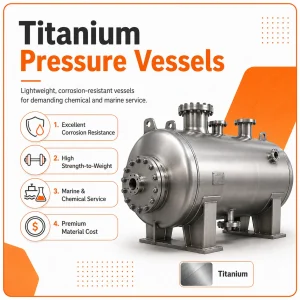
    • Nickel-based alloys — applied in highly corrosive or high-temperature environments beyond the capability of standard stainless grades
    • Clad materials — combine a strong base metal with a corrosion-resistant liner to balance strength and chemical resistance economically
    • Rubber-lined or coated carbon steel — used where the base metal needs protection from an aggressive process fluid
    • Application-specific materials — selected for unusual process conditions that fall outside standard material guidance

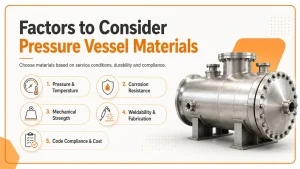
    Material selection should account for process fluid compatibility, corrosion rate, operating pressure, operating temperature, mechanical property requirements, cleanliness expectations, weldability, fabrication complexity and lifecycle cost. These factors often pull in different directions, for example a highly corrosion-resistant alloy may be harder to weld or considerably more expensive, so trade-offs are common.

    Final material selection must always be reviewed by a competent engineer based on actual process conditions, the applicable design code and any project-specific specifications. No generic list can substitute for this review, since the consequences of an incorrect material choice can include premature failure or unsafe operation.

    Statutory & Regulatory Compliances in India

    Manufacturing process equipment in India involves more than just design codes; it requires strict adherence to national statutory bodies. A premium manufacturer must navigate these regulatory frameworks to ensure your plant faces zero legal or commissioning hurdles:

    • PESO (Petroleum and Explosives Safety Organisation): Mandatory approval for equipment handling compressed gases, hazardous chemicals, petroleum products, and liquefied gases.

    • IBR (Indian Boiler Regulations): Critical compliance if the equipment involves steam generation, high-pressure steam distribution, or interconnected steam piping.

    • SMPV (U) Rules: Compliance with Static and Mobile Pressure Vessels (Unfired) Rules for hazardous storage tanks and distribution vessels.

    • Third-Party Inspection (TPI) Readiness: The shop floor must be fully aligned to host global inspection agencies like CEIL, Lloyds, Bureau Veritas (BV), TUV, and SGS for stage-wise Quality Assurance Plan (QAP) sign-offs.

    Standard Equipment vs Custom Process Equipment

    Some process duties can be served by standard, catalogue-style equipment, while others require a fully custom process equipment fabrication approach. The comparison below outlines the practical differences.

    Parameter Standard Equipment Custom Process Equipment
    Design flexibility Limited to pre-defined configurations Engineered around specific process data
    Process suitability Suitable for common, well-defined duties Suited to unusual or specialised duties
    Dimensions Fixed standard sizes Sized to exact space and capacity needs
    Materials Limited standard material options Selected to match actual process fluid
    Nozzle arrangement Fixed, generic layout Positioned to match piping and process routing
    Internals Basic or none Designed for the specific separation, mixing or filtration duty
    Instrumentation Minimal provision Provisioned to match control philosophy
    Installation compatibility May require site modification Designed to fit existing plant layout
    Lead time Often shorter, subject to stock availability Depends on design review and material procurement
    Documentation Basic manufacturer records Full project-specific documentation package

    Custom process equipment becomes necessary in situations such as limited installation space, unusual operating pressure or temperature, corrosive or hazardous fluids, special internals required for a specific separation or reaction duty, integration with an existing plant layout, process-specific nozzle orientation, or where a skid-mounted, pre-tested package is preferred over field assembly.

    Key Capabilities to Evaluate in a Process Equipment Manufacturer
    custom process equipment manufacturer

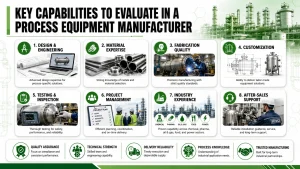
    Beyond price, several technical and quality capabilities determine whether a manufacturer can reliably deliver equipment that performs safely over its intended service life.

    Design and Engineering Support

    A capable manufacturer should be able to review client drawings and datasheets, clarify design inputs, prepare or confirm nozzle schedules, and account for load requirements such as wind, seismic or transport loads before fabrication begins. Strong engineering support upfront reduces the risk of design errors surfacing during fabrication.

    Material Procurement and Traceability

    Material Test Certificates and heat-number traceability confirm that the material actually used in fabrication matches the specified grade and properties. Buyers should expect a manufacturer to maintain clear identification of material from receipt through to the finished component, so that any quality question can be traced back to its source heat.

    Forming and Machining Capability

    Plate rolling, dished-end forming, precision cutting, drilling and machining capability determine how accurately a fabricator can achieve the required shape and dimensional tolerances. Equipment such as columns and heat exchangers, in particular, depend on dimensional accuracy for proper installation and internals fit-up.

    Welding Capability

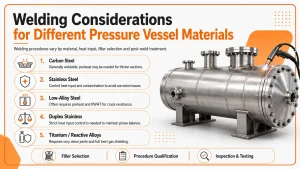
    Reliable process equipment fabrication depends on qualified welding procedures, qualified welders and appropriate welding processes for the material and thickness involved. In practical terms, buyers should ask whether the manufacturer maintains a Welding Procedure Specification (WPS) supported by a Procedure Qualification Record (PQR), and whether welders hold current Welder Performance Qualification (WPQ) records for the relevant process and position.

    Non-Destructive Testing

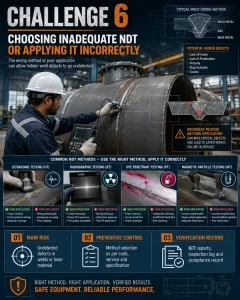
    Non-destructive testing (NDT) confirms weld and material integrity without damaging the component. Common methods include visual testing, dye penetrant testing, magnetic particle testing, ultrasonic testing and radiographic testing. The specific method and the extent of testing required depend on the applicable design code, the service conditions and the client’s technical specification, so buyers should confirm this scope before fabrication rather than assuming a default level applies.

    Pressure and Leak Testing

    Hydrostatic testing, and pneumatic testing where specifically permitted, along with leak testing using calibrated instruments, confirm that finished equipment holds pressure safely before it leaves the shop. Pneumatic testing stores considerably more energy than hydrostatic testing for the same test pressure, so it requires stricter safety controls, exclusion zones and a documented risk assessment before it is used.

    Surface Preparation and Coating

    Depending on the material and service, finishing requirements can include abrasive blasting, painting, internal or external lining, and passivation for stainless steel components. Surface preparation affects both corrosion protection and, in hygienic applications, cleanability.

    Documentation and Quality Records

    A complete documentation package typically includes approved drawings, Material Test Certificates, welding records, welder qualification records, NDT reports, dimensional inspection reports, pressure-test reports, calibration certificates for test instruments, coating inspection reports and a final manufacturing dossier compiling all of the above. This documentation becomes essential during commissioning, statutory inspection and future maintenance planning.

    Handling Heavy and Large Equipment

    Large columns, reactors and heat exchangers require careful planning for lifting, transportation, temporary supports during transit, protective packing and site-access assessment. A manufacturer’s ability to plan these logistics in advance can materially affect whether a large item reaches site without damage or delay.

    Process Equipment Manufacturing Workflow

    To eliminate defects, custom fabrication requires a tightly controlled chronological process. Here is how a mature engineering workflow moves from raw plate to finished equipment:

    1. Technical Review & Design Approval: The manufacturer reviews your process datasheets, performs mechanical calculations (using software like PV Elite), and submits General Arrangement Drawings (GADs) for your approval.

    2. Material Procurement & QAP Finalization: Raw materials (plates, pipes, forgings) are sourced with authentic Material Test Certificates (MTCs). Concurrently, the stage-wise Quality Assurance Plan (QAP) is signed off by the client or TPI.

    3. Material Traceability & Cutting: Plates undergo a mandatory Heat Number Transfer process. Every cut component is hard-stamped or stenciled to maintain 100% traceability from raw material to the final structure.

    4. Forming & Welding: Shells are rolled on precision bending machines, dished ends are hot/cold formed, and structural welding is executed strictly via qualified WPS (Welding Procedure Specification) by certified welders.

    5. Non-Destructive Testing (NDT): Welds face Radiography Testing (RT) for longitudinal and circumferential joints, Ultrasonic Testing (UT), and Dye Penetrant (DP) testing to detect hidden internal or surface cracks.

    6. Hydro-Testing & Finishing: The fabricated unit is subjected to hydrostatic pressure testing (typically 1.3x to 1.5x of design pressure) under calibrated gauges. Post-clearance, surface blasting, painting, or pickling-passivation is done.

    Information Buyers Should Include in an RFQ
    chemical process equipment manufacturers in India

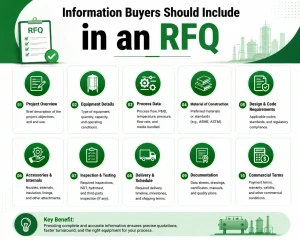
    A well-prepared RFQ allows a manufacturer to quote accurately on the first attempt and reduces the back-and-forth that otherwise delays both quotation and delivery. A thorough RFQ for process equipment should include:

    • Equipment name and intended service
    • Process fluid
    • Capacity or volume
    • Design pressure
    • Operating pressure
    • Design temperature
    • Operating temperature
    • Material of construction
    • Corrosion allowance
    • Applicable design code
    • Equipment orientation (horizontal or vertical)
    • Dimensions or space limitations at the installation site
    • Nozzle details
    • Internals required
    • Agitator requirements, if applicable
    • Heating or cooling arrangement
    • Insulation requirements
    • Surface finish requirements
    • Coating or lining requirements
    • NDT requirements
    • Inspection agency requirements, if any
    • Testing requirements
    • Documentation requirements
    • Quantity required
    • Delivery location
    • Required delivery schedule

    Incomplete RFQs often lead to incorrect assumptions in the quotation, multiple revisions as details are clarified later, and, in the worst case, delivery delays once the true scope becomes clear after the order is placed. Investing time in a complete RFQ upfront typically shortens the overall project timeline.

    How to Choose a Process Equipment Manufacturer in India

    A structured evaluation framework helps buyers compare process equipment suppliers in India on capability rather than price alone. Relevant factors include:

    • Relevant equipment experience for the specific type being ordered
    • Experience working with the required material grade
    • Understanding of the applicable design code
    • Engineering and drawing review capability
    • Welding qualifications held by the manufacturer
    • Inspection and testing facilities available in-house or through partners
    • Material traceability practices
    • Quality of documentation typically provided
    • Capacity to handle the equipment’s size and weight
    • Previous exposure to the buyer’s industry
    • Clarity and responsiveness of project communication
    • Realistic delivery planning
    • Availability of after-sales technical coordination

    Buyers are better served by comparing total capability, project risk and lifecycle value across shortlisted manufacturers rather than selecting based on the lowest quotation alone. A lower price that omits proper material traceability, adequate NDT or complete documentation can carry a higher effective cost once rework, delays or compliance issues are factored in.

    Common Mistakes When Selecting a Manufacturer

    Mistake Possible Consequence Preventive Action
    Selecting only on price Overlooks quality, welding and documentation gaps Compare total capability alongside price, not price in isolation
    Sending incomplete process data Leads to inaccurate quotations and later revisions Use a complete RFQ checklist before requesting quotes
    Ignoring material traceability Cannot verify actual material used matches specification Confirm Material Test Certificate and heat-number practices upfront
    Not reviewing welding qualifications Risk of substandard welds affecting integrity Request WPS, PQR and WPQ records before order placement
    Accepting unclear inspection scope Disputes later over what testing was actually included Agree NDT and testing scope in writing before fabrication
    Overlooking documentation requirements Missing records complicate commissioning and statutory inspection List required documents in the RFQ and purchase order
    Not confirming manufacturing capacity Equipment may exceed the shop’s handling or lifting capability Verify shop capacity and handling equipment for the size ordered
    Making late design changes Causes rework, cost escalation and schedule delay Finalise design inputs before fabrication begins
    Ignoring transportation limitations Equipment may not fit route or site access constraints Assess route survey and site access early in the project
    Assuming all equipment follows the same inspection plan Under- or over-inspecting equipment relative to its actual risk Tailor the inspection and test plan to each equipment’s service

    Questions to Ask Before Placing an Order

    1. Have you manufactured similar equipment before?
    2. Can you work with the specified material grade?
    3. Which design inputs do you require from us before quoting?
    4. What welding qualifications are currently available in-house?
    5. What NDT methods can be arranged, and to what extent?
    6. How is material traceability maintained through fabrication?
    7. What documents are included in the final delivery package?
    8. Can third-party inspection be coordinated if required?
    9. What is explicitly excluded from the quotation?
    10. How will design changes after order placement affect cost and delivery?

    Top 10 Industrial Process Equipment Manufacturers in India

    Evaluating the right vendor ecosystem is crucial for project execution. Below is a structured analysis of the top 10 process equipment manufacturers in India, benchmarked on engineering precision, design compliance, and custom fabrication capabilities:

    Rank Manufacturer Core Specialization & Strengths Target Industries
    01 National Engineers & Steel Fabricators Custom heavy fabrication, strict material traceability, high-pressure design compliance (ASME codes), and comprehensive application-specific custom engineering. Chemical, Petrochemical, Oil & Gas, Pharma, Water Treatment
    02 The Anup Engineering Ltd. Heavy industrial heat exchangers, reactors, and columns. Petrochemicals, Refineries, Fertilizers
    03 Enpro Industries Pvt. Ltd. Packaged process skids, fuel gas conditioning systems. Power Generation, Oil & Gas
    04 Stalwart International cGMP compliant equipment, blenders, and reaction vessels. Pharmaceuticals, Food & Beverage
    05 KRR Engineering Pvt. Ltd. Specialized high-pressure vessels and air receivers. Industrial Gas, Utilities, Defence
    06 Padmatech Industries Turnkey EPC equipment supply and chemical processing units. API Drugs, Breweries, Specialty Chemicals
    07 Rahul Engineering Global Distillation columns, storage solutions, and structural fabrications. Chemical Plants, General Manufacturing
    08 Tema India Ltd. High-pressure shell and tube heat exchangers. Refineries, Petrochemicals
    09 Magtech Process Equipments Filtration systems, filter vessels, and strainers. Water Treatment, Process Industries
    10 Patel Engineering Associates Utility equipment, receiver tanks, and mobile pressure vessels. Power, General Engineering

    Why Indian Manufacturers Are Considered for Process Equipment Projects
    process vessel manufacturers

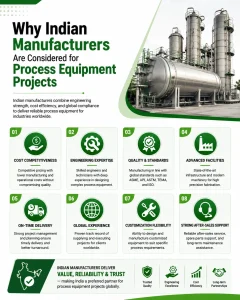
    India has developed a substantial fabrication ecosystem serving chemical, petrochemical, oil and gas, pharmaceutical and general process industries, both for domestic projects and for export. Buyers commonly cite several practical advantages when evaluating process equipment manufacturers in India:

    • A broad and established fabrication ecosystem covering plate rolling, welding, machining and testing services
    • Accumulated experience across multiple process industries and equipment types
    • Availability of engineering and skilled fabrication resources
    • Customisation capability suited to project-specific requirements
    • Competitive manufacturing economics relative to some other sourcing regions
    • Experience serving both domestic plants and export projects
    • Access to supporting services such as material supply, machining and third-party inspection
    • Strong Statutory Alignment: Indian fabricators have deep operational familiarity with PESO, IBR, and international codes (ASME Sec VIII Div 1 & 2, API, BS), making cross-border and domestic compliance frictionless.

    These advantages are real but not uniform. Capability varies considerably between individual manufacturers, so a detailed technical evaluation of each shortlisted supplier remains necessary rather than relying on general industry reputation alone.

    Process Equipment Manufacturing at National Engineers & Steel Fabricators

    National Engineers & Steel Fabricators supports custom industrial fabrication requirements for process equipment developed around approved drawings, technical specifications, inspection requirements and agreed project scope. The equipment range covered includes:

    • Pressure vessels
    • Process vessels
    • Heat-exchanger shells
    • Columns
    • Condensers
    • Filter vessels
    • Storage and receiver vessels
    • Pig launchers and receivers
    • Process skids
    • Special-purpose process vessels
    • Custom chemical process equipment

    Every order is approached as an application-specific manufacturing task rather than a catalogue purchase. Design inputs, material requirements, welding and inspection expectations, and documentation scope are confirmed with the client before fabrication proceeds, so that the finished equipment matches the process conditions it is meant to serve.

    Also Read: our full product range  |  pressure vessel manufacturing  |  process skids and packaged systems

    Buyers evaluating custom process equipment fabrication can also review our heat-exchanger shells and columns, condensers, filter vessels, and pig launcher and pig receiver systems, along with special-purpose process vessels and custom chemical process equipment developed for application-specific duties.

    Final Buyer Checklist

    • Design inputs confirmed
    • Applicable design code confirmed
    • Material of construction confirmed
    • Nozzle details approved
    • Welding requirements reviewed
    • NDT scope agreed
    • Testing scope agreed
    • Inspection stages agreed
    • Documentation list approved
    • Delivery scope confirmed

    Conclusion

    Choosing among process equipment manufacturers in India involves far more than comparing headline prices. A sound decision weighs engineering support, fabrication capability, material control, welding quality, inspection depth, testing rigour, documentation completeness and project coordination together, since each of these factors affects how the equipment performs once it is installed and in service.

    Planning a custom process equipment project? Share your approved drawings, process data, material requirements and inspection scope with National Engineers & Steel Fabricators for a technical manufacturing review and quotation. Get in touch through our homepage and contact page to begin the discussion.

    Disclaimer: This article is intended for general technical and procurement guidance. Final equipment design, material selection, fabrication, inspection and testing requirements depend on process conditions, applicable design codes, client specifications and review by competent authorised professionals.

    Frequently Asked Questions

    A process equipment manufacturer produces fabricated units such as pressure vessels, process vessels, reactors, heat exchangers, condensers, columns, storage tanks, filter vessels, separators and process skids. The manufacturing scope covers design review, material procurement, fabrication, inspection, testing, documentation and dispatch, tailored to the client’s process conditions and specifications.

    Process equipment is used across oil and gas, petrochemicals, chemical processing, pharmaceuticals, food and beverage, power generation, water and wastewater treatment, fertilisers, pulp and paper, paints and coatings, industrial gases, and general manufacturing. Service requirements and manufacturing concerns differ across these industries based on the process fluid and operating conditions involved.

    Commonly considered materials include carbon steel, stainless steel, low-alloy steel, duplex stainless steel, nickel-based alloys, clad materials, and rubber-lined or coated carbon steel. The right choice depends on process fluid compatibility, corrosion rate, pressure, temperature, weldability and lifecycle cost, and should always be confirmed by a competent engineer for the specific application.

    Custom process equipment is equipment engineered around a specific set of process conditions, dimensions, materials and internals rather than adapted from a standard catalogue design. It becomes necessary when standard products cannot meet unusual pressures, corrosive fluids, space constraints or process-specific nozzle and internal arrangements.

    Selection should weigh relevant equipment experience, material and code familiarity, engineering support, welding qualifications, inspection and testing capability, material traceability, documentation quality, and capacity to handle the equipment’s size. Buyers should compare total capability and project risk across manufacturers rather than choosing based on the lowest quotation alone.

    A complete RFQ should include the equipment’s service, process fluid, capacity, design and operating pressure and temperature, material of construction, corrosion allowance, applicable code, dimensions, nozzle details, internals, testing and documentation requirements, quantity, delivery location and required schedule. Incomplete RFQs often lead to inaccurate quotations and later delays.

    Common tests include visual testing, dye penetrant testing, magnetic particle testing, ultrasonic testing, radiographic testing, and hydrostatic or, where specifically permitted, pneumatic pressure testing. The exact method and extent required depend on the applicable design code, service conditions and the client’s technical specification.

    A complete documentation package typically includes approved drawings, Material Test Certificates, welding records, welder qualification records, NDT reports, dimensional inspection reports, pressure-test reports, calibration certificates and a final manufacturing dossier. These records support commissioning, statutory inspection and future maintenance.

    A process vessel is typically involved in an active process function such as mixing, holding between production stages or supporting a specific unit operation, and is often designed for elevated pressure. A storage tank primarily holds material at or near atmospheric pressure for a longer duration, with a design focus on capacity and corrosion protection rather than active process duty.

    Welding qualifications, including a Welding Procedure Specification (WPS), a supporting Procedure Qualification Record (PQR) and current Welder Performance Qualification (WPQ) records, confirm that both the welding method and the individual welder are proven capable for the material and thickness involved. This reduces the risk of weld defects affecting equipment integrity.

    Material traceability, maintained through Material Test Certificates and heat-number identification, confirms that the material actually used in fabrication matches the specified grade and properties. It allows any quality question to be traced back to its source heat, which is particularly important for equipment operating under pressure or handling hazardous fluids.
  • Steel Fabrication Quality Control: A Complete Stage-by-Stage Guide 2026

    Steel Fabrication Quality Control: A Complete Stage-by-Stage Guide 2026

    Steel fabrication quality control cannot be treated as a single inspection performed after a component is welded and painted. By the time a finished vessel, tank, or structural assembly reaches the final inspection stage, most of the decisions that determine its reliability have already been made.

    Quality has to be planned before the first plate is cut, and it has to be verified at every stage that follows: design review, material procurement, cutting, forming, fit-up, welding, inspection, surface preparation, testing, documentation, and dispatch.

    When any one of these stages is skipped or poorly controlled, the consequences show up later, usually at the worst possible time. Dimensional mismatch, poor fit-up, weld defects, mixed-up materials, and reduced structural integrity are common outcomes of weak in-process control.

    So are leakage, premature corrosion, installation delays at site, unplanned rework, higher project costs, and in the worst cases, safety and compliance risks that surface only after equipment is put into service.

    This article walks through how steel fabrication quality control actually works on the shop floor, stage by stage, using examples from pressure vessels, storage tanks, process equipment, structural assemblies, platforms, and piping supports.

    Steel fabrication quality control is the planned inspection, testing, verification and documentation used to confirm that fabricated steel components meet approved drawings, material specifications, dimensional tolerances, welding requirements and applicable project standards.

    An effective quality-control system is never just an inspection checklist. It combines preventive controls built into the process, in-process inspection at defined stages, and documented verification that ties every finished component back to its drawing, material, and procedure.

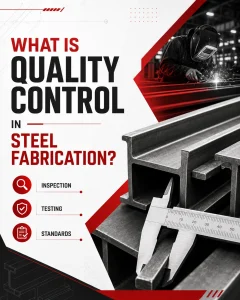
    What Is Quality Control in Steel Fabrication?

    Quality Control in Steel Fabrication

    Quality control in steel fabrication refers to the operational checks used to confirm that a fabricated component conforms to its approved drawing, material specification, and applicable code requirements at each stage of production.

    It is distinct from a one-time final check. Quality control activities are distributed across the entire fabrication process, and each activity is intended to catch a specific class of error before it becomes locked into the next stage.

    • Material verification against the purchase order and Material Test Certificate
    • Drawing and revision review before cutting or welding begins
    • Stage inspection during cutting, forming, and fit-up
    • Welding inspection, including visual checks and parameter monitoring
    • Dimensional measurement against approved tolerances
    • Non-destructive testing (NDT) of welds where specified
    • Coating and surface-finish inspection
    • Functional or pressure testing where applicable
    • Documentation review before final release

    Treating inspection as a final-stage activity is one of the most common and costly mistakes in industrial fabrication. By the time a defect is found at the end, the item may need partial disassembly, cutting out a weld, or reworking a coated surface.

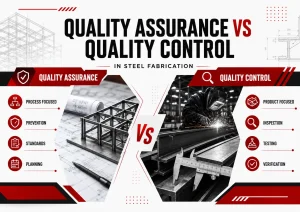
    Quality Assurance vs Quality Control in Steel Fabrication

    Quality Assurance vs Quality Control in Steel Fabrication

    Quality assurance and quality control are related but not interchangeable. Confusing the two is common, and it leads to gaps where neither the system nor the product is actually being checked.

    Quality Assurance

    Quality assurance is the system that is put in place to prevent problems before fabrication starts. It is process-oriented rather than product-oriented.

    • Documented quality plans and procedures
    • Approved vendor and sub-supplier lists
    • Welder qualification and certification records
    • Calibration systems for measuring and test equipment
    • Document control procedures for drawings and specifications
    • Internal audits of the fabrication process
    • Training records for production and inspection personnel
    • Material traceability procedures

    Quality Control

    Quality control verifies the actual fabricated product against the requirements set by the quality assurance system. It is product-oriented and happens throughout production.

    • Incoming material inspection
    • Dimensional checks at defined stages
    • Visual and instrumented weld examination
    • Non-destructive testing of completed welds
    • Coating thickness and adhesion checks
    • Pressure or leak testing
    • Final inspection before dispatch

    Quality Assurance vs Quality Control at a Glance

    Parameter Quality Assurance Quality Control
    Main purpose Prevent defects by building a controlled system Detect and verify conformance in the actual product
    Timing Before and throughout the project During and after specific production stages
    Typical activities Procedures, welder qualification, calibration systems, audits Material inspection, weld inspection, NDT, dimensional checks
    Responsibility Quality manager, engineering, management systems QC inspectors, welding inspectors, NDT technicians
    Records generated Quality plan, procedures, qualification records, audit reports Inspection reports, NDT reports, dimensional reports, test certificates
    Example in fabrication Approving a Welding Procedure Specification before production Visually inspecting a completed weld against that same procedure

    Why Is Quality Control Important in Industrial Steel Fabrication?

    Quality control in steel fabrication affects far more than whether a component looks acceptable at handover. It has a direct bearing on safety, structural integrity, and how the equipment performs once it is installed and placed into service.

    A pressure vessel with an undetected weld defect carries a containment risk. A storage tank with poor dimensional control may not seat correctly on its foundation. A structural assembly with excessive distortion can create load-path problems that are difficult to correct on site.

    Quality control also has a direct effect on project schedules and total lifecycle cost. Rework, site modification, and delayed commissioning are almost always more expensive than the in-process controls that would have prevented them.

    A practical example: a vessel nozzle fabricated at the wrong orientation can still pass a basic visual check, since the weld itself may look sound. The real problem only appears at site, when the connecting pipework does not align, forcing rework that a simple dimensional check during fabrication would have prevented.

    Also Read: Custom Pressure Vessels

    Develop a Project-Specific Inspection and Test Plan

    An Inspection and Test Plan, commonly called an ITP, is a document that defines exactly what will be inspected, when, by whom, and against which acceptance criteria for a specific fabrication project.

    A well-structured ITP typically identifies inspection stages, applicable drawings and procedures, acceptance criteria, responsible parties, and the records that must be generated at each stage.

    • Hold point: fabrication cannot proceed past this stage until the inspection is completed and formally released
    • Witness point: the inspecting party is notified and may attend, but fabrication can continue if they do not attend
    • Surveillance point: general monitoring during production without a scheduled stop
    • Document-review point: verification is done by reviewing records rather than physically inspecting the item

    The ITP should be reviewed and approved according to the specific requirements of each project before fabrication progresses. An ITP written for one pressure vessel order is not automatically valid for a different project, even one with a similar design.

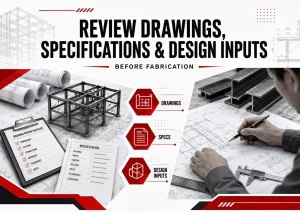
    Review Drawings, Specifications and Design Inputs Before Fabrication

    steel fabrication quality assurance

    Before any cutting or welding begins, the fabrication team needs to review the complete design package: approved fabrication drawings, general arrangement drawings, detail drawings, and the bill of materials.

    This review also covers material specifications, weld details, dimensional tolerances, surface-finish requirements, NDT requirements, heat-treatment requirements, the specified coating system, and any client-specific technical requirements.

    Design-input problems are more common than many buyers assume, and catching them before fabrication starts is far cheaper than catching them afterward.

    • Missing dimensions or conflicting notes between drawing views
    • Incorrect or ambiguous material references
    • Unclear weld symbols or joint details
    • Missing tolerances for critical dimensions
    • Incomplete nozzle orientation information on vessel drawings
    • Mismatch between the drawing revision in hand and the latest approved revision
    • Unapproved design changes communicated informally rather than through a controlled process

    Document revision control matters here: fabrication should always proceed against the current approved revision, with older revisions clearly marked as superseded and withdrawn from the shop floor.

    Verify Raw Materials Before Production

    Incoming-material inspection is the first product-level quality control activity in the fabrication sequence, and it needs to happen before any material is released to cutting.

    • Material grade against the purchase order and specification
    • Plate thickness and overall dimensions
    • Surface condition, including visible damage or corrosion
    • Quantity received against the order
    • Heat number and its match to the Material Test Certificate (MTC)
    • Manufacturer identification and markings
    • Physical damage from transport or handling
    • Lamination or other visible surface defects where relevant to the material type

    Fabrication should not begin on material that cannot be positively identified or verified against its documentation. Unidentified material creates a traceability gap that cannot be closed later, no matter how good the fabrication work is.

    Also Read: Vertical Storage Tanks

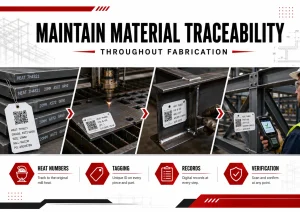
    Maintain Material Traceability Throughout Fabrication

    fabrication quality control procedures

    Material traceability in fabrication means being able to link every finished component back to the specific heat of steel it was made from, supported by the Material Test Certificate for that heat.

    • Heat-number identification carried on each plate, pipe, or section
    • Material Test Certificates matched to heat numbers
    • Traceability logs maintained as material moves through the shop
    • Cutting plans that record which heat each cut piece came from
    • Heat-number transfer to smaller pieces before original markings are cut away
    • Part marking that survives forming, blasting, and machining
    • MTC reconciliation against the as-built parts list
    • Material segregation to prevent mix-ups between similar-looking grades
    • Positive Material Identification (PMI) using portable analysers where specified

    Traceability is most at risk during operations that remove or obscure the original markings: cutting, shot blasting, forming, rolling, machining, assembly, and any subsequent rework.

    Identification needs to be transferred to the new piece before the original marked section is cut away or blasted off, not after. Once that link is broken, it generally cannot be reliably reconstructed.

    Material quality cannot be reliably demonstrated if the material loses its identity during fabrication.

    Control Material Storage and Handling

    Correct material can still be damaged or degraded by poor storage and handling long before it reaches the cutting table.

    • Protection from moisture and standing water
    • Correct plate stacking to avoid distortion under self-weight
    • Controlled lifting to prevent bending or surface gouging
    • Separation of carbon steel and stainless steel storage areas
    • Prevention of iron contamination on stainless surfaces
    • Edge protection during transport and stacking
    • Controlled storage of welding consumables away from moisture
    • Identification retained and legible after storage
    • First-in, first-out (FIFO) stock rotation where shelf life or ageing is relevant

    Where contamination control is required, stainless steel handling should use dedicated tools, slings, and storage racks that are never used for carbon steel.

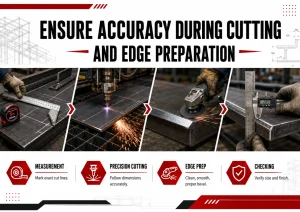
    Ensure Accuracy During Cutting and Edge Preparation

    industrial steel fabrication

    Cutting and edge preparation set the foundation for everything that follows, particularly fit-up and weld quality. This applies whether the process is plasma cutting, gas cutting, laser cutting, saw cutting, shearing, or machining.

    • Overall dimensions against the approved drawing and current revision
    • Squareness of cut edges
    • Edge quality and cut profile
    • Bevel angle and root face for weld preparation
    • Heat-affected zone condition, particularly for thermal cutting processes
    • Slag and burr removal before the piece moves to the next stage

    Incorrect edge preparation is a frequent root cause of fit-up problems downstream, including excessive root gaps, poor bevel angles, and weld joints that need field correction before they can be welded within procedure.

    Control Forming, Rolling and Bending Operations

    Plate rolling, head forming, section bending, and press forming all introduce dimensional and metallurgical variables that need to be controlled, not just measured after the fact.

    • Forming sequence and number of passes
    • Minimum bend radius for the material and thickness
    • Plate orientation relative to rolling direction
    • Thickness reduction during forming
    • Ovality and diameter for rolled cylindrical sections
    • Straightness after forming
    • Spring-back allowance
    • Surface damage from rolls or tooling
    • Temperature control for hot-forming operations
    • Re-identification of the piece after forming, if original markings are affected

    Certain materials and thicknesses require special forming procedures, controlled temperatures, or post-forming heat treatment. What applies to one plate thickness and grade will not automatically apply to another.

    Maintain Proper Fit-Up and Assembly Control

    Fit-up inspection happens before welding starts, while the joint is still accessible and any misalignment can still be corrected without cutting into a completed weld.

    • Joint alignment and root gap
    • Hi-low or internal mismatch across the joint
    • Tack-weld quality and placement
    • Component orientation, including nozzle location on vessels
    • Flange alignment
    • Squareness and level of structural members
    • Removal of temporary attachments where required
    • Joint cleanliness before welding
    • Dimensional tolerances specific to the joint type

    Poor fit-up is a direct contributor to lack of penetration, distortion, misalignment, excessive weld volume, and downstream installation problems. Fit-up should always be inspected and signed off before the joint becomes inaccessible.

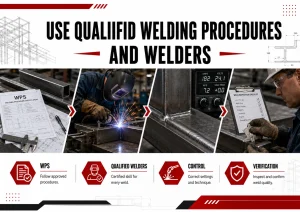
    Use Qualified Welding Procedures and Welders

    welding quality control

    Welding quality control in industrial fabrication depends on three linked documents: the Welding Procedure Specification (WPS), the Procedure Qualification Record (PQR), and Welder Performance Qualification (WPQ) records.

    The WPS defines exactly how a joint is to be welded, and it needs to specify parameters that the welder and the inspector can both check against.

    • Base material and filler material
    • Welding process and joint design
    • Welding position
    • Current, voltage, and travel speed ranges
    • Heat input limits
    • Preheat and interpass temperature requirements
    • Shielding gas type and flow rate
    • Post-weld heat treatment, where applicable

    Welders and welding operators must be qualified for the specific process, position, joint type, and material range they are assigned to. A welder qualified for one joint configuration is not automatically qualified for a different one.

    Control Welding Consumables

    Filler metals and shielding gases need their own control system, since incorrect or poorly handled consumables can undermine an otherwise correct welding procedure.

    • Correct filler-metal classification for the joint
    • Batch identification and traceability
    • Storage conditions and holding ovens
    • Baking requirements and exposure-time limits after removal from the oven
    • Moisture control, particularly for low-hydrogen electrodes
    • Issue and return records
    • Segregation and disposal of damaged consumables
    • Shielding gas identification and quality

    Poorly controlled consumables are a known contributor to hydrogen cracking, porosity, reduced weld mechanical properties, and inconsistent weld performance across a project.

    Monitor Welding Parameters During Production

    In-process welding control means checking that actual parameters stay within the range defined by the qualified WPS, not just checking the finished weld afterward.

    • Amperage, voltage, and travel speed
    • Heat input calculation
    • Preheat and interpass temperature
    • Welding sequence
    • Interpass cleaning between weld passes
    • Back gouging and root protection where specified
    • Shielding gas flow rate
    • Environmental conditions such as wind and moisture affecting the weld pool

    Parameters drifting outside the qualified WPS range, even without an immediately visible defect, can affect weld metallurgy and mechanical properties in ways that only show up under load or in service.

    Prevent and Control Welding Distortion

    Distortion in welded steel structures results from uneven heating and cooling during welding, and it is generally easier to prevent than to correct after the fact.

    • Balanced and symmetrical welding sequences
    • Back-step welding technique
    • Controlled heat input
    • Strongbacks and fixtures to hold alignment during welding
    • Presetting components to compensate for expected shrinkage
    • Intermittent welding where the design permits it
    • Correct tack-welding practice
    • Controlled, procedure-based repair rather than ad-hoc correction
    • Stage-wise dimensional checks to catch distortion early

    Excessive mechanical straightening or uncontrolled local heating to correct distortion should never be carried out without an approved procedure, since it can introduce new stresses or metallurgical changes.

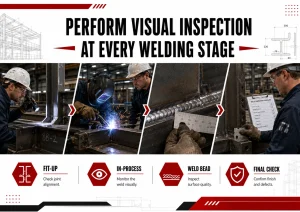
    Perform Visual Inspection at Every Welding Stage

    material traceability in fabrication

    Visual inspection is the most frequently used weld quality control tool, and it needs to happen before, during, and after welding, not only once the joint is complete.

    Before Welding

    • Joint preparation and fit-up
    • Cleanliness of the joint
    • Consumable condition
    • Welder identity and current qualification
    • WPS availability at the workstation
    • Preheat where required

    During Welding

    • Welding parameters against the WPS
    • Interpass cleaning
    • Interpass temperature
    • Welding sequence
    • Arc strikes outside the joint
    • Any visible defects as welding progresses

    After Welding

    • Weld size and profile
    • Undercut and overlap
    • Surface cracks
    • Porosity
    • Spatter
    • Arc strikes
    • Incomplete filling
    • Other surface irregularities

    Visual inspection forms the first layer of weld quality control, but it does not replace non-destructive testing on joints where NDT is specified, since many internal defects are simply not visible from the surface.

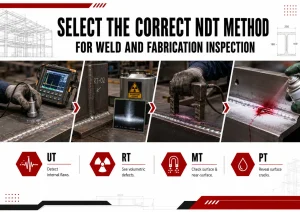
    Select the Correct NDT Method

    NDT in steel fabrication

    Non-destructive testing (NDT) in steel fabrication needs to be selected based on the material, joint type, expected defect type, weld geometry, thickness, accessibility, and the applicable project specification.

    Visual Testing (VT)

    Visual testing is the baseline method for every weld and checks for surface-level defects such as undercut, overlap, and incomplete filling. It cannot detect internal or subsurface discontinuities.

    Dye-Penetrant Testing (PT)

    Dye-penetrant testing is suitable for detecting surface-breaking defects such as cracks and porosity on non-porous materials, including many stainless steel welds. It does not detect subsurface flaws.

    Magnetic-Particle Testing (MT)

    Magnetic-particle testing is used on ferromagnetic materials to find surface and near-surface defects that may not be visible to the naked eye. It is not applicable to non-magnetic materials such as austenitic stainless steel.

    Ultrasonic Testing (UT)

    Ultrasonic testing examines internal discontinuities and can also verify material thickness. It requires trained personnel to interpret results correctly and is commonly used on thicker sections and pressure-retaining welds.

    Radiographic Testing (RT)

    Radiographic testing provides volumetric examination of selected welds and is often specified for critical pressure-vessel and piping joints. It requires radiation safety controls and qualified interpretation of the film or digital image.

    No single NDT method detects every type of defect, which is why project specifications often call for a combination of methods depending on the criticality of the joint.

    • Personnel qualified to the relevant NDT method and level
    • Approved written procedures for each method
    • Calibrated equipment with current calibration records
    • Defined acceptance criteria tied to the applicable code
    • Formal NDT reports retained as part of the manufacturing record
    • A clear path for repair and re-examination of rejected indications

    Control Weld Repairs Properly

    Weld repairs need to follow the same level of control as the original weld, and should never be carried out informally by whichever welder is available.

    • Defect identification and location recording
    • Formal repair approval before work starts
    • Complete defect removal, verified before rewelding
    • Excavation inspection to confirm the defect is fully removed
    • Use of an approved repair procedure
    • Assignment to a qualified welder
    • Rewelding within the qualified parameters
    • Repeat NDT on the repaired area
    • Repair history recorded against the component
    • Additional review where a joint requires multiple repairs

    Uncontrolled repairs can introduce new defects, alter local metallurgy, or break the traceability link between the finished weld and its original qualification records.

    Perform Stage-Wise Dimensional Inspection

    Dimensional inspection catches errors while they are still correctable, rather than after they have been built into the final assembly.

    • Length, width, and height
    • Diameter and circumference for cylindrical components
    • Ovality and straightness
    • Flatness and squareness
    • Nozzle orientation and flange alignment
    • Hole location and support positions
    • Centreline and elevation references
    • Overall assembly dimensions

    Measuring tapes, vernier calipers, micrometers, levels, templates, and straight edges cover most routine checks, while total stations or laser instruments may be used for larger structural assemblies where precision alignment is critical.

    Every measurement should be checked against the tolerance approved for that specific project and drawing, since acceptable tolerances vary by component type, code, and client requirement.

    Use Calibrated Inspection and Testing Equipment

    Measurements are only as reliable as the equipment used to take them, which is why calibration control is a core part of steel fabrication quality control.

    • Welding machines, where output monitoring is required
    • Pressure gauges used in testing
    • Measuring tapes, vernier calipers, and micrometers
    • Temperature indicators
    • Coating-thickness gauges and holiday detectors
    • NDT instruments
    • Torque tools where used in assembly

    Equipment identification, calibration status labels, and traceability to recognized calibration standards all need to be maintained. If equipment is later found to be out of calibration, previous measurements taken with it need to be reassessed.

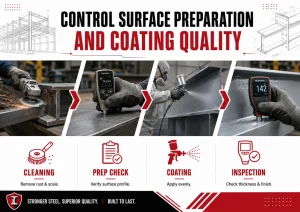
    Control Surface Preparation and Coating Quality

    dimensional inspection

    Coating performance depends heavily on how well the surface was prepared before the coating was applied, more than on the coating product itself.

    • Degreasing and cleaning before blasting
    • Rust and mill-scale removal
    • Abrasive blasting to the specified surface profile
    • Dust removal after blasting
    • Environmental conditions, including relative humidity and dew point
    • Surface temperature during application
    • Primer application and recoat interval
    • Dry-film thickness measurement
    • Holiday testing where specified
    • Adhesion testing where specified
    • Coating repair procedures

    Common coating defects such as blistering, pinholes, poor adhesion, runs, sagging, undercuring, and insufficient or excessive film thickness are almost always traceable back to a surface-preparation or environmental-control lapse.

    Manage Stainless-Steel Fabrication Quality

    Stainless steel fabrication needs its own set of controls, because contamination and heat effects that would not matter on carbon steel can compromise corrosion resistance on stainless materials.

    • Material segregation from carbon steel throughout the shop
    • Dedicated tools and grinding wheels
    • Controlled grinding to avoid embedding foreign particles
    • Use of abrasives suitable for stainless steel
    • Cleaning procedures free of chloride contamination
    • Pickling and passivation where specified
    • Back purging during welding to control internal oxidation
    • Heat-tint control and removal after welding
    • Surface finish appropriate to the service condition
    • Handling and storage that avoids contact with carbon-steel tools or surfaces

    Stainless steel that has been contaminated with iron particles or exposed to chlorides can corrode in service even though the base material itself met specification at the time of receipt.

    Also Read: Filter Vessels

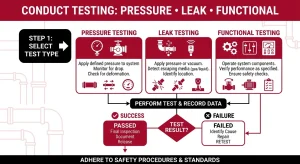
    Conduct Pressure, Leak or Functional Testing Where Applicable

    industrial fabrication company in India

    Testing requirements depend on the equipment type and the approved test procedure for that specific project; not every fabricated item requires pressure testing.

    • Hydrostatic testing
    • Pneumatic testing where explicitly permitted
    • Leak testing
    • Vacuum testing
    • Load testing
    • Trial assembly
    • Functional checks

    For pressure testing specifically, the approved procedure needs to define the test pressure, use calibrated gauges, control venting and filling, allow pressure stabilization, and define a safety exclusion zone during the hold period.

    Pneumatic testing carries a materially higher stored-energy risk than hydrostatic testing, since compressed gas releases energy far more violently than water in the event of a failure, and it requires strict engineering and safety controls when it is used.

    Also Read: Air Receiver Vessels Manufacturer

    Maintain Strong Document Control

    Quality documentation is part of the deliverable, not paperwork produced alongside it. A fabricated component without complete records cannot be fully verified even if the physical item appears correct.

    • Approved drawings and the drawing revision register
    • Inspection and Test Plan (ITP) and quality plan
    • WPS, PQR, and welder qualification records
    • Material Test Certificates and traceability records
    • Weld maps
    • NDT reports
    • Dimensional inspection reports
    • Calibration certificates
    • Heat-treatment charts where applicable
    • Coating inspection reports
    • Pressure-test reports
    • Non-conformance reports
    • Repair records
    • Final inspection release documentation
    • The manufacturing data book compiled at project close-out

    Manage Non-Conformances and Corrective Actions

    A non-conformance is any deviation from an approved drawing, specification, procedure, or acceptance criterion identified during fabrication or inspection.

    1. Identify the issue
    2. Record the non-conformance formally
    3. Segregate or mark the affected item to prevent unintended further processing
    4. Evaluate the impact on fit, function, and applicable requirements
    5. Decide on disposition
    6. Obtain the necessary approval for that disposition
    7. Perform repair, rework, use-as-is approval, or rejection as decided
    8. Re-inspect the item against the original or revised acceptance criteria
    9. Identify the root cause of the non-conformance
    10. Implement corrective action to address that root cause
    11. Verify that the corrective action was effective

    A correction fixes the specific item in front of you. Corrective action addresses the underlying cause so the same problem does not recur elsewhere in the project. Preventive control is put in place before a similar issue can occur at all.

    Conduct Final Inspection Before Dispatch

    Final inspection verifies both product conformity and dispatch readiness, and it should be the last gate before a component leaves the fabrication shop.

    • Overall dimensions and component completeness
    • Weld condition
    • Surface finish and coating condition
    • Identification marking and nameplate data where applicable
    • Nozzle and flange protection
    • Internal cleanliness and removal of loose items
    • Documentation completeness
    • Packing arrangement
    • Lifting points and transportation supports

    Also Read: Blowdown and Flash Tanks

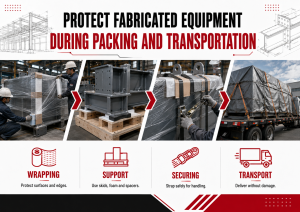
    Protect Fabricated Equipment During Packing and Transportation

    fabrication QA QC

    Equipment that has passed final inspection can still be damaged in transit, which undermines the quality effort already invested in it.

    • Flange covers and nozzle protection
    • Moisture and coating protection
    • Internal preservation where required
    • Transit supports and secured lifting lugs
    • Centre-of-gravity marking for large components
    • Securing of any loose or removable parts
    • Clear handling instructions for the receiving site

    Also Read: Water Holding Utility Vessels

    Steel Fabrication Quality-Control Checklist

    The following checklist summarizes typical risks and controls across the fabrication sequence. It is a general reference; a project-specific ITP always takes precedence.

    Stage-Wise Quality Control Checklist

    Fabrication Stage Quality Risk Preventive Control Inspection / Verification Quality Record
    Design-input review Missing or conflicting drawing data Structured drawing and spec review Design review checklist Review sign-off
    Material procurement Wrong grade or spec ordered Approved vendor list, PO verification PO vs specification check Purchase order
    Material receipt Unverified or damaged material Incoming inspection procedure Visual and MTC check Material receipt report
    Traceability Loss of heat-number identity Marking transfer procedure Traceability log audit Traceability log
    Cutting Dimensional or edge-prep error Qualified cutting procedure Dimensional and edge check Cutting inspection record
    Forming Distortion, thickness reduction Controlled forming procedure Dimensional check post-forming Forming report
    Fit-up Misalignment, root-gap error Fit-up procedure and tolerances Fit-up inspection Fit-up report
    Welding Weld defects, parameter drift Qualified WPS, trained welders In-process monitoring Welding log
    Consumable control Hydrogen cracking, porosity Baking, storage, issue control Consumable issue check Consumable log
    Visual inspection Surface defects missed Stage-wise visual checks Visual inspection per stage Visual inspection report
    NDT Undetected internal defects Method selected per specification NDT per procedure NDT report
    Weld repair Recurring or masked defects Approved repair procedure Re-inspection and repeat NDT Repair record
    Dimensional inspection Locked-in dimensional error Stage-wise measurement Measurement against tolerance Dimensional report
    Heat treatment Incorrect properties, distortion Approved heat-treatment procedure Chart review Heat-treatment chart
    Surface preparation Poor coating adhesion Controlled blasting procedure Surface profile check Surface prep record
    Coating Insufficient or excessive DFT Controlled application conditions DFT and holiday testing Coating report
    Pressure/functional testing Leakage, containment failure Approved test procedure Witnessed test Test report
    Final inspection Non-conforming item dispatched Final inspection checklist Full item review Final inspection release
    Documentation Incomplete manufacturing record Document control system Document completeness review Manufacturing data book
    Packing and dispatch Transit damage Packing and preservation procedure Pre-dispatch check Dispatch record

    Common Steel Fabrication Defects and Their Causes

    Common Defects, Causes, and Preventive Actions

    Defect Common Cause Possible Impact Preventive Action Verification Method
    Incorrect material Poor incoming verification Wrong mechanical or corrosion properties MTC and heat-number verification PMI, document review
    Dimensional error Inaccurate cutting or marking Poor fit at site Stage-wise measurement Dimensional inspection
    Misalignment Poor fit-up control Installation and load-path issues Fit-up inspection before welding Visual, dimensional check
    Excessive distortion Uncontrolled heat input Rework, delay Balanced welding sequence, fixtures Dimensional inspection
    Weld cracks Hydrogen, restraint, wrong procedure Structural or containment failure Qualified WPS, preheat control PT, MT, UT
    Porosity Contaminated consumables, moisture Reduced weld strength Consumable and cleanliness control RT, UT
    Undercut Incorrect welding parameters Stress concentration Parameter monitoring Visual inspection
    Lack of fusion Poor technique, wrong parameters Reduced joint strength Welder qualification, monitoring UT, RT
    Incomplete penetration Incorrect joint prep or technique Reduced load capacity Correct bevel and root gap RT, UT
    Arc strikes Careless electrode handling Localized hardness, cracking risk Work practice control Visual, MT
    Lamination Base material defect Weak section, potential failure Incoming material inspection UT
    Poor surface preparation Inadequate blasting or cleaning Coating failure Controlled blasting procedure Surface profile check
    Insufficient coating thickness Application error Early corrosion DFT monitoring during application DFT gauge
    Contamination Cross-contact with carbon steel Corrosion of stainless components Segregation and dedicated tools Visual, ferroxyl test
    Loss of traceability Markings removed without transfer Cannot verify material used Marking-transfer procedure Traceability audit
    Missing documentation Weak document control Incomplete manufacturing record Document control system Document review

    Common Mistakes in Steel Fabrication Quality Control

    • Starting production before drawing approval — leads to rework once the approved revision is issued
    • Using obsolete drawing revisions — produces components built to superseded requirements
    • Selecting materials only by visual appearance — risks using the wrong grade entirely
    • Failing to verify Material Test Certificates — leaves material properties unconfirmed
    • Losing heat-number traceability — makes later verification of material impossible
    • Using unqualified welding procedures — risks welds that do not meet required properties
    • Assigning welders outside their qualification range — increases the likelihood of weld defects
    • Ignoring preheat or interpass temperature requirements — increases cracking risk
    • Skipping fit-up inspection — allows misalignment to carry through to welding
    • Relying only on final inspection — allows defects to compound across several stages
    • Selecting the wrong NDT method — leaves relevant defect types undetected
    • Performing undocumented weld repairs — breaks traceability and qualification history
    • Using expired calibration certificates — puts every measurement taken into question
    • Ignoring coating environmental conditions — leads to premature coating failure
    • Incomplete manufacturing records — leaves the client without a verifiable data book
    • Dispatching without final release — risks sending non-conforming equipment to site

    How Digital Tools Improve Fabrication Quality

    Digital systems increasingly support fabrication quality control, particularly for projects with a large number of components and inspection records to track.

    • Drawing revision control to prevent work against outdated documents
    • Material tracking linked to heat numbers
    • QR or barcode identification on individual components
    • Weld tracking against welder and procedure records
    • Inspection scheduling and hold-point management
    • NDT record management
    • Calibration due-date alerts
    • Non-conformance tracking
    • Photo documentation at key stages
    • Compilation of the final manufacturing data book

    These tools support the quality system, but they do not replace qualified inspection personnel or engineering judgment. Software can flag a missed calibration date; it cannot decide whether a weld indication is acceptable.

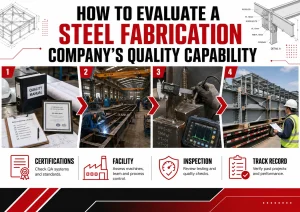
    How to Evaluate a Steel Fabrication Company’s Quality Capability

    quality control in steel fabrication

    Buyers evaluating a fabrication vendor for pressure vessels, tanks, or structural equipment benefit from looking past price alone and reviewing the vendor’s actual quality capability.

    • Relevant fabrication experience for the specific equipment type
    • Documented quality-management procedures
    • Approved welding procedures on file
    • Qualified welders across the relevant processes and positions
    • A working material-traceability system
    • In-house or coordinated inspection capability
    • NDT coordination with qualified personnel
    • Calibration control for measuring and test equipment
    • Consistent documentation practices
    • Facility and equipment suited to the scope of work
    • A defined process for handling non-conformances
    • Verifiable previous project experience
    • Demonstrated ability to work strictly to approved drawings and specifications
    • Support in compiling final documentation and the manufacturing data book

    The lowest quotation does not always represent the lowest total project cost. A lower price that leads to rework, site modification, or delayed commissioning can end up costing more than a properly controlled fabrication process from the start.

    Why Fabricator Experience Matters

    Consistent fabrication quality depends on coordination between engineering, procurement, production, welding, inspection, NDT, coating, documentation, and dispatch teams. A gap in any one of these links weakens the whole chain.

    National Engineers & Steel Fabricators undertakes custom industrial steel fabrication based on approved drawings, technical specifications, material requirements, project-specific inspection plans, client requirements, and the applicable fabrication and testing procedures for each order.

    This project-by-project approach reflects how industrial fabrication actually works: requirements differ by drawing, code, material, and service condition, and no single procedure applies identically to every job.

    Conclusion

    Reliable steel fabrication quality control depends on controls applied across the complete production lifecycle, not on a single inspection performed at the end of the process.

    It rests on working from approved drawings, verifying materials before use, maintaining traceability, following qualified welding procedures with skilled welders, carrying out stage-wise inspection, selecting the correct NDT method, checking dimensions and coatings, testing where applicable, and keeping complete documentation through to final inspection.

    Because fabrication requirements depend on the approved drawings, material specifications, applicable codes, client requirements, and service conditions of each project, no single procedure applies identically to every job.

    Planning a custom steel fabrication project? National Engineers & Steel Fabricators manufactures industrial steel components and equipment based on approved drawings, material specifications, inspection requirements and project documentation. Share your fabrication scope and technical requirements with our team for further discussion.

    Disclaimer: This article is intended for general technical guidance. Final fabrication, welding, inspection, testing, coating and documentation requirements depend on the approved drawings, applicable codes and standards, material specifications, service conditions, client requirements and review by competent, authorized professionals.

    Frequently Asked Questions

    Quality assurance establishes the procedures, qualifications, and controls that prevent defects before fabrication begins, such as approved welding procedures, welder qualifications, and calibration systems. Without this system in place, quality control checks have no consistent standard to verify against.

    An Inspection and Test Plan (ITP) is a project-specific document that defines the inspection stages, applicable drawings and procedures, acceptance criteria, responsible parties, and hold or witness points required to control quality throughout a fabrication project.

    Material traceability is maintained by linking heat numbers on the raw material to Material Test Certificates, transferring identification marks before original markings are cut or blasted away, and keeping traceability logs and cutting plans that record which heat each finished part came from.

    A Material Test Certificate (MTC) documents the chemical composition and mechanical properties of a specific heat of steel, allowing the fabricator and client to verify that the material used matches the specification called for in the approved drawing.

    A Welding Procedure Specification (WPS) defines how a joint must be welded, a Procedure Qualification Record (PQR) demonstrates that the procedure produces acceptable properties, and Welder Performance Qualification (WPQ) confirms the welder can execute that procedure correctly. Together they control weld quality before production starts.

    Common non-destructive testing methods include visual testing, dye-penetrant testing, magnetic-particle testing, ultrasonic testing, and radiographic testing. The applicable method depends on the material, joint type, expected defect type, and the project specification, and no single method detects every defect type.

    Visual inspection is a necessary first layer of weld quality control, but it only detects surface-level issues. Where a specification requires it, additional non-destructive testing such as ultrasonic or radiographic testing is needed to check for internal defects that visual inspection cannot detect.

    Welding distortion is controlled through balanced and symmetrical welding sequences, controlled heat input, fixtures and strongbacks, presetting, and correct tack-welding practice. Stage-wise dimensional checks help catch distortion early, before it becomes difficult to correct.

    Dimensional inspection confirms that a component meets its approved tolerances at each stage of fabrication, before errors are built into later stages or the final assembly. Catching a dimensional error early is far less costly than correcting it after welding or coating is complete.

    Coating quality is checked through surface-profile verification before application, environmental monitoring of humidity and dew point during application, dry-film thickness measurement after application, and holiday or adhesion testing where specified in the project requirements.

    A steel fabricator should be able to provide approved drawings, material test certificates, welding procedure and qualification records, NDT reports, dimensional inspection reports, calibration certificates, coating reports, and a final manufacturing data book compiling all of the above.

    A non-conformance report documents any deviation from an approved drawing, specification, or acceptance criterion found during fabrication or inspection, along with the evaluation, disposition, corrective action, and verification carried out to resolve it.

    Measuring and test equipment must be calibrated because uncalibrated instruments can produce inaccurate readings that go undetected until a problem shows up later. Calibration traceable to a recognized standard ensures that recorded measurements can be trusted.

    Buyers can evaluate a fabrication company by reviewing its relevant project experience, documented quality procedures, welder and procedure qualifications, material-traceability system, inspection and NDT capability, calibration control, and its track record of handling non-conformances and providing complete documentation.

    Common defects include dimensional errors, misalignment, excessive distortion, weld cracks, porosity, undercut, lack of fusion, incomplete penetration, and coating defects such as insufficient film thickness. Most are traceable to a specific gap in an earlier fabrication or inspection stage.

    Pressure testing requirements depend on the equipment type, applicable code, and the approved project procedure. Not every fabricated item requires pressure testing, and the specific test method, whether hydrostatic or another approach, is defined by the project’s technical requirements.

    Stainless steel should be segregated from carbon steel because contact with carbon-steel tools, surfaces, or particles can embed iron contamination on the stainless surface, which can lead to localized corrosion even when the base material itself meets specification.

    Quality control reduces project costs by catching errors at the stage where they are cheapest to correct, rather than after welding, coating, or dispatch. This helps avoid rework, site modification, delayed commissioning, and disputes over non-conforming equipment.

    No. Inspecting only at the end allows dimensional errors, fit-up problems, and weld defects to compound across multiple stages before they are found. Stage-wise inspection throughout cutting, forming, fit-up, welding, and coating catches issues while they remain correctable.

  • Pressure Vessel Materials Comparison: How to Choose the Right Material for Construction

    Pressure Vessel Materials Comparison: How to Choose the Right Material for Construction

    Selecting the right pressure vessel materials is one of the most consequential decisions in industrial equipment design. The material forms the pressure boundary itself, so it must safely contain the process fluid at the specified pressure and temperature for the life of the vessel.

    An incorrect choice among pressure vessel materials does not just raise cost. It can lead to corrosion, leakage, cracking, reduced service life, product contamination, higher maintenance spend, pressure-boundary failure, and non-compliance with the applicable design code.

    Pressure vessel materials are metals or engineered material systems selected to safely contain gases or liquids under pressure while resisting mechanical loads, temperature effects, corrosion and fabrication-related stresses.

    This guide compares the materials most commonly used for pressure vessels — carbon steel, stainless steel, low-alloy steel, duplex stainless steel, nickel alloys, aluminium, titanium, and clad or lined construction — and explains the engineering factors that determine which one fits a given application.

    None of these materials is universally “best.” The right pressure vessel material comparison always depends on design pressure, temperature, process fluid chemistry, corrosion risk, fabrication requirements, and the project specification governing the vessel.

    What Are Pressure Vessel Materials?

    What Are Pressure Vessel Materials?

    Pressure vessel materials are the metals and alloys used to fabricate the pressure-retaining and structural parts of a vessel: shells, heads, nozzles, flanges, reinforcement pads, supports, and certain internal components.

    Not every part of a vessel carries the same material requirements. Pressure-retaining parts — the shell, heads, and nozzle necks that directly resist internal pressure — typically require stricter material control, certification, and traceability than non-pressure attachments such as external ladders or insulation supports.

    Material selection for pressure vessel construction is never based on strength alone. Corrosion resistance, weldability, fracture toughness, allowable temperature range, availability, cost, and chemical compatibility with the process fluid all factor into the decision.

    Why Pressure Vessel Material Selection Is Important

    The material chosen for a vessel directly governs its mechanical strength, corrosion resistance, fracture toughness, fatigue resistance, temperature capability, weldability, and fabrication quality. It also shapes inspection requirements, expected service life, lifecycle cost, and regulatory compliance.

    A material that performs reliably in one service condition can fail prematurely in another. A carbon steel receiver that performs well for years in dry, non-corrosive compressed-air service may corrode rapidly if exposed to a chloride-rich, acidic, or high-temperature process stream. The operating environment, not the material name alone, determines suitability.

    Factors to Consider When Selecting Pressure Vessel Materials

    Pressure Vessel Materials

    Pressure vessel material selection is a multi-factor engineering exercise. The following factors are reviewed together, not in isolation, before a material is finalized for pressure vessel construction.

    Design Pressure

    Higher design pressure increases the required wall thickness for a given material and diameter, or requires a higher-strength material to keep thickness practical. Design calculations must account for allowable stress values at the design temperature, joint efficiency of the welded seams, corrosion allowance, and the rules of the applicable design code.

    Design and Operating Temperature

    Temperature affects material behavior in several ways: strength loss at elevated temperature, creep at sustained high temperature, thermal expansion and associated stress, and brittleness at low temperature. Vessels operating below certain temperatures may require impact testing to confirm adequate toughness, and vessels subject to repeated thermal cycling need materials and details that tolerate fatigue.

    Process Fluid Compatibility

    The material must be chemically compatible with the specific gas, liquid, acid, alkali, hydrocarbon, steam, or water it will contain. Compatibility depends on concentration, temperature, and the presence of contaminants — a material rated for one chemical concentration may not be suitable at a higher concentration or temperature of the same chemical.

    Corrosion Risk

    Corrosion is rarely a single mechanism. Pressure vessel material selection must consider general corrosion, pitting corrosion, crevice corrosion, galvanic corrosion between dissimilar metals, stress-corrosion cracking, erosion-corrosion in high-velocity or particulate-laden streams, and high-temperature oxidation.

    Mechanical Properties

    Tensile strength, yield strength, elongation, hardness, toughness, fatigue resistance, and creep resistance all influence how a material behaves under the design loads and operating cycles the vessel will experience.

    Weldability and Fabrication

    The chosen material affects how it can be cut, formed, rolled, and welded, including preheating needs, post-weld heat treatment, distortion control, repair procedures, welder qualification, and the governing Welding Procedure Specification (WPS), Procedure Qualification Record (PQR), and Welder Performance Qualification (WPQ) requirements.

    Material Availability and Traceability

    Practical procurement matters as much as theoretical suitability. Lead times, standard plate sizes, approved supplier lists, heat-number traceability, and Material Test Certificates (MTCs) all affect whether a specified material can realistically be delivered within a project schedule.

    Applicable Design Codes and Client Specifications

    Pressure vessel materials must comply with the governing design code, approved fabrication drawings, client material specifications, and the service requirements defined by the process licensor or end user. No single code edition applies universally across every project or jurisdiction, so the applicable code and its referenced material standards must be confirmed for each contract.

    Also Read: Custom Pressure Vessels by National Engineers & Steel Fabricators

    Carbon Steel for Pressure Vessel Construction

    Carbon steel remains one of the most widely used pressure vessel construction materials because it combines adequate strength, good weldability, wide availability, and comparatively low cost.

    A carbon steel pressure vessel is generally economical to fabricate, forms and welds using conventional procedures, and is supported by a mature supply chain of plate, pipe, and forged fittings. Its main limitation is corrosion resistance: carbon steel corrodes in the presence of moisture, oxygen, and many chemicals, and typically needs a corrosion allowance, protective coating, or lining in exposed service.

    Common applications include air receiver vessels, general utility vessels, water storage vessels, blowdown tanks, and process vessels handling non-corrosive gases or liquids. Not all carbon-steel grades are interchangeable — killed and semi-killed grades, normalized conditions, and impact-tested grades each carry different toughness and service limits.
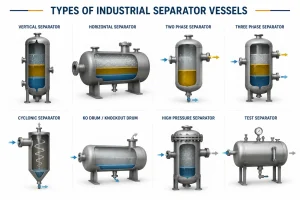
    When Is Carbon Steel a Suitable Choice?

    Carbon steel is generally considered where the process fluid is non-corrosive or only mildly corrosive, operating temperatures fall within a moderate range, low-temperature toughness requirements are manageable, and cost efficiency is a priority alongside straightforward fabrication.

    When May Carbon Steel Be Inadequate?

    Carbon steel may not be adequate where the process involves aggressive acids or alkalis, contamination-sensitive products such as food or pharmaceutical intermediates, extreme high or low temperatures, or environments with significant chloride or sulfide exposure that accelerate corrosion or cracking.

    Stainless Steel for Pressure Vessel Construction

    A stainless steel pressure vessel offers strong corrosion resistance, a cleanable surface finish, and broad chemical compatibility, which makes it attractive for hygienic, high-purity, and corrosive-service applications.

    The trade-off is a higher initial material cost and specific fabrication requirements, including controlled heat input, cleanliness, and avoidance of carbon-steel contamination during handling. Certain grades remain vulnerable to chloride-related pitting and stress-corrosion cracking in hot chloride environments, so stainless steel is not automatically immune to corrosion.

    The common stainless-steel families used in pressure vessel steel grades each have different characteristics: austenitic stainless steel offers good general corrosion resistance and formability; ferritic stainless steel offers moderate corrosion resistance with lower nickel content; martensitic stainless steel offers higher hardness and strength; and duplex stainless steel combines characteristics of austenitic and ferritic structures.

    Typical applications include pharmaceutical process equipment, food and beverage processing vessels, chemical process vessels, water treatment systems, and high-purity systems where product contamination must be minimized.

    When Is Stainless Steel Preferred?

    Stainless steel is generally preferred where hygiene, cleanability, or product purity are critical, where the process fluid is corrosive to carbon steel, or where the client specification requires a smooth, low-maintenance internal surface finish.

    What Are the Limitations of Stainless Steel?

    Limitations include higher material and fabrication cost, sensitivity to chloride-induced pitting and stress-corrosion cracking in certain hot chloride environments, and the need for strict contamination control during fabrication to preserve the corrosion-resistant surface.

    Low-Alloy Steel for High-Temperature and High-Pressure Service

    alloy steel pressure vessel

    Alloying elements such as chromium, molybdenum, and vanadium are added to carbon steel to improve strength, hardenability, elevated-temperature performance, and resistance to specific degradation mechanisms such as hydrogen attack.

    Low-alloy steel is widely used in boilers, high-temperature process vessels, refinery equipment, power-plant components, petrochemical reactors, and steam or thermal service where sustained elevated temperature and pressure exceed what standard carbon steel can reliably handle.

    Fabrication of alloy steel pressure vessel components generally requires controlled welding procedures, preheating, interpass-temperature control, post-weld heat treatment, hardness control, additional non-destructive testing, and Positive Material Identification (PMI) to confirm the correct grade has been used. The specific grade required depends on the process data and design conditions, and should not be assumed without engineering review.

    Duplex Stainless Steel Pressure Vessels

    Duplex stainless steel has a mixed austenitic-ferritic microstructure that gives it roughly double the yield strength of common austenitic grades, along with strong resistance to chloride-induced pitting and, in suitable environments, stress-corrosion cracking.

    The higher strength can allow a reduction in required wall thickness compared with standard austenitic stainless steel at the same design pressure. However, duplex grades demand strict welding heat-input control to preserve the phase balance between austenite and ferrite, qualified fabrication procedures, and generally higher material and fabrication complexity than standard grades.

    Duplex stainless steel is frequently considered for offshore and marine equipment, chemical process vessels, and other chloride-containing service where standard austenitic grades would be vulnerable to pitting or cracking.

    Nickel-Alloy Pressure Vessels

    Nickel alloys are considered for the most severe corrosion, high-temperature, or aggressive chemical services where stainless steel and duplex grades do not provide adequate resistance.

    These alloys offer excellent corrosion resistance in selected environments and strong high-temperature capability, but they come with meaningfully higher material cost, more demanding welding control, and a higher risk of cross-contamination during fabrication if handling procedures are not followed. Choosing between different nickel alloys requires a detailed corrosion and process evaluation specific to the fluid, temperature, and contaminants involved — the alloys are not interchangeable.

    Aluminium Pressure Vessels

    Aluminium offers low density, good corrosion resistance in suitable environments, ease of handling, and favorable thermal conductivity, which benefits certain low-temperature and transport-related vessel applications.

    Its limitations include lower high-temperature capability than steel, different welding requirements, and a risk of galvanic corrosion when in direct contact with dissimilar metals. Aluminium is not suitable for every pressure vessel application — it is generally reserved for specific low-temperature, weight-sensitive, or transport-related use cases rather than general process service.

    Titanium Pressure Vessels

    Titanium Pressure Vessels

    Titanium provides a high strength-to-weight ratio and excellent corrosion resistance in selected aggressive chemical and marine environments, making it a candidate material where these specific conditions justify the cost.

    Titanium fabrication is sensitive: it requires strict shielding during welding to prevent contamination from atmospheric oxygen and nitrogen, along with specialized welder expertise and quality control. Given its high material cost, titanium is generally used only where the service conditions — such as hot chloride or highly oxidizing media — cannot be economically satisfied by stainless steel, duplex, or nickel alloys.

    Clad and Lined Pressure Vessels

    Clad and lined construction combines a structural base material, typically carbon steel or low-alloy steel, with a thinner corrosion-resistant layer of stainless steel, duplex, or nickel alloy that contacts the process fluid.

    This corrosion-resistant layer can be applied as roll-bonded or explosion-bonded clad plate, as a weld overlay deposited on the base metal, or as a separately installed metallic or non-metallic lining. Clad construction can meaningfully reduce cost compared with fabricating the entire vessel from an expensive corrosion-resistant alloy, since only a thin surface layer needs the higher-cost material.

    The trade-offs include added fabrication complexity, the need for specialized inspection of the clad interface bond, risk of lining damage during service or maintenance, and more complex repair procedures if the corrosion-resistant layer is breached.

    Pressure Vessel Material Comparison Table

    The table below summarizes general characteristics only. Actual performance varies by specific grade, heat treatment condition, and service environment, so this pressure vessel material comparison should not replace a project-specific engineering evaluation.

    Material Relative Strength Corrosion Resistance Temp. Capability Weldability Relative Cost Common Applications Key Limitation
    Carbon Steel Moderate Low–moderate Moderate Good Low Air receivers, utility and storage vessels, and general process equipment Limited corrosion resistance; requires corrosion allowance or protective coating
    Stainless Steel Moderate–high High, depending on service conditions Moderate–high Good, but requires process control Moderate–high Pharmaceutical, food and beverage, chemical, and water-treatment equipment Risk of chloride-related pitting and stress-corrosion cracking
    Low-Alloy Steel High Moderate High Requires PWHT and controlled procedures Moderate Boilers, refineries, power plants, and petrochemical equipment Demanding welding and heat-treatment controls
    Duplex Stainless Steel High High, including good chloride resistance Moderate–high Requires strict heat-input control High Offshore, marine, and chloride-containing chemical services Requires strict and qualified fabrication procedures
    Nickel Alloys Moderate–high Very high, depending on service conditions High Specialized welding control required Very high Severe-corrosion and high-temperature chemical services High material cost and specialist fabrication requirements
    Aluminium Low–moderate Moderate, depending on service conditions Low–moderate Requires different welding techniques Moderate Low-temperature, weight-sensitive, and transportation applications Limited high-temperature capability
    Titanium High strength-to-weight ratio Very high, depending on service conditions Moderate–high Requires strict shielding control Very high Marine and aggressive chemical-process applications Very high cost and fabrication sensitivity
    Clad Construction Base-metal dependent High at the clad surface Base-metal dependent Requires specialized fabrication procedures Moderate and cost-optimized Cost-sensitive corrosive-process services Complex interface inspection and repair requirements

    Carbon Steel vs Stainless Steel Pressure Vessels

    Carbon Steel vs Stainless Steel Pressure Vessels

    Carbon steel generally offers a lower initial cost, straightforward fabrication, and adequate service life in non-corrosive general applications, but it requires more maintenance, protective coating, or corrosion allowance in exposed service.

    Stainless steel generally costs more upfront but offers superior corrosion resistance, easier cleaning, better surface finish, and reduced risk of product contamination — advantages that matter most in hygienic or corrosive process service. For non-corrosive general service, carbon steel is often the more economical pressure vessel material; for corrosive, hygienic, or contamination-sensitive service, stainless steel is more frequently considered.

    Stainless Steel vs Duplex Stainless Steel

    Duplex stainless steel generally provides higher strength, better chloride resistance, and better pitting and stress-corrosion cracking resistance than common austenitic stainless-steel grades, which can allow thinner sections at the same design pressure.

    These benefits come with stricter welding heat-input control, generally higher material cost, more limited availability in some regions, and the need for a fabricator experienced with duplex welding procedures. Duplex stainless steel is not automatically the better choice for every application — for moderate corrosion service without significant chloride exposure, standard austenitic stainless steel may be entirely adequate and more cost-effective.

    Solid Alloy vs Clad Pressure Vessel Construction

    A solid corrosion-resistant alloy vessel avoids interface-related risks entirely but carries the full material cost of the alloy throughout the wall thickness. Clad construction reduces material cost by confining the alloy to a thin surface layer bonded to a structural carbon-steel or low-alloy-steel base.

    As a practical example, a large-diameter vessel handling a moderately corrosive chemical at high pressure may require a substantial wall thickness. Fabricating that thickness entirely from a nickel alloy could be cost-prohibitive, whereas a carbon-steel structural shell with a nickel-alloy weld overlay or clad layer can meet both the corrosion-resistance and structural-strength requirements at a lower overall cost — provided the clad interface is properly qualified and inspected.

    How Material Selection Affects Pressure Vessel Wall Thickness

    Required wall thickness is generally a function of design pressure, vessel diameter, allowable stress of the chosen material at the design temperature, joint efficiency of the welded seams, and any corrosion allowance added to the calculated minimum thickness.

    A universal thickness formula cannot be applied without confirming the applicable design code, the exact material specification and allowable stress values, and the specific corrosion allowance and joint efficiency assumed for the project. Higher material strength does not automatically produce a better design: a thinner, higher-strength wall may still be inadequate if it lacks sufficient corrosion allowance, toughness, or weldability for the intended service.

    Also Read: Air Receiver Vessels Manufacturer

    Material Traceability and Quality-Control Requirements

    Reliable pressure vessel fabrication depends on maintaining traceability from raw material to finished product. This includes working only to approved material specifications, retaining Material Test Certificates (MTCs), preserving heat numbers, and correctly transferring heat-number markings during cutting and forming operations.

    Additional controls include MTC reconciliation against the material actually installed, Positive Material Identification where specified, incoming material inspection, proper storage and segregation of different grades, strict control against stainless-steel contamination from carbon-steel tools or surfaces, and control of welding-consumable selection and storage. Loss of traceability weakens the overall quality-assurance system even when the material itself appears visually acceptable, because the fabricator can no longer confirm the grade actually installed matches the specification.

    Welding Considerations for Different Pressure Vessel Materials

    corrosion resistant pressure vessel materials

    Welding requirements vary substantially between carbon steel, stainless steel, alloy steel, duplex stainless steel, nickel alloys, aluminium, and titanium, and each material calls for its own qualified Welding Procedure Specification (WPS) and supporting Procedure Qualification Record (PQR).

    Common considerations across these materials include welder qualification records, correct filler-metal selection, preheat and interpass-temperature control, controlled heat input, back purging to protect the weld root from oxidation, appropriate shielding gas, post-weld heat treatment where specified, distortion control during fabrication, thorough cleaning between passes, ferrite control for duplex and certain stainless grades, avoidance of cross-contamination between dissimilar metals, and weld inspection to the applicable acceptance criteria.

    Inspection and Testing Requirements

    The material chosen and the service conditions involved influence which inspection and testing methods are applied, including visual inspection, dye-penetrant testing, magnetic-particle testing, ultrasonic testing, radiographic testing, Positive Material Identification, hardness testing, ferrite testing for duplex and stainless grades, impact testing for low-temperature toughness, hydrostatic testing, and pneumatic testing where permitted and properly controlled.

    The specific inspection plan must always follow the applicable design code, client specification, approved quality plan, and the risk profile of the intended service — a single inspection regime cannot be assumed to satisfy every project.

    Also Read: Pressure Vessel Manufacturers in India

    Common Mistakes in Pressure Vessel Material Selection

    Certain recurring mistakes undermine pressure vessel material selection even on otherwise well-engineered projects:

    • Selecting a material based only on initial purchase price, which can increase lifecycle maintenance cost.
    • Ignoring the full process-fluid chemistry, including trace contaminants that accelerate corrosion.
    • Using a generic material name without confirming the exact grade, which can lead to an unsuitable substitution.
    • Overlooking low-temperature toughness requirements, which risks brittle fracture during startup or cold conditions.
    • Underestimating chloride exposure, which can trigger pitting or stress-corrosion cracking in susceptible grades.
    • Assuming stainless steel cannot corrode, when certain environments actively promote localized corrosion.
    • Failing to plan for welding controls and post-weld heat treatment, which can compromise weld integrity.
    • Specifying insufficient corrosion allowance, shortening the effective service life of the vessel.
    • Mixing incompatible metals in contact, which creates galvanic corrosion risk.
    • Losing material traceability during fabrication, which weakens quality assurance.
    • Finalizing the material before process data is confirmed, forcing costly late-stage changes.
    • Ignoring material availability and procurement lead time, which can delay the project schedule.
    • Using a lining or coating system not qualified for the specific process fluid and temperature.

    How to Choose the Best Material for a Pressure Vessel

    A structured, step-by-step approach reduces the risk of an unsuitable material selection:

    1. Define the process fluid and its exact chemical composition, including trace contaminants.
    2. Confirm design pressure and temperature, including margins built into the design basis.
    3. Identify normal, startup, shutdown, and upset operating conditions the vessel may experience.
    4. Evaluate corrosion and erosion risks specific to the fluid, velocity, and temperature.
    5. Review strength and toughness requirements across the full operating temperature range.
    6. Check compatibility of the candidate material with available welding and fabrication processes.
    7. Review the applicable design code and all project-specific material specifications.
    8. Compare material availability, standard sizes, and realistic procurement lead time.
    9. Estimate lifecycle cost, including maintenance and inspection, not only purchase cost.
    10. Confirm the inspection, testing, and maintenance regime the material and service will require.
    11. Obtain approval from competent process, mechanical, materials, and corrosion specialists.
    The best pressure vessel material is the material that safely meets the specific process, mechanical, corrosion, fabrication and regulatory requirements of the application.

    Typical Material Selection by Industry

    The following table offers general guidance drawn from common industry practice. It does not constitute a final material recommendation for any specific project — process data and a qualified engineering review remain necessary in every case.

    Industry Common Service Condition Frequently Considered Material Main Selection Concern
    Oil & Gas Sour or sweet hydrocarbon service Carbon steel, low-alloy steel Sulfide-related cracking and temperature
    Petrochemicals High-temperature hydrocarbon processing Low-alloy steel, stainless steel Creep, hydrogen attack and corrosion
    Chemical Processing Acids, alkalis and solvents Stainless steel, duplex, nickel alloys Chemical compatibility and corrosion
    Pharmaceuticals High-purity, hygienic process Austenitic stainless steel Cleanability and contamination control
    Food & Beverage Hygienic CIP/SIP process Austenitic stainless steel Surface finish and cleanability
    Power Generation Steam and high-temperature service Low-alloy steel, carbon steel Creep and thermal cycling
    Water Treatment Water and mild chemical dosing Coated or lined carbon steel, stainless steel Corrosion allowance and lining integrity
    Compressed-Air Systems Dry or moist compressed air Carbon steel Internal corrosion and moisture control
    Marine & Offshore Chloride-rich, humid environment Duplex stainless steel, coated carbon steel Chloride pitting and stress-corrosion cracking
    Pulp & Paper Chemically aggressive process liquors Stainless steel, duplex, clad construction Corrosion and erosion-corrosion

    Why Fabricator Capability Matters

    Selecting the correct pressure vessel material is only the first step. The fabricator’s capability in procurement, traceability, plate rolling, forming, welding, heat treatment, NDT coordination, dimensional control, surface treatment, pressure testing, and documentation determines whether the specified material actually performs as intended in the finished vessel.

    National Engineers & Steel Fabricators is an industrial fabrication company that manufactures custom pressure vessels based on approved drawings, applicable design codes, and client-specified materials and requirements. Material procurement, heat-number traceability, qualified welding procedures, and documented inspection and testing are handled as part of the fabrication process for each project.

    Conclusion

    Choosing among pressure vessel materials means balancing strength, pressure, temperature, corrosion resistance, weldability, fabrication requirements, availability, inspection needs, maintenance, lifecycle cost, and the applicable design code.

    Carbon steel, stainless steel, low-alloy steel, duplex stainless steel, nickel alloys, aluminium, titanium, and clad construction each bring distinct advantages and limitations to pressure vessel construction. None is universally best — the right pressure vessel materials for a given project are the ones that safely and reliably meet its specific process, mechanical, and regulatory requirements.

    Disclaimer: This article is intended for general technical guidance. Final pressure vessel material selection, design, fabrication, welding, inspection and testing requirements depend on the applicable design code, process fluid, pressure, temperature, corrosion conditions, client specifications and review by competent, authorized engineering professionals.

    Frequently Asked Questions

    Carbon steel is suitable for many pressure vessel applications, particularly non-corrosive or mildly corrosive services within moderate temperature ranges. It generally needs a corrosion allowance, protective coating, or lining where exposure to moisture, chemicals, or aggressive process fluids is expected.

    Stainless steel is generally considered when the process demands corrosion resistance, hygienic cleanability, or a contamination-sensitive product, such as pharmaceutical, food, or high-purity chemical service. The specific grade must still be checked against chloride exposure and temperature to confirm suitability.

    Carbon steel generally costs less and fabricates more easily but has lower corrosion resistance, while stainless steel costs more upfront but offers stronger corrosion resistance, better surface finish, and lower contamination risk. The right choice depends on the process fluid, hygiene requirements, and lifecycle cost expectations.

    Corrosion resistance is service-dependent rather than absolute. Nickel alloys and titanium generally offer the highest corrosion resistance in aggressive, high-temperature, or chloride-rich environments, but the specific alloy must be matched to the exact process fluid and contaminants through a corrosion evaluation.

    Aluminium can be used for pressure vessels in specific applications such as low-temperature or weight-sensitive equipment, where its low density and good corrosion resistance in suitable environments are advantageous. It is not generally suitable for high-temperature process service or environments prone to galvanic corrosion.

    Low-alloy steels contain elements such as chromium and molybdenum that improve strength retention, hardenability, and resistance to specific high-temperature degradation mechanisms. This makes them well suited to boilers, refinery equipment, and other high-temperature, high-pressure service where standard carbon steel would not perform adequately.

    A clad pressure vessel combines a structural base metal, typically carbon or low-alloy steel, with a thinner corrosion-resistant layer of stainless steel, duplex, or nickel alloy bonded to the surface exposed to the process fluid. This construction can reduce material cost compared with a solid corrosion-resistant alloy vessel.

    Operating temperature affects strength, creep behavior, thermal expansion, and low-temperature toughness. High temperatures may require alloy steels rated for creep resistance, while low temperatures may require impact-tested materials to avoid brittle fracture risk.

    Not all stainless-steel grades are interchangeable for pressure vessel service. Austenitic, ferritic, martensitic, and duplex grades each have different strength, corrosion resistance, and weldability characteristics, so the grade must be selected to match the specific design and process conditions.

    ASME pressure vessel materials refer to the metals and alloys listed in the applicable ASME Boiler and Pressure Vessel Code sections and their referenced material specifications, which set allowable stress values and other requirements for use in vessels designed to that code.

    Traceability is maintained through Material Test Certificates, heat-number marking that is correctly transferred during cutting and forming, controlled material storage and segregation, and reconciliation procedures that confirm the material actually installed matches the specification.

    Higher material strength can allow a thinner calculated wall in some cases, but thickness is also governed by corrosion allowance, joint efficiency, and code-required margins. A thinner, higher-strength wall is not automatically a better design if it compromises corrosion allowance or long-term reliability.

    Final material selection should be reviewed and approved by competent, authorized process, mechanical, materials, and corrosion engineering professionals, in line with the applicable design code and project specification.

    An experienced pressure vessel manufacturer can provide practical fabrication input — covering weldability, availability, and lead time — alongside the client’s engineering team, though final material approval remains the responsibility of the qualified engineers overseeing the project.

  • 10 Common Challenges in Pressure Vessel Manufacturing and How to Solve Them

    10 Common Challenges in Pressure Vessel Manufacturing and How to Solve Them

    Pressure vessels are not built to the same tolerance as ordinary storage tanks. A vessel holds pressurized fluid or gas, often at elevated temperature, and any weakness in the shell, a nozzle joint or a weld can become a safety incident rather than a maintenance complaint. That is why pressure vessel manufacturing challenges deserve close attention during project planning.

    A single incorrect design input, an unqualified weld or a missed inspection stage can lead to leakage, rework, schedule delays or a containment failure. Design-input accuracy, material traceability, qualified welding, staged inspection and complete documentation matter more here than in general fabrication work.

    This article walks through the ten problems that most often appear during fabrication, why each occurs, the risk it creates, and how an experienced fabrication team prevents or corrects it. It also covers what buyers should verify before selecting a manufacturer and when custom fabrication becomes necessary.

    What Are the Main Challenges in Pressure Vessel Manufacturing?

    pressure vessel manufacturing challenges

    The main pressure vessel manufacturing challenges include incorrect material selection, design errors, welding defects, dimensional inaccuracies, inadequate non-destructive testing (NDT), pressure test failures, corrosion protection gaps and documentation or compliance shortfalls. Each affects containment safety, service life or delivery schedule, and each has a defined preventive control used during fabrication.

    Pressure Vessel Manufacturing Challenges at a Glance

    1. Incomplete or incorrect design inputs delay engineering and create rework.
    2. Selecting the wrong material of construction shortens service life or causes early corrosion.
    3. Plate forming and dimensional errors create fit-up and installation problems.
    4. Welding defects compromise the pressure boundary and require repair.
    5. Loss of material and weld traceability weakens quality assurance.
    6. Choosing inadequate or incorrect NDT methods leaves defects undetected.
    7. Hydrostatic or pneumatic test failures point to unresolved fabrication issues.
    8. Corrosion, surface preparation and coating failures reduce vessel life.
    9. Code compliance, inspection and documentation gaps create acceptance risk.
    10. Cost overruns, rework and delivery delays result from poor stage control.

    Understanding the Pressure Vessel Manufacturing Process

    Pressure vessel manufacturing follows a defined sequence, and quality depends on controlling every stage rather than relying on the final test alone. This differs from general industrial metal fabrication, where dimensional tolerance and code compliance are usually less strict.

    The typical process includes: design-input review, engineering calculations and drawing approval, material procurement and verification, plate cutting and edge preparation, rolling and forming, fit-up and dimensional checks, welding, NDT and stage inspection, post-weld heat treatment (PWHT) where required, hydrostatic or pneumatic testing, surface preparation and coating, and final documentation and dispatch.

    Most pressure vessel manufacturing challenges trace back to a weakness introduced at one of these stages, such as an unrecorded material substitution or a skipped dimensional check, which is difficult to detect later and often surfaces only during hydrostatic testing or, worse, in service.

    Challenge 1: Incomplete or Incorrect Design Inputs

    Direct answer: Design-input errors happen when the datasheet is incomplete, design and operating conditions are confused, or drawings are revised after fabrication starts, leading to incorrect shell thickness and rework.

    Why does design-input review fail?

    Common issues include incorrect design pressure or temperature, a missing corrosion allowance, unclear fluid properties, an incomplete nozzle schedule, or missing wind and seismic load data found only during engineering review.

    Confusing operating conditions with design conditions is a frequent error. Design pressure and temperature must include a margin above normal operating values; treating the two as identical understates the required shell thickness. Late revisions to an approved drawing are equally disruptive, forcing partial rework once cutting or forming has begun.

    Consequences include incorrect shell thickness, insufficient nozzle reinforcement, unplanned rework, procurement delays and plant-integration problems.

    Solution

    An experienced fabrication team works from a design-input checklist before releasing drawings: a client-approved datasheet, P&ID review to confirm nozzle count and function, a confirmed nozzle schedule, material and corrosion-allowance review, confirmation of the applicable code edition, formal client approval of the GA drawing, and a documented change-control procedure for post-approval revisions.

    Buyers should confirm that vessel orientation, nozzle placement and fluid characteristics were reviewed jointly with engineering before drawings were released, since selecting the right industrial pressure vessel configuration at this stage avoids downstream rework.

    Challenge 2: Selecting the Wrong Material of Construction

    Direct answer: Material of construction (MOC) selection fails when a material is chosen mainly on cost or availability rather than compatibility with the process fluid, temperature and corrosion allowance, which shortens vessel life below its intended design life.

    Carbon steel suits non-corrosive, moderate-temperature applications, while stainless or alloy steel is generally required for corrosive chemicals, chloride-bearing fluids, hydrogen service or hygienic applications. Temperature limits, weldability and availability all factor into the decision. A material that looks cost-effective at procurement can create a higher lifecycle cost if it corrodes early or forces unplanned shutdowns.

    Solution

    Reliable selection involves a process-fluid compatibility review, an adequate corrosion allowance, and confirmation that the material is weldable and compatible with the intended PWHT cycle. Material Test Certificates (MTCs) are reconciled against the purchase specification, positive material identification (PMI) is applied where specified, heat-number traceability is maintained through fabrication, and any substitution requires client and code approval.

    Service Condition Material Concern Practical Control
    Corrosive chemical service Chloride stress corrosion, pitting Corrosion allowance, alloy selection based on fluid chemistry
    High-temperature service Reduced allowable stress, creep Design-code allowable stress tables, temperature-rated material
    Hydrogen service Hydrogen embrittlement, blistering Material selection per applicable hydrogen-service guidance
    Hygienic or food-grade service Surface finish and cleanability Stainless steel with specified finish and passivation
    Low-temperature service Brittle fracture risk Impact-tested material where required by code

    Final material selection depends on engineering calculations, the applicable code and specific process conditions, so a single grade cannot be recommended for every application.

    Challenge 3: Plate Forming and Dimensional Accuracy Problems

    Direct answer: Dimensional inaccuracies such as incorrect rolling radius, ovality, shell mismatch or nozzle orientation errors occur when rolling, forming and fit-up are not checked at each stage, creating piping-connection and installation problems.

    Common issues include incorrect rolling radius, shell ovality, mismatch between shell courses, dished-end mismatch, out-of-roundness, incorrect overall length, nozzle orientation errors, and saddle or leg misalignment. Welding-induced distortion can also shift dimensions that were correct at fit-up. A misaligned nozzle forces field rework of connected piping, and saddle misalignment creates uneven loading once the vessel is installed and filled.

    Solution

    Dimensional control depends on calibrated measuring tools, templates for critical dimensions, and stage-wise inspection rather than a single check at the end. A controlled rolling sequence, tack-weld verification and confirmation against the approved GA drawing reduce the risk of carrying an error forward. Nozzle orientation is verified before final welding, and a final dimensional report is issued as part of the manufacturing record.

    Horizontal, vertical, cylindrical and application-specific vessels each have different fabrication and support requirements, which is why buyers should understand the different types of pressure vessels relevant to their application before finalizing the design.

    Challenge 4: Pressure Vessel Welding Defects

    Direct answer: Pressure vessel welding defects such as porosity, lack of fusion, incomplete penetration and cracking typically result from incorrect parameters, contaminated joint surfaces or inadequate preheat, and they compromise the pressure boundary if not detected and repaired.

    How can welding defects be prevented?

    Common defects include porosity, slag inclusion, lack of fusion, incomplete penetration, undercut, cracking, burn-through, excessive reinforcement, arc strikes and welding-induced distortion. Recurring causes are incorrect welding parameters, contaminated joint surfaces, poor edge preparation, incorrect or damp consumables, inadequate preheat, inconsistent welder technique and uncontrolled interpass temperature. Because these defects directly affect the pressure boundary, pressure vessel welding defects are treated as a fabrication-stage risk rather than a cosmetic issue.

    Solution

    Weld quality is controlled through a qualified WPS, supported by a PQR and individual WPQ records for each welder assigned to pressure-boundary joints. Consumables are stored to prevent moisture pickup, preheat and interpass temperature are monitored where required, joint preparation and fit-up are inspected before welding, and the weld sequence is planned to reduce distortion on thick or large-diameter shells. Visual inspection after each stage, combined with weld mapping and documented repair records, allows any defect to be traced to its location and welder.

    Challenge 5: Loss of Material and Weld Traceability

    Direct answer: Traceability is lost when heat numbers are not transferred during plate cutting, part separation or nozzle fabrication, weakening the quality assurance chain for pressure-boundary components that must trace back to their original material certificate.

    Traceability can break down during plate cutting, forming, consumable handling, nozzle fabrication, repair work, or an undocumented substitution. Because a vessel’s shell and nozzles are pressure-boundary components, each piece must stay traceable to its original Material Test Certificate throughout fabrication.

    Solution

    Traceability is maintained through a documented material identification procedure that transfers the heat number to every cut piece before separation, MTC reconciliation, weld maps recording joint location and welder, consumable batch records, and stage-wise documentation retained through dispatch.

    Essential Traceability Records

    • Material Test Certificates for plates, nozzles and fittings.
    • Heat-number transfer records for every cut piece.
    • Weld maps identifying joint location, welder and repair history.
    • Welder identification and qualification records.
    • Consumable batch and storage records.
    • Stage-wise inspection sign-offs.

    Challenge 6: Choosing Inadequate NDT or Applying It Incorrectly.

    pressure vessel design challenges

    Direct answer: NDT fails to catch defects when the method chosen does not match the material, weld type or defect it needs to detect, since visual, dye penetrant, magnetic particle, ultrasonic and radiographic testing each detect different defect categories.

    Which NDT method should be used?

    Visual testing catches surface-level issues such as undercut. DPT detects surface-breaking discontinuities on non-porous materials, MPT finds surface and near-surface defects on ferromagnetic materials, UT evaluates internal weld integrity, and RT provides a volumetric image to detect porosity, inclusions and incomplete penetration. No single method covers every defect type, which is why pressure vessel inspection and testing typically combines more than one method depending on joint type, thickness and code requirement.

    Solution

    NDT selection is based on material, weld type, thickness, applicable code and project specification, not applied uniformly across every joint. It is carried out by qualified personnel following approved procedures, at the correct fabrication stage, against defined acceptance criteria. Any indication outside the criteria triggers repair and re-examination, and third-party witness points are scheduled where the inspection and test plan requires them. Full radiography is not a universal requirement for every pressure vessel; the extent of RT depends on the applicable code, joint category and client specification.

    Challenge 7: Hydrostatic or Pneumatic Test Failures

    Direct answer: Pressure testing failures usually trace back to weld or nozzle leakage, defective temporary closures, incorrect test pressure or trapped air rather than the test itself, which is why testing cannot compensate for incomplete NDT or poor fabrication.

    What causes a pressure vessel to fail hydro testing?

    A vessel can fail testing due to weld or nozzle leakage, defective temporary closures, incorrect test pressure, inadequate venting, trapped air, a faulty gauge, poor test preparation, dimensional movement, or incomplete NDT beforehand. In most cases, the test is revealing a fabrication issue that should have been caught earlier.

    Pneumatic testing carries greater stored-energy risk than hydrostatic testing because compressed gas releases energy more suddenly if a failure occurs, which is why it is used only where hydrostatic testing is impractical and with added precautions.

    Solution

    Pressure testing is carried out against an approved procedure, using calibrated gauges and the correct test medium. Pressurization is controlled in stages, venting is completed beforehand, and an exclusion zone is established around the vessel. Inspection hold points, continuous leak monitoring and a documented acceptance criterion are standard parts of a controlled test, with results recorded in a formal test report.

    Pressure testing must be planned and supervised by competent personnel in accordance with the applicable code, approved procedure and site-safety requirements.

    Compressed-air receivers illustrate this discipline in practice: air receiver vessel manufacturing requires the same controlled welding, NDT, traceability and pressure testing as a process pressure vessel, even though the application is utility rather than process service.

    Challenge 8: Corrosion, Surface Preparation and Coating Failures

    Direct answer: Coating and corrosion problems occur when surface preparation does not meet the specified standard, the coating system is mismatched to the environment, or the base material was already unsuitable, meaning coating cannot correct a poor material choice.

    Corrosion risk comes from internal corrosion caused by the process fluid, external atmospheric corrosion, chemical attack, crevice corrosion at flanged joints, and chloride-related concerns. On the coating side, poor surface preparation, an incorrect coating system, inadequate dry-film thickness (DFT), or transport damage all shorten protective life.

    Solution

    Corrosion control starts with correct material selection, an adequate corrosion allowance, and, where specified, an internal lining suited to the process fluid. Surface preparation follows the specified standard before a compatible coating is applied, with DFT verified by inspection rather than assumed. Drainage design that avoids standing liquid, transport protection and preservation before installation extend coating life. Coating cannot correct an unsuitable base-material selection; these are separate decisions made at different project stages.

    Challenge 9: Code Compliance, Inspection and Documentation Gaps

    Direct answer: Documentation gaps arise when the applicable code edition is misapplied, the Quality Assurance Plan (QAP) or Inspection and Test Plan (ITP) is incomplete, or weld repairs and deviations go unrecorded, creating acceptance risk at final inspection.

    Common gaps include applying an outdated code edition, an incomplete QAP or missing ITP, unapproved deviations from the approved drawing, missing NDT reports or MTCs, missing calibration records, unrecorded weld repairs, and an incomplete Manufacturing Data Record (MDR) at dispatch. It is worth distinguishing manufacturing code requirements from additional client-specification requirements, third-party inspection requirements set by the purchase order, and in-service inspection requirements that apply after installation.

    Solution

    A compliance matrix mapping code, client specification and inspection requirements is established early, along with a document-submission schedule. The QAP and ITP are approved before fabrication begins, with inspection hold and witness points scheduled accordingly. Any deviation from the approved drawing goes through formal approval rather than being resolved informally on the shop floor, and the MDR is reviewed against a document index before dispatch.

    Where a project specifies ASME BPVC Section VIII as the applicable design code, fabrication and inspection follow that code’s construction rules, but not every vessel requires a formal ASME certification stamp; this depends on the client specification, jurisdiction and contractual scope.

    Challenge 10: Cost Overruns, Rework and Delivery Delays

    Direct answer: Schedule and cost overruns typically stem from incomplete drawings, late client changes, rejected welds or delayed inspection calls rather than the fabrication work itself, and each is manageable with earlier planning and stage-gate control.

    Recurring causes include incomplete drawings at fabrication start, material shortages, late client-driven changes, rejected welds requiring repair, delayed inspection calls, subcontractor coordination gaps, unplanned PWHT requirements, an incorrect Bill of Materials (BOM), and dispatch-stage documentation delays.

    Solution

    A design freeze before fabrication begins, combined with disciplined procurement planning, reduces the risk of late changes disrupting the schedule. A realistic production schedule with material-status tracking and an inspection notification plan keeps hold points from becoming bottlenecks. Stage-gate quality checks catch problems before they compound, a formal change-order process prevents undocumented scope changes, and early coordination with third-party inspection (TPI) agencies keeps dispatch on track.

    Buyers evaluating a custom fabrication partner should review how engineering, fabrication, inspection and delivery are planned together, since schedule risk usually comes from gaps between these functions rather than within any single one.

    Challenge-versus-Solution Summary Table

    Manufacturing Challenge Main Risk Preventive Control Verification Record
    Incomplete design inputs Incorrect thickness, rework Design-input checklist, drawing approval Approved GA drawing, datasheet
    Wrong material selection Early corrosion, reduced life Fluid compatibility review, corrosion allowance Material Test Certificate
    Dimensional/forming errors Fit-up and installation issues Stage-wise dimensional inspection Dimensional inspection report
    Welding defects Compromised pressure boundary Qualified WPS, PQR, WPQ Weld map, visual inspection record
    Loss of traceability Weakened quality assurance Heat-number transfer procedure Traceability log, MTC reconciliation
    Inadequate NDT Undetected defects Method selection per code/spec NDT reports
    Pressure test failure Leakage, unresolved defects Approved test procedure, calibrated gauges Hydrostatic/pneumatic test report
    Corrosion/coating failure Reduced service life Surface prep standard, compatible coating Coating/DFT inspection report
    Documentation gaps Acceptance risk at dispatch Compliance matrix, QAP/ITP approval Manufacturing Data Record
    Cost overrun/delay Schedule slippage Design freeze, stage-gate checks Production and inspection schedule

    How a Strong Pressure Vessel Quality-Control System Prevents Failures

    Pressure vessel quality control is not a single inspection step; it is a set of checks distributed across the fabrication sequence.

    Before Fabrication

    Drawing and datasheet review, material verification, WPS/PQR/WPQ review for assigned welders, QAP and ITP approval with the client or TPI agency, and calibration checks on measuring tools and gauges.

    During Fabrication

    Fit-up inspection before welding, in-process weld monitoring, ongoing material and weld traceability, stage-wise dimensional checks, NDT at defined hold points, and repairs carried out under an approved procedure.

    Before Dispatch

    Final NDT and review of outstanding indications, hydrostatic or pneumatic pressure testing, surface and coating inspection, final dimensional report, compilation of the Manufacturing Data Record, and packing and preservation for transport.

    Heavy engineering fabrication capability depends on more than equipment; it also depends on qualified manpower, inspection discipline and coordinated project management across these three stages, which is part of what buyers should assess when reviewing heavy engineering fabrication capability.

    Manufacturing Documents Buyers Should Request

    Before accepting delivery, buyers should request: approved GA drawing; design calculations, where included in scope; Material Test Certificates; material traceability records; weld map; WPS/PQR/WPQ records as contractually required; NDT reports; PWHT chart, where applicable; dimensional inspection report; hydrostatic or pneumatic test report; coating inspection report; calibration certificates; third-party inspection release note, where applicable; Manufacturing Data Record; and dispatch clearance documentation.

    The final package depends on the applicable code, the purchase order and the agreed inspection scope, so not every project requires every item on this list.

    How to Select a Reliable Pressure Vessel Manufacturer

    Among the many pressure vessel manufacturers in India, buyers benefit from evaluating capability against a consistent set of criteria rather than comparing quotations alone. The list above of common pressure vessel manufacturing challenges gives a practical basis for this evaluation.

    Relevant criteria include fabrication experience with the applicable vessel type and code, engineering-review capability, a controlled material-handling and traceability system, qualified welding procedures, coordinated NDT capability, in-house and third-party inspection support, dimensional-control capability, documentation discipline, customization capability, a realistic production schedule, clearly stated scope exclusions, and responsive post-order communication. A manufacturer strong in welding but weak in documentation still creates acceptance risk at dispatch.

    Why Custom Pressure Vessel Manufacturing Helps Solve Application-Specific Challenges

    ASME pressure vessel manufacturing

    Custom pressure vessel manufacturing becomes necessary when standard configurations cannot meet a project’s specific requirements. This typically applies to non-standard pressure and temperature combinations, unique fluid service, special nozzle arrangements, skid-mounted integration, limited plant space, a specific orientation, custom internals, corrosion-resistant material requirements, mandatory third-party inspection, special coating or lining systems, and project-specific documentation formats.

    Based on project specifications and inspection requirements, an experienced fabrication team typically works from the client’s drawings, datasheet, duty conditions and inspection expectations to develop a vessel that meets both the process requirement and the applicable code. National Engineers & Steel Fabricators manufactures custom pressure vessels on this basis, using client-supplied drawings, datasheets, duty conditions and inspection requirements as the starting point for engineering review.

    Conclusion

    Most pressure vessel manufacturing challenges begin well before the first weld is struck. Incomplete design inputs, an unsuitable material choice or a skipped dimensional check at fit-up tend to surface later as welding defects, failed hydrostatic tests or documentation gaps at dispatch. Correct inputs, qualified materials, controlled welding procedures, staged inspection and complete documentation address these risks at the point they are created rather than after the fact.

    Final testing remains an important checkpoint, but it cannot replace stage-wise quality control across the manufacturing sequence. Buyers evaluating a fabrication partner should weigh engineering discipline, traceability, welding quality and documentation alongside price, since a lower quotation that skips stage-wise inspection often costs more in rework, delay or premature failure.

    Share your pressure vessel drawings, datasheet, material requirements, design conditions, NDT scope and inspection expectations with National Engineers & Steel Fabricators for a technical and commercial review.

    Disclaimer:
    This article is intended for general technical guidance. Final design, fabrication and testing requirements depend on the applicable design code, service conditions, client specifications and review by a competent, authorized engineer.

    Frequently Asked Questions

    Welding defects usually result from incorrect welding parameters, contaminated joint surfaces, poor edge preparation, incorrect or damp consumables, inadequate preheat, inconsistent welder technique, or uncontrolled interpass temperature. A qualified WPS, verified PQR, and individually qualified welders (WPQ) reduce this risk, along with fit-up inspection and stage-wise visual checks.

    Manufacturing defects are prevented through stage-wise control rather than a single final inspection: design-input verification, material traceability, qualified welding procedures, dimensional checks at each forming and fit-up stage, and NDT at defined hold points. Defects caught early are corrected through documented repair and re-inspection before proceeding to the next stage.

    Material selection determines how a vessel performs against its process fluid, operating temperature and corrosion allowance over its service life. A material chosen mainly for cost or availability, without checking compatibility, weldability and code-allowable stress, can corrode early or fail to meet design margins, creating higher lifecycle cost.

    Visual testing, dye penetrant testing (DPT), magnetic particle testing (MPT), ultrasonic testing (UT) and radiographic testing (RT) are the methods commonly used. Each detects different defect types, so selection depends on the material, joint type, thickness and applicable code, rather than applying one method uniformly to every weld.

    Common causes include weld or nozzle leakage, defective temporary closures, incorrect test pressure, inadequate venting, trapped air, a faulty pressure gauge, poor test preparation, or incomplete NDT before testing. In most cases, the result reflects a fabrication issue that an earlier inspection stage should have identified.

    Typical documents include the approved GA drawing, Material Test Certificates, traceability records, weld map, WPS/PQR/WPQ records, NDT reports, PWHT chart where applicable, dimensional and pressure test reports, coating inspection report, calibration certificates and the Manufacturing Data Record. The exact package depends on the applicable code and purchase order.

    ASME BPVC Section VIII sets construction rules for pressure vessel design, materials, fabrication and inspection when specified as the applicable code. Not every vessel requires a formal ASME certification stamp; whether a stamp is required depends on the client specification, jurisdiction and contractual scope, so this should be confirmed at the design-input stage.

    Evaluate fabrication experience with the relevant vessel type and code, engineering-review capability, material traceability systems, qualified welding procedures, NDT and inspection coordination, documentation discipline, customization capability, and a realistic production schedule. Comparing these criteria together, rather than quotation price alone, gives a more reliable picture of manufacturing risk.

    Yes. Custom pressure vessel manufacturing is based on the client’s approved drawings, datasheet, duty conditions and inspection requirements. An experienced fabrication team reviews these inputs against the applicable design code before releasing drawings for fabrication, adjusting nozzle arrangement, internals or coating as the application requires.

  • Storage Tank Capacity Calculation Guide: Formula, Safety Factors & Manufacturer Tips

    Storage Tank Capacity Calculation Guide: Formula, Safety Factors & Manufacturer Tips

    If you are planning to buy or install an industrial storage tank, getting the storage tank capacity calculation right is one of the most important steps in the entire project. A wrong capacity estimate can lead to storage shortage, process delay, overfilling risk, space planning issues, and incorrect fabrication cost estimation.

    Many plant owners, project engineers, and purchase managers rely on rough size guesses instead of proper tank capacity calculation. This often creates problems later, especially when the tank is already fabricated and installed on site.

    This guide is written for industrial buyers, fabrication buyers, project engineers, and manufacturing companies who want a clear, practical understanding of tank capacity formula, litres conversion, working capacity, safety factors, and how to choose the right storage tank manufacturer in India.

    By the end of this article, you will be able to estimate approximate tank volume yourself, understand the difference between total and working capacity, and know exactly what details to share with a manufacturer for accurate, custom tank design.

    What Is Storage Tank Capacity?

    Storage tank capacity simply means the internal volume of a tank that is available to hold liquid, gas, or process material. It tells you how much a tank can physically store, based on its internal dimensions.

    Storage tank capacity is usually measured in litres, kilolitres (KL), or cubic metres. In some technical documents, it is also referred to as water capacity, especially for pressure vessels and air receiver tanks where capacity is tested using water filling methods.

    Storage tanks are used across many industrial applications, including liquid storage, air receiver vessels, pressure vessels, chemical process tanks, and general industrial storage tanks. The purpose of the tank often decides the shape, orientation, and design of the vessel.

    It is also important to understand that design capacity and usable capacity are not always the same. Design capacity refers to the full internal volume based on tank dimensions, while usable capacity is the actual safe volume available for daily operation, after accounting for safe filling limits and internal fittings.

    Why Storage Tank Capacity Calculation Is Important?

    Storage Tank Capacity Calculation

    Getting your storage tank capacity calculation right at the planning stage saves time, money, and operational headaches later. Here is why this step matters so much for industrial buyers.

    • Correct storage planning: You can plan how much raw material or liquid your plant can hold at any given time.
    • Process continuity: Adequate capacity keeps your production line running without frequent refilling or supply interruptions.
    • Safety: Proper capacity calculation avoids overfilling, pressure build-up, and related safety risks.
    • Cost estimation: Fabrication cost depends directly on tank size, material quantity, and thickness, all linked to capacity.
    • Material selection: Larger capacity tanks may need different shell thickness or material grade.
    • Space planning: Knowing the exact dimensions helps in planning the installation area and civil foundation.
    • Fabrication drawing approval: Capacity figures are a key part of the general arrangement drawing that gets approved before fabrication.
    • Avoiding overfilling: Working capacity limits prevent liquid overflow and related safety hazards.
    • Future capacity expansion: Understanding current capacity helps in planning any future expansion of storage requirement.

    Where Can You Find Tank Capacity?

    If you already own a tank or are reviewing an existing installation, tank capacity information is usually available in more than one place. You do not always need to calculate it from scratch.

    • Name plate fixed on the tank body
    • Manufacturer drawing or general arrangement drawing
    • Design document submitted during fabrication approval
    • Test certificate, especially for pressure vessels
    • Technical datasheet shared by the manufacturer
    • Compliance plate, where applicable, as per statutory requirement
    • Previous purchase record or order documentation
    • Original fabrication drawing kept in your project file

    If none of these documents are available, a basic tank volume calculation, explained in the next sections, can help you estimate approximate capacity. However, the final design and confirmed capacity should always be verified by the manufacturer or a qualified engineer before ordering a new tank or planning any modification.

    Basic Storage Tank Capacity Formula

    Basic Storage Tank Capacity Formula

    Most industrial storage tanks, whether horizontal or vertical, are cylindrical in shape. This makes the basic storage tank capacity formula fairly simple to apply.

    The standard formula for cylinder volume is:

    Cylinder Volume = π × r² × L

    Where:

    r = internal radius of the tank

    L = internal length (for horizontal tanks) or height (for vertical tanks)

    π = 3.142 (approximate value)

    This tank capacity formula gives you the volume in cubic units, based on whatever unit you use for radius and length. To get a usable answer in litres, you need one more conversion step.

    If your dimensions are in centimetres:

    Litres = π × r² × L ÷ 1000

    If your dimensions are in metres:

    Cubic Metre = π × r² × L

    Litres = Cubic Metre × 1000

    This tank capacity calculation approach works well for a quick estimate. It is commonly used to check horizontal tank capacity calculation, vertical tank sizing, and general cylinder tank capacity calculation before approaching a manufacturer for a detailed design.

    Example of Storage Tank Capacity Calculation

    Let us walk through a simple, practical example so the formula becomes easy to apply on your own tank dimensions.

    Suppose you have a cylindrical tank with the following dimensions:

    3.142 × 50 × 50 × 320 ÷ 1000

    = approx. 2514 litres

    • Tank diameter = 100 cm (so radius = 50 cm)
    • Tank length = 320 cm

    Applying the formula:

    This figure of approximately 2514 litres is the approximate internal capacity of the tank. In real-world use, actual usable capacity may be somewhat lower, because of factors like dish end shape, shell thickness, nozzle level, safe filling limit, and the specific application requirement. This is exactly why a rough tank capacity calculation should always be treated as a starting estimate, not the final number used for ordering or fabrication.

    Horizontal Tank Capacity Calculation

    Horizontal Tank Capacity Calculation

    Horizontal tank capacity calculation follows the same basic cylinder formula, using diameter and length as the two key measurements.

    Horizontal storage tanks are widely used for industrial liquid storage, air receiver vessels, chemical tanks, and various process applications where floor height is limited but floor area is available.

    One important detail buyers often miss is the effect of dish ends. Most horizontal tanks have curved (dished) ends rather than flat ends, and these dish ends add some extra volume beyond the straight cylindrical length. This is why a manufacturer’s calculation may show slightly higher capacity than a simple straight-length estimate.

    It is also worth remembering that working capacity is usually lower than total capacity, since a safe filling margin is kept at the top of the tank. For industrial storage tank capacity planning, always ask the manufacturer for both total and working figures.

    For projects requiring a horizontal storage tank manufacturer in India, National Engineers & Steel Fabricators designs and fabricates horizontal tanks based on exact site and process requirements, including diameter, length, dish end type, and nozzle placement suited to your application.

    Vertical Tank Capacity Calculation

    Vertical tank capacity calculation uses the same cylinder formula, but here the key dimensions are diameter and height instead of diameter and length.

    Vertical tanks are a good fit where floor space is limited but vertical height is available. They are commonly used in process plants, chemical storage areas, and facilities where a smaller footprint is preferred.

    For vertical tanks, height, foundation design, and installation site conditions matter a great deal. Wind load, seismic considerations, and support structure design are additional factors that a manufacturer will usually evaluate before finalizing the tank design, especially for taller vertical vessels.

    Total Capacity vs Working Capacity

    One of the most common points of confusion for buyers is the difference between total capacity and working capacity. These two figures serve different purposes, and mixing them up can lead to storage planning mistakes.

    Parameter Total Capacity Working Capacity
    Meaning Full internal volume Usable safe volume
    Used For Design reference Daily operation
    Safety Margin Not always included Includes safe filling space
    Buyer Importance Size understanding Practical storage planning

    As a general rule, buyers should always ask the manufacturer for working capacity, not just the total capacity figure, since working capacity reflects what the tank can practically and safely hold during day-to-day operation.

    Tank Capacity in Liters, KL and Cubic Meters

    Storage tank capacity is expressed in different units depending on the industry and tank size. Understanding the basic conversion helps you compare quotations and technical datasheets easily.

    Here are the standard conversions:

    • 1 cubic metre = 1000 litres
    • 1000 litres = 1 KL (kilolitre)
    • 10,000 litres = 10 KL
    Liters Kiloliters (KL) Cubic Meters
    1,000 1 1
    5,000 5 5
    10,000 10 10
    25,000 25 25
    50,000 50 50

    Factors That Affect Industrial Storage Tank Capacity

    Industrial Storage Tank Capacity

    A basic formula gives you an estimate, but real-world industrial storage tank capacity depends on several additional design factors. Understanding these helps buyers ask the right questions during the ordering process.

    • Tank diameter: A larger diameter significantly increases volume, since radius is squared in the formula.
    • Tank length or height: Longer horizontal tanks or taller vertical tanks directly increase capacity.
    • Shell thickness: Thicker shells slightly reduce internal volume compared to outer dimensions.
    • Dish end type: Curved dish ends add extra volume beyond straight cylindrical length.
    • Nozzle placement: Nozzle position can affect safe filling level and usable capacity.
    • Manhole position: Manhole location influences internal fittings and access design.
    • Safe filling limit: A margin is always kept below full capacity for safety.
    • Liquid type: Different liquids have different density and handling requirements affecting design.
    • Temperature expansion: Liquids expand with temperature, so allowance is built into design capacity.
    • Pressure rating: Higher pressure requirements often mean different shell design and thickness.
    • Internal coating or lining: Coating thickness can marginally affect usable internal volume.
    • Application requirement: Chemical, water, or process liquid storage each have specific design needs.
    • Site installation condition: Foundation, space, and access at site can influence final tank dimensions.
    • Future storage requirement: Buyers planning expansion often request additional capacity margin upfront.

    Capacity Calculation for Pressure Vessels

    Pressure vessel capacity calculation is more involved than a simple storage tank, because it is not only about internal volume. A pressure vessel must be designed to safely handle specific operating conditions.

    Along with basic tank volume calculation, a pressure vessel manufacturer in India will also evaluate the following before finalising a design:

    • Operating pressure the vessel will experience during normal use
    • Design pressure, which includes a safety margin above operating pressure
    • Design temperature and its effect on material behaviour
    • Material grade suitable for the application and pressure rating
    • Shell thickness calculated as per applicable design code
    • Welding quality and joint efficiency requirements
    • Testing requirement, such as hydrostatic testing before dispatch
    • Safety standard and applicable statutory compliance
    • Application type, such as air receiver, liquid receiver, or process vessel

    This is why pressure vessel fabrication should always be handled by an experienced custom pressure vessel manufacturer in India who understands both the volume requirement and the pressure design requirement together, rather than treating capacity as a standalone number.

    Common Mistakes Buyers Make While Selecting Tank Capacity

    pressure vessel capacity calculation

    Many buyers unintentionally make small mistakes while finalising tank capacity, which later create operational or fabrication issues. Being aware of these can save significant time and cost.

    • Choosing tank size only by outer dimensions instead of internal volume
    • Ignoring working capacity and focusing only on total capacity
    • Not considering future expansion needs at the planning stage
    • Not checking liquid density before finalising capacity
    • Ignoring temperature expansion allowance for the stored liquid
    • Not confirming material compatibility with the stored liquid or gas
    • Not checking pressure rating required for the application
    • Not reviewing the fabrication drawing carefully before approval
    • Not discussing nozzle and manhole positions in advance
    • Comparing manufacturers only on price instead of design and fabrication quality

    What Details Should You Share With a Tank Manufacturer?

    To get an accurate quotation and design, buyers should share complete technical details with the manufacturer right at the enquiry stage. This avoids repeated back-and-forth and design revisions.

    • Required storage capacity, both total and working
    • Liquid or gas type to be stored
    • Operating pressure requirement
    • Operating temperature requirement
    • Material preference, if any
    • Available space at the installation site
    • Whether a horizontal or vertical tank is preferred
    • Nozzle details and quantity required
    • Manhole requirement and preferred position
    • Coating or internal lining requirement
    • Installation location and site conditions
    • Industry application, such as chemical, water, or process use
    • Inspection or testing requirement expected before dispatch

    How to Choose the Right Storage Tank Manufacturer in India

    Selecting the right storage tank manufacturer in India directly affects the quality, safety, and long-term performance of your industrial tank. Here are the key points to evaluate.

    • Fabrication experience across different tank types and industries
    • Technical design support offered during the planning stage
    • Material quality used in shell, dish ends, and internal fittings
    • Welding quality and adherence to fabrication standards
    • Testing process followed before dispatch
    • Custom fabrication capability for non-standard requirements
    • Industry experience relevant to your specific application
    • Delivery timeline commitment for project planning
    • After-sales support for maintenance and future modification
    • Ability to manufacture tanks strictly as per client requirement, not just standard sizes

    Buyers evaluating an industrial fabrication company in India or a steel fabrication company in India should look beyond price alone and focus on overall fabrication capability, design support, and consistency of quality across projects.

    How National Engineers & Steel Fabricators Helps With Custom Tank Design

    National Engineers & Steel Fabricators, based in Sachin GIDC, Surat, Gujarat, manufactures custom industrial storage tanks, pressure vessels, horizontal storage tanks, liquid receiver tanks, and other fabricated process equipment as per each client’s specific requirement.

    As an experienced industrial fabrication company in Gujarat, the team supports buyers right from the capacity-based design stage, helping translate raw requirements such as expected storage volume, liquid type, and site conditions into a practical, fabrication-ready design.

    The scope of work at National Engineers & Steel Fabricators includes material selection, shell and dish end fabrication, welding, finishing, testing, and delivery, all handled under one roof. This integrated approach helps reduce coordination delays that buyers often face when working with multiple vendors.

    • Custom capacity design based on your process and storage requirement
    • Horizontal and vertical tank fabrication for varied site conditions
    • Pressure vessel fabrication as per applicable design and safety requirements
    • Industrial steel fabrication for tanks, structures, and process equipment
    • Process equipment manufacturing for chemical, water, and industrial applications
    • Custom fabrication for a wide range of industrial applications
    • Supply capability across Gujarat and other regions of India

    Whether you need a single custom storage tank or ongoing fabrication support for multiple projects, National Engineers & Steel Fabricators works closely with buyers to ensure the final capacity, design, and build quality match the actual application requirement.

    When Should You Contact a Custom Storage Tank Manufacturer?

    There are several situations where reaching out to an experienced custom storage tank manufacturer makes practical sense, rather than relying only on a rough in-house estimate.

    • Setting up a new plant or production facility
    • Planning capacity expansion for an existing facility
    • Replacing an old or worn-out storage tank
    • Sourcing new process equipment for a changed application
    • Requiring a pressure vessel for a specific operating condition
    • Needing chemical or liquid storage suited to a particular material
    • Requiring a customized nozzle layout for your process line
    • General industrial fabrication requirement beyond standard products
    • Needing a site-specific tank design due to space or layout constraints

    Quick Answer

    Q: How do you calculate storage tank capacity?

    A: Storage tank capacity can be calculated using the cylinder volume formula: π × radius² × length or height. If the dimensions are in centimetres, divide the result by 1,000 to get the capacity in litres. However, the actual working capacity may be lower because of dish ends, nozzle position, safe filling limits, and other design factors.

    Helpful Resources

    For related reading and product details, explore:

    Conclusion

    Storage tank capacity calculation gives you a practical starting point to understand approximate tank volume, using a simple, reliable formula that works for both horizontal and vertical tanks. This is genuinely useful during early project planning, budgeting, and space evaluation.

    However, the final capacity, pressure rating, material thickness, nozzle placement, and overall design should always be verified and finalised by an experienced manufacturer or engineer before fabrication begins. This ensures the tank performs safely and reliably for your specific application, well beyond what a basic formula alone can confirm.

    Looking for a custom storage tank manufacturer in India? Contact National Engineers & Steel Fabricators for storage tanks, pressure vessels, horizontal tanks, and industrial fabrication solutions designed as per your project requirement.

    Looking for a custom storage tank manufacturer in India?
    Contact National Engineers & Steel Fabricators for storage tanks, pressure vessels, horizontal tanks, and industrial fabrication solutions designed as per your project requirements.

    FAQs

    The basic tank capacity formula for a cylindrical tank is π × r² × L, where r is the internal radius and L is the internal length or height, depending on whether the tank is horizontal or vertical. Multiplying this by 3.142 gives the volume, which can then be converted into litres or cubic metres as needed.

    Horizontal tank capacity calculation uses diameter and length as the main measurements, applied in the same cylinder volume formula. However, since most horizontal tanks have curved dish ends, actual capacity is often slightly higher than a straight-length estimate, which is why manufacturers add a separate allowance for dish end volume.

    Total capacity refers to the full internal volume of the tank, while working capacity refers to the usable, safe volume available during actual operation. Working capacity is generally lower than total capacity, since a safety margin is maintained near the top of the tank to avoid overfilling.

    Litres and kilolitres (KL) are practical, easy-to-understand units for expressing liquid storage volume, especially for industrial and commercial applications. Larger tanks are often expressed in KL or cubic metres simply because the litre figures would otherwise become very large and harder to read quickly.

    Yes, industrial storage tank capacity can be fully customized based on your specific process requirement, available site space, liquid type, and future expansion plans. A custom storage tank manufacturer will design the tank dimensions, material, and fittings around your exact capacity requirement rather than offering only standard, fixed sizes.

    Before ordering a storage tank, you should share the required capacity, liquid or gas type, operating pressure and temperature, preferred material, available installation space, horizontal or vertical orientation, nozzle and manhole requirements, and any coating or testing needs. Sharing complete details upfront helps the manufacturer prepare an accurate design and quotation.

    There are several capable manufacturers in India, and the right choice depends on your specific application, budget, and location. National Engineers & Steel Fabricators, based in Sachin GIDC, Surat, Gujarat, is a reliable custom storage tank manufacturer in India, known for handling storage tanks, pressure vessels, and industrial fabrication solutions designed around each client’s exact requirement.

  • Coalescer vs Separator: What’s the Difference and Which Industrial Separator Vessel Should You Choose?

    Coalescer vs Separator: What’s the Difference and Which Industrial Separator Vessel Should You Choose?

    Every gas or liquid stream in an industrial plant carries something it should not. Compressed air carries moisture. Natural gas carries oil mist. Process water carries free oil. Left untreated, these contaminants corrode pipelines, damage compressors, and increase unplanned downtime.

    That is why oil & gas plants, chemical units, power stations, and compressed air systems depend on separation equipment. Two terms come up constantly in this space: coalescer and separator. Many buyers use them interchangeably, but they are built differently and solve different problems.

    Understanding the coalescer and separator difference helps you pick the right industrial separator vessel for your process, and avoid an expensive redesign later. This guide walks through the complete coalescer vs separator comparison, how each one works, where it fits, and how to select and fabricate a filter separator vessel for your plant.

    Quick Answer

    A coalescer merges fine liquid droplets into larger drops for easy removal.
    A separator splits bulk gas, liquid, and solid phases using gravity, baffles,
    or centrifugal force. Most plants use both together inside one filter separator vessel.

    What is a Coalescer?

    What is a Coalescer?

    A coalescer is process equipment that merges tiny, suspended liquid droplets in a gas or liquid stream into larger droplets that settle and drain out easily. It handles the fine mist that gravity alone cannot remove.

    How a Coalescer Works

    The gas or liquid passes through a coalescing element made of fine fibres, mesh, or specially engineered media. Tiny droplets collide inside this media and combine, or “coalesce”, into bigger drops. These heavier drops fall by gravity into a sump or drain, while the cleaned gas or liquid continues downstream.

    • Applications: compressed air dryers, natural gas processing, fuel and lube oil filtration, and removing oil mist from air lines.
    • Advantages: very high removal efficiency for sub-micron droplets, compact footprint, and strong protection for downstream equipment such as compressors and turbines.
    • Limitations: coalescing elements need periodic replacement, can clog if solids are present, and are not designed to handle bulk liquid slugs.
    • Suitable industries: oil & gas, compressed air systems, power generation, and chemical processing.

    What is a Separator?

    What is a Separator?

    A separator is broader process equipment that splits bulk quantities of gas, liquid, and solids using physical separation principles rather than fine coalescing media. It is usually the first stage of treatment in a process line.

    Working Principle

    • Gravity separation: the heavier liquid settles at the bottom of the vessel while gas rises to the top, based on density difference.
    • Mechanical separation: internal baffles, vanes, and mist eliminators redirect flow to improve phase separation.
    • Centrifugal separation: cyclonic action flings heavier liquid and solid particles outward against the vessel wall.
    • Applications: wellhead gas separation, compressor suction scrubbers, knockout drums, and three-phase oil-water-gas separation.

    Industrial examples include oil & gas wellhead separators, steam-condensate separators, and inlet scrubbers ahead of gas compressors.

    Coalescer vs Separator

    The table below breaks down the coalescer vs separator comparison across the factors that matter most to procurement and process engineers.

    Parameter Coalescer Separator
    Purpose Merges fine liquid droplets into larger droplets Separates bulk gas, liquid and solid phases
    Working Principle Coalescing media or fine fibre pads Gravity, baffles, mesh pads or centrifugal force
    Efficiency Very high for fine mist and sub-micron liquid droplets High for bulk liquid separation, lower for fine mist
    Pressure Drop Moderate to high, increases as media loads Low to moderate, usually more stable
    Maintenance Element cleaning or replacement depends on loading Periodic cleaning and internal inspection
    Applications Compressed air, gas polishing, fuel filtration, oil mist removal Wellhead separation, knockout drums, scrubbers, oil-water separation
    Fine Mist Removal Excellent for micron-level liquid droplets Limited unless fitted with demister or mist eliminator
    Bulk Liquid Removal Suitable for trace liquid carryover Best for large bulk liquid volumes
    Cost Lower equipment cost, but recurring element cost Cost depends on size, design and pressure rating
    Performance Stage Best as a final polishing stage Best as a primary bulk-separation stage
    Installation Compact, often inline with piping Larger footprint, usually standalone vessel
    Industries Oil & gas, compressed air, fuel systems, power plants Oil & gas, chemical, petrochemical, water treatment
    Service Life Depends on element quality, loading and maintenance Depends on material, design, service and maintenance
    Operating Principle Droplet collision, coalescence and drainage Density difference, residence time and phase separation

    Coalescer and Separator Difference Explained

    The coalescer and separator difference becomes clearer when you look at how each performs across real industrial streams.

    • Compressed Air: a separator removes bulk condensate after the compressor aftercooler, while a coalescer polishes the air to remove residual oil mist before it reaches instruments.
    • Natural Gas: an inlet separator removes free liquids and slugs from wellhead gas, and a coalescer downstream captures fine liquid mist to protect compressors and meters.
    • Steam: a moisture separator removes condensate from steam lines to protect turbines, improving efficiency and preventing water hammer.
    • Oil & Gas Processing: three-phase separators split oil, water, and gas in bulk, while coalescers refine the water-in-oil or oil-in-water content to meet discharge limits.
    • Chemical Plant: separators handle bulk solvent recovery streams, and coalescers remove trace water from organic solvents before reuse.
    • Water Treatment: oil water separators remove free and dispersed oil from effluent, and coalescing plates inside them speed up oil droplet growth for faster skimming.

    Coalescer vs Separator Filter

    Coalescer vs Separator Filter

    A filter removes solid particles from a gas or liquid stream using a physical barrier. A separator removes bulk liquid or solid phases using gravity or mechanical force. A coalescer removes fine liquid droplets by merging them into larger drops.

    In real plants, these three functions rarely work alone. A single filter separator vessel usually combines a filter stage for solids, a coalescing stage for fine liquid mist, and a separator section for bulk liquid knockout, all inside one shell.

    This combination is common in natural gas processing, where the incoming stream carries solids, water, and hydrocarbon liquids together, and a single-purpose vessel simply cannot handle all three.

    What is a Filter Separator Vessel?

    A filter separator vessel is a combination unit that filters solids, coalesces fine liquid droplets, and separates bulk liquid, all in a single pressure vessel. It is widely used in natural gas gathering and processing systems.

    Key Internal Components

    • Coalescing element: merges fine liquid droplets and traps solid particles.
    • Separator element or vane pack: removes larger liquid droplets carried over from the first stage.
    • Mist eliminator: a final wire-mesh or vane-type pad that catches residual mist before the gas outlet.
    • Drain system: automatic or manual drain valves that remove collected liquid without shutting down the vessel.
    • Applications: gas gathering stations, gas metering skids, compressor inlet protection, and gas processing plants.
    • Advantages: handles solids, fine mist, and bulk liquid together, saving space and installation cost compared to three separate units.
    • Maintenance: periodic element replacement, drain valve testing, and internal inspection during scheduled shutdowns.

    Types of Industrial Separator Vessels

    Types of Industrial Separator Vessels

    Industrial separator vessel is a broad category. Here are the common types you will come across when specifying equipment:

    • Gas Liquid Separator: removes liquid carryover from a gas stream.
    • Oil Water Separator: splits free and dispersed oil from water for treatment or discharge.
    • Filter Separator Vessel: combines filtration, coalescing, and separation in one unit.
    • Vertical Separator: suits smaller footprints and lower liquid volumes.
    • Horizontal Separator: handles higher liquid volumes and longer residence time.
    • Two Phase Separator: separates gas from a single liquid phase.
    • Three Phase Separator: separates gas, oil, and water in one vessel.
    • Cyclonic Separator: uses centrifugal force for compact, high-velocity separation.
    • Knock Out Drum: protects downstream compressors or flares from liquid slugs.
    • Slug Catcher: absorbs large liquid slugs from multiphase pipelines before processing.

    Gas Liquid Separator

    A gas liquid separator removes entrained liquid droplets from a gas stream before it reaches compressors, meters, or flare systems. It typically uses gravity settling followed by a mist eliminator pad.

    • Applications: compressor suction protection, gas metering skids, and flare knockout drums.
    • Industries: oil & gas, power generation, and chemical processing.
    • Advantages: protects rotating equipment, improves gas quality, and reduces maintenance costs downstream.
    • Selection tip: size the vessel for peak flow rate and expected liquid loading, not just average flow.

    Oil Water Separator

    An oil water separator removes free and dispersed oil from wastewater before discharge or reuse. Most designs use parallel or corrugated plate packs that speed up oil droplet coalescence and rise rate.

    • Industrial applications: refineries, workshops, tank farms, and stormwater treatment at industrial sites.
    • Environmental benefit: helps plants meet discharge norms for oil and grease content in effluent.
    • Maintenance: regular sludge and oil skimming, plate pack cleaning, and inlet screen checks.

    Industrial Filtration Equipment

    Separator vessels are one part of a wider industrial filtration equipment family. Understanding where each piece fits helps you design a complete treatment train:

    • Filters and strainers remove solid particles using a physical barrier.
    • Coalescers merge and remove fine liquid droplets.
    • Scrubbers remove gaseous contaminants and fine particulates using a liquid wash.
    • Separator vessels remove bulk liquid or solid phases.
    • Pressure vessels house all of the above under safe operating pressure and temperature.

    How to Select the Right Separator Vessel

    Choosing the correct industrial separator vessel comes down to matching equipment design to your actual process conditions. Consider these factors:

    • Flow rate: peak and average gas or liquid flow determine vessel diameter.
    • Pressure and temperature: define the design code, wall thickness, and material grade.
    • Fluid properties: density, viscosity, and droplet size distribution affect separation efficiency.
    • Required efficiency: downstream equipment sensitivity decides how fine the separation needs to be.
    • Operating conditions: continuous or intermittent flow, slug potential, and turndown ratio.
    • Maintenance access: davit arms, quick-opening closures, and drain valve placement.
    • Material of construction: carbon steel, stainless steel, or clad material based on corrosion risk.
    • Applicable codes: ASME Section VIII or relevant IS standards depending on jurisdiction.
    • Budget and lead time: balance upfront cost against long-term maintenance and replacement cost.
    • Future expansion: specify enough margin in the design to handle future capacity increases.

    Separator Vessel Fabrication Process

    Separator vessel fabrication follows a controlled sequence to meet ASME and IS standard requirements. A typical workflow looks like this:

    1. Raw material selection and mill test certificate verification.
    2. Plate cutting to design dimensions using CNC or plasma cutting.
    3. Rolling the plate into the required shell diameter.
    4. Shell fabrication and longitudinal seam welding.
    5. Dish end forming and fitment at both vessel ends.
    6. Nozzle fabrication and welding as per the nozzle schedule.
    7. Full welding of all shell, dish end, and nozzle joints.
    8. Post Weld Heat Treatment (PWHT), where the design code requires it.
    9. Non-Destructive Testing (NDT), including radiography and dye penetrant checks.
    10. Hydro testing at the specified test pressure to confirm structural integrity.
    11. Surface preparation and painting as per the specified paint system.
    12. Final dimensional and quality inspection before dispatch.
    13. Dispatch with test certificates and quality documentation.

    Reputed manufacturers follow ASME Section VIII and relevant IS standards through every stage, backed by documented quality control at each checkpoint.

    Industries Using Separator Vessels

    Separator vessels are used wherever a process stream mixes gas, liquid, or solids, including:

    • Oil & Gas and Refineries
    • Chemical and Petrochemical plants
    • Power Plants
    • Food and Pharmaceutical processing
    • Water Treatment facilities
    • Fertilizer and Steel plants
    • Paper mills
    • Marine and Energy sectors

    Common Problems and Maintenance Tips

    • Pressure loss: check for clogged elements or scaling on internals.
    • Filter clogging: replace coalescing or filter elements on a fixed schedule, not only on failure.
    • Corrosion: inspect internals during shutdowns and monitor wall thickness with periodic UT checks.
    • Moisture carryover: verify mist eliminator condition and check for vessel level control issues.
    • Preventive steps: schedule regular inspection, timely cleaning, and planned element replacement to avoid unplanned shutdowns.

    Why Choose a Custom Pressure Vessel Manufacturer in India?

    Off-the-shelf equipment rarely matches every process condition exactly. A custom pressure vessel manufacturer in India can design around your actual flow rate, pressure, fluid, and space constraints, rather than forcing your process to fit a standard model.

    • Customization: vessel size, nozzle layout, and internals matched to your process data sheet.
    • Engineering and fabrication: in-house design review and code-compliant fabrication under one roof.
    • Testing and quality: NDT, hydro testing, and documented quality control at every stage.
    • Lead time and cost: domestic fabrication often reduces lead time and freight cost compared to imported vessels.
    • After-sales support: easier access for spares, element replacement, and site support.

    National Engineers & Steel Fabricators works with plant engineers and EPC contractors across India to design and fabricate separator vessels matched to real operating data, not generic catalogue sizes.

    Why National Engineers is a Trusted Process Equipment Manufacturer in India

    National Engineers & Steel Fabricators has over 35 years of experience in custom fabrication and pressure vessel manufacturing, based out of Sachin GIDC, Surat.

    • Custom fabrication: pressure vessels, filter separator vessels, and heavy fabrication work built to customer specifications.
    • Quality testing: hydro testing, NDT, and documented inspection at each production stage.
    • Industrial standards: fabrication carried out in line with applicable ASME and IS code requirements.
    • Experienced team: an engineering team familiar with process equipment for varied industrial applications.
    • Industries served: oil & gas, chemical, power, and general industrial manufacturing sectors.
    • Timely delivery: planned production scheduling to meet project timelines.

    For plant engineers and procurement teams evaluating a process equipment manufacturer in India, National Engineers offers direct access to design, fabrication, and testing under a single point of contact.

    Conclusion

    Coalescers and separators solve different problems in the same process line. A separator handles bulk gas, liquid, and solid separation, while a coalescer refines the stream further by merging fine droplets for easy removal. Understanding this coalescer vs separator difference is the first step toward specifying the right industrial separator vessel.

    The right choice always depends on your specific application: flow rate, pressure, fluid properties, and required efficiency. Rather than guessing, work with an experienced process equipment manufacturer who can review your process data and recommend the correct vessel type and configuration.

    National Engineers & Steel Fabricators designs and fabricates custom separator vessels, filter separator vessels, and pressure vessels for clients across India. Contact the team to discuss your process requirements and get a vessel specification suited to your plant.

    Also, Read: Top 10 Pressure Vessel Manufacturers in India: Complete Guide to Choosing the Best Supplier

    Frequently Asked Questions

    Neither is universally better; they serve different stages of treatment. A separator is better for removing large volumes of liquid quickly, while a coalescer is better for capturing fine, sub-micron droplets that gravity cannot settle. Most industrial systems use a separator first for bulk removal, followed by a coalescer for final polishing, rather than choosing one over the other.

    A filter separator vessel is a combination unit that filters out solids, coalesces fine liquid droplets, and separates bulk liquid within a single pressure vessel. It is widely used in natural gas gathering and processing, where the stream carries solids, water, and hydrocarbon liquid together, and no single-purpose vessel can treat all three efficiently.

    A gas liquid separator uses gravity settling and internal baffles or mist eliminator pads to remove entrained liquid droplets from a gas stream. As the gas slows down inside the larger vessel diameter, heavier liquid droplets fall out of the flow and collect at the bottom for drainage, while the cleaned gas exits through the top outlet.

    Separator vessels are used across oil & gas, refineries, chemical and petrochemical plants, power generation, food and pharmaceutical processing, water treatment, fertilizer, steel, paper, and marine industries. Any process that mixes gas, liquid, or solids at some stage typically needs a separator vessel to protect downstream equipment and meet quality or discharge requirements.

    An oil water separator is equipment that removes free and dispersed oil from wastewater before discharge or reuse. It typically uses parallel or corrugated plate packs to speed up oil droplet coalescence, allowing oil to rise and be skimmed off while treated water exits separately. It is common in refineries, workshops, and industrial effluent treatment systems.

    Maintenance frequency depends on service conditions, but most plants inspect separator vessels every six to twelve months, with coalescing or filter elements replaced on a fixed schedule rather than waiting for failure. High-solids or high-liquid-loading services may need more frequent checks. A structured preventive maintenance plan reduces the risk of unplanned shutdowns and pressure drop issues.

    Carbon steel is the most common material for standard services, while stainless steel or clad materials are used where corrosion resistance is critical, such as in chemical or high-moisture environments. Material selection depends on the process fluid, operating pressure and temperature, and applicable design code, and is finalized during the engineering review stage.

    Yes. Separator vessels are commonly custom-fabricated to match specific flow rates, pressure and temperature ratings, nozzle layouts, and internal configurations. Custom fabrication allows the vessel to fit actual process data rather than a generic catalogue size, which improves separation efficiency and avoids oversizing or undersizing the equipment for the application.

    National Engineers & Steel Fabricators, based in Sachin GIDC, Surat, is a process equipment manufacturer with over 35 years of experience in custom pressure vessel and heavy fabrication work. The team handles engineering, fabrication, and quality testing under one roof for clients across oil & gas, chemical, and general industrial sectors.

    Industrial filtration equipment is a broad category that includes filters, strainers, coalescers, scrubbers, and separator vessels, all designed to remove unwanted solids, liquids, or gases from a process stream. Each type handles a different contaminant or particle size, and plants often combine several types into one treatment train to meet process and environmental requirements.

    Start with your actual process data: flow rate, operating pressure and temperature, fluid properties, and required separation efficiency. From there, confirm the applicable design code, material of construction, and maintenance access needs. Working with an experienced process equipment manufacturer helps translate this data into a correctly sized and configured separator vessel.

    A two-phase separator splits gas from a single liquid phase, such as gas and water, or gas and oil. A three-phase separator goes a step further and separates gas, oil, and water simultaneously within one vessel, using density differences and sufficient residence time. Three-phase separators are common in upstream oil & gas production.

    No. A coalescer is designed for fine droplet removal and is not built to handle bulk liquid slugs or high liquid loading. Using a coalescer alone in a bulk-liquid service would overload the elements quickly and cause excessive pressure drop. Separators and coalescers are complementary, not interchangeable, and most systems use both in sequence.

    Pressure drop across a clean coalescing element is usually low, but it rises gradually as the element loads with liquid and solids over time. Most manufacturers specify a maximum allowable pressure drop, beyond which the element should be replaced. Monitoring differential pressure is the simplest way to track coalescer condition between scheduled maintenance.

  • Custom Fabrication in Sachin GIDC for Steel & Industrial Work In 2026

    Custom Fabrication in Sachin GIDC for Steel & Industrial Work In 2026

    Sachin GIDC is one of the most active industrial zones in Surat, Gujarat. It is home to hundreds of manufacturing units across textiles, chemicals, engineering, packaging, pharmaceuticals and heavy industries. With so many factories and plants operating in a single zone, the demand for reliable, high-quality fabrication services is constant.

    Industrial units in Sachin GIDC often work with custom layouts, unique machinery configurations and process-specific requirements. Standard, off-the-shelf fabrication products rarely fit these needs. That is why custom fabrication in Sachin GIDC has become an essential service for plant owners, production managers, EPC contractors and procurement teams.

    Custom fabrication means manufacturing steel structures, metal components, industrial platforms, tanks, frames, ducts and other fabricated items as per the specific dimensions, load requirements, site conditions and industry application of each client. It is not a one-size-fits-all product. It is engineered and built for your exact requirement.

    National Engineers & Steel Fabricators is a fabrication company based in Surat, offering custom steel fabrication, metal fabrication and industrial fabrication services to businesses in and around Sachin GIDC. With hands-on experience across diverse industrial projects, the team understands what local factories and plants actually need.

    What Is Custom Fabrication?

    Custom fabrication is the process of designing and manufacturing metal or steel components, structures and equipment based on specific client requirements. Unlike standard fabrication — where products follow a fixed design — custom fabrication in Sachin GIDC is tailored to match the exact dimensions, material grade, load capacity, function and environment of each project.

    A factory may need a machine support frame with non-standard dimensions. A chemical plant may need a storage tank of a specific capacity. A warehouse may need a mezzanine floor built to fit a unique floor plan. In all these cases, only custom fabrication works.

    The process involves reviewing client drawings or site requirements, selecting the right material, and then cutting, bending, welding, rolling, drilling and assembling the components to precise specifications. Materials used can include mild steel, stainless steel, carbon steel, MS pipes, structural angles, channels and plates.

    Custom fabrication is commonly used for structural steel work, MS and SS fabrication, industrial equipment support structures, pressure vessels, platforms, staircases, pipeline supports, ducting and many other applications that standard products cannot fulfil.

    Why Custom Fabrication Is Important for Sachin GIDC Industries

    custom fabrication in Sachin GIDC

    Every factory and plant in Sachin GIDC has a different layout, different machinery and different operational requirements. A fabrication product that works for one plant may not fit another. That is where custom fabrication becomes critical.

    Factories need customised structures for their production lines. Industrial plants need equipment supports, tanks and platforms that match their process flow and space availability. EPC companies need fabrication done as per engineering drawings to maintain project accuracy and safety standards.

    Local industries in Sachin GIDC also benefit from faster service when they work with a nearby fabrication company. Site visits happen quickly, design changes are addressed faster, and delivery timelines are shorter. This matters a lot in plant maintenance, expansion and breakdown situations where delays cost money.

    Industrial fabrication in Sachin GIDC covers a wide range of work — production plant structures, machine bases, utility platforms, storage tanks, ducting, chutes, staircases, walkways, pipe support frames and custom industrial sheds. All of these need to be manufactured as per site-specific requirements, which is why a fabrication company in Sachin GIDC Surat with real industrial experience is essential.

    Custom Steel Fabrication in Sachin GIDC

    Steel is the most commonly used material in industrial fabrication. It offers strength, durability and versatility that suits a wide range of industrial applications. Custom steel fabrication in Sachin GIDC involves designing and manufacturing steel-based structures and components as per client drawings and site requirements.

    National Engineers & Steel Fabricators provides the following steel fabrication services for industries in and around Sachin GIDC:

    • MS fabrication for machine frames, support structures, platforms and industrial components
    • SS fabrication for food-grade, pharmaceutical and chemical plant applications
    • Structural steel fabrication for factory sheds, overhead bridges and industrial buildings
    • Machine base frames and equipment skids
    • Industrial platforms and elevated working structures
    • Staircases and handrail systems for plant access
    • Storage tanks and process vessels
    • Heavy-duty steel structures for manufacturing units
    • Pipe support frames and rack systems
    • Custom fabricated components for production plants and processing facilities

    All steel fabrication work is done based on drawings, measurements or site survey data. Material grade is selected as per the load requirement, corrosion environment and service life expectation of each project.

    Custom Metal Fabrication in Sachin GIDC

    Custom Metal Fabrication in Sachin GIDC

    Metal fabrication is the complete process of converting raw metal material into finished structural or mechanical components. Custom metal fabrication in Sachin GIDC involves multiple stages — from design review to final installation — to ensure each product fits the client’s exact requirement.

    The key processes involved in custom metal fabrication include:

    • Cutting — precision cutting of metal plates, sheets and sections using the right method for each material and thickness
    • Bending — shaping metal using press brakes and bending machines to achieve exact angles and profiles
    • Welding — MIG, TIG and arc welding techniques to join components with strong, clean welds
    • Drilling — precision drilling for bolt connections, fittings and assembly requirements
    • Rolling — shaping metal into curves, cylinders or cones for tanks, ducts and curved structures
    • Assembling — putting together all fabricated parts in the correct sequence and alignment
    • Finishing — grinding, polishing, shot blasting, painting or galvanising as required
    • Site installation — delivering and installing the fabricated structure or component at the client’s plant

    Custom metal parts and industrial components manufactured through this process are built to exact specification. This ensures proper fitment, safety and long service life in industrial environments.

    Industrial Fabrication in Sachin GIDC

    Industrial fabrication goes beyond simple metalwork. It covers the engineering, manufacturing and installation of structural and mechanical systems that form the backbone of any factory or plant. Industrial fabrication in Sachin GIDC serves a wide range of manufacturing sectors that operate in this zone.

    Common industrial fabrication requirements include:

    • Fabrication for manufacturing units — production line structures, machine bases, conveyor supports
    • Chemical plants — acid-resistant tanks, pipe racks, safety platforms and chemical process equipment supports
    • Textile industries — machine support frames, shed extensions, mezzanine floors and utility systems
    • Engineering units — heavy fabrication for dies, jigs, fixtures and machine components
    • Process plants — reactor supports, heat exchanger skids, utility structures
    • Warehouses — storage racks, mezzanine floors, loading dock structures
    • Heavy machinery setups — large equipment foundations and structural enclosures
    • Utility structures — electrical panels enclosures, cable trays, plant utility frames
    • Plant maintenance and modification work — upgrade of existing structures, addition of platforms or reinforcement of old frames

    Also Read: Top 10 Industrial Fabrication Companies in Gujarat for Custom Steel & Heavy Fabrication Work (2026)

    Services Offered by National Engineers & Steel Fabricators — Custom Fabrication Company in Sachin GIDC

    custom fabrication manufacturer in Sachin GIDC

    As an experienced custom fabrication company in Sachin GIDC, National Engineers & Steel Fabricators offers end-to-end fabrication services to meet the varied needs of industrial clients in Surat and surrounding areas.

    Structural Steel Fabrication

    Design and fabrication of steel structures for plant buildings, industrial sheds, overhead walkways and load-bearing frames.

    Industrial Shed Fabrication

    Pre-engineered and custom steel shed fabrication for factories, warehouses, storage units and production facilities.

    MS and SS Fabrication

    Mild steel and stainless steel fabrication for a wide range of industrial components, tanks, frames and process equipment supports.

    Custom Machine Structure Fabrication

    Fabrication of machine bases, equipment enclosures, support skids and custom mechanical structures as per engineering drawings.

    Tank Fabrication

    Design and fabrication of MS and SS storage tanks, process tanks, water tanks and chemical storage tanks in various capacities.

    Platform and Staircase Fabrication

    Custom industrial platforms, elevated working areas, staircases and railings for safe plant access.

    Pipeline Support Structure Fabrication

    Pipe support frames, sleepers, rack systems and overhead pipe bridges for process piping layouts.

    Ducting and Chute Fabrication

    Custom MS and SS ducting, exhaust channels, material chutes and air handling structures for production facilities.

    Heavy Fabrication Work

    High-capacity fabrication for large industrial structures, equipment skids and heavy-duty frames requiring skilled welding and precision assembly.

    On-Site Fabrication and Installation

    Complete site-based fabrication and installation service — the team visits the site, fabricates as per local conditions and installs the finished structure.

    Repair and Modification Fabrication

    Structural repair, reinforcement and modification of existing fabricated structures in running plants.

    Custom Industrial Equipment Fabrication

    Specialised fabrication of non-standard industrial equipment and process components based on client-provided specifications or NESF-designed solutions.

    Industries That Need Fabrication Services in Sachin GIDC

    Fabrication Services in Sachin GIDC

    Sachin GIDC hosts a diverse mix of industries. Each has unique fabrication requirements based on its process, environment and operational demands.

    Textile Industry

    Textile mills and processing units need machine frames, loom supports, shed expansions and utilities structures. Steel fabrication is used extensively for structural and mechanical support.

    Chemical and Dye Industry

    Chemical plants require corrosion-resistant tanks, process platforms, pipe racks and equipment skids. SS and specialty MS fabrication is critical for safe chemical handling.

    Pharmaceutical Industry

    Pharmaceutical units need clean-room-compatible SS fabrication, equipment platforms and utility supports that meet hygiene and finish standards.

    Engineering and Auto Component Units

    Engineering firms need jigs, fixtures, machine bases and precision frames. Heavy and light fabrication both find regular use here.

    Packaging Industry

    Packaging plants need conveyor structures, pallet racks, machine supports and mezzanine floors to manage material flow efficiently.

    Food Processing Industry

    Food plants require SS fabrication for tanks, hoppers, conveyors and processing equipment that meets food safety and hygiene requirements.

    Plastic and Polymer Industry

    Plastic manufacturing units need heavy machine bases, mould storage racks and structural frames for extrusion and moulding setups.

    Power and Utility Units

    Power infrastructure and utility service units need steel structures, cable trays, transformer supports and utility sheds.

    Warehousing and Logistics

    Warehouses need heavy-duty storage racks, mezzanine floors, loading dock structures and shed expansions.

    Oil and Gas Support Units

    Oil and gas-related industries need heavy fabrication for equipment skids, pressure vessel supports and piping structures built to strict engineering standards.

    Why Choose National Engineers & Steel Fabricators?

    National Engineers & Steel Fabricators is a trusted custom fabrication manufacturer in Sachin GIDC and Surat, known for delivering quality industrial fabrication work across a range of industries.

    • Drawing-based fabrication — all custom work is done as per client-provided drawings or site measurements. No guesswork.
    • Material expertise — proper selection of mild steel, stainless steel and structural steel grades for each application.
    • Skilled team — experienced welders, fabricators and quality checkers who understand industrial requirements.
    • Site visit support — the team visits your site before fabrication begins to assess dimensions, access and installation conditions.
    • Timely delivery — project timelines are discussed upfront and adhered to for smooth plant operations.
    • Industrial understanding — real experience working with manufacturing units, chemical plants, textile industries and engineering firms.
    • Repair and modification capability — not just new work; NESF also handles structural upgrades and modifications on existing plant infrastructure.
    • Local presence in Surat — proximity to Sachin GIDC means faster response, quicker site visits and better coordination.

    Also Read: Top 15 Steel Fabrication Companies in Gujarat (2026)

    Fabrication Process Followed by Professional Manufacturers

    A professional fabrication process ensures accuracy, safety and quality at every stage. Here is how National Engineers & Steel Fabricators approaches each project:

    1. Step 1 — Requirement Discussion: Understand the project scope, site conditions, load requirements and material preferences.
    2. Step 2 — Site Visit or Drawing Review: Inspect the site or review client-provided drawings and specifications.
    3. Step 3 — Material Selection: Choose the right material grade based on application, environment and load.
    4. Step 4 — Design and Measurement Finalization: Confirm dimensions, tolerances and assembly design before fabrication begins.
    5. Step 5 — Cutting and Shaping: Cut and shape raw material to exact dimensions using appropriate cutting methods.
    6. Step 6 — Welding and Assembly: Weld components with the correct technique (MIG, TIG or arc) and assemble into the final structure.
    7. Step 7 — Quality Checking: Inspect weld quality, dimensions, alignment and finish against the approved drawing.
    8. Step 8 — Surface Finishing: Apply painting, primer, anti-rust coating, galvanising or polishing as required.
    9. Step 9 — Delivery and Installation: Transport the fabricated structure to the site and install as per the project plan.
    10. Step 10 — Final Inspection: Conduct a final check after installation to ensure everything is correctly fitted and safe for use.

    Also Read: Top 15 Custom Fabrication Manufacturers in India: A Complete Buyer’s Guide (2026)

    Materials Used in Custom Fabrication

    Material selection is one of the most important decisions in any fabrication project. The right material ensures the finished structure meets strength, durability, corrosion resistance and safety requirements.

    • Mild Steel (MS) — the most widely used fabrication material. Suitable for structural frames, platforms, machine bases and industrial structures where high corrosion resistance is not required.
    • Stainless Steel (SS) — used where hygiene, corrosion resistance or aesthetic finish is needed. Common in food processing, pharmaceutical and chemical plants.
    • Carbon Steel — used in high-strength and pressure-rated applications such as pressure vessels and heavy machine components.
    • Industrial-grade plates and sheets — available in various thicknesses for tanks, enclosures and sheet metal work.
    • Pipes and tubes — used in structural frameworks, railings, pipe supports and equipment skids.
    • Angles and channels — standard structural sections used in frames, gantries and support structures.
    • Beams (I-beams, H-beams) — used for heavy-load structural work, overhead cranes and industrial building frames.
    • Custom metal sections — special profiles rolled or fabricated to match non-standard project requirements.

    Material choice depends on several factors: expected load, operating environment, exposure to chemicals or moisture, temperature range, service life and maintenance frequency. A good fabrication manufacturer will guide you on the right material for your project rather than using whatever is most easily available.

    Benefits of Working with a Local Fabrication Company in Sachin GIDC Surat

    Local Fabrication Company in Sachin GIDC Surat

    Many industrial buyers focus only on price when selecting a fabrication vendor. But working with a local fabrication company in Sachin GIDC Surat has practical advantages that go beyond cost.

    • Faster site visits — no travel delays. The team can visit your plant on short notice to take measurements or inspect issues.
    • Better communication — face-to-face meetings are possible, which makes design discussions, change requests and approval processes easier.
    • Quick modification support — if a dimension change or design update is needed, a local team can act on it much faster.
    • Local industrial understanding — a Surat-based fabrication company understands the specific working conditions, common materials and operational challenges of industries in this area.
    • Easier inspection — you can visit the fabrication workshop to check progress, material quality and workmanship during the project.
    • Reduced transport time — shorter distance means less time spent on logistics and lower transport risk for large fabricated structures.
    • Better coordination — plant teams find it easier to coordinate with a local partner who speaks the same operational language and understands Surat industrial norms.
    • Suitable for urgent fabrication — breakdown repairs, sudden expansion work or emergency replacement fabrication is handled much faster when the vendor is nearby.

    How to Choose the Right Custom Fabrication Manufacturer in Sachin GIDC

    Choosing a fabrication partner for your industrial project is an important decision. Here is a practical guide to help procurement teams and plant owners make the right choice.

    • Check experience — ask how many years the company has been in industrial fabrication and what types of projects they have handled.
    • Check fabrication capability — confirm that the workshop has the right equipment for your project size and material.
    • Review material knowledge — a good custom fabrication manufacturer in Sachin GIDC should be able to recommend the right material grade for your application.
    • Ask about past industrial work — request examples or references from similar projects in your industry.
    • Check welding quality — inspect weld samples or completed work if possible. Poor welding leads to structural failure and safety risks.
    • Ask for drawing-based fabrication — confirm that the company works from engineering drawings or site measurements, not guesswork.
    • Check delivery timeline — ask for a realistic project timeline and see if the company can commit to it in writing.
    • Check installation support — find out whether the company provides on-site installation or only delivers the fabricated structure.
    • Avoid choosing based only on lowest price — fabrication quality, material grade and workmanship directly affect safety and service life. The cheapest option often leads to higher long-term costs.
    • Choose quality, safety and durability — these are the real metrics that matter for industrial fabrication work.

    Common Applications of Custom Fabrication Work

    Custom fabrication is used across almost every area of an industrial facility. Some common real-world applications include:

    • Industrial platforms and elevated work areas for safe equipment access
    • Machine bases and equipment skids for production machinery installation
    • Storage tanks for raw materials, process chemicals and water
    • Steel structures for plant buildings and factory extensions
    • Ducting systems for ventilation, exhaust and air handling
    • Material chutes for gravity-fed material transfer systems
    • Material handling structures — hoppers, bins and loading stations
    • Walkways and access bridges within production facilities
    • Mezzanine floors for additional production or storage space above existing floors
    • Support frames for piping, electrical conduits and utility lines
    • Factory sheds and storage structures
    • Pipe supports, sleepers and rack systems
    • Custom machinery parts and replacement components for production equipment

    Custom Fabrication vs Regular Fabrication

    Custom Fabrication vs Regular Fabrication

    It is worth understanding the difference between custom fabrication and regular (standard) fabrication when planning an industrial project.

    Regular fabrication follows a fixed design or standard dimensions. Products like standard angle frames, generic pipe supports or off-the-shelf platforms fall in this category. They work well when your site layout, load requirements and dimensions match the standard product.

    Custom fabrication is designed and built for your specific requirement. If your plant has a non-standard floor plan, unusual load distribution, specific process requirements or tight installation space, custom fabrication is the right choice. It ensures the finished product fits your site, works within your process constraints and meets your safety requirements.

    For most industrial buyers in Sachin GIDC — who are operating complex, site-specific plants — custom fabrication is the practical default. It avoids costly rework, improper fitment and safety risks that arise from using standard products in non-standard conditions.

    Why Quality Matters in Steel and Industrial Fabrication

    Steel fabrication in Sachin GIDC serves critical functions in industrial plants. A poorly fabricated platform, machine base or tank support can create serious safety risks and operational problems.

    • Safety — structures that hold load, support heavy machinery or form access systems must be fabricated to correct strength specifications.
    • Load-bearing strength — every fabricated structure has a rated load capacity. Proper material selection, welding quality and design ensure it is met.
    • Long service life — quality fabrication reduces the need for early replacement. Poor-quality welds, thin material or wrong grades lead to faster degradation.
    • Plant performance — equipment and structures that are properly built perform better and cause fewer operational interruptions.
    • Lower maintenance — well-fabricated structures require less frequent repair, reducing plant downtime and maintenance costs.
    • Better fitment — custom fabrication made as per drawings fits correctly the first time, avoiding costly site rework.
    • Reduced breakdown risk — structural failures from poor fabrication can cause production stoppages and equipment damage.
    • Professional welding and finishing — proper weld penetration, clean joints and correct surface finishing are signs of quality that directly affect structural integrity.

    Service Area — Sachin GIDC and Surrounding Industrial Zones

    National Engineers & Steel Fabricators provides custom fabrication, steel fabrication, custom metal fabrication and industrial fabrication support to businesses across Surat and the surrounding industrial belt.

    Service locations include:

    • Sachin GIDC
    • Surat city and industrial estates
    • Pandesara Industrial Estate
    • Hojiwala Industrial Estate
    • Palsana
    • Kadodara
    • Hazira Industrial Area
    • Other Gujarat industrial areas

    Whether you are located within Sachin GIDC or in a nearby industrial zone in Surat or South Gujarat, the team at National Engineers & Steel Fabricators can provide site visit support, fabrication and on-site installation.

    Need Custom Fabrication in Sachin GIDC?

    Contact National Engineers & Steel Fabricators for steel, metal and industrial fabrication work as per your project requirement. Contact Us

    Frequently Asked Questions (FAQs)

    National Engineers & Steel Fabricators is a trusted fabrication company in Sachin GIDC Surat that provides custom steel fabrication, MS and SS fabrication, industrial fabrication and on-site installation services for factories, plants and industrial units in and around Sachin GIDC.

    Steel fabrication refers to the process of cutting, welding and assembling steel components. Custom fabrication is specifically made to client-provided drawings or site requirements, as opposed to standard products with fixed designs. Custom steel fabrication combines both: it is steel-based and built to specification.

    Yes. A professional fabrication company in Sachin GIDC Surat like National Engineers & Steel Fabricators provides on-site installation as part of the service. The team delivers the fabricated structure to your plant and installs it correctly as per the project plan.

    Common materials include mild steel, stainless steel, carbon steel, industrial-grade plates, pipes, angles, channels and beams. The right material is selected based on the load, environment, corrosion exposure, temperature and service life requirement of each project.

    Industries including textile, chemical, pharmaceutical, engineering, packaging, food processing, plastic, power and utility, warehousing and oil and gas support units in Sachin GIDC regularly require industrial fabrication services for plant structures, equipment supports, tanks and process systems.

    Check the company’s experience, fabrication capability, material knowledge, welding quality and track record with similar industrial projects. Ensure they work from drawings, provide on-site installation and give a realistic delivery timeline. Do not choose based on price alone — quality and safety matter more.

    Yes. Custom fabrication is specifically designed to be done as per client-provided engineering drawings, CAD files or site measurement data. All fabrication work at National Engineers & Steel Fabricators is drawing-based or measurement-based to ensure accurate fitment and quality.

    Custom metal fabrication in Sachin GIDC is the process of cutting, bending, welding, rolling, drilling and assembling metal materials — mainly steel — into specific industrial components, structures or equipment as per client requirements. It covers everything from simple brackets to complex industrial platforms and tanks.

    A local custom fabrication manufacturer in Sachin GIDC offers faster site visits, quicker modification support, better communication and shorter delivery timelines. They understand the industrial conditions and requirements of Surat-based factories better than distant suppliers, making them a more practical and reliable partner for fabrication projects.

  • What Is Metal Fabrication? Meaning, Process, Types & Industrial Applications

    What Is Metal Fabrication? Meaning, Process, Types & Industrial Applications

    Every piece of steel you see in a factory floor, every bridge girder overhead, every pressure vessel in an oil refinery, every staircase in an industrial plant — all of it starts as raw metal and ends as a finished structure through one fundamental process: metal fabrication.

    Metal fabrication is the backbone of modern industry. Without it, construction projects would stall, manufacturing plants would not function, and critical infrastructure would not exist. From structural frameworks and storage tanks to precision machine components and industrial platforms, metal fabrication touches virtually every sector of the economy.

    If you are a plant owner, procurement manager, civil engineer, construction company, or industrial buyer trying to understand metal fabrication — what it means, how it works, and how to choose the right metal fabricator — this guide covers everything you need to know.

    What Is Metal Fabrication?

    Metal fabrication is the process of cutting, shaping, bending, welding, and assembling raw metal materials into finished products, components, or structures. It transforms metal sheets, bars, rods, and profiles into functional items used in construction, manufacturing, infrastructure, and industrial applications.

    In simpler words: if raw metal goes in and a useful structure or component comes out, that is metal fabrication at work.

    Metal Fabrication Definition and Meaning

    Metal Fabrication Definition and Meaning

    The metal fabrication definition, at its core, refers to any industrial activity that takes raw metallic materials and converts them into predetermined shapes, structures, or assemblies through a sequence of manufacturing operations.

    The metal fabrication meaning goes beyond just cutting or welding. It encompasses the entire workflow — from engineering design and material procurement to the final quality-checked, ready-to-install product. When we say metal fabrication means converting raw metal into useful goods, we are describing both a craft and an industrial science.

    What is fabricated metal? Fabricated metal refers to any metal product that has undergone one or more manufacturing processes — such as cutting, bending, welding, or machining — to achieve a desired shape or function. Examples include steel beams, pressure vessels, storage tanks, machine frames, industrial platforms, and stainless steel railings.

    How Does Metal Fabrication Work?

    Metal fabrication work follows a structured sequence that begins with a design requirement and ends with an inspected, finished product. Here is how the complete workflow looks in practice:

    1. Design and Engineering

    Every fabrication job starts with a design. Engineers or draftsmen prepare detailed drawings — using CAD (Computer-Aided Design) software — that define dimensions, tolerances, material grades, weld specifications, and finish requirements. This stage prevents costly errors downstream and ensures that the fabricated product meets the client’s exact specifications.

    2. Material Selection

    The right metal for fabrication is chosen based on load requirements, environmental exposure, corrosion resistance, weldability, and budget. Common choices include mild steel, stainless steel, structural steel, aluminum, and cast iron. Poor material selection at this stage leads to premature failure in the field.

    3. Cutting

    Raw metal stock — sheets, plates, bars, tubes — is cut to required dimensions using plasma cutting, laser cutting, waterjet cutting, shearing, or sawing. CNC-controlled cutting machines ensure high accuracy and repeatability, especially for complex profiles or large production runs.

    4. Bending and Forming

    Cut pieces are bent or formed into required shapes using press brakes, rolling machines, or hydraulic forming tools. Sheet metal can be bent at precise angles; pipes and plates can be rolled into cylindrical or curved forms. This step gives the component its three-dimensional shape before assembly.

    5. Welding

    Welding joins metal components by melting and fusing them together. It is one of the most critical steps in fabrication. Common welding processes include MIG (Metal Inert Gas), TIG (Tungsten Inert Gas), stick welding (SMAW), and submerged arc welding (SAW). Weld quality directly determines the strength and safety of the final product.

    6. Machining

    Some components require tight dimensional tolerances that welding or cutting alone cannot achieve. Machining operations — such as drilling, milling, turning, and grinding — are performed on CNC or conventional machines to produce holes, threads, flanges, and precision surfaces.

    7. Assembly

    Individual fabricated parts are assembled into the final structure or component. Assembly may involve bolting, welding, riveting, or mechanical fastening. This stage requires skilled fitters who can read engineering drawings and match tolerances accurately.

    8. Surface Finishing

    The completed assembly undergoes surface treatment to protect against corrosion, improve aesthetics, or meet regulatory standards. Common finishing methods include sandblasting, shot blasting, painting (epoxy, polyurethane), powder coating, galvanizing, and passivation for stainless steel.

    9. Quality Inspection

    Before dispatch, every fabricated product is inspected against the design specification. Inspection may include dimensional checks, weld inspection (visual, UT, RT, PT), pressure testing (for vessels), and surface finish evaluation. ISO-certified fabrication shops follow documented quality control procedures.

    10. Installation

    For structural and site-erected fabrications, the metal fabricator or their team handles erection, installation, and commissioning at the project site. This ensures the fabricated structure integrates correctly with the civil, mechanical, and process systems.

    What Does a Metal Fabricator Do?

    Metal Fabricator

    A metal fabricator is a skilled tradesperson or a company that takes raw metal materials and transforms them into usable structures, parts, or equipment through cutting, welding, forming, and finishing operations.

    In practical terms, metal fabricators handle the following responsibilities:

    • Reading and interpreting engineering drawings and specifications
    • Selecting appropriate metals and material grades for the project
    • Operating cutting, bending, welding, and machining equipment
    • Assembling components into complete structures or products
    • Performing quality checks and dimensional verification
    • Applying surface treatments and protective coatings
    • Coordinating with project engineers and site teams for installation
    • Maintaining safety standards and certifications

    Steel fabricators work specifically with structural steel, carbon steel, and stainless steel — the most widely used metals in heavy industry and construction. Large metal fabrication shops typically employ multiple specialists: fitters, welders, machinists, quality controllers, and project managers.

    Types of Metal Fabrication

    1. Industrial Metal Fabrication

    Covers the manufacture of heavy equipment, process plant components, storage tanks, pressure vessels, heat exchangers, and industrial machinery. This is the most complex and demanding type of fabrication work, often governed by international standards like ASME, IS, or EN.

    2. Structural Metal Fabrication

    Structural metal fabrication involves creating load-bearing frameworks for buildings, bridges, industrial plants, warehouses, and infrastructure. This includes fabrication of beams, columns, trusses, staircase structures, platforms, walkways, pipe supports, and support frames. Steel is the primary material in structural fabrication. Accurate detailing and robust welding are critical here, as structural failures can have severe safety consequences.

    3. Sheet Metal Fabrication

    Sheet metal fabrication works with thin metal sheets (typically under 6 mm) to produce enclosures, ducts, panels, cabinets, covers, and housings. It is widely used in HVAC systems, electrical panel manufacturing, automotive bodywork, and kitchen equipment.

    4. Steel Fabrication

    Metal fabrication steel work is arguably the most common form. Structural steel fabrication spans everything from large industrial plant frameworks to pre-engineered buildings. Fabricated structural metal manufacturing involves large-scale production of standard profiles — I-beams, H-sections, angle iron, channels, and hollow sections — cut and assembled for specific projects.

    5. Iron Fabrication

    Iron fabrication refers specifically to working with cast iron and wrought iron. Though less common than steel fabrication today, iron fabrication is still used for decorative metalwork, counterweights, machine bases, manhole covers, and some structural castings.

    6. Custom Metal Fabrication

    When standard off-the-shelf products do not meet project requirements, custom metal fabrication fills the gap. Customers provide specifications or drawings, and the fabricator produces one-off or small-batch components tailored to exact dimensions, materials, and performance criteria.

    7. Commercial Metal Fabrication

    Commercial fabrication covers retail fixtures, signage frames, food service equipment, furniture frames, and architectural metalwork for commercial buildings. Though less technically demanding than industrial work, it requires precision in aesthetics and finish quality.

    Materials Used in Metal Fabrication

    The choice of metal for fabrication determines the performance, cost, and lifespan of the final product. Here are the most common materials:

    • Mild Steel (Carbon Steel): The most widely used metal in fabrication due to its affordability, weldability, and strength. Suitable for structural frames, tanks, platforms, and general engineering.
    • Stainless Steel: Highly resistant to corrosion and ideal for food processing equipment, pharmaceutical plants, chemical storage, and offshore applications.
    • Structural Steel: High-strength steel grades (like IS 2062, ASTM A36) used in beams, columns, trusses, and heavy structural fabrication.
    • Aluminum: Lightweight and corrosion-resistant. Used in aerospace, transport, and where weight reduction is critical.
    • Copper and Brass: Used in electrical components, heat exchangers, plumbing fittings, and marine hardware.
    • Cast Iron: Suitable for heavy-duty machine bases, counterweights, and components where vibration damping is needed.
    • Duplex and Super Duplex Steel: High-performance alloys used in oil & gas, chemical processing, and offshore environments.

    Tools and Machines Used in Metal Fabrication

    Modern metal fabrication

    Modern metal fabrication shops are equipped with a range of specialized machines that enable precision work at scale:

    • CNC Plasma and Laser Cutting Machines: For precise cutting of sheets and plates with complex profiles and tight tolerances.
    • Press Brakes: Hydraulic or CNC-controlled machines used to bend sheet metal at precise angles.
    • Welding Machines: MIG, TIG, SMAW, and SAW welding equipment for all joining applications.
    • Rolling Machines (Plate Rolls): Form flat plates into cylinders or cones — essential for vessel and tank fabrication.
    • Drilling Machines and Radial Drills: Create holes, counter-bores, and tapped threads in metal components.
    • CNC Milling and Turning Centers: For precision machining of flanges, shafts, nozzles, and machined surfaces.
    • Grinding and Polishing Machines: Used for surface preparation and finishing.
    • Shearing Machines: Cut sheet metal in straight lines at high speed.
    • Overhead Cranes and Material Handling Equipment: Move heavy fabricated structures safely within the shop.
    • NDT Equipment: Ultrasonic testing (UT), radiography (RT), and dye penetrant (PT) equipment for weld inspection.

    Applications of Metal Fabrication Across Industries

    Metal fabrication works cuts across nearly every major industry. Here is where fabricated metal finds real-world application:

    Construction and Infrastructure

    Structural steel frameworks for buildings, bridges, flyovers, metro stations, and industrial sheds. Without structural metal fabrication, large-scale construction simply cannot proceed.

    Oil and Gas Industry

    Pressure vessels, heat exchangers, storage tanks, process skids, pipe supports, and flare stacks are all fabricated metal components critical to upstream, midstream, and downstream operations.

    Power Plants and Energy

    Steam drums, air receiver vessels, boiler components, structural platforms for turbines, and cable trays in thermal, solar, and nuclear power plants are all fabricated in metal fabrication manufacturing facilities.

    Manufacturing and Heavy Industry

    Machine bases, equipment housings, conveyors, material handling systems, and factory fitouts all rely on metal fabricating work. Custom-fabricated jigs, fixtures, and tooling are also common in manufacturing environments.

    Automotive and Aerospace

    Chassis components, body panels, exhaust systems, and precision aerospace structural parts are all products of specialized metal fabrication. Aerospace fabrication demands extremely tight tolerances and certified processes.

    Food Processing and Pharmaceuticals

    Stainless steel tanks, mixing vessels, conveyors, piping systems, and clean-room equipment are fabricated to food-grade or pharmaceutical-grade standards. Hygiene and surface finish are paramount in these applications.

    Warehouses and Logistics

    Pre-engineered steel structures, mezzanine floors, pallet racking systems, and dock levelers are all products of fabricated structural metal manufacturing.

    Structural Metal Fabrication: The Foundation of Industrial Construction

    Structural metal fabrication is a specialized subset that focuses exclusively on creating load-bearing components for civil and industrial structures. The goal is not just to shape metal, but to produce components that can withstand real-world forces — gravity, wind, seismic loads, dynamic equipment vibration, and thermal expansion.

    Typical structural fabrication products include:

    • I-beams, H-beams, and column sections for building frames
    • Industrial staircases, handrails, and walkway platforms
    • Bridge trusses and gantry structures
    • Industrial sheds and pre-engineered building frames
    • Pipe supports, anchor frames, and equipment plinths
    • Mezzanine structures and elevated floors in factories
    • Crane runway beams and monorail systems

    Fabricated structural metal manufacturing is strictly governed by codes like IS 800 (Indian Standard), AISC (USA), or Eurocode 3 to ensure that all structures meet safety requirements.

    What Is the Difference Between Welding and Metal Fabrication?

    Welding is one step within the broader metal fabrication process. Fabrication is the complete journey — from raw material to finished product — while welding is specifically the joining operation within that journey.

    Think of it this way: a car is not just welded — it is designed, cut, stamped, welded, painted, and assembled. All of that together is fabrication. Welding is just one of those steps, albeit a very important one.

    A qualified welder can weld, but may not have the full fabrication skills of fitting, reading complex drawings, or machining. A metal fabricator typically has a broader skill set that includes welding along with other competencies.

    Metal Fabrication vs Machining: What Is the Difference?

    Metal Fabrication vs Machining

    Both fabrication and machining transform metal, but they work differently. Metal fabrication primarily joins or reshapes metal pieces — cutting, bending, welding, forming. Machining removes material from a solid metal workpiece to create precise dimensions — turning, milling, drilling, grinding.

    In practice, both processes are often used together. A fabricated vessel, for example, will have machined nozzle flanges to ensure leak-free connections. A fabricated machine frame will have machined mounting surfaces for motors and gearboxes.

    Benefits of Metal Fabrication

    • Strength and Durability: Properly fabricated metal structures last decades, even in harsh industrial environments.
    • Customization: Every project can be fabricated to exact specifications — dimensions, material, finish, and performance requirements.
    • Cost-Effectiveness: While initial costs can vary, fabricated metal structures offer excellent lifecycle value due to longevity and low maintenance.
    • Design Flexibility: Complex geometries, multiple materials, and varied thicknesses can all be combined in a single fabricated assembly.
    • Scalability: From one-off prototypes to large-scale batch production, fabrication adapts to any volume requirement.
    • Safety: When fabricated to code and quality-inspected, metal structures provide reliable safety performance in high-risk industrial environments.
    • Integration: Fabricated components can be designed to interface precisely with existing plant or machinery.

    Common Challenges in Metal Fabrication

    Not all fabrication work is equal. Buyers and project managers should be aware of these common pitfalls:

    • Design Errors: Ambiguous or incomplete drawings lead to rework, delays, and cost overruns. Always work with fabricators who have in-house engineering capability.
    • Poor Material Selection: Using a lower-grade or incorrect alloy may compromise strength, corrosion resistance, or weldability.
    • Inaccurate Cutting and Forming: Cumulative dimensional errors in cutting and bending can make final assembly impossible or result in misaligned structures.
    • Weak or Defective Welds: Inadequate welder qualification, wrong welding parameters, or skipped preheat can cause weld cracking or porosity — serious safety risks.
    • Surface Finishing Failures: Inadequate surface preparation before painting leads to early coating failure and corrosion.
    • Lack of Quality Control: Fabrication without proper inspection at each stage results in defective products that may only fail after installation.

    How to Choose the Right Metal Fabrication Company

    Choosing the right metal fabricator is one of the most important decisions on any industrial or construction project. Here is a practical checklist:

    • Experience and Track Record: Look for fabricators with proven experience in your specific application — structural, pressure vessels, process equipment, etc.
    • Machinery and Infrastructure: A well-equipped shop with CNC cutting, welding stations, and material handling equipment signals the ability to handle complex, large-scale work.
    • Qualified and Skilled Team: Check for certified welders (ASME, BIS, or equivalent), qualified engineers, and experienced QC personnel.
    • Material Knowledge: Good fabricators understand metallurgy, can advise on material grades, and source from reliable mills.
    • Quality Control System: ISO 9001 certification or equivalent is a good indicator of a formal QC framework.
    • Custom Fabrication Capability: Confirm the fabricator can handle your specific design requirements, not just off-the-shelf products.
    • Delivery Timeline and Project Management: Fabrication delays can disrupt your entire project schedule. Assess the fabricator’s planning and execution track record.
    • Safety Standards: A reputable shop follows OSHA or equivalent safety norms and has documented safety practices.
    • Previous Project Portfolio: Ask for reference projects of similar scope and complexity.
    • After-Sales Support: Does the fabricator provide installation, erection, or post-delivery support?

    Why Quality Matters in Metal Fabrication

    In metal fabrication, quality is not an optional add-on — it is a fundamental requirement. A structural beam that fails causes catastrophic collapse. A pressure vessel with a defective weld can rupture under operating conditions. A corroded platform endangers workers every single day.

    High-quality fabrication delivers: greater safety for workers and plant assets, longer service life that reduces total cost of ownership, lower maintenance frequency and downtime, compliance with regulatory and statutory requirements, and the ability to withstand full design loads without compromise.

    Investing in quality fabrication from a reputable fabricator consistently costs less in the long run than repairing or replacing substandard work.

    The Future of Metal Fabrication

    The metal fabrication industry is evolving rapidly. Here are the trends shaping its future:

    • CNC and Automation: Computer-controlled cutting, bending, and welding reduce human error and dramatically increase repeatability and throughput.
    • Robotic Welding: Automated welding robots are now deployed in high-volume fabrication for consistent weld quality at speed.
    • Laser Cutting Technology: Fiber laser cutting machines offer unmatched precision, speed, and versatility for complex profiles.
    • BIM Integration: Building Information Modelling (BIM) is enabling better coordination between fabricators, designers, and site teams — reducing errors and rework.
    • AI-Based Design and Nesting: Artificial intelligence tools optimize cut nesting patterns to minimize material waste and reduce costs.
    • Sustainable Fabrication: Growing focus on scrap recycling, energy-efficient machines, and low-VOC coatings to reduce environmental impact.
    • 3D Metal Printing (Additive Manufacturing): For complex, one-off components, metal 3D printing is beginning to complement traditional fabrication.

    Conclusion

    Metal fabrication is the foundation on which modern industry is built — literally and figuratively. Whether it is a high-rise structural frame, a pressure vessel in a refinery, an industrial platform in a power plant, or a stainless steel tank in a food factory, it all comes back to skilled fabrication of metal performed to specification, quality-inspected, and properly installed.

    Understanding what metal fabrication is, how it works, and what to look for in a fabricator empowers you to make better procurement decisions, design stronger projects, and build partnerships with the right suppliers.

    If you are looking for a reliable, experienced metal fabrication company for your next industrial or construction project, partner with a team that brings proven expertise, certified quality processes, and the right infrastructure to deliver on time and to specification.

    Frequently Asked Questions (FAQs)

    The meaning of metal fabrication is the industrial conversion of raw metal materials into functional structures or components through operations such as cutting, forming, welding, machining, and finishing.

    A metal fabricator reads engineering drawings, selects materials, operates cutting and welding equipment, assembles components, performs quality checks, and delivers finished metal products or structures to specification.

    The main types include structural metal fabrication, industrial fabrication, sheet metal fabrication, steel fabrication, iron fabrication, custom metal fabrication, and commercial fabrication.

    Structural metal fabrication involves producing load-bearing components like beams, columns, trusses, platforms, staircases, and industrial frameworks for buildings, bridges, and industrial plants.

    Fabricated metal refers to any metal product that has been processed through cutting, welding, forming, or machining to achieve a specific shape or function — such as a steel beam, pressure vessel, or tank.

    No. Welding is one step within the broader metal fabrication process. Fabrication covers the entire workflow from raw material to finished product, while welding is specifically the joining operation.

    Common materials include mild steel, structural steel, stainless steel, cast iron, aluminum, copper, and brass. The choice depends on the application’s strength, corrosion resistance, and environmental requirements.

    Metal fabrication is used in construction, oil & gas, power plants, manufacturing, automotive, aerospace, food processing, warehousing, and infrastructure projects worldwide.

    Evaluate experience, machinery, welder certifications, quality systems (ISO), custom fabrication ability, delivery track record, safety practices, and previous project portfolio before choosing a fabricator.

    Steel fabrication is the manufacturing of components and structures from steel through cutting, welding, forming, and machining. It is the most common type of metal fabrication used in structural and industrial applications.

    Metal fabrication work refers to all the operations involved in converting raw metal into finished products — including design reading, material handling, cutting, welding, assembly, quality inspection, and surface finishing.

  • Top 20 Industrial Equipment Manufacturers in India (2026)

    Top 20 Industrial Equipment Manufacturers in India (2026)

    India’s manufacturing sector runs on machines, and behind every functioning factory, refinery, or power plant stands a network of industrial equipment manufacturers in India working quietly to keep production moving. Whether it is a pressure vessel holding pressurised gas, a storage tank for chemicals, or a heat exchanger regulating temperature in a process line, industrial equipment forms the backbone of almost every heavy industry operating in the country today.

    Over the last decade, demand for industrial equipment manufacturers in India has grown steadily. This is driven by expansion in fabrication, chemical processing, pharmaceutical production, construction, power generation, refining, infrastructure development, oil and gas exploration, food processing, engineering services, and other heavy industries. Each of these sectors depends on dependable industrial machinery manufacturers in India to supply equipment that meets strict safety, durability, and performance requirements.

    For a plant manager, procurement head, or business owner, finding the right partner among hundreds of industrial equipment suppliers in India can feel overwhelming. Equipment quality, fabrication capability, certifications, and after-sales support all influence whether a project runs smoothly or faces costly delays. That is exactly where this guide helps.

    In this blog, we will walk through what industrial equipment manufacturers actually do, the types of equipment commonly fabricated in India, the industries that rely on them, and a practical framework for choosing the best industrial equipment manufacturers in India for your specific project. We will also compare the top industrial machinery manufacturing companies in India so you can shortlist confidently rather than guess. This is meant to be a helpful, informative resource, not a sales pitch, so you can make a well-informed decision based on your actual requirements.

    What Are Industrial Equipment Manufacturers?

    Industrial Equipment Manufacturers

    In simple terms, industrial equipment manufacturers in India are companies that design, fabricate, and supply machinery and equipment used in industrial production processes. This includes everything from pressure vessels and storage tanks to boilers, reactors, and heavy structural components used inside factories, plants, and processing units.

    It helps to understand the difference between the various players in this space, since the terms are often used loosely:

    • Manufacturers design and build equipment from raw materials, often based on technical drawings or codes such as ASME or IBR. An industrial equipment manufacturer in India typically has in-house fabrication facilities, engineering teams, and testing capability.
    • Suppliers may or may not manufacture equipment themselves. Many industrial equipment suppliers in India source from multiple manufacturers and handle logistics, documentation, and after-sales coordination.
    • Fabricators specialise in cutting, welding, and assembling metal components, often working on custom orders rather than standard catalogue products.
    • Service providers focus on installation, maintenance, inspection, or repair rather than producing new equipment.

    Industrial equipment manufacturers typically produce pressure vessels, tanks, heat exchangers, boilers, structural steel assemblies, and other process equipment used across chemical, pharmaceutical, and engineering industries. Businesses generally prefer working with experienced industrial equipment suppliers in India because established players understand code compliance, material behaviour, and project timelines far better than newer or unverified vendors. Experience also tends to translate into fewer design errors, smoother inspections, and equipment that performs reliably over its expected lifespan.

    Types of Industrial Equipment Manufactured in India

    Industrial machinery manufacturers in India produce a wide variety of equipment depending on the industry they serve, and this list of industrial equipment manufacturers in India would not be complete without first understanding what they actually build. Some of the most common categories include:

    • Pressure vessels – Used to store or process gases and liquids at pressures different from atmospheric pressure, common in chemical and oil & gas plants.
    • Storage tanks – Large containers for raw materials, chemicals, water, or finished products, fabricated in various capacities and materials.
    • Air receivers – Vessels that store compressed air for industrial pneumatic systems, helping stabilise air supply to machinery.
    • Heat exchangers – Equipment that transfers heat between two or more fluids, essential in refineries, chemical plants, and HVAC systems.
    • Industrial chimneys – Tall structures designed to release exhaust gases safely while meeting pollution control norms.
    • Reactors – Vessels where chemical reactions are carried out under controlled temperature and pressure conditions.
    • Boilers and boiler components – Equipment used to generate steam for power generation or process heating.
    • Material handling systems – Conveyors, hoists, and bulk handling equipment used to move raw materials or finished goods within a plant.
    • Structural fabrication – Steel structures such as platforms, walkways, pipe racks, and support frames used across industrial sites.
    • Process plant equipment – Equipment used specifically within chemical, pharma, or food processing plants, often custom-built per process flow.
    • Heavy fabrication equipment – Large, often oversized, equipment that requires specialised handling, welding, and transport arrangements.
    • Custom fabricated equipment – Equipment built to a client’s exact technical specifications rather than standard sizes.

    Many heavy industrial equipment manufacturers in India also specialise in custom industrial equipment manufacturers’ work, building one-off or low-volume equipment exactly to a client’s process requirement. This is common when standard catalogue equipment cannot match the exact operating conditions, space constraints, or material handling needs of a particular plant. Several industrial equipment fabrication companies in India have built strong reputations specifically around this kind of custom, project-based fabrication work, where engineering judgement matters as much as welding skill. Buyers researching heavy industrial equipment manufacturers in India for the first time often find that fabrication companies with this project-based focus offer more flexibility than catalogue-only suppliers.

    Also, Read: Top 10 Pressure Vessel Manufacturers in India: Complete Guide to Choosing the Best Supplier

    Industries Served by Industrial Equipment Manufacturers

    A wide range of sectors depend on industrial equipment manufacturers in India to keep their operations running safely and efficiently, and this is part of why demand for industrial equipment suppliers in India keeps rising year after year.

    • Chemical industry – Needs reactors, storage tanks, pressure vessels, and piping systems that can handle corrosive or hazardous substances.
    • Pharmaceutical industry – Relies on stainless steel vessels, reactors, and process equipment built to strict hygiene and contamination-control standards.
    • Oil & gas – Requires pressure vessels, separators, and heavy fabricated structures designed for high-pressure, high-temperature environments.
    • Petrochemical plants – Depend on heat exchangers, columns, and reactors capable of withstanding extreme operating conditions over long periods.
    • Food processing – Uses stainless steel tanks, mixers, and hygienic process equipment designed for easy cleaning and food safety compliance.
    • Cement plants – Need heavy structural fabrication, material handling systems, and equipment that can withstand abrasive dust and continuous operation.
    • Power plants – Rely on boilers, heat exchangers, and structural steel work designed for continuous, high-temperature operation.
    • Textile industry – Uses processing tanks, dyeing equipment, and material handling systems suited to continuous production lines.
    • Water treatment plants – Need storage tanks, filtration vessels, and piping systems built to handle large water volumes reliably.
    • Infrastructure and construction – Depend on structural fabrication, custom-built equipment, and heavy steel components for large-scale projects.
    • Steel plants – Require heavy industrial equipment such as structural frameworks, handling systems, and process vessels suited to high-temperature operations.
    • Engineering industries – Source a wide mix of fabricated components, pressure vessels, and custom equipment depending on the end project.

    How to Choose the Best Industrial Equipment Manufacturer in India

    Best Industrial Equipment Manufacturer in India

    Selecting the right partner among the many industrial equipment manufacturers in India is rarely about price alone. Whether you are comparing large industrial machinery manufacturers in India or smaller, specialised industrial equipment suppliers in India, the same core factors apply. Here are the factors that genuinely matter:

    • Manufacturing experience – Years in business often correlate with fewer design errors and better handling of unexpected project challenges.
    • Material quality – Confirm that raw materials meet relevant grades and come with proper test certificates.
    • Custom fabrication capability – Check whether the manufacturer can handle non-standard sizes, materials, or design requirements.
    • Certifications and compliance – Look for ASME, IBR, ISO, or other applicable certifications depending on your industry.
    • Engineering design support – A manufacturer with an in-house design team can catch issues before fabrication begins, saving time and cost.
    • Production capacity – Make sure the facility can realistically handle your order volume and size within your timeline.
    • Industry-specific expertise – A manufacturer familiar with your sector will understand code requirements and operating conditions better.
    • Timely delivery – Ask about typical lead times and how the manufacturer handles delays caused by raw material shortages or design changes.
    • After-sales support – Confirm whether the manufacturer offers installation guidance, spare parts, or maintenance support after delivery.
    • Safety standards – Review the manufacturer’s safety record and quality control processes during fabrication.
    • Client portfolio – Past projects, especially in your industry, indicate whether the manufacturer can handle your specific requirement.
    • Location and logistics support – Proximity to your site or strong logistics support can reduce transport costs and delivery risk.

    These factors together help separate the best industrial equipment manufacturers in India from vendors who simply quote the lowest price without the capability to deliver reliably. Decision-makers comparing the best industrial equipment manufacturers in India should weigh these criteria together rather than focusing on any single factor in isolation.

    Also, Read: Air Receiver Tank Manufacturers – Complete Industrial Guide 2026

    Key Selection Criteria Table

    Selection Factor Why It Matters What Buyers Should Check
    Quality of Materials Determines durability and safety of the final equipment Material test certificates, grade compliance
    Certifications Confirms the manufacturer follows recognised codes and standards ASME, IBR, ISO certifications
    Customization Capability Needed when standard equipment does not fit project requirements Past custom projects, engineering flexibility
    Fabrication Setup Indicates whether the unit can handle your project size and volume Plant capacity, machinery, welding facilities
    Design Team Helps avoid costly errors before fabrication starts In-house engineers, drawing review process
    Testing Facility Ensures equipment is verified before dispatch Hydro testing, NDT, inspection reports
    Delivery Timeline Affects overall project scheduling Typical lead time, track record on deadlines
    Industry Experience Indicates familiarity with sector-specific requirements Years in business, relevant past clients
    Service Support Impacts long-term equipment performance Installation support, spare parts availability

    Top 20 Industrial Equipment Manufacturers in India

    Below is a curated list of the top industrial machinery manufacturing companies in India, covering a mix of fabrication specialists, heavy engineering companies, and process equipment manufacturers. This list of industrial equipment manufacturers in India is meant to help you compare options based on location, products, and industry focus, whether you need a large industrial equipment manufacturer in India for a turnkey project or work with focused industrial equipment suppliers in India for a single piece of equipment.

    1. National Engineers & Steel Fabricators

    National Engineers Logo

    Location: Surat, Gujarat

    National Engineers & Steel Fabricators has built its reputation around industrial fabrication and equipment manufacturing expertise that spans pressure vessels, storage tanks, air receivers, and heavy structural fabrication. The company works closely with clients across chemical, pharmaceutical, engineering, power, and process industries, offering custom fabrication solutions designed around each client’s specific operating conditions rather than forcing standard catalogue equipment into a project.

    What sets the company apart among industrial equipment manufacturers in India is its engineering-first approach: drawings, material selection, and fabrication sequencing are worked out before any cutting or welding begins, which helps reduce errors and rework later in the project. The fabrication facility is equipped to handle both lighter process equipment and heavier structural work, giving the company flexibility across project types and sizes.

    Quality control runs throughout the fabrication process rather than being limited to a final inspection, and the team places consistent emphasis on durability, weld integrity, and dimensional accuracy. For businesses that need a manufacturer willing to engage with the technical details of a project rather than simply executing a drawing, National Engineers & Steel Fabricators is a reliable choice. The company’s client-focused approach, combined with genuine engineering understanding, makes it a strong option among industrial equipment suppliers in India for chemical, pharma, and process-driven projects.

    Best suitable for: Custom pressure vessels, tanks, and heavy structural fabrication for chemical, pharma, and process industries.

    2. Bharat Heavy Electricals Limited (BHEL)

    Location: New Delhi (headquarters), with manufacturing units across India


    BHEL is one of the largest and most well-known names among heavy industrial equipment manufacturers in India, with a manufacturing footprint that includes boilers, turbines, generators, and large power plant equipment. Government-backed and decades old, the company primarily serves the power generation sector, alongside transportation, defence, and industrial systems. Its scale allows it to take on extremely large projects that smaller fabricators simply cannot handle.

    BHEL’s manufacturing units are spread across multiple states, giving it a wide logistics and service network. As one of the most established industrial machinery manufacturers in India, it continues to anchor the country’s power infrastructure projects. Best suitable for large-scale power generation equipment and turnkey power plant projects where scale and long execution track record matter more than fast turnaround.

    3. Larsen & Toubro (L&T Heavy Engineering)


    Location: Mumbai, Maharashtra (headquarters)

    L&T’s Heavy Engineering division is widely regarded as one of the most capable heavy fabrication and process equipment manufacturers in the country, supplying reactors, columns, heat exchangers, and other critical equipment to refineries, petrochemical plants, and fertiliser units. The company’s scale, engineering depth, and project execution experience make it a go-to name for very large, technically demanding orders. Its manufacturing facilities are equipped to fabricate oversized equipment that requires special transport planning. As an industrial equipment manufacturer in India operating at very large scale, L&T continues to set benchmarks for heavy fabrication quality. Best suitable for large refinery and petrochemical projects requiring heavy, technically complex equipment.

    4. Thermax Limited

    Location: Pune, Maharashtra

    Thermax has built a strong name in energy and environment equipment, manufacturing boilers, heaters, and process equipment used across power, chemical, and process industries. The company is known for combining equipment manufacturing with energy efficiency consulting, helping clients reduce operating costs alongside supplying the equipment itself. Thermax also has a meaningful export presence, supplying boilers and heat-related equipment to clients outside India. Among industrial equipment suppliers in India, Thermax stands out for pairing equipment supply with measurable efficiency gains. Best suitable for businesses seeking boilers, heaters, or energy-efficient process equipment with engineering support included.

    5. ISGEC Heavy Engineering

    Location: Noida, Uttar Pradesh (headquarters); manufacturing in Yamunanagar, Haryana

    ISGEC operates across multiple verticals, including sugar machinery, boilers, presses, castings, and process plant equipment, making it one of the more diversified industrial machinery manufacturers in India. Its fabrication facilities can handle very large and heavy equipment, and the company has executed projects for both domestic clients and international buyers. ISGEC’s diversification across industries gives it broad engineering experience that smaller, single-sector manufacturers may lack, making it one of the more versatile industrial machinery manufacturers in India for multi-sector projects. Best suitable for sugar plant machinery, boilers, and heavy press equipment for varied process industries.

    6. Walchandnagar Industries

    Location: Walchandnagar, Maharashtra

    With roots going back to the early twentieth century, Walchandnagar Industries has long experience manufacturing heavy equipment for sugar, cement, and defence-related sectors, alongside specialised components for the space and nuclear programs. The company’s long operating history gives it deep institutional knowledge of heavy fabrication processes that newer entrants are still building. Its facilities are set up for large, often custom, single-unit equipment rather than high-volume production. Among heavy industrial equipment manufacturers in India, Walchandnagar remains known for taking on technically demanding, low-volume projects. Best suitable for heavy, custom-engineered equipment for sugar, cement, and specialised government or defence projects.

    7. GMM Pfaudler

    Location: Karad, Maharashtra (manufacturing); Anand, Gujarat (headquarters)

    GMM Pfaudler specialises in glass-lined and corrosion-resistant process equipment, primarily serving chemical and pharmaceutical clients who need vessels capable of withstanding aggressive chemical reactions. Its partnership with the global Pfaudler brand gives it access to technology and design practices used internationally, which is a meaningful differentiator versus purely domestic fabricators. The company has expanded through acquisitions to widen its process equipment portfolio in recent years. As an industrial equipment manufacturer in India focused on corrosion-resistant technology, GMM Pfaudler serves a narrower but highly specialised niche. Best suitable for chemical and pharma companies needing glass-lined reactors and corrosion-resistant vessels.

    8. Praj Industries

    Location: Pune, Maharashtra

    Praj Industries is known for engineering and equipment supply to the bioenergy, brewery, and water treatment sectors, with particular strength in ethanol and biofuel plant equipment. As India has pushed forward with biofuel blending targets, Praj’s specialised process equipment has found growing demand domestically and overseas. The company tends to operate more as a process-equipment-and-engineering specialist than a generalist fabricator, focusing depth over breadth. Among industrial equipment suppliers in India serving the bioenergy sector, Praj has built notable depth in ethanol plant technology. Best suitable for ethanol, brewery, and water treatment plant equipment with strong process engineering backing.

    9. Forbes Marshall

    Location: Pune, Maharashtra

    Forbes Marshall has built a focused reputation in steam engineering and control instrumentation, supplying valves, steam traps, and related process control equipment to industries that rely heavily on steam systems, such as textiles, food processing, and chemicals. Rather than competing on size and scale like some larger heavy engineering firms, the company differentiates through specialised, application-specific products and strong technical service support, placing it among notable industrial machinery manufacturers in India for steam-intensive industries. Best suitable for steam systems, control valves, and instrumentation for process industries relying on steam.

    10. Kirloskar Brothers Limited

    Location: Pune, Maharashtra

    Kirloskar Brothers is one of India’s oldest and most recognised names in pumps and fluid management equipment, serving irrigation, power, water supply, and industrial process applications. Its century-long operating history and wide product range make it a familiar choice for buyers who prioritise established brand reliability. The company also has a notable presence in large-scale water infrastructure projects across India. As a long-established industrial equipment manufacturer in India, Kirloskar Brothers continues to be a trusted name for pumping systems. Best suitable for industrial pumps and fluid handling systems across power, water, and process sectors.

    11. Elecon Engineering

    Location: Vallabh Vidyanagar, Gujarat

    Elecon Engineering focuses on material handling equipment and industrial gears, supplying conveyors, crushers, and gearboxes used in mining, cement, power, and steel industries. Its long-standing focus on power transmission and bulk material handling has made it a specialist name in sectors where continuous, heavy-duty operation is the norm. The company’s gear manufacturing division operates somewhat independently from its material handling business, giving it depth in two related but distinct product lines. Elecon is often grouped among heavy industrial equipment manufacturers in India serving continuous-duty, abrasive-environment industries. Best suitable for material handling systems and industrial gearboxes for mining, cement, and steel plants.

    12. Texmaco Rail & Engineering

    Location: Kolkata, West Bengal

    Texmaco is primarily known for railway wagons and rail infrastructure equipment, but its heavy engineering division also produces structural steel components and process equipment for industrial clients. The company’s manufacturing scale and long association with Indian Railways give it experience handling large, structurally demanding fabrication work. This rail-heavy background translates into strong capability for heavy structural fabrication projects outside the railway sector as well, placing Texmaco among notable industrial equipment fabrication companies in India for large transport and infrastructure work. Best suitable for heavy structural fabrication and steel components, particularly for transport-linked infrastructure projects.

    13. Triveni Engineering & Industries

    Location: Noida, Uttar Pradesh

    Triveni Engineering operates across sugar manufacturing, power transmission, and water/wastewater treatment equipment, giving it a somewhat unusual but practical combination of process expertise. Its gearbox manufacturing subsidiary supplies high-speed gears used in turbines and compressors, which is a more specialised, technically demanding niche within industrial machinery manufacturing. The company’s diversified structure means clients can sometimes source related equipment from a single corporate group rather than multiple vendors, making Triveni one of the more flexible industrial machinery manufacturers in India for varied requirements. Best suitable for sugar plant equipment, high-speed gearboxes, and water treatment systems.

    14. Hindustan Dorr-Oliver

    Location: Mumbai, Maharashtra

    Hindustan Dorr-Oliver specialises in equipment and engineering for mineral processing, water treatment, and waste management, with technology roots tracing back to international process engineering practices. The company typically takes on more engineering-and-equipment-supply contracts rather than pure fabrication work, meaning clients often get integrated process design alongside the physical equipment. Its long association with mineral processing has given it particular depth in solid-liquid separation equipment. As one of the more process-engineering-focused industrial equipment suppliers in India, it typically bundles design work with equipment supply. Best suitable for mineral processing, water treatment, and waste management equipment with integrated process engineering.

    15. Cethar Limited

    Location: Tiruchirappalli (Trichy), Tamil Nadu

    Cethar has historically focused on boiler manufacturing and power plant equipment, particularly for the cement and sugar industries in South India. Its location in Tamil Nadu’s industrial belt gives it proximity advantages for clients based in southern states, reducing logistics costs and lead times for regional projects. The company’s boiler fabrication experience spans both new installations and retrofit or upgrade projects for existing plants. As a regional industrial equipment manufacturer in India with strong South Indian presence, Cethar continues to serve cement and sugar plant clients reliably. Best suitable for boiler equipment and power plant fabrication for cement and sugar industry clients in South India.

    16. McNally Bharat Engineering

    Location: Kolkata, West Bengal

    McNally Bharat has long experience in material handling, mineral processing, and power plant equipment, with project execution capability that spans engineering, fabrication, and installation. The company has historically worked on large turnkey contracts rather than standalone equipment supply, which suits clients who prefer a single point of accountability for complex projects. Its presence in eastern India gives it logistical advantages for projects in that region. McNally Bharat’s turnkey approach makes it a relevant name among industrial machinery manufacturers in India handling integrated project execution. Best suitable for turnkey material handling and power plant projects requiring integrated engineering and execution.

    17. Tega Industries

    Location: Kolkata, West Bengal

    Tega Industries specialises in wear-resistant rubber and polymer products used in mining and mineral processing equipment, a narrower but important niche within industrial machinery manufacturing. Rather than fabricating entire equipment systems, the company focuses on components that extend equipment life in abrasive, high-wear environments. This focused approach has helped it build an export business alongside its domestic operations. Tega occupies a focused niche among industrial equipment suppliers in India that specialise in wear-resistant components rather than complete systems. Best suitable for wear-resistant components and equipment linings for mining and mineral processing plants.

    18. Voltas Limited (Engineering Products & Services)

    Location: Mumbai, Maharashtra

    Best known to consumers for air conditioning, Voltas also runs a substantial engineering products and services division supplying material handling equipment, mining machinery, and water management systems for industrial and infrastructure clients. This dual identity means the company brings strong project management and after-sales service culture from its consumer business into its industrial equipment operations. Its engineering division has executed large infrastructure-linked equipment contracts across India. Voltas brings strong project management culture into its work as an industrial equipment manufacturer in India serving infrastructure clients. Best suitable for material handling equipment, mining machinery, and water management systems for infrastructure projects.

    19. KSB Limited

    Location: Pune, Maharashtra

    KSB manufactures pumps and valves for industrial, power, water, and building services applications, with German parentage that brings international engineering standards into its Indian manufacturing operations. The company’s product range spans general industrial pumps to highly specialised pumps used in power plants and process industries. Its combination of global technology transfer and local manufacturing has made it a steady, dependable name rather than a flashy one. KSB’s German engineering heritage gives it a distinct position among industrial machinery manufacturers in India focused on pumps and valves. Best suitable for industrial pumps and valves for power, water, and process applications requiring international design standards.

    20. Godrej & Boyce (Process Equipment Division)

    Location: Mumbai, Maharashtra

    Part of the broader Godrej Group, the Process Equipment division manufactures pressure vessels, heat exchangers, and process columns primarily for refineries, petrochemical, and fertiliser plants. The backing of a large, diversified conglomerate gives this division financial stability and long-term project commitment that smaller, standalone fabricators sometimes struggle to match. Its manufacturing facilities are designed to handle heavy, code-compliant equipment for demanding process environments. Backed by a large conglomerate, Godrej & Boyce remains among the more financially stable industrial equipment suppliers in India for long-cycle refinery projects. Best suitable for pressure vessels and heat exchangers for refinery, petrochemical, and fertiliser plant projects.

    Also, Read: Top 10 Best Structural Steel Fabrication Companies in India (2026 Updated List)

    Comparison Table of Top 20 Companies

    Rank Company Name Location Main Equipment Category Best For
    1 National Engineers & Steel Fabricators Ahmedabad, Gujarat Pressure vessels, tanks, heavy fabrication Custom fabrication for chemical, pharma, process industries
    2 Bharat Heavy Electricals Limited (BHEL) New Delhi / Pan-India Boilers, turbines, power equipment Large-scale power generation projects
    3 Larsen & Toubro (Heavy Engineering) Mumbai, Maharashtra Reactors, columns, heat exchangers Refinery and petrochemical projects
    4 Thermax Limited Pune, Maharashtra Boilers, heaters Energy-efficient process equipment
    5 ISGEC Heavy Engineering Noida, UP / Yamunanagar Sugar machinery, boilers, presses Diversified heavy process equipment
    6 Walchandnagar Industries Walchandnagar, Maharashtra Sugar, cement, defence equipment Heavy custom-engineered equipment
    7 GMM Pfaudler Karad, Maharashtra Glass-lined reactors, vessels Chemical and pharma process equipment
    8 Praj Industries Pune, Maharashtra Bioenergy, brewery equipment Ethanol and water treatment plants
    9 Forbes Marshall Pune, Maharashtra Steam systems, control valves Steam-dependent process industries
    10 Kirloskar Brothers Limited Pune, Maharashtra Pumps, fluid management Industrial and water pumping systems
    11 Elecon Engineering Vallabh Vidyanagar, Gujarat Material handling, gearboxes Mining, cement, steel plants
    12 Texmaco Rail & Engineering Kolkata, West Bengal Structural fabrication, rail equipment Heavy structural fabrication
    13 Triveni Engineering & Industries Noida, Uttar Pradesh Sugar equipment, gearboxes Sugar plants and high-speed gearboxes
    14 Hindustan Dorr-Oliver Mumbai, Maharashtra Mineral processing, water treatment Process engineering with equipment supply
    15 Cethar Limited Trichy, Tamil Nadu Boilers, power plant equipment Cement and sugar industry boilers
    16 McNally Bharat Engineering Kolkata, West Bengal Material handling, power plant equipment Turnkey material handling projects
    17 Tega Industries Kolkata, West Bengal Wear-resistant components Mining and mineral processing linings
    18 Voltas Limited (Engineering Division) Mumbai, Maharashtra Material handling, water management Infrastructure-linked equipment projects
    19 KSB Limited Pune, Maharashtra Pumps and valves Power, water, and process pumping needs
    20 Godrej & Boyce (Process Equipment) Mumbai, Maharashtra Pressure vessels, heat exchangers Refinery and petrochemical equipment

    Why India Is Becoming a Hub for Industrial Equipment Manufacturing

    Several factors are pushing India toward becoming a global hub for industrial equipment manufacturers in India:

    • Strong engineering base – India produces a large number of mechanical, chemical, and metallurgical engineers each year, supporting a steady talent pipeline for design and fabrication work.
    • Skilled workforce – Decades of fabrication and welding experience across industrial clusters in Gujarat, Maharashtra, and Tamil Nadu have created a deep pool of skilled labour.
    • Cost-effective manufacturing – Lower labour and operational costs compared to many Western countries allow Indian industrial machinery manufacturers in India to offer competitive pricing without necessarily compromising quality.
    • Growing infrastructure and industrial demand – Domestic expansion in chemical, power, and infrastructure projects keeps order books full for established manufacturers.
    • Export potential – Many top industrial machinery manufacturing companies in India now supply equipment to clients in the Middle East, Africa, and Southeast Asia.
    • Custom fabrication capabilities – Indian fabricators have built strong expertise in handling custom, project-specific equipment rather than only mass-produced catalogue items.
    • Government support for manufacturing – Initiatives promoting domestic manufacturing have encouraged investment in fabrication infrastructure and capacity expansion.
    • Demand from chemical, pharma, power, oil & gas, and construction sectors – Continued growth across these sectors ensures steady, long-term demand for industrial equipment suppliers in India.

    Together, these factors explain why heavy industrial equipment manufacturers in India and smaller fabrication-focused players alike continue to attract both domestic and overseas buyers.

    Also, Read: Top 15 Heavy Fabrication Companies in Gujarat

    Manufacturer vs Supplier vs Fabrication Company

    Understanding the difference between these terms helps buyers know exactly what they are sourcing and from whom.

    • Industrial equipment manufacturer in India – Designs and produces equipment in-house, usually with engineering, fabrication, and testing capability under one roof.
    • Industrial equipment suppliers in India – May source from one or more manufacturers, focusing on distribution, documentation, and client coordination rather than fabrication itself.
    • Industrial equipment fabrication companies in India – Specialise in custom welding and assembly work, often executing designs provided by clients or third-party engineers.
    • Custom industrial equipment manufacturers in India – Manufacturers who specifically focus on non-standard, project-specific equipment rather than catalogue products.
    Type What They Do Typical Strength
    Manufacturer Designs and fabricates equipment in-house End-to-end control over quality and design
    Supplier Sources and distributes equipment from manufacturers Wider product range, faster sourcing
    Fabrication Company Executes custom welding and assembly work Flexibility for non-standard projects
    Custom Manufacturer Builds equipment to exact client specifications Strong fit for unique operating conditions

    In practice, many of the best industrial equipment manufacturers in India operate across more than one of these categories, combining design, fabrication, and supply under a single roof.

    Benefits of Working with Custom Industrial Equipment Manufacturers

    Custom Industrial Equipment Manufacturers

    Choosing custom industrial equipment manufacturers in India over standard catalogue suppliers offers several practical advantages, and this is one of the main reasons custom industrial equipment manufacturers in India continue to win repeat business from technically demanding clients:

    • Equipment built as per project requirement – Avoids forcing your process around equipment that wasn’t designed for it.
    • Better space utilisation – Custom dimensions can fit tighter plant layouts more efficiently than standard sizes.
    • Material selection flexibility – Choose materials specifically suited to your process conditions, such as corrosion resistance or temperature tolerance.
    • Higher operational efficiency – Equipment designed around your exact process tends to perform more consistently.
    • Longer equipment life – Proper material and design choices reduce wear and extend service life.
    • Better safety – Equipment engineered for your specific operating pressures and temperatures reduces failure risk.
    • Industry-specific design – Custom manufacturers often bring deeper sector knowledge relevant to your exact application.
    • Support for heavy-duty applications – Custom fabrication can accommodate unusually large, heavy, or complex equipment that standard suppliers may not offer.

    Common Mistakes Buyers Should Avoid

    Many buyers make avoidable mistakes when shortlisting industrial equipment manufacturers in India:

    • Choosing only based on price – The cheapest quote often skips testing, documentation, or quality material grades.
    • Not checking past projects – Past work tells you whether the manufacturer has handled requirements similar to yours.
    • Ignoring certifications – Missing certifications can cause compliance issues later, especially for regulated industries.
    • Not reviewing material quality – Always ask for material test certificates before finalising an order.
    • Poor communication during design stage – Unclear requirements at the start often lead to costly changes later.
    • Not confirming testing process – Ask specifically how the manufacturer tests equipment before dispatch.
    • No clarity on delivery timeline – Get a written timeline rather than a verbal estimate.
    • Not checking after-sales support – Confirm what happens if equipment needs servicing or spare parts after installation.

    Avoiding these mistakes is especially important when comparing several industrial equipment fabrication companies in India for the same project, since small differences in process and documentation can lead to very different outcomes.

    Documents and Details Buyers Should Ask Before Finalizing

    Before finalising an order with any industrial equipment manufacturer in India, ask for the following:

    • Company profile
    • Product catalogue
    • Previous project details
    • Material test certificate
    • Design drawings
    • Quality inspection process
    • Delivery timeline
    • Warranty or service terms
    • Compliance details
    • Quotation with technical specifications

    Having these documents in hand before signing off protects both technical accuracy and project timelines, regardless of whether you’re working with a large industrial equipment manufacturer in India or a smaller, specialised industrial equipment fabrication company.

    Why National Engineers & Steel Fabricators Can Be a Good Choice

    For businesses specifically looking for custom fabrication and industrial equipment solutions, National Engineers & Steel Fabricators is worth considering as part of your shortlist. The company’s engineering-based approach means projects start with a clear technical understanding rather than jumping straight into fabrication, which tends to reduce costly mid-project changes.

    Its ability to handle varied industrial requirements, from pressure vessels to structural fabrication, gives it flexibility across different project types without sacrificing focus on durable, well-engineered output. For industries needing tanks, vessels, fabricated structures, and process equipment, this combination of engineering discipline and fabrication capability is genuinely useful.

    That said, the right fit always depends on your specific project scope, location, and budget, so it’s worth evaluating National Engineers & Steel Fabricators alongside other industrial equipment manufacturers in India mentioned in this list before finalising your decision.

    Final Buying Checklist

    • Define your equipment requirement clearly, including capacity, material, and operating conditions.
    • Check the manufacturer’s experience in your specific industry.
    • Review technical drawings carefully before approving fabrication.
    • Confirm material grade matches your process requirements.
    • Ask for the testing process used before dispatch.
    • Compare delivery timelines across shortlisted vendors.
    • Review safety standards and certifications.
    • Check whether installation or post-delivery support is included.
    • Finalise based on overall quality and capability, not price alone.

    Conclusion

    India is home to many reliable industrial equipment manufacturers, ranging from large, decades-old heavy engineering companies to focused, engineering-driven fabrication specialists. This list of industrial equipment manufacturers in India shows just how varied the top industrial machinery manufacturing companies in India really are, spanning power equipment, process vessels, pumps, and heavy structural fabrication. The right choice ultimately depends on your specific product requirement, industry, expected quality standards, customization needs, and delivery timeline rather than any single “best” answer that fits every project.

    If your requirement involves non-standard sizes or materials, working with custom industrial equipment manufacturers in India rather than catalogue-only suppliers will usually serve you better. For businesses specifically seeking custom fabrication and industrial equipment manufacturing support, National Engineers & Steel Fabricators can be a suitable option worth evaluating among the best industrial equipment manufacturers in India, particularly for projects involving pressure vessels, tanks, and heavy structural fabrication. Whichever company you choose from this list, taking the time to verify certifications, past projects, and material quality will save considerable cost and stress later in your project.

    Looking for reliable industrial equipment manufacturing or custom fabrication support? Contact National Engineers & Steel Fabricators to discuss your project requirements.

    Also, Read: Top 15 Custom Fabrication Manufacturers in India: A Complete Buyer’s Guide (2026)

    FAQs

    Check manufacturing experience, certifications, material quality, custom fabrication capability, and after-sales support. Reviewing past projects in your specific industry also helps confirm whether the industrial equipment manufacturer in India can meet your requirements.

    They typically manufacture pressure vessels, storage tanks, heat exchangers, boilers, reactors, structural fabrication, and material handling systems used across chemical, pharma, power, and process industries.

    Chemical, pharmaceutical, oil & gas, petrochemical, food processing, cement, power, textile, water treatment, infrastructure, steel, and engineering industries all rely heavily on industrial equipment manufacturers.

    An industrial equipment manufacturer in India designs and fabricates equipment in-house, while industrial equipment suppliers in India often source from multiple manufacturers and focus on distribution, documentation, and coordination rather than fabrication itself.

    For large or unique projects, custom industrial equipment manufacturers in India are often better since they design equipment around your exact specifications rather than fitting your process to standard sizes.

    Heavy industrial equipment manufacturers in India produce large-scale machinery such as boilers, pressure vessels, and structural fabrication used in power, cement, steel, and heavy process industries, often requiring specialised handling and transport.

    India combines a strong engineering talent base, skilled fabrication workforce, cost-effective production, and growing domestic and export demand, making it a competitive hub for industrial machinery manufacturing.

    Check certifications, material test certificates, design drawings, testing process, delivery timeline, and after-sales support before finalising any industrial equipment purchase.

    National Engineers & Steel Fabricators is a strong option for custom fabrication and industrial equipment needs, particularly for chemical, pharma, and process industry projects requiring engineering-led solutions.

  • Top 10 Industrial Fabrication Companies in Gujarat for Custom Steel & Heavy Fabrication Work (2026)

    Top 10 Industrial Fabrication Companies in Gujarat for Custom Steel & Heavy Fabrication Work (2026)

    Gujarat has long been one of India’s most industrially active states, and its strength in engineering and manufacturing is well-reflected in the depth of its fabrication sector. From large-scale chemical complexes in Vadodara and Surat to power plants along the coast and pharmaceutical units in Ahmedabad, every sector depends on precisely built metal structures, vessels, tanks, and assemblies. This is why finding the right industrial fabrication companies in Gujarat is not merely a procurement decision — it is a critical step in ensuring project safety, operational efficiency, and long-term durability.

    Whether you are setting up a greenfield plant, expanding an existing facility, or replacing ageing structural equipment, working with an experienced industrial fabrication company in Gujarat can make all the difference. In this guide, we walk you through what industrial fabrication involves, the types of services available, how to evaluate a fabrication partner, and a curated list of ten reliable companies worth considering.

    What is Industrial Fabrication?

    Industrial fabrication is the process of transforming raw metals — primarily steel, stainless steel, and aluminium — into finished structural components, equipment, and systems used in industrial operations. The work spans multiple disciplines and stages.

    At its core, industrial fabrication work in Gujarat involves cutting metal sheets, plates, and sections to precise dimensions, followed by forming operations such as bending, rolling, and pressing. Skilled welders then join these components using processes like MIG, TIG, SAW, or arc welding, depending on material type and application. After assembly, the fabricated product undergoes surface treatment — shot blasting, painting, galvanising, or coating — to protect against corrosion and environmental exposure. For complex structures, on-site installation and alignment are also part of the scope.

    The output can range from a simple structural bracket to a massive pressure vessel or a multi-storey industrial platform. What ties all of it together is precision, material integrity, and adherence to engineering drawings and safety codes.

    Types of Industrial Fabrication Services in Gujarat

    Gujarat’s fabrication sector covers a remarkably wide scope. The most common categories include:

    • Heavy Industrial Fabrication: Large-scale structural work such as heavy frames, gantries, industrial sheds, and plant structures requiring high-tonnage material handling and advanced welding.
    • Industrial Steel Fabrication: General fabrication using mild steel, carbon steel, and alloy steel for platforms, staircases, walkways, pipe supports, and structural components.
    • Pressure Vessel Fabrication: Manufacturing of ASME- or IBR-compliant vessels used in chemical, petrochemical, and pharmaceutical processing.
    • Storage Tank Fabrication: Horizontal and vertical storage tanks, floating roof tanks, and lining-based tanks for chemicals, fuels, water, and food-grade liquids.
    • Structural Fabrication: Steel structures for warehouses, mezzanine floors, overhead conveyors, and industrial building frames.
    • Custom Fabrication: One-off or low-volume fabrication as per client-supplied drawings or specifications, covering non-standard dimensions and special materials.
    • Plant Equipment Fabrication: Heat exchangers, reactors, condensers, scrubbers, agitators, and other process equipment.

    Industrial Sheds and Platforms: Pre-engineered steel sheds, maintenance platforms, and elevated walkways used across plant environments.

    Why Gujarat is a Hub for Industrial Fabrication Manufacturers and Suppliers

    industrial fabrication company in Gujarat

    Gujarat’s industrial ecosystem is among the most diverse and productive in Asia. It hosts major clusters in chemicals, petrochemicals, pharmaceuticals, oil and gas, textiles, food processing, power generation, and infrastructure. Each of these sectors demands a continuous supply of fabricated metal components and structures.

    The availability of skilled labour — welders, fitters, structural engineers, and NDT inspectors — combined with proximity to steel mills and raw material suppliers makes the state an ideal base for industrial fabrication manufacturers in Gujarat. Port connectivity through Mundra, Kandla, and Hazira further supports export-oriented fabrication businesses. Government infrastructure investment in PCPIR zones, DMIC corridors, and SEZs has added fresh capacity and attracted both domestic and multinational buyers to source from Gujarat.

    For buyers, this concentration means more choices, competitive pricing, faster lead times, and easier access to companies that understand local regulatory and site requirements — advantages that buyers sourcing from far-off states often miss.

    How to Choose the Best Industrial Fabrication Company in Gujarat

    With dozens of fabrication companies operating across the state, narrowing down to the right partner requires a structured evaluation. Here are the key factors to assess:

    • Experience and Track Record: Look for companies with a proven portfolio in your industry segment. A fabricator who has worked on chemical plant vessels will understand material specifications, code compliance, and process environment demands better than a general workshop.
    • Material Quality and Sourcing: Reputable fabricators source steel from established mills and maintain material test reports (MTRs) for traceability. Ask about their material procurement process.
    • Welding Standards and Certifications: For critical applications, welding must comply with standards such as IS, AWS, ASME, or EN. Check if the company holds relevant certifications and whether their welders are qualified.
    • Machinery and Shop Floor Capacity: A well-equipped fabrication shop with CNC plasma cutters, press brakes, welding positioners, and shot blasting facilities can handle larger and more precise work.
    • Customisation Capability: The best industrial fabrication manufacturers in Gujarat are capable of fabricating from drawings, models, or even conceptual sketches — not just standard items.
    • Quality Inspection and Testing: In-process inspection, NDT testing (UT, RT, MPT, DPT), hydrotest capabilities, and third-party inspection coordination are signs of a quality-driven company.
    • Delivery Reliability: Ask for references or case studies. Delays in fabrication translate directly to project overruns.
    • Safety Compliance: A responsible fabrication company will have documented safety protocols, trained safety officers, and appropriate PPE compliance on the shop floor.
    • After-Sales Support: For ongoing projects or in case of rework needs, reliable after-sales communication and support add significant value.

    When Do You Need a Custom Industrial Fabrication Manufacturer in Gujarat?

    Custom Industrial Fabrication Manufacturer in Gujarat

    Standard, off-the-shelf fabricated products serve many routine needs. But industrial operations frequently require items that cannot be sourced from stock. This is when a custom industrial fabrication manufacturer in Gujarat becomes essential.

    Common situations where custom fabrication is the only practical route include:

    • Non-standard tank dimensions or capacities dictated by site constraints or process specifications
    • Heavy-duty structural frames designed to carry specific static and dynamic loads
    • Plant-specific process equipment with unique nozzle configurations, heating or cooling jackets, or internal agitation systems
    • Industrial sheds or structures designed to fit within an existing plant layout without standard column grids
    • Replacement or upgrade components for older equipment where original drawings are the only reference
    • Special alloy or clad-material fabrication for high-corrosion or high-temperature environments

    A custom industrial fabrication supplier in Gujarat with strong engineering support — in-house draughtsmen, design engineers, and process knowledge — can translate your requirements into accurate fabrication drawings and deliver exactly what your project demands.

    Top 10 Industrial Fabrication Companies in Gujarat

    The companies listed below have been selected based on service breadth, industry reputation, fabrication capacity, and buyer feedback. This is not a ranking by size but a practical guide for buyers evaluating credible fabrication partners in the state.

    1. National Engineers & Steel Fabricators (NESF)

    industrial fabrication companies in Gujarat

    Overview: National Engineers & Steel Fabricators (NESF) stands as one of the most trusted names among industrial fabrication companies in Gujarat. With a strong foundation built over years of delivering high-quality fabrication for process industries, NESF has earned a consistent reputation as a reliable industrial fabrication manufacturer in Gujarat and a dependable industrial fabrication supplier in Gujarat across multiple sectors.

    Key Fabrication Services: NESF offers an end-to-end range of industrial fabrication services including pressure vessel fabrication (ASME and IBR compliant), storage tank fabrication, heavy industrial fabrication of structural assemblies, industrial steel fabrication for platforms and pipe supports, custom fabrication as per engineering drawings, and plant equipment manufacturing. Their facility is equipped to handle both heavy industrial fabrication and precision steel fabrication work under one roof.

    Why Choose NESF: NESF combines a well-maintained fabrication shop with qualified welding professionals and rigorous in-process quality checks. The company supports clients through design clarification, material sourcing, fabrication, inspection coordination with third parties, and dispatch. Their experience across chemical, pharmaceutical, oil & gas, and infrastructure projects means they understand the differing compliance requirements each industry carries. Buyers who need a custom industrial fabrication manufacturer in Gujarat with genuine engineering depth and project discipline will find NESF to be a strong and credible choice.

    Best Suitable For: Chemical, pharmaceutical, and petrochemical plants requiring pressure vessels, storage tanks, heavy structures, and custom plant equipment. Also suitable for EPC contractors and project management companies looking for a dependable fabrication partner in Gujarat.

    2. Larsen & Toubro Heavy Engineering (Gujarat Operations)

     industrial fabrication manufacturer in Gujarat

    Overview: A division of India’s largest engineering conglomerate, L&T Heavy Engineering’s Gujarat facilities are globally recognised for manufacturing ultra-heavy pressure vessels, reactors, heat exchangers, and specialised process equipment for refinery, nuclear, and defence applications.

    Key Fabrication Services: Hydrocracker reactors, column shells, pressure vessels, heat exchangers, nuclear plant components, and offshore structures.

    Why Choose This Company: Unmatched heavy industrial fabrication capacity, ASME U-stamp, and international quality certifications.

    Best Suitable For: Refineries, nuclear power, petrochemical mega-projects, and export-oriented heavy equipment requirements.

    3. Shree Ganesh Engineering Works, Rajkot

    Overview: A well-established industrial fabrication company in Gujarat with a strong presence in Rajkot’s engineering belt, Shree Ganesh Engineering Works focuses on mid-scale industrial steel fabrication and machinery component manufacturing.

    Key Fabrication Services: Steel structures, machinery parts, custom fabricated assemblies, material handling equipment, and industrial platforms.

    Why Choose This Company: Competitive pricing, fast turnaround, and extensive experience serving local textile, agricultural, and engineering buyers.

    Best Suitable For: Mid-size industries in and around Rajkot needing reliable structural and custom fabrication support.

    4. Mehta Engineering Works, Vadodara

    Overview: Operating from Vadodara’s industrial corridor, Mehta Engineering Works is a recognised industrial fabrication manufacturer in Gujarat specialising in heat exchangers, pressure vessels, and process industry equipment.

    Key Fabrication Services: Heat exchangers, shell and tube equipment, pressure vessels, storage tanks, and fabricated piping assemblies.

    Why Choose This Company: Deep process industry expertise, strong IBR compliance track record, and proximity to major chemical and petrochemical clusters.

    Best Suitable For: Chemical, petrochemical, and power sector buyers in the Vadodara–Bharuch belt.

    5. Sigma Fabricators, Surat

    industrial fabrication supplier in Gujarat

    Overview: A growing name among industrial fabrication suppliers in Gujarat, Sigma Fabricators serves the textile, diamond processing, and general engineering industries of Surat with a range of structural and custom fabrication services.

    Key Fabrication Services: Shed structures, mezzanine floors, industrial steel fabrication, platforms, conveyors, and light-to-medium structural assemblies.

    Why Choose This Company: Strong local presence, quick response time, and cost-efficient fabrication for medium-scale facilities.

    Best Suitable For: Textile mills, warehouses, and light industrial units in and around Surat.

    6. Patel Steel Fabricators, Ahmedabad

    Overview: Patel Steel Fabricators is a well-known industrial steel fabrication company in Gujarat operating from Ahmedabad with clients spanning food processing, pharmaceutical, and infrastructure sectors.

    Key Fabrication Services: Stainless steel and mild steel fabrication, food-grade processing equipment, industrial tanks, structural steel, and site installation.

    Why Choose This Company: Strong stainless steel capability, food and pharma compliance awareness, and a well-maintained facility near Ahmedabad’s industrial zones.

    Best Suitable For: Food processing plants, pharmaceutical units, and dairy equipment buyers in central Gujarat.

    7. Dynamic Engineering Corporation, Ankleshwar

    industrial fabrication services in Gujarat

    Overview: Located in Ankleshwar’s petrochemical estate, Dynamic Engineering Corporation focuses on industrial fabrication work in Gujarat for the chemical and specialty chemical sectors.

    Key Fabrication Services: Chemical reactor vessels, MS and SS tanks, pipe supports, plant structures, and skid-mounted assemblies.

    Why Choose This Company: Deep familiarity with chemical plant environments, corrosion-resistant material expertise, and established vendor relationships with GIDC-based buyers.

    Best Suitable For: Chemical, specialty chemical, and agrochemical plants in the Ankleshwar–Bharuch industrial belt.

    8. Bhavnagar Steel Fabricators, Bhavnagar

    Overview: Serving the marine, ship recycling, and port infrastructure industries, Bhavnagar Steel Fabricators is among the leading heavy industrial fabrication companies in the Saurashtra region.

    Key Fabrication Services: Heavy structural fabrication, marine-grade steel assemblies, port infrastructure components, material handling frames, and large storage structures.

    Why Choose This Company: Experience with heavy-duty marine and port sector demands, availability of heavy plate processing, and strong regional network.

    Best Suitable For: Port authorities, maritime businesses, and infrastructure developers in coastal Gujarat.

    9. Paramount Industries, Morbi

    industrial fabrication work in Gujarat

    Overview: Paramount Industries is a respected industrial fabrication company in Gujarat operating from Morbi, known primarily for fabrication services supporting the ceramics, building materials, and utility equipment industries.

    Key Fabrication Services: Kiln support structures, industrial sheds, storage bins, material handling systems, conveyor frameworks, and general structural fabrication.

    Why Choose This Company: Proven track record in the ceramics manufacturing belt, strong regional delivery network, and experienced site installation teams.

    Best Suitable For: Ceramic tiles manufacturers, building materials companies, and utility operators in North Gujarat.

    10. Sudarshan Engineering, Jamnagar

    best industrial fabrication companies in Gujarat

    Overview: Jamnagar’s position as a global refining hub has created strong demand for local fabrication support, and Sudarshan Engineering is among the established players meeting that demand with a focus on industrial fabrication services for oil and gas operations.

    Key Fabrication Services: Structural steel for refinery maintenance, piping spool fabrication, tankage, pressure vessels, equipment skids, and plant modification work.

    Why Choose This Company: Proximity to refinery clients, familiarity with oil and gas safety standards, and capability for quick-turnaround maintenance fabrication.

    Best Suitable For: Refineries, oil storage terminal operators, and LPG bottling facilities in the Jamnagar–Devbhumi Dwarka corridor.

    Also, Read: Top 15 Heavy Fabrication Companies in Gujarat

    Industrial Fabrication Company vs Industrial Fabrication Supplier in Gujarat

    Buyers often use these terms interchangeably, but there are meaningful distinctions worth understanding before you place an order.

    An industrial fabrication company in Gujarat typically operates its own manufacturing facility — machines, welding equipment, fabrication bays — and produces items in-house. The fabrication company is directly accountable for quality, dimensional accuracy, and lead time because it controls every step from cutting to dispatch.

    An industrial fabrication supplier in Gujarat, on the other hand, may source fabricated products from multiple manufacturers and supply them to project sites or distributors. Suppliers add value through inventory management, consolidated supply, and wider product variety — but the depth of customisation may be limited.

    Some businesses operate as both — manufacturing standard items and supplying third-party fabricated components for turnkey project delivery. For custom, high-specification, or safety-critical work, engaging directly with an industrial fabrication manufacturer in Gujarat — one that fabricates in-house and maintains full quality control — is strongly recommended.

    Common Industries That Use Industrial Fabrication Services in Gujarat

    Practically every manufacturing and processing industry in Gujarat has some dependence on industrial fabrication. The most active buyer segments include:

    • Chemical & Petrochemical: Reaction vessels, storage tanks, piping systems, heat exchangers, and structural platforms for complex process units.
    • Pharmaceutical: SS fabricated vessels, reactor systems, clean utility skids, and GMP-compliant structural enclosures.
    • Food & Beverage Processing: Hygienic-grade tanks, conveyors, processing line structures, and bottling plant frameworks.
    • Textile: Dyeing vessel fabrication, infrastructure supports, and industrial shed erection.
    • Power Generation: Boiler structural components, coal and ash handling systems, chimney structures, and cable tray supports.
    • Oil & Gas: Tank farms, spool fabrication, flare systems, skid assemblies, and wellhead structures.
    • Water Treatment: MS and SS storage tanks, filter housings, clarifier structures, and pipe support systems.
    • Infrastructure & Construction: Steel bridges, pre-engineered buildings, mezzanine floors, gantry cranes, and elevated walkways.

    Also, Read: Top 15 Custom Fabrication Manufacturers in India: A Complete Buyer’s Guide (2026)

    Benefits of Working with a Local Industrial Fabrication Company in Gujarat

    Sourcing from a local industrial fabrication company in Gujarat — as opposed to a distant supplier — offers several tangible advantages that directly impact project efficiency and cost.

    • Faster Communication: Direct access to the shop floor and engineering team shortens feedback loops on drawing approvals, material queries, and scope changes.
    • Site Visits Made Practical: Physical inspection of the work in progress is possible without significant travel expense or time loss.
    • Lower Logistics Costs: Shorter transport distances reduce freight charges, damage risk, and transit delays — particularly relevant for heavy or over-dimensional loads.
    • Better Customisation: Local companies can respond quickly to mid-project modifications without the rigidity of a long-distance supply chain.
    • Regulatory Familiarity: Local fabricators understand state-level inspection agencies, third-party certifiers active in the region, and GIDC or port authority requirements.

    Ongoing Support: After project completion, a nearby fabricator is accessible for warranty claims, repair work, or follow-on orders without extended delays.

    Checklist Before Finalising an Industrial Fabrication Manufacturer in Gujarat

    Use this checklist when evaluating any potential fabrication partner:

    1. Is the company’s shop floor equipped for your required fabrication scale (tonnage, plate thickness, vessel diameter)?
    2. Can they provide material test reports (MTRs) and welder qualification records?
    3. Do they hold relevant certifications — ASME, IBR, ISO 9001, or sector-specific approvals?
    4. Have they delivered similar projects to your industry segment? Can they provide references?
    5. Do they have NDT capabilities in-house, or do they work with qualified NDT agencies?
    6. What is their realistic lead time, and do they have a documented delivery track record?
    7. Is their pricing inclusive of inspection, surface treatment, and primary packing?
    8. Do they accommodate third-party inspection (TPI) access during fabrication?
    9. What is their post-dispatch support process for punch list items or documentation needs?
    10. Are their safety practices — on-site and in the workshop — consistent with your company’s vendor qualification standards?

    Conclusion

    Gujarat’s fabrication industry is mature, diverse, and capable of meeting the most demanding project specifications. Whether you need a single custom pressure vessel, a series of storage tanks, or complete structural fabrication for a new plant, industrial fabrication companies in Gujarat can deliver — provided you choose the right one.

    The right choice comes down to a combination of experience in your sector, genuine fabrication capability, quality systems, and the reliability to deliver on time. Avoid selecting a fabricator solely on price — the cost of rework, delays, or non-compliance in a critical fabrication item far exceeds any initial saving.

    Among the companies mentioned in this guide, National Engineers & Steel Fabricators (NESF) stands out as a leading option for buyers seeking an integrated industrial fabrication manufacturer and supplier in Gujarat — particularly for custom, heavy, and process-critical fabrication work. Their combination of in-house capabilities, industry experience, and quality discipline makes them a dependable partner for projects where precision and compliance are non-negotiable.

    Evaluate your options carefully, visit shortlisted shops if feasible, and use the checklist above to make a well-informed decision. The right industrial fabrication company in Gujarat will not just fabricate your order — it will contribute to the success of your project.

    Also, Read: Top 10 Pressure Vessel Manufacturers in India: Complete Guide to Choosing the Best Supplier

    Frequently Asked Questions (FAQs)

    Industrial fabrication services in Gujarat typically include pressure vessel fabrication, storage tank manufacturing, structural steel fabrication, custom equipment manufacturing, industrial shed fabrication, platform and staircase fabrication, heat exchanger manufacturing, piping spool fabrication, and on-site installation. Many companies also offer surface treatment, testing, and inspection as part of an integrated package.

    Evaluate potential partners on the basis of relevant industry experience, fabrication shop capacity, welding certifications, material traceability, NDT capabilities, delivery record, and safety compliance. Requesting references, conducting a shop visit, and running a technical pre-qualification process before placing an order are strongly advisable for high-value or safety-critical items.

    Custom industrial fabrication refers to the manufacture of metal structures, vessels, or equipment built specifically to a client’s design drawings, dimensions, or performance specifications — rather than from stock or standard catalogues. It is common in process industries where tanks, reactors, or structural items must fit precise site layouts or meet specific process conditions.

    Industrial steel fabrication is the broader category — it covers any metal fabrication work using steel as the primary material, including structural, architectural, or equipment work across a wide range of sizes. Heavy industrial fabrication specifically refers to large-scale, high-tonnage work — such as pressure vessels, large storage tanks, refinery structures, and heavy-duty frames — that requires specialised cranes, large welding equipment, and significant shop floor space.

    Industrial fabrication services in Gujarat are actively used by chemical and petrochemical plants, pharmaceutical manufacturers, oil and gas operators, food processing units, textile mills, power generation facilities, water treatment plants, port and maritime operators, and construction and infrastructure companies.

    Yes. National Engineers & Steel Fabricators (NESF) is an established industrial fabrication manufacturer in Gujarat with its own fabrication facility and a comprehensive range of services covering pressure vessels, storage tanks, heavy structures, custom fabrication, and plant equipment manufacturing. They serve clients across chemical, pharmaceutical, oil & gas, and infrastructure sectors.

    Choosing a local industrial fabrication supplier in Gujarat reduces logistics costs, shortens lead times, allows easier mid-project communication and site visits, and gives you access to suppliers who understand local regulatory frameworks, inspection agencies, and industrial environment conditions. Local sourcing also supports stronger post-delivery support and faster resolution of any quality or documentation issues.